

01 · Document purpose
Start by asking why a Certificate of Origin is being requested
A Certificate of Origin may be requested to support a preferential tariff claim under a trade agreement, to satisfy a commercial or banking requirement, or to provide non-preferential origin information. Those purposes are not interchangeable.
Business.gov.au describes a Certificate of Origin as certifying where exported goods were grown, produced or manufactured. DFAT separately identifies the free trade agreements that require or allow preferential Certificates of Origin from authorised issuers.
The buyer should record who requested the document, under which rule, for which shipment and what benefit or clearance step it is expected to support. “We always need a COO” is not a sufficient document instruction.
02 · Origin concepts
Product-origin wording and FTA originating status are related but not identical
A retail label may state an Australian country-of-origin claim under consumer and food-labelling rules. A preferential origin claim asks whether the goods satisfy the specific rules of origin in a trade agreement.
Australian honey that is genuinely Australian may be straightforward under a wholly obtained rule, but the exporter still needs to use the correct agreement, tariff classification, proof format and supporting records. Packaging, invoicing or shipment through another country can add documentary questions even where the honey itself has not changed.
Do not treat an Australian front-label statement as automatic evidence that every preferential-origin requirement has been completed.
03 · Document map
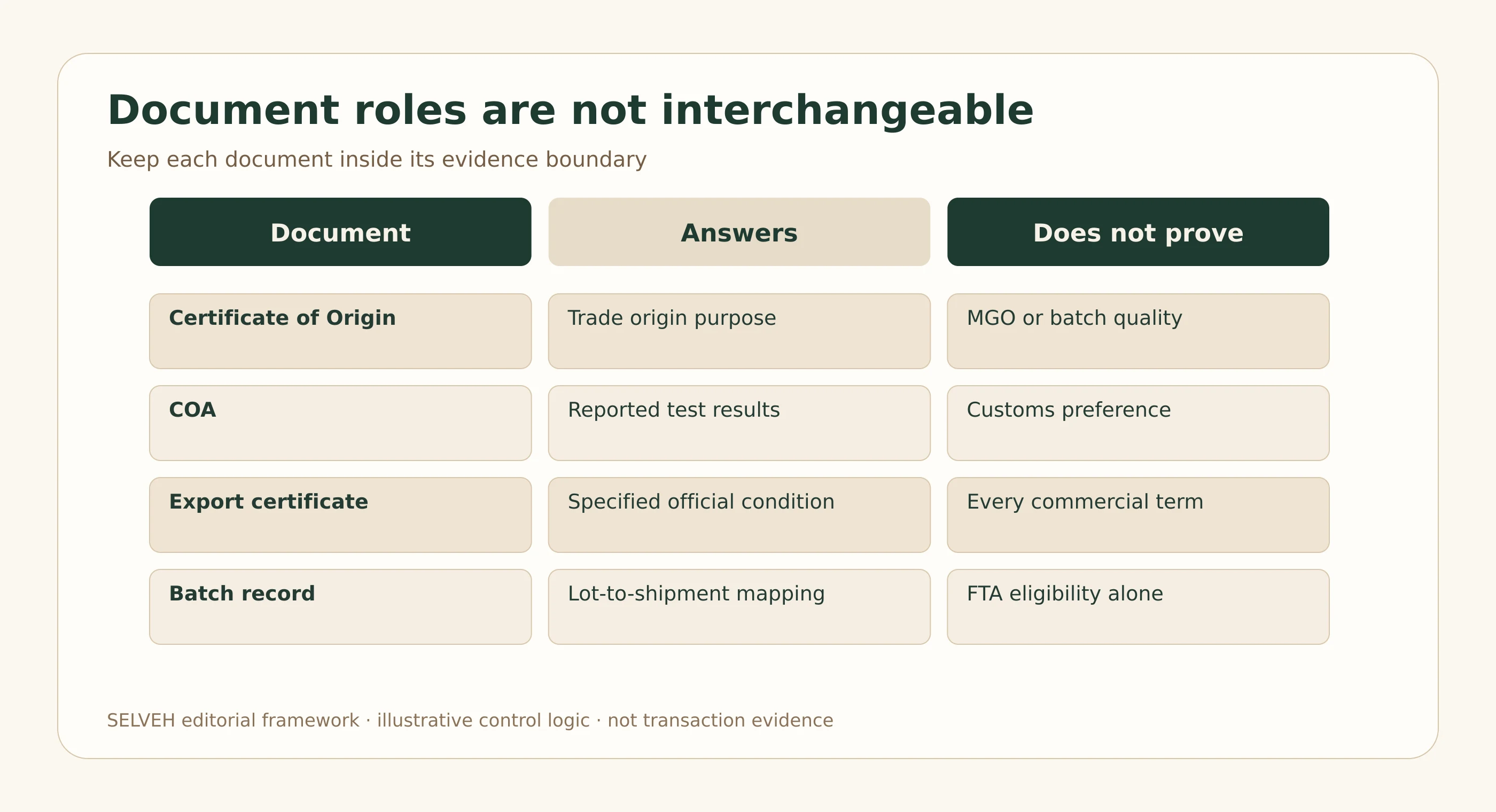
A Certificate of Origin cannot replace the rest of the evidence pack
| Document | Primary question answered | What it does not prove |
|---|---|---|
| Certificate of Origin | Origin for the stated preferential or non-preferential purpose. | MGO, quality, food safety or batch release. |
| COA / laboratory report | What was tested and reported for the identified sample. | Shipment origin or customs preference. |
| Government export certificate | Specified official export/importing-country certification. | Every commercial term or private quality claim. |
| Batch record | How source, packing, testing and finished goods connect. | Preferential tariff eligibility by itself. |
| Commercial invoice / packing list | Transaction value, parties, goods and packing quantities. | Independent quality or authenticity. |
04 · Certificate type
Distinguish preferential and non-preferential origin documents
A preferential Certificate of Origin supports a claim for reduced or zero customs duty under an applicable trade agreement. The goods must satisfy that agreement's rules of origin and the proof must meet its format and issuer requirements.
A non-preferential or ordinary Certificate of Origin identifies origin for other trade purposes. It does not automatically create an FTA tariff entitlement.
DFAT lists accredited bodies that issue preferential Certificates of Origin for specified Australian agreements. Charges and application requirements apply. Buyers and exporters should verify the current authorised route rather than copying a certificate used for another destination.
05 · UAE CEPA
For the UAE, connect the honey tariff benefit to the correct proof of origin
The Australia-UAE Comprehensive Economic Partnership Agreement entered into force on 1 October 2025. DFAT states that the UAE's 5 per cent duty on honey was eliminated from that date for qualifying Australian goods.
The agreement's rules-of-origin chapter provides for proof through a Certificate of Origin issued by a competent authority or an Origin Declaration implemented under the agreement. The Certificate of Origin must include the Annex 3B minimum information, carry a unique serial reference and official seal, be completed in English and remains valid for one year from issue.
Do not simplify this to “Australian honey is duty free”. The product must meet the originating rule and the importer must make the claim with the appropriate proof and customs data. The exporter should confirm the current issuer and application evidence before shipment.
06 · Field reconciliation
Reconcile the certificate to the shipment before release
Check exporter, producer where required, importer or consignee, product description, HS classification, origin criterion, invoice reference, quantity or gross weight, shipment details, issuing body, issue date, certificate number and any authorised signature or seal requirements.
The description should identify the goods consistently across the Certificate of Origin, commercial invoice, packing list and customs entry. A minor typographical discrepancy may be treated differently from a conflict that creates doubt about the originating status.
The UAE CEPA text provides processes for retrospective issue, certified copies and correction. These are controlled exceptions, not reasons to leave the certificate until after dispatch.
07 · Singapore contrast
Do not copy the UAE origin workflow into Singapore
Singapore Customs describes ordinary non-preferential Certificates of Origin as optional documents that may be obtained for commercial reasons. Singapore also distinguishes preferential origin documentation and self-certification routes under selected agreements.
For imports, Singapore Customs states that goods outside its dutiable categories are non-dutiable and incur GST, while SFA requires the relevant food importer registration and a TradeNet permit for processed food. That means the commercial reason for requesting a Certificate of Origin may differ from the UAE tariff-preference case.
The importer should confirm the actual documentary requirement. A document that is optional for customs preference may still be requested by a customer, bank, marketplace or internal compliance process.
08 · Issuer & records
Verify the issuer and keep the origin working papers
DFAT lists authorised issuers accredited under Australia's FTA Certificate of Origin Recognition Scheme for agreements that use that route. The exporter applying for a certificate must be prepared to support the origin claim with appropriate documents.
Keep the application, supplier declarations where relevant, production/origin records, invoice, packing list, issued certificate and any amendment or replacement together. The Certificate of Origin is the output of an origin assessment, not the entire evidence file.
If honey lots are blended or the packing/export structure changes, confirm whether the existing origin analysis still applies to the goods being shipped.
09 · Release gate
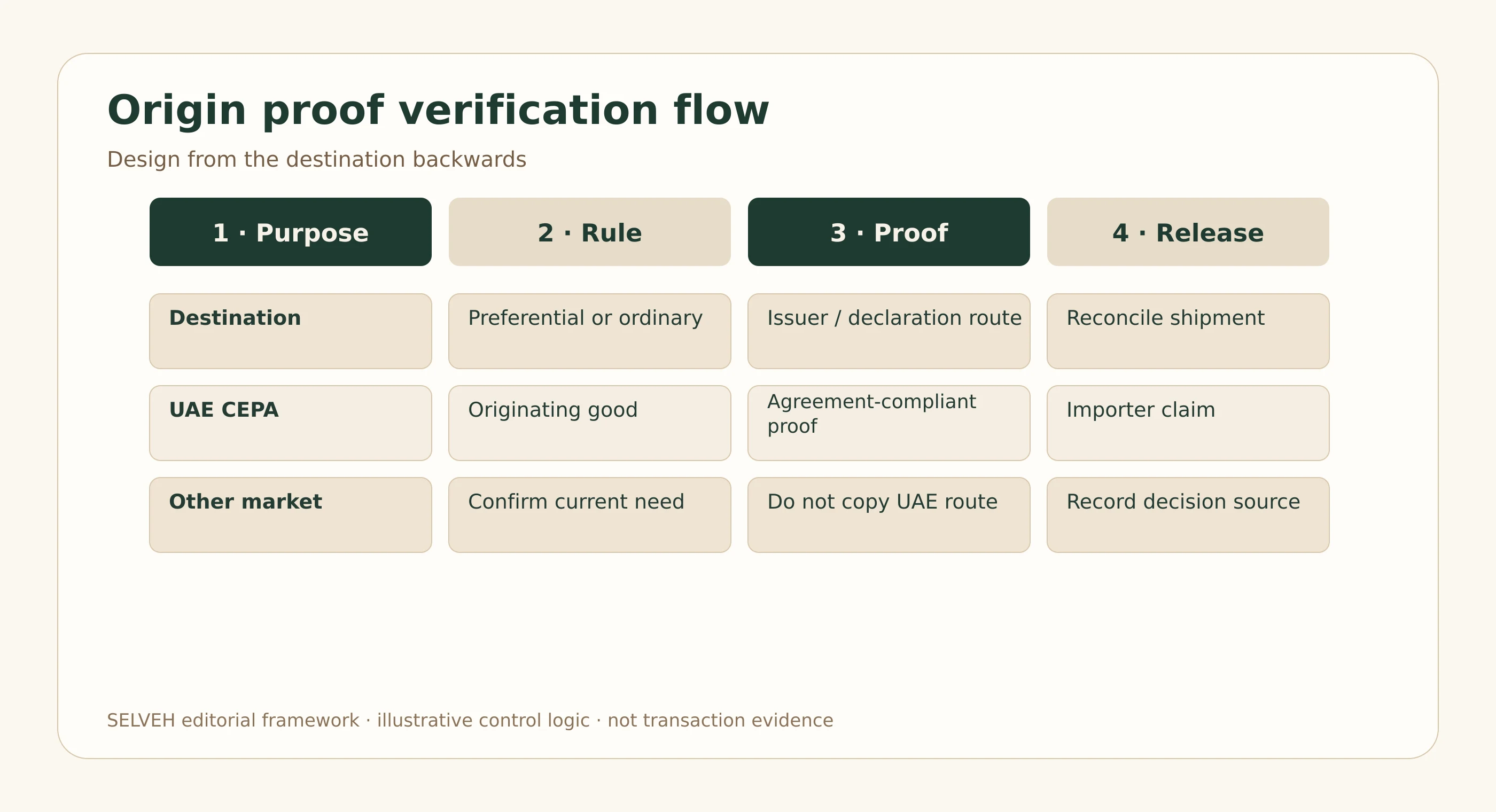
Make origin proof part of pre-shipment release
Assign ownership for classification, origin assessment, certificate application, importer confirmation and final document reconciliation. Set a latest safe date for issue before collection.
Release should stop if the importer expects a preferential claim but the goods, origin criterion, issuer or proof format is unresolved. It should also stop if certificate data conflicts materially with the invoice or physical shipment.
Where no Certificate of Origin is required, record that decision and its source rather than leaving the document line blank.
10 · Buyer tool
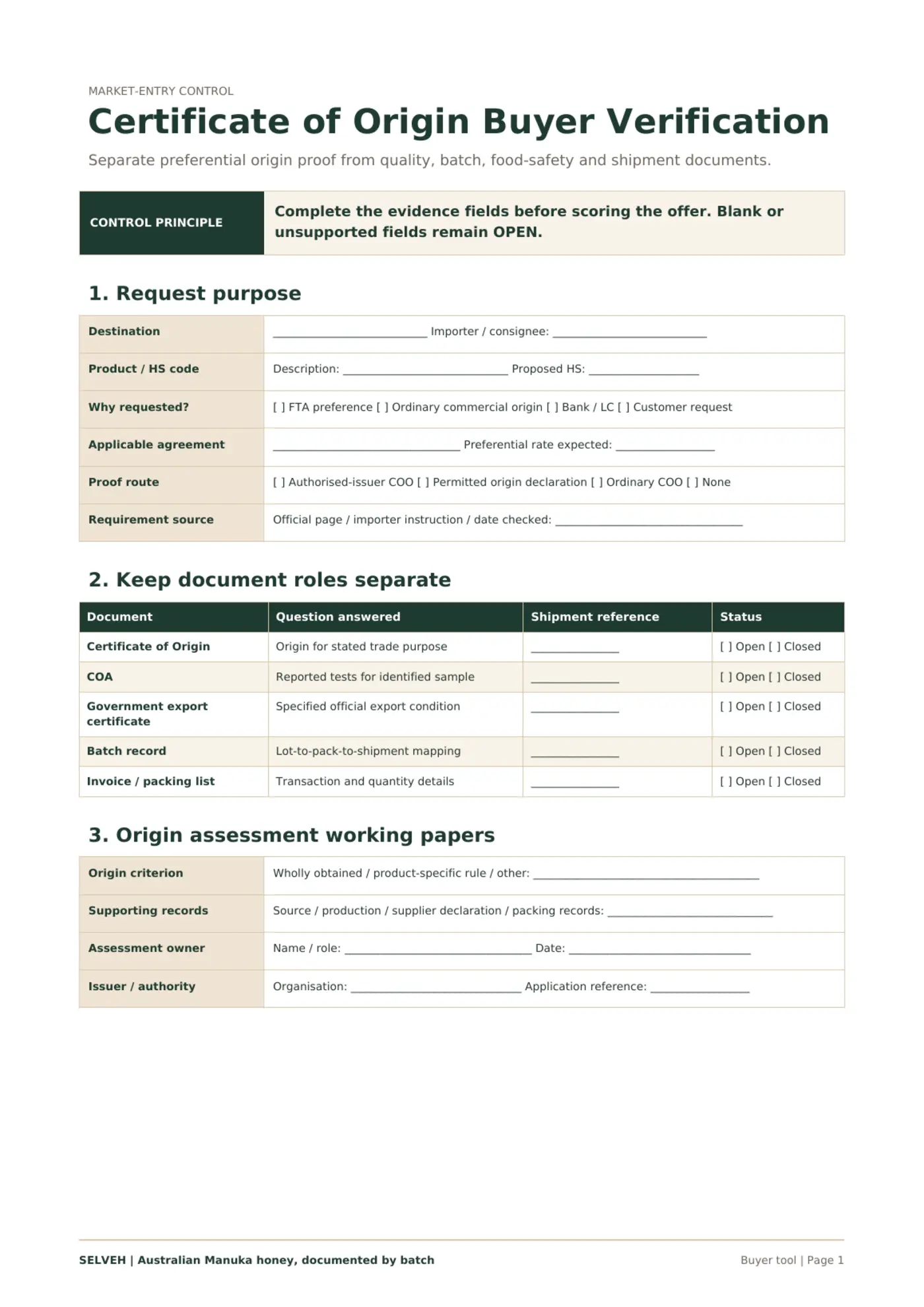
Use a document-role and origin-verification matrix
The downloadable matrix identifies the request purpose, certificate type, agreement, origin criterion, issuer, evidence owner and shipment fields. It also separates the Certificate of Origin from COA, export certification and batch records.
This tool is not an origin ruling, customs declaration, certificate application or legal advice.
11 · Red flags
Investigate these Certificate of Origin situations
- The supplier provides an ordinary COO when the importer expects an FTA preference claim.
- The certificate uses a different product description, HS code, invoice or quantity from the shipment.
- The document is described as government food-safety approval.
- An origin declaration is made by a party that has not confirmed it can use that route.
- The certificate is copied from a previous shipment or different destination.
- The shipment is booked while the origin criterion or issuer remains unresolved.
12 · Buyer FAQ
Frequently asked questions
Is a Certificate of Origin always mandatory for honey exports?
No. The requirement depends on the destination, trade agreement, tariff claim and commercial arrangement. Confirm the purpose for the actual shipment.
Does a Certificate of Origin prove the honey is Mānuka?
No. It addresses origin for its stated trade purpose. Mānuka identity, MGO and authenticity require separate evidence.
Is a Certificate of Origin the same as a DAFF export certificate?
No. Government export certification and origin documentation serve different purposes, even when both are required for one shipment.
Does UAE CEPA make all Australian honey automatically duty free?
The agreement eliminated the honey tariff for qualifying originating goods, but the rules of origin and proof requirements still need to be satisfied.
Can a certificate be issued after shipment?
Some agreements, including UAE CEPA, provide controlled retrospective procedures in defined circumstances. Do not assume retrospective issue will cure an avoidable release failure.
13 · SELVEH status
What SELVEH can state today
SELVEH can define the Certificate of Origin questions that should be closed for future UAE and other export transactions.
SELVEH should not claim an issued Certificate of Origin, preferential eligibility, customs acceptance, exporter status, approved issuer application or completed shipment until the actual product, origin analysis and transaction documents exist.
Sources
Official trade and market-entry sources
- DFAT - How to obtain a Certificate of Origin
- Business.gov.au - How to get a Certificate of Origin
- DFAT - UAE CEPA Chapter 3 Rules of Origin
- DFAT - UAE CEPA key benefits for Australia
- Singapore Customs - Origin documentation overview
- Singapore Customs - Import procedures overview
- Singapore Food Agency - Commercial food imports
Source review: Official sources reviewed 22 August 2026. Trade rules and administrative practice can change; verify the current requirement for the actual shipment.
Trade planning
Need to map origin proof for a planned shipment?
Tell us the destination, importer, product format and intended tariff route. We will separate the Certificate of Origin decision from batch, quality and export-certification requirements.
Start a trade enquiry