
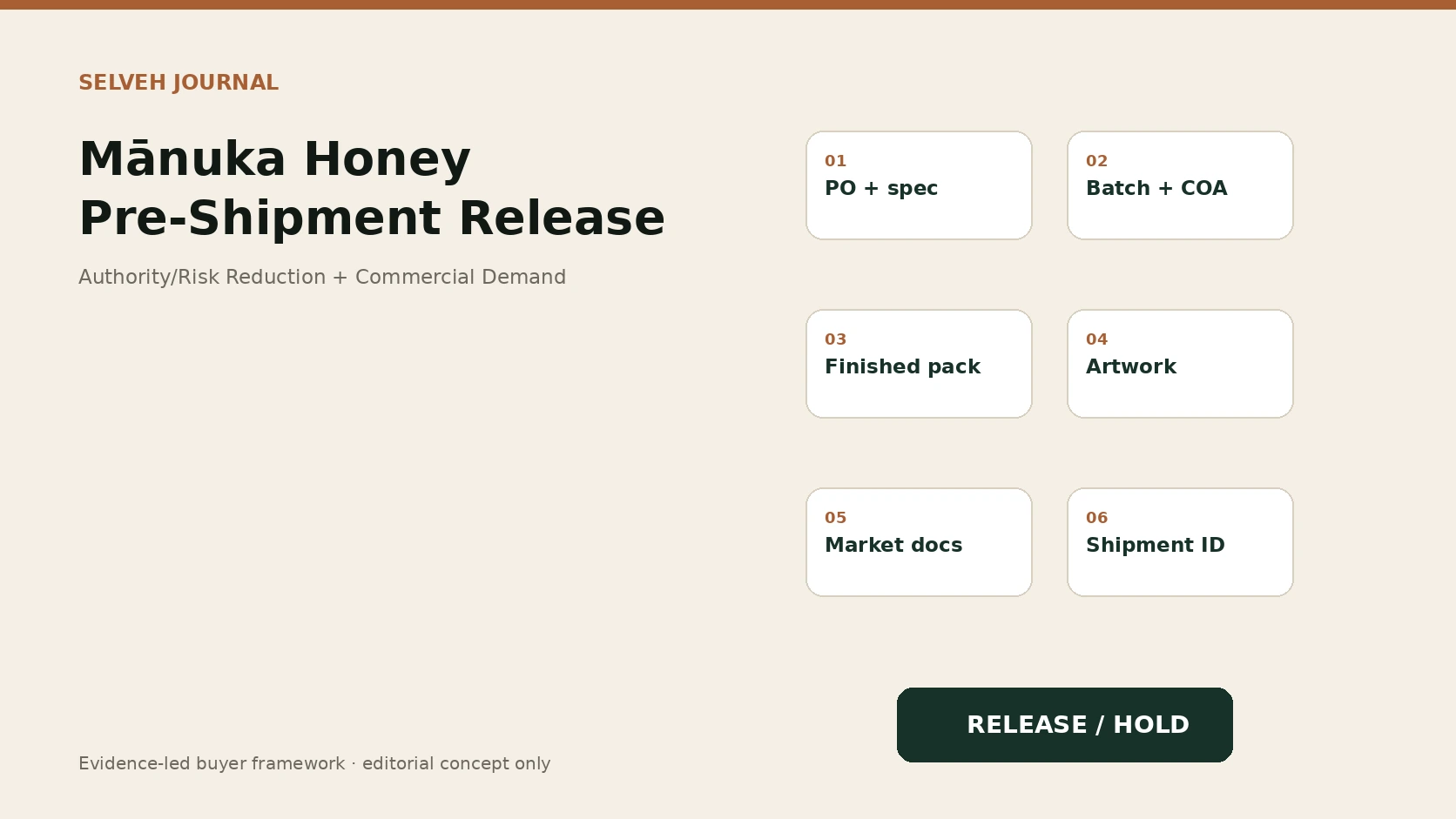
01 · Release gate
Pre-shipment release is a decision, not an admin formality
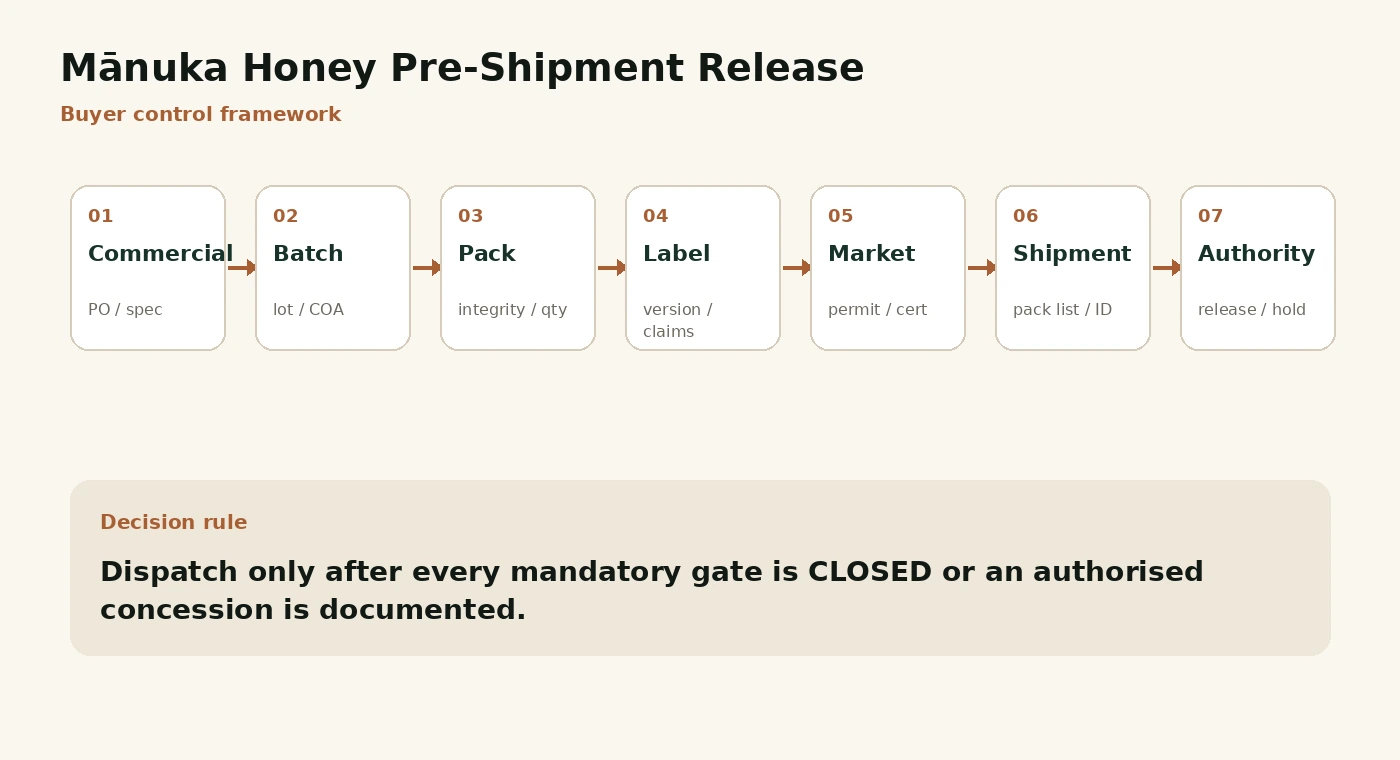
A finished pallet can still be commercially unready if the wrong label version was applied, the batch evidence does not match the purchase order, a destination document is missing or the buyer has not closed an agreed exception. The purpose of pre-shipment release is to stop physical dispatch until the transaction evidence is coherent.
The release record should identify the purchase order, supplier, product/SKU, production batch or lot, quantity, destination, planned dispatch and the person authorised to release or hold the goods.
The checklist should not become a substitute for the underlying documents. Its job is to point to the evidence and show that the buyer or supplier has actually reviewed it.
02 · Commercial match
Reconcile the purchase order and product specification first
Confirm grade, pack size, units, case configuration, agreed Incoterm and named place, price basis, artwork version and any required certificates against the approved purchase order or contract. If the commercial document and the product specification conflict, release should stop until the discrepancy is resolved.
This step also catches scope drift: a packaging substitution, changed case count or different MGO grade can be operationally convenient while still being commercially unacceptable.
Use controlled document versions. A release reviewer should be able to identify which specification and quotation the shipment is meant to satisfy without relying on email memory.
03 · Batch identity
Make the batch identity continuous across product and evidence
The batch or lot identifier on the finished goods should reconcile with the supplier release record and the relevant test documentation. Where a buyer relies on MGO or other analytical results, the report should be tied to the actual batch and the required method/scope should be appropriate to the transaction.
NATA explains that accreditation applies to defined scopes and that a NATA endorsement is not permitted for testing outside the accredited scope. For export-facing decisions, buyers should therefore check the report and scope rather than relying only on the laboratory name.
Do not release a shipment because “the supplier always tests” if the actual lot evidence required by the purchase agreement has not been provided.
04 · Finished pack
Verify the finished pack, not only the component specification
Check the production-representative finished jar for closure integrity, tamper-evidence feature where specified, label placement, obvious defects, case packing and any agreed pallet or protective configuration. Record any sampling method or supplier QA evidence used.
For Australian pre-packaged goods, NMI requires accurate net measurement and appropriate package marking. A buyer does not need to reproduce the packer’s entire measurement-control system in the release checklist, but should know which evidence supports the declared quantity and whether any non-conforming packs were quarantined.
If a pack defect is cosmetic but accepted under a written concession, record the concession rather than silently treating it as compliant.
05 · Label & claims
Release the exact approved artwork version
Match the label version on the goods to the approved artwork file and verify that any controlled claims - such as origin wording, MGO grade or private certification marks - are supported by the evidence required for that claim.
Do not rely on a photograph from a previous production run if the artwork has changed. The release evidence should be tied to the current SKU and version.
Market-specific labels must be reviewed against the destination pathway and importer requirements in force for the transaction.
06 · Shelf-life status
Check remaining shelf life at dispatch and expected arrival
The batch release should record production/packing date, best-before or other durability information where applicable, storage conditions and the remaining life expected at dispatch. If the buyer or retailer has a minimum remaining-life requirement at arrival, work backwards from the expected transit time.
A shipment can be legally sellable and still be commercially unsuitable if too much of the sell-through window has been consumed before arrival.
Do not alter date markings informally to solve a logistics delay. Any change must follow the applicable law and documented product basis.
07 · Destination gate
Close destination requirements at transaction time
DAFF directs exporters to Micor for importing-country requirements. The current Micor guidance for UAE edible apiculture products states that EX188B government certification with endorsement 600 is required. Current Singapore guidance states that government certification is not required for edible apiculture products, but the importer needs a food import permit through TradeNet and processed-food establishment/QA evidence may need to be produced on request.
These two markets illustrate why one generic “export document pack” is not enough. The release checklist should contain a destination-specific gate that links to the current Micor page and importer confirmation.
Requirements can change. Recheck the official source for the actual shipment rather than treating this article or an earlier shipment as standing approval.
08 · Export documents
Make shipment documents part of release, not an afterthought
DAFF states that export documents verify that goods meet applicable Australian and importing-country requirements, and that required documents must be obtained before export where they apply. NEXDOC is used for honey and edible apiculture certification to relevant markets.
The release record should therefore identify who is responsible for the government certificate, commercial invoice, packing list, transport booking information and any importer-side permit or registration reference needed for border clearance.
The exact document set depends on destination and transaction. Avoid copying a certificate from another market into a generic checklist.
09 · Shipment identity
Match cartons, pallets and transport references to the released goods
Before dispatch, reconcile case count and total units to the packing list, identify pallet or shipment marks where used, and confirm that the transport booking refers to the correct consignee, destination and agreed commercial term.
If seals, container numbers or pallet IDs are part of the transaction, record them at the stage they become available. The release chain should make it difficult for a correctly documented batch to be confused with a different physical consignment.
Where freight is arranged by the buyer, define the handover point clearly so that “released from production” and “collected by carrier” are not treated as the same event.
10 · Deviations
Use HOLD, CONCESSION and RELEASE deliberately
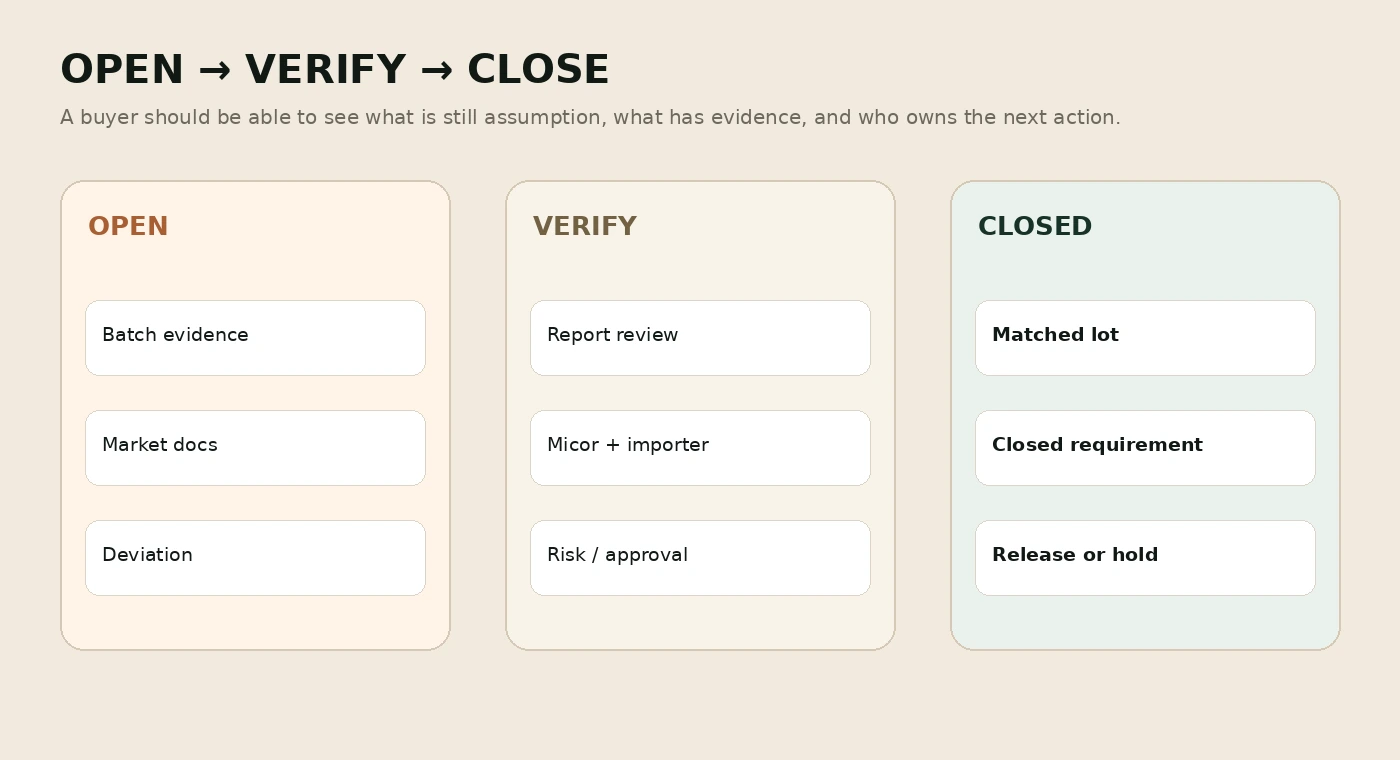
A binary tick-box system can hide unresolved issues. Use explicit statuses. HOLD means dispatch must not proceed. CONCESSION means a defined deviation has been reviewed and accepted by an authorised party. RELEASE means all mandatory gates are closed or approved concessions are documented.
Every concession should identify the issue, affected quantity, risk assessment or commercial rationale, approver and any corrective or preventive action. This keeps urgency from silently rewriting the specification.
If the buyer cannot identify who has authority to accept a deviation, the safe default is HOLD.
11 · Buyer tool
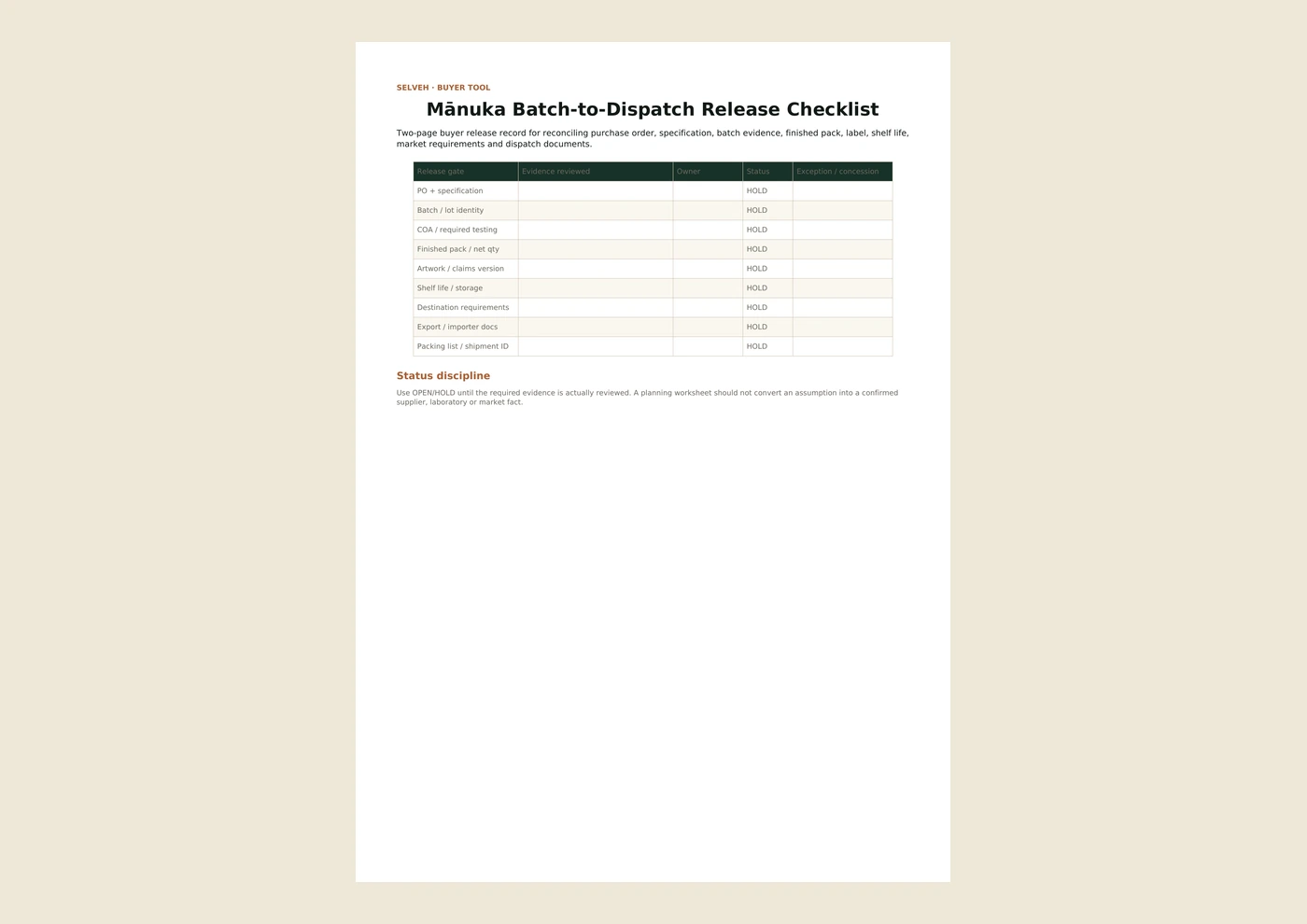
Use a Batch-to-Dispatch Release Checklist
The downloadable checklist brings the commercial, batch, packaging, label, shelf-life, market and shipment controls into one release record. It is designed to link each gate to the underlying evidence and owner.
It is a buyer-control template, not a government certificate, customs declaration, laboratory report or guarantee of market entry.
12 · Red flags
Investigate these release situations
- The COA has the right grade but a different or unclear batch identifier.
- The finished label cannot be reconciled to the approved artwork version.
- The shipment is “ready” but the destination-market document owner is still unknown.
- A packaging or quantity deviation is accepted verbally with no concession record.
- The supplier wants collection to proceed while a mandatory buyer approval remains OPEN.
13 · SELVEH status
What SELVEH can state today
SELVEH can define a future pre-shipment release architecture and require batch-to-dispatch evidence to be reconciled before release.
SELVEH should not represent any supplier lot, certificate, importer permit, destination approval, shipment or customs outcome as released or confirmed until the actual transaction evidence has been reviewed.
Sources
Sources and evidence notes
- DAFF - Australian export documents and certification
- DAFF - Request export documents
- Micor - UAE edible apiculture products
- Micor - Singapore edible apiculture products
- NATA - Test reports explained
- National Measurement Institute - Guide to the sale of pre-packaged goods
Editorial boundary: Current official, technical and public commercial information is separated from SELVEH recommendations. Public supplier material is illustrative only. No open supplier, packaging component, batch, laboratory result, importer, production schedule, certificate or shipment is represented as confirmed SELVEH evidence.
Trade planning
Need a batch-to-dispatch evidence structure?
Use the trade enquiry to define destination, grade, pack and documentation expectations. Release requirements can then be mapped to the actual transaction.
Start a trade enquiry