01 · Treat provenance as evidence, not mood
Origin is a claim that needs reasonable support
Premium food brands often tell origin through landscapes, flora, harvest stories and place names. Those elements can make provenance understandable, but they are not substitutes for the records behind the claim.
The ACCC states that country-of-origin claims must be true, accurate and based on reasonable grounds (opens in new tab). It also identifies honey as a priority food for Australian country-of-origin labelling. Most food offered for retail sale in Australia must follow the Country of Origin Food Labelling Information Standard 2016 (opens in new tab), with the applicable format depending on the food and the type of origin claim.
For a wholesale buyer, the useful question is therefore not “Does this look Australian?” but “What facts and records support the exact origin wording proposed for this product?”
02 · Do not blur different locations
Produced in, made in and packed in are not interchangeable ideas
A food can be packed in one country while its primary ingredient was produced elsewhere. A brand can be Australian-owned while the food itself has another origin. A laboratory can be in Australia while the tested honey was sourced overseas. Those facts may all be true at the same time.
Australian country-of-origin rules define how claims such as “grown in”, “produced in” and “made in” are used and how priority-food labels are presented. The ACCC’s current guidance (opens in new tab) explains that honey is a priority food and distinguishes the standard-mark formats used for Australian-produced or made foods, foods packed in Australia and imported foods.
| Concept | What it can tell you | What it cannot prove alone |
|---|---|---|
| Production origin | Where the honey itself was produced, subject to the applicable claim rules. | Who packed it, which batch was tested or whether a private scheme applies. |
| Packing location | Where bulk honey was packed or repacked. | Where the honey was originally produced. |
| Brand owner location | Where the brand or business is based. | Origin of the food. |
| Laboratory location | Where testing was performed. | Origin of the tested product. |
| Botanical identity | What floral source or identity evidence supports. | Country of production unless the traceability chain also supports it. |
03 · Move from story to records
What evidence can sit behind an Australian provenance statement?
No single document universally proves every origin claim. The appropriate evidence depends on the supply chain, the statement being made, the buyer’s risk and the destination rules. A useful buyer file may combine several layers rather than searching for one “origin certificate”.
| Evidence layer | Buyer question | Typical limitation |
|---|---|---|
| Producer or source record | Who supplied the honey and from what identified source or harvest lot? | May not show later blending, packing or shipment. |
| Apiary / harvest information | What location and harvest information is recorded upstream? | Commercial availability and format vary by supplier. |
| Bulk-lot record | How was the honey identified after receipt and storage? | Does not prove source if the upstream link is missing. |
| Packing record | Which input lot became which finished lot? | Packing in Australia is not proof the honey was produced in Australia. |
| Label approval | What origin wording was approved for the finished SKU? | An approved artwork file is a claim, not the underlying proof. |
| Transaction / shipment record | Which lot and quantity were actually sold and dispatched? | Does not replace upstream origin evidence. |
The right file makes the claim auditable: the buyer can follow the relevant product quantity through those layers without changing the meaning of “Australian” at each hand-off.
04 · Follow the same identity forward
Build an origin chain from source to shipment
Source
Producer, harvest or upstream supplier record.
Input lot
The received honey lot carrying the source identity.
Handling
Storage, blending or transfer records where identity can change.
Packed lot
The finished lot printed or otherwise identified on the product.
Approved claim
Artwork and commercial description supported by the evidence.
Shipment
The lot and quantity delivered to the buyer.
If the chain includes blending, repacking or a change of custody, make the relationship explicit. A new lot code should not erase the parent lot. If one Australian source lot is mixed with another, the origin claim may remain straightforward; if Australian and imported inputs are mixed, the claim analysis changes materially and should be reviewed against the applicable labelling rules.
For the operational side of parent-child lot mapping, use our Mānuka Honey Batch Documentation guide.
05 · Private label adds parties
Brand owner, producer and packer may be different businesses
Private-label supply chains can involve a beekeeper or honey producer, an aggregator or processor, a contract packer, a brand owner, an exporter and an importer. That structure can be perfectly legitimate, but it makes role clarity essential.
A buyer should be able to identify who owns the honey at each stage, who controls the source records, who assigns the packed lot, who approves the artwork, who releases the product and who supplies the shipment documents. If the brand owner never physically handles the honey, its origin claim still needs to rest on evidence held somewhere in the chain.
Do not infer production origin from the address on a brand website or from a packer’s Australian facility. Conversely, do not dismiss a private-label model simply because several parties are involved. The test is whether responsibilities and records remain coherent.
06 · Separate botanical identity from country of origin
“Mānuka” and “Australian” answer different verification questions
An MGO result is not a country-of-origin test. Botanical or authenticity frameworks can include chemical markers and identity criteria, but an Australian-origin claim still needs an origin chain.
The Australian Manuka Honey Association states (opens in new tab) that products carrying its Mark of Authenticity must be produced entirely in Australia, independently tested against its criteria and managed to preserve identity. AMHA also describes member batch traceability from shelf back to apiary (opens in new tab). Those statements are specific to the association’s scheme and members; they should not be generalised to every supplier or represented as government certification.
For buyers, the disciplined sequence is: verify the product identity framework, verify the country-of-origin evidence, then verify that both relate to the same lot. Do not let one layer substitute for the other.
For MGO-specific interpretation and scheme boundaries, read MGO Grades in Australian Mānuka Honey: A Buyer’s Guide.
07 · Know when provenance becomes marketing-only
Origin and traceability red flags
- Australian imagery without a clear claim: flags, maps or native landscapes imply origin while the factual wording stays vague.
- Packing confused with production: “packed in Australia” is presented as proof the honey itself was produced in Australia.
- Brand address used as origin evidence: an Australian office or company registration is treated as proof of food origin.
- Batch identity disappears: source records exist, but there is no map to the finished packed lot.
- Supplier statement with no supporting trail: the claim cannot be reconciled to source, lot and packing records.
- Origin changes between documents: website, label, invoice and specification use inconsistent wording.
- Private mark described as law: an association logo or membership is presented as mandatory government certification.
- Chemistry used as geography: MGO or another analytical marker is treated as standalone proof of Australian production.
- Uncontrolled blending: input origins change but the finished origin claim is not reassessed.
Origin review is partly a consistency exercise. If each document tells a different story, the buyer should resolve the discrepancy before relying on the marketing claim.
08 · Make origin verification repeatable
Buyer checklist for Australian Mānuka provenance
| Check | Question |
|---|---|
| Exact claim | What wording will appear on the label, website, specification and invoice? |
| Meaning | Does the claim refer to production, making, packing, brand ownership or something else? |
| Source evidence | Which record identifies the producer/source and relevant lot? |
| Lot continuity | Can source identity be followed through storage, blending and packing? |
| Packing location | Is packing location stated separately from production origin? |
| Finished lot | Which packed batch carries the claim? |
| Shipment | Can the dispatched quantity be matched to that finished lot? |
| Scheme claim | If a private mark is used, is current membership/approval verified with the scheme owner? |
| Destination | Has the applicable destination-market origin and labelling requirement been checked? |
This checklist is a commercial verification framework, not a substitute for country-specific legal advice.
Original-value asset · Template / buyer resource · No email gate
Origin & Traceability Verification Worksheet
A two-page buyer worksheet for separating production origin, packing location, botanical claims, lot identity and shipment records before relying on provenance wording.
09 · Questions buyers ask most
Practical origin and traceability questions for buyers
Does an Australian-owned brand automatically mean the honey is Australian?
No. Brand ownership and food origin are different facts. A buyer should verify the origin claim for the product itself using the applicable source, lot and supply-chain evidence.
Is “packed in Australia” the same as “produced in Australia”?
No. Packing location and production origin are different claims. Australian country-of-origin guidance distinguishes “grown in”, “produced in”, “made in” and “packed in” statements, so the wording should match the facts of the product and supply chain.
Can MGO or another chemistry result prove Australian origin?
No. Analytical markers can support botanical or scheme-specific identity questions, but a country-of-origin statement still needs an origin and traceability chain. Do not let chemistry replace provenance records.
What changes when several source lots are blended?
The new blend needs documented parent lots and a clear release basis. If all inputs have the same verified origin, the chain may remain straightforward; if origins differ, the proposed claim needs fresh review against the applicable labelling and destination requirements.
10 · Current-stage disclosure
What SELVEH can state today
SELVEH is a Melbourne-based brand developing its first Australian Mānuka honey collection. As at 17 August 2026, this article does not claim that a final supplier, apiary, harvest region, packer, packed batch, AMHA mark, export shipment or finished origin documentation has been selected or completed.
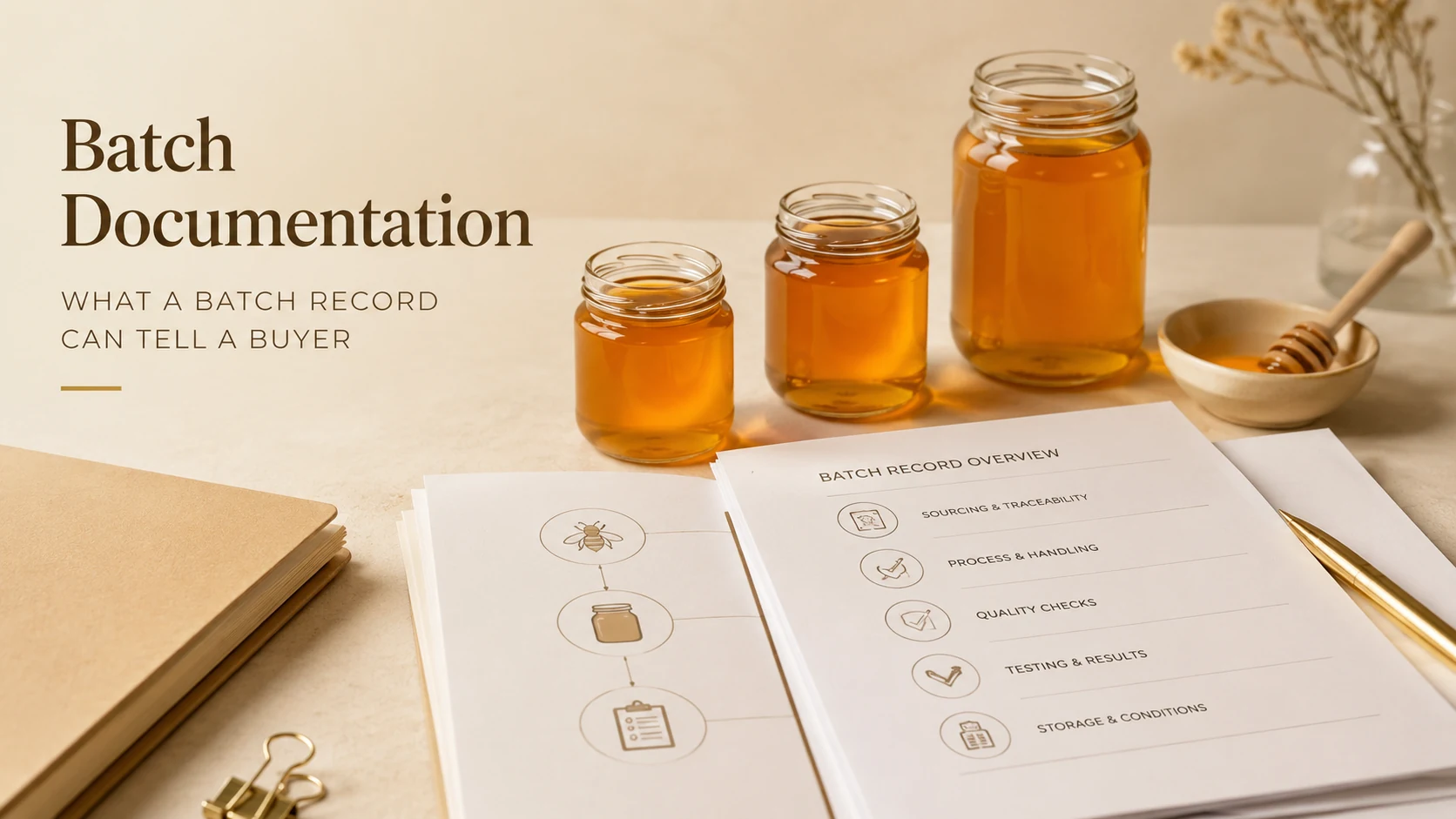
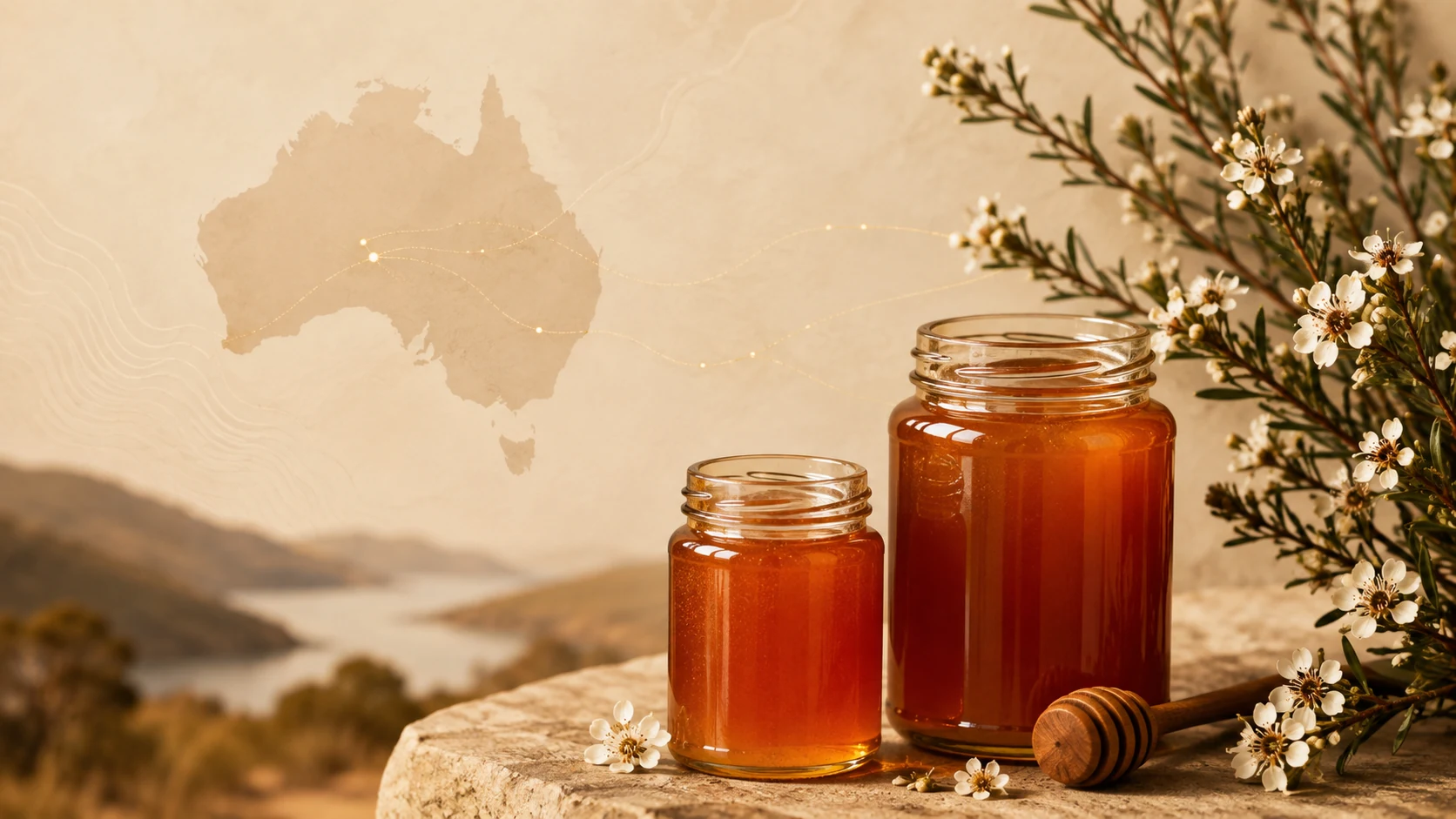
The landscape and jar imagery on this site is brand/editorial imagery, not documentary proof of a specific honey lot. Once a commercial product is confirmed, any public origin statement should be supported by the relevant supplier and batch evidence before it is treated as a product fact.
For analytical and COA verification, continue to Australian Mānuka Honey COA, Batch Testing & Traceability. For lot mapping, read Mānuka Honey Batch Documentation.
When the evidence chain includes a laboratory report, use How to Read a Mānuka Honey Certificate of Analysis (COA): A Buyer’s Guide to verify sample identity, result, method and lot relevance.
For importers, distributors & premium retail
Need to verify what “Australian” means in a proposed range?
Tell us your destination, channel, pack format and intended claim. We will separate confirmed origin evidence from questions that still need supplier or regulatory resolution.
Start a trade enquiryPrimary references
- ACCC — Country of origin food labelling
- ACCC — Country of origin claims
- FSANZ — Country of origin labelling
- FSANZ — Food traceability
- Australian Manuka Honey Association — Mark of Authenticity
- Australian Manuka Honey Association — Quality standards
Source review: Primary and official sources were reviewed on 17 August 2026. Re-review is triggered by a material source, law, scheme or regulatory change, or when new first-party SELVEH supplier, batch, packing or buyer evidence becomes available.
This article is general educational information for trade and quality conversations. It is not legal or regulatory advice and does not certify any SELVEH origin claim, supplier, batch, private scheme or destination-market compliance. Country-of-origin rules and import requirements can change; verify the current rules for the relevant market before a commercial decision. Read our Editorial Standards.