01 · Governance
Every material label statement should have an evidence owner
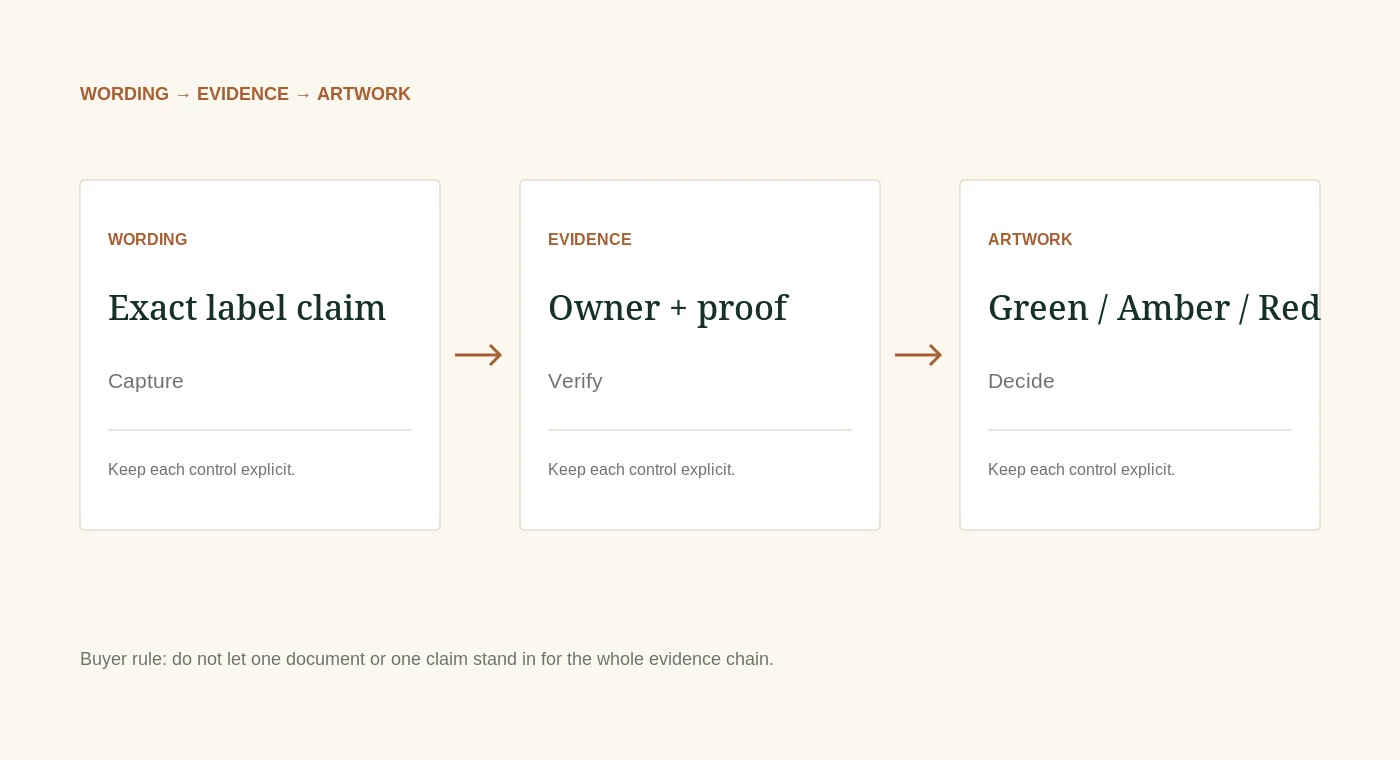
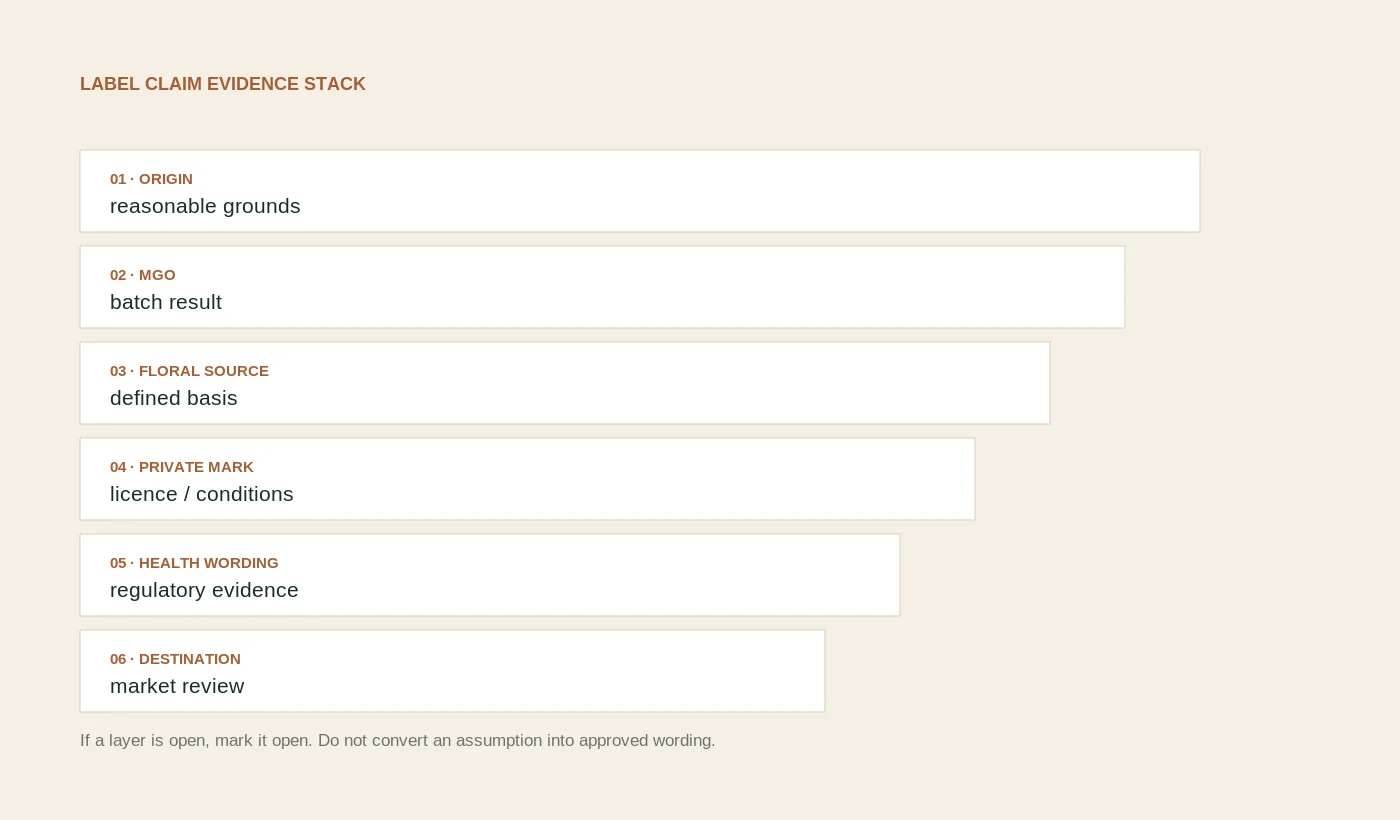
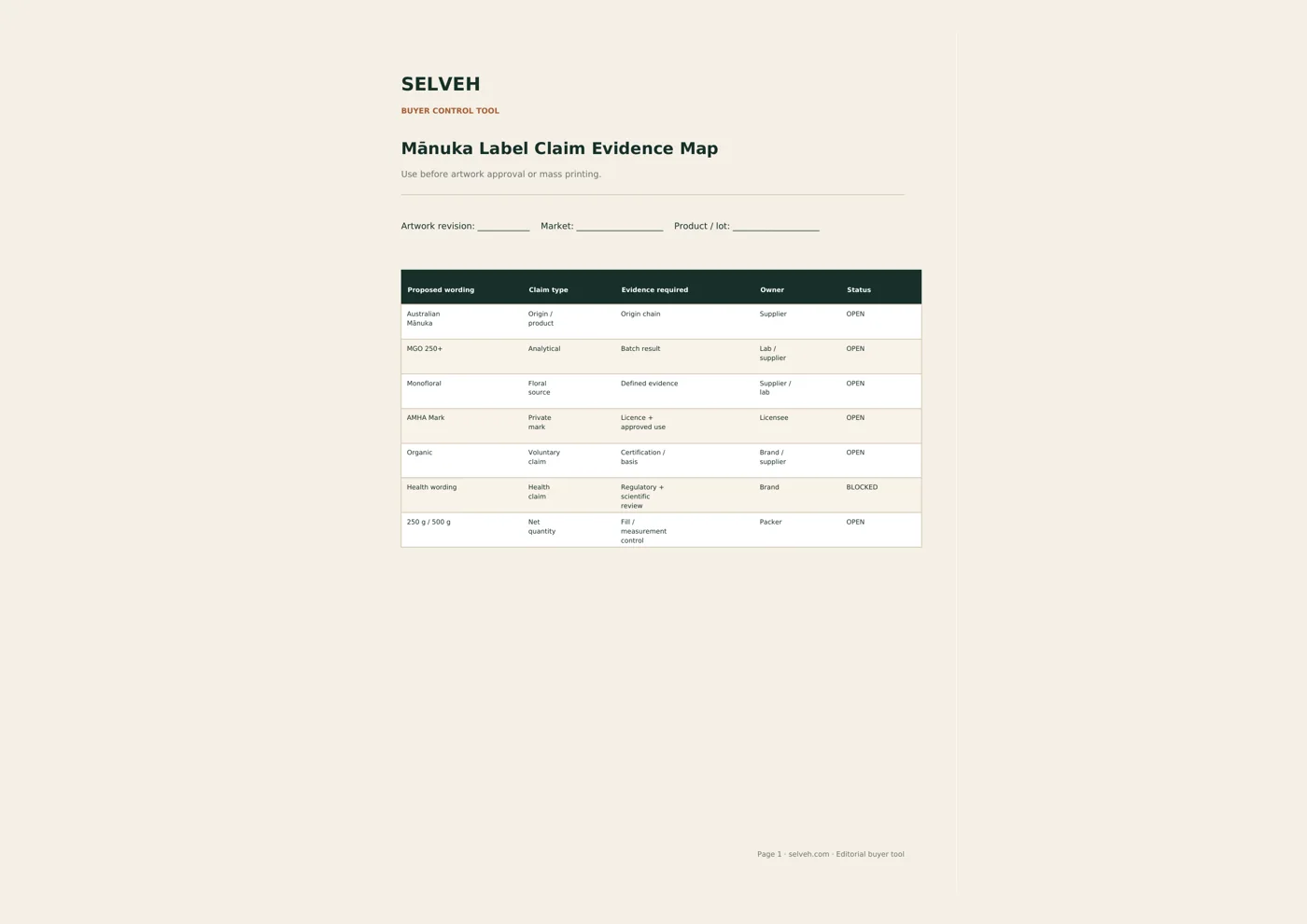
The simplest control is a claim register. For each proposed statement, record the exact wording, claim type, evidence owner, evidence required, market-specific review and artwork status. That turns “we think this is fine” into a traceable approval decision.
The ACCC states that business claims should be true, accurate, based on reasonable grounds and capable of being proved. That principle applies beyond advertisements: packaging, quotations, websites and other business communications can all create representations. For a premium food product, the pack should therefore be treated as an evidence surface.
02 · Origin wording
“Australian” needs an origin basis, not just Australian branding
Country-of-origin claims can be explicit or implied through words, symbols and overall presentation. The ACCC says country-of-origin claims must be true, accurate and based on reasonable grounds, and honey is a priority food under Australia’s country-of-origin food-labelling framework when sold at retail in Australia.
The buyer should separate the origin of the honey from the location of packing, ownership of the brand and address of the seller. “Australian Mānuka”, “Packed in Australia” and “Australian owned” communicate different things. The evidence map should identify which representation is intended and which source records support it.
03 · MGO grade
Treat an MGO number as a batch-evidence claim
If the artwork says “MGO 250+”, the buyer should define what result is required, which laboratory or method is acceptable, how the result is linked to the batch and what happens if the result is below the printed threshold at release. The label should not be approved simply because a supplier says that grade is normally available.
MGO wording should also avoid implying more than the evidence establishes. A concentration result is not by itself proof of Australian origin, monofloral status, therapeutic effect or a private certification. Keep the grade claim narrow and link it to the relevant batch evidence.
04 · Floral source
Monofloral or multifloral wording needs a defined basis
Floral-source wording should point to a named definition or evidence method rather than operating as an aesthetic descriptor. If the proposed label says “monofloral Australian Mānuka”, record the definition being used, the supplier or laboratory evidence and the lot to which it applies.
Where the buyer relies on a private industry framework such as AMHA criteria, identify that scheme explicitly. Do not translate a scheme-specific definition into a universal legal claim unless the applicable law supports that conclusion.
05 · Private marks & logos
A test result does not automatically grant the right to use a private mark
Private certification and authenticity marks have their own licensing and conditions of use. AMHA’s Mark of Authenticity, for example, is licensed to eligible members and its conditions state that the mark may be used only on verified Australian Mānuka products covered by the licence. AMHA also requires sighting of labels, packaging and promotional materials displaying the mark.
That means “we passed the test” and “we may print the logo” are separate questions. The artwork status should remain blocked until the brand or responsible party has the actual licence or approval required for the proposed use.
06 · Health wording
Health and therapeutic-style wording is a high-risk area
FSANZ Standard 1.2.7 sets requirements for nutrition content and health claims. FSANZ states that health claims must be supported by scientific evidence and that general- and high-level health claims operate within specific food-health relationship rules. A premium-honey marketing idea should therefore not be converted into a health claim without a formal regulatory and evidence review.
Claims such as “supports immunity”, “heals”, “antibacterial for your body” or disease-related wording can create substantially different regulatory issues from an analytical statement such as “MGO 250+”. SELVEH should not use therapeutic or disease claims as a shortcut to premium positioning.
07 · Organic & sustainability
Voluntary premium claims still need evidence
Words such as “organic”, “sustainable”, “raw”, “unheated”, “single origin” or similar premium descriptors can influence purchase decisions and should not be treated as harmless decoration. The ACCC’s general misleading-claims principles still apply, and some claims may also engage specific certification, process or destination-market requirements.
If the evidence is still under supplier review, leave the claim off the final artwork. An Amber internal note is safer than a public label that later has to be withdrawn, over-stickered or defended without documentation.
08 · Mandatory information
Net quantity and mandatory label information are control fields too
For pre-packaged goods in Australia, the National Measurement Institute sets measurement-marking rules including correct units. The declared “250 g” or “500 g” is therefore not simply part of the visual hierarchy; the packer needs fill and measurement controls that support the declaration.
Mandatory information can also include food identification, lot identification, supplier details, date marking, storage directions and other items depending on the product and market. These fields should sit in the artwork control process alongside voluntary claims, even though their legal basis differs.
09 · Destination market
Do not approve one global label by assumption
A label that is suitable for Australia is not automatically suitable for Singapore, the UAE or another export market. Importer details, country-of-origin wording, language, nutrition panels, claim restrictions and registration workflows can differ. The base artwork can be controlled centrally, but destination-market overlays need their own review.
For SELVEH, the existing Singapore and UAE import guides should own those detailed market rules. The label-claims article owns the governance question: has the right market reviewer closed the claim before artwork approval?
10 · Artwork gate
Use Green, Amber and Red before print approval
Green means the wording, evidence and market review are closed for the proposed use. Amber means the wording may be defensible but a material evidence, licence or market check is still open. Red means do not print: the claim is unsupported, misleading, prohibited, outside a private-mark licence or inconsistent with the current product evidence.
Artwork should not move to mass printing while any material front-of-pack claim remains Amber unless the unresolved field will be removed before print. The cost of waiting for evidence is usually lower than the cost of destroying labels, over-stickering stock or defending a misleading representation.
11 · Buyer tool
Build the evidence map before artwork sign-off
The downloadable SELVEH map is designed around the exact wording proposed for the pack. It asks for the claim type, evidence owner, evidence required, market check, batch or licence link where relevant and final artwork status. It can be used during supplier review, artwork review and pre-production sign-off.
The point is not to make legal review mechanical. The point is to expose unsupported assumptions early enough that the buyer can obtain evidence, change the wording or remove the claim before labels are printed.
12 · SELVEH status
What SELVEH can govern now - and what must wait
SELVEH can define a claim-control system now and can keep origin, MGO, floral-source, private marks, health wording and destination requirements in separate evidence lanes. It can also ensure future artwork has controlled revision and approval status.
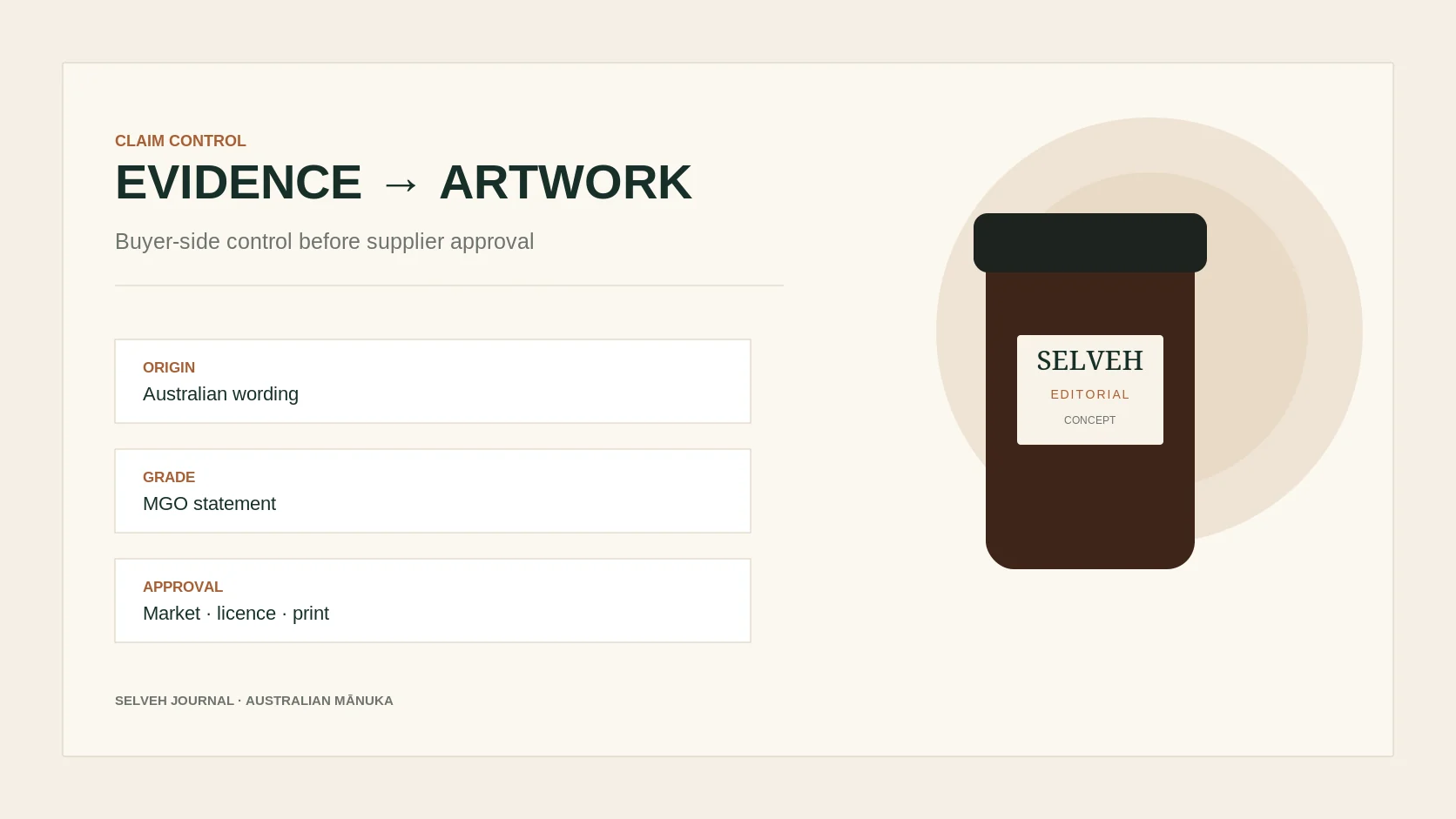
SELVEH should not publish final certification logos, monofloral wording, organic claims, health claims, importer details or final grade statements until the supplier, batch, licence and destination evidence are verified. Current packaging visuals remain concepts rather than approved commercial artwork.
Sources
Sources and evidence notes
- Australian Competition and Consumer Commission — False or misleading claims
- Australian Competition and Consumer Commission — Country of origin food labelling
- Food Standards Australia New Zealand — Nutrition, health and related claims
- Food Standards Australia New Zealand — Truth in labelling, weights and measures and legibility
- National Measurement Institute — Guide to the sale of pre-packaged goods
- Australian Mānuka Honey Association — Licensing and Conditions for the Mark of Authenticity
- Australian Mānuka Honey Association — Mark of Authenticity application and packaging review
Editorial boundary: This page distinguishes current regulatory or scheme information from SELVEH buyer-side recommendations. Where supplier, batch, licence or destination evidence is not yet verified, the article keeps the status open rather than implying a final SELVEH capability.
Trade planning
Need to turn supplier evidence into safer label wording?
SELVEH is developing its Australian Mānuka supply programme. Final artwork, claims, certifications, importer details and destination approvals remain subject to verification.
Start a trade enquiry