
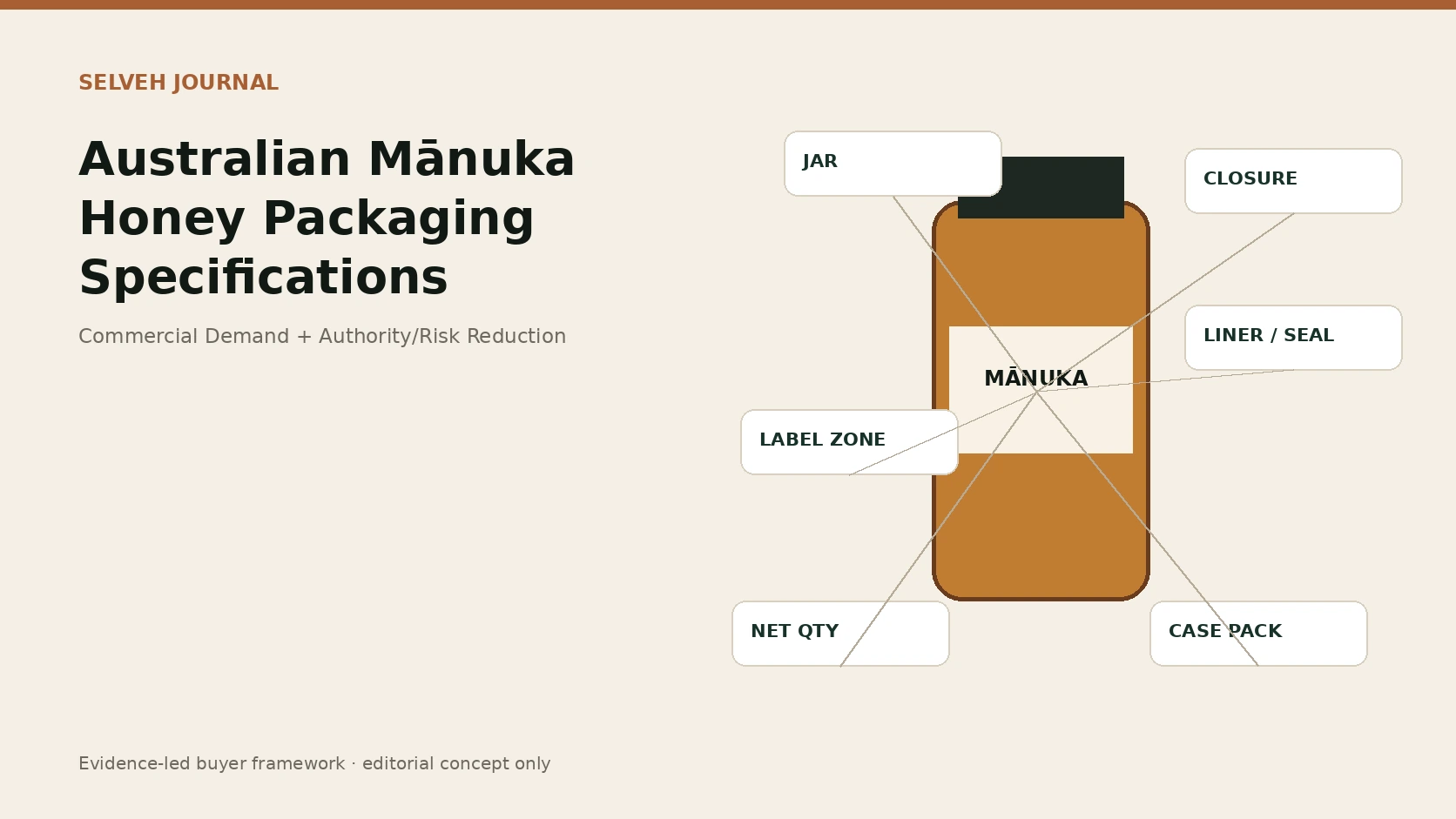
01 · Packaging system
A jar specification is more than container size
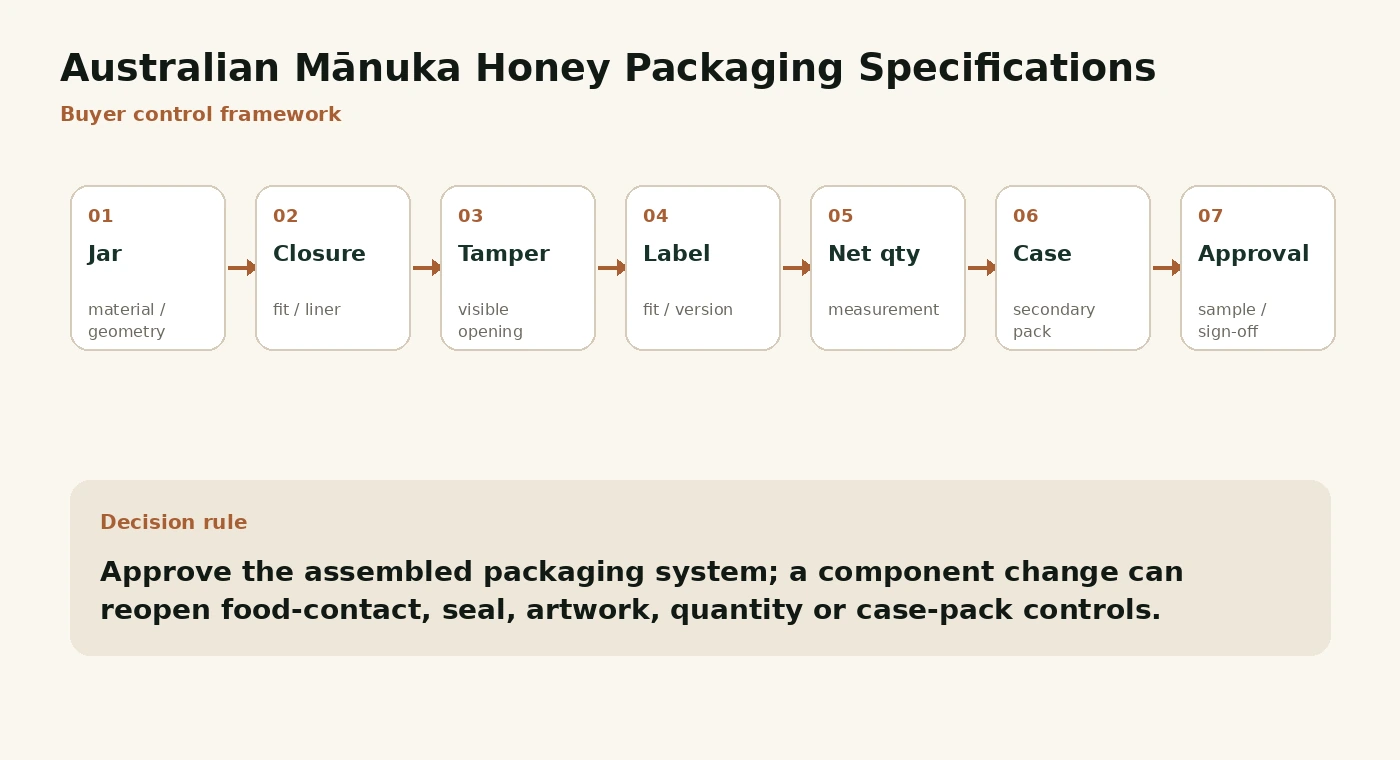
For a private-label Mānuka product, the commercial pack is a system: primary container, closure, liner or seal, tamper-evidence feature, label or decoration, declared net quantity, case pack and any transport protection. A change to one component can affect another.
A new lid can change sealing behaviour. A different jar diameter can change label fit and case count. A heavier glass pack can change freight and breakage exposure. A taller closure can change carton dimensions. Buyers should therefore approve the assembled system rather than individual components in isolation.
The specification should identify supplier or component code, material, dimensions, tolerances where relevant, approved artwork version and who owns substitution approval.
02 · Food-contact suitability
Food-contact suitability is a release requirement, not an aesthetic preference
FSANZ states that under Standard 3.2.2 food businesses must use packaging that is fit for its intended purpose, is not likely to contaminate food and does not create contamination during packaging. Packaging can create risk through dirty or damaged materials, fragments or chemical migration.
For a buyer, that means “glass jar” or “plastic jar” is not enough information. Ask the packer to confirm that the actual food-contact components are suitable for the intended food and use conditions, including the liner or seal that contacts the product.
Do not infer regulatory suitability from appearance, supplier marketing language or the fact that a component is commonly used for another food. Keep relevant supplier declarations or specifications with the packaging approval record.
03 · Jar
Specify jar geometry, material and operational fit
For a focused material-system comparison, use the glass versus PET Mānuka honey packaging guide.
The jar record should define nominal capacity, material, colour or transparency, neck/finish compatibility, key dimensions and the intended fill mass. A buyer should also check whether the component runs reliably on the selected filling and capping equipment.
For Mānuka honey, premium appearance matters commercially, but the technical approval still comes first. Heavy glass may create a strong shelf presence while increasing unit weight, freight exposure and breakage risk. Plastic can change weight and handling but may create different brand or barrier considerations.
Public Australian honey packers show that both glass and plastic formats are used in private-label operations. That demonstrates available format diversity, not a recommendation that one material is universally superior.
04 · Closure & liner
Treat the closure, liner and seal as one integrity system
A closure specification should identify material, colour, thread or finish compatibility, liner/seal type and any torque or application requirement controlled by the packer. Buyers should ask what evidence the supplier uses to verify that the closure system remains intact through normal handling and distribution.
If a liner, induction seal or other barrier is used, define whether it is intended for product protection, leak resistance, tamper evidence or more than one function. These terms should not be used interchangeably without knowing the component design.
Any substitution should be re-approved where it can affect seal integrity, label presentation, food contact or destination acceptance.
05 · Tamper evidence
Tamper evidence should be specified by function
A buyer may request an induction seal, shrink band, breakable closure feature or another tamper-evident format as a commercial or customer requirement. Do not assume that “tamper evident” describes one standard technology or that every market applies the same rule to honey.
Write the requirement functionally: what evidence of opening should be visible, what component creates it, how it is applied, and how the finished pack is checked. If a retailer, importer or destination authority has a specific requirement, record that source separately.
SELVEH should not claim a universal Australian legal requirement for a particular tamper-evidence technology unless a relevant rule is identified for the product and transaction.
06 · Net quantity
Net quantity is a legal measurement control in Australia
Australia’s National Measurement Institute states that pre-packaged goods must carry an accurate measurement marking and that the measurement is net content, excluding packaging. The guide also sets requirements for marking position, character size and the identification of the packer for goods packed in Australia.
For a 250 g or 500 g honey jar, the packaging specification should therefore connect the physical container and fill process to the declared net quantity and the packer’s measurement-control system. A visually identical jar does not prove compliant fill control.
Buyers should also make sure the label layout leaves the measurement marking clear and does not create conflicts with artwork or promotional elements.
07 · Label zone
Approve the label zone against the real container
Artwork dimensions should be based on the production jar, not a generic mock-up. Curvature, taper, seams, embossing and the main display area can change how a label sits and whether mandatory information remains legible.
Before print release, confirm the label size, application orientation, safe area, overlap or gap, adhesive suitability and any interaction with a tamper band or closure. A physical or production-representative sample is stronger evidence than a flat artwork PDF alone.
Keep claim approval separate from print-fit approval: a label can be legally worded but mechanically unsuitable, or technically well fitted but contain an unapproved claim.
08 · Secondary packaging
Case pack is part of the commercial specification
Define units per case, carton material, internal dividers or protective inserts, gross case weight, external dimensions and case markings. For glass jars, secondary packaging also has a direct relationship with breakage exposure and pallet efficiency.
The right case count depends on pack weight, warehouse handling, retailer requirements and freight economics. Avoid copying a standard case count simply because it is common in another SKU.
If palletisation is part of the supplier scope, define cases per layer, layers per pallet, pallet type and any stretch-wrap, corner-protection or labelling requirements used for dispatch.
09 · Approval gate
Use a packaging approval sample before production release
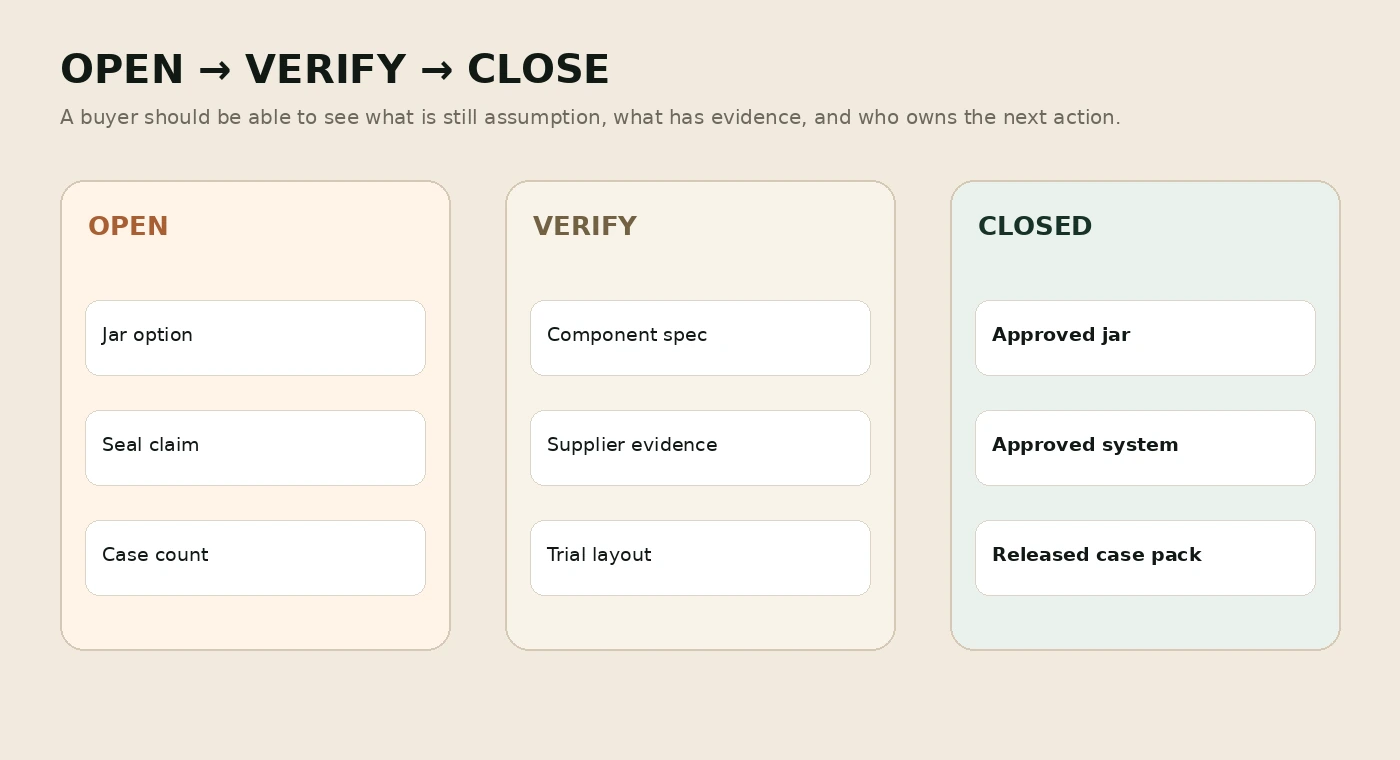
The buyer should approve the assembled jar, closure, seal/tamper feature, label placement and case configuration against the written specification before commercial production where practical. Record the approval date and sample/version identity.
A packaging sample is not a substitute for batch release or label-claim evidence, but it can close dimensional, visual and component-compatibility questions before a full run.
If the supplier proposes a substitution after approval, reopen only the affected controls and document the decision rather than accepting an undocumented “equivalent” component.
10 · Buyer tool
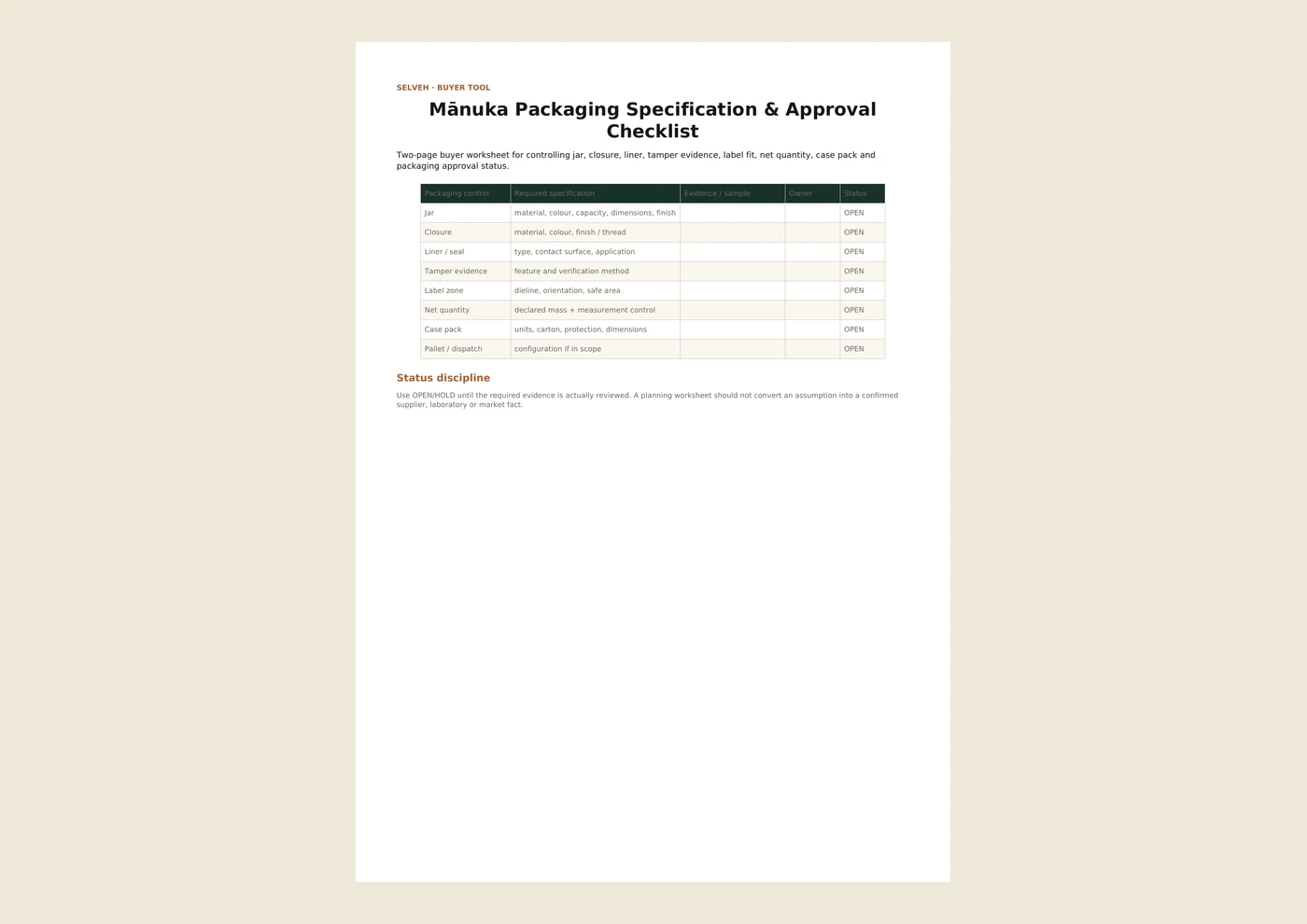
Use a Packaging Specification & Approval Checklist
The downloadable checklist separates primary pack, closure/seal, artwork fit, net measurement, case pack and approval evidence. It is designed to make OPEN packaging assumptions visible before purchase orders and print files are released.
It is not a certification or evidence that any current SELVEH packaging has been finalised.
11 · Red flags
Investigate these packaging statements
- “Food grade” with no component specification or supporting supplier documentation.
- “Tamper evident” without identifying the feature and how it is verified.
- A label dieline created before the production jar and closure are confirmed.
- A 250 g or 500 g pack approved visually with no link to net-quantity control.
- A supplier substitution described as “equivalent” without assessing seal, food-contact, artwork or case-pack effects.
12 · SELVEH status
What SELVEH can state today
SELVEH can define the packaging fields and approval evidence that a future private-label pack should contain and can compare stock component options offered by a supplier.
SELVEH should not represent a specific jar, closure, tamper system, case pack or packaging supplier as final until the actual component specification and approval evidence are closed.
Sources
Sources and evidence notes
- FSANZ - Food packaging
- FSANZ - Chemicals in food packaging
- National Measurement Institute - Guide to the sale of pre-packaged goods
- Honey Australia - Private label packaging formats
- Bendigo Honey - Contract manufacturing and packaging coordination
Editorial boundary: Current official, technical and public commercial information is separated from SELVEH recommendations. Public supplier material is illustrative only. No open supplier, packaging component, batch, laboratory result, importer, production schedule, certificate or shipment is represented as confirmed SELVEH evidence.
Trade planning
Defining a private-label packaging system?
Use the trade enquiry to define pack size, destination, presentation and packaging constraints. Component options can then be assessed against a written specification.
Start a trade enquiry