01 · Classification
Monofloral and multifloral are claim categories, not quality scores
A monofloral claim is intended to communicate that one floral source predominates according to a defined basis. A multifloral Mānuka claim indicates that Leptospermum-derived nectar is present alongside nectar from other floral sources. The exact threshold or evidence basis can depend on the scheme, market or contractual definition being used.
The Australian Mānuka Honey Association publishes criteria for its own authenticity framework and describes Australian Mānuka as potentially monofloral or multifloral. Its criteria document describes monofloral Mānuka as having at least 50% of nectar derived from one floral source. That is useful scheme evidence, but a buyer should not automatically present a private-industry criterion as a universal Australian legal definition.
02 · Keep concepts separate
Do not turn floral-source wording into an MGO ranking
MGO is an analytical concentration, usually expressed in mg/kg, that forms part of many commercial Mānuka grade statements. Floral-source classification answers a different question: what botanical source or source mix is being represented. A monofloral claim does not by itself prove a particular MGO concentration, and multifloral wording does not prove low MGO or poor quality.
Australian research illustrates why the concepts must remain separate. Cokcetin and colleagues analysed Australian Leptospermum honeys and reported substantial variation in MGO and DHA across samples and species, including both monofloral and multifloral samples. The buyer should therefore request the actual batch result rather than infer chemistry from the floral word on the label.
03 · Australian context
Australia’s Leptospermum diversity complicates simple comparisons
Australia has many native Leptospermum species rather than a single commercial botanical story. Research has shown that DHA production in Australian Leptospermum nectar is species-dependent and that not every species produces the same DHA profile. Because DHA is a precursor relevant to MGO development, species and regional context can matter to the chemistry without providing a simple consumer-facing ranking.
This is also why Australian Mānuka should not be authenticated by casually importing a New Zealand rule or marker threshold. The evidence base, botanical diversity and applicable schemes differ. A buyer should record exactly which definition and method the supplier is relying on.
04 · Evidence types
Pollen analysis can be evidence, but it is not a magic percentage
Pollen analysis may support a floral-origin assessment, especially when interpreted by an experienced laboratory in the context of local flora and sampling. But a buyer should not assume that one pollen percentage universally proves nectar contribution or that an internet threshold can be applied across Australian products without knowing the method and definition.
Research that informed New Zealand Mānuka authentication has discussed limitations of pollen-only approaches, including specificity issues where related plant pollen can be difficult to distinguish. That research is useful as a caution: botanical authentication should be method-aware. It is not a regulatory standard for Australian Mānuka and should not be copied as one.
05 · Chemical evidence
Chemical markers should be interpreted within the claim framework
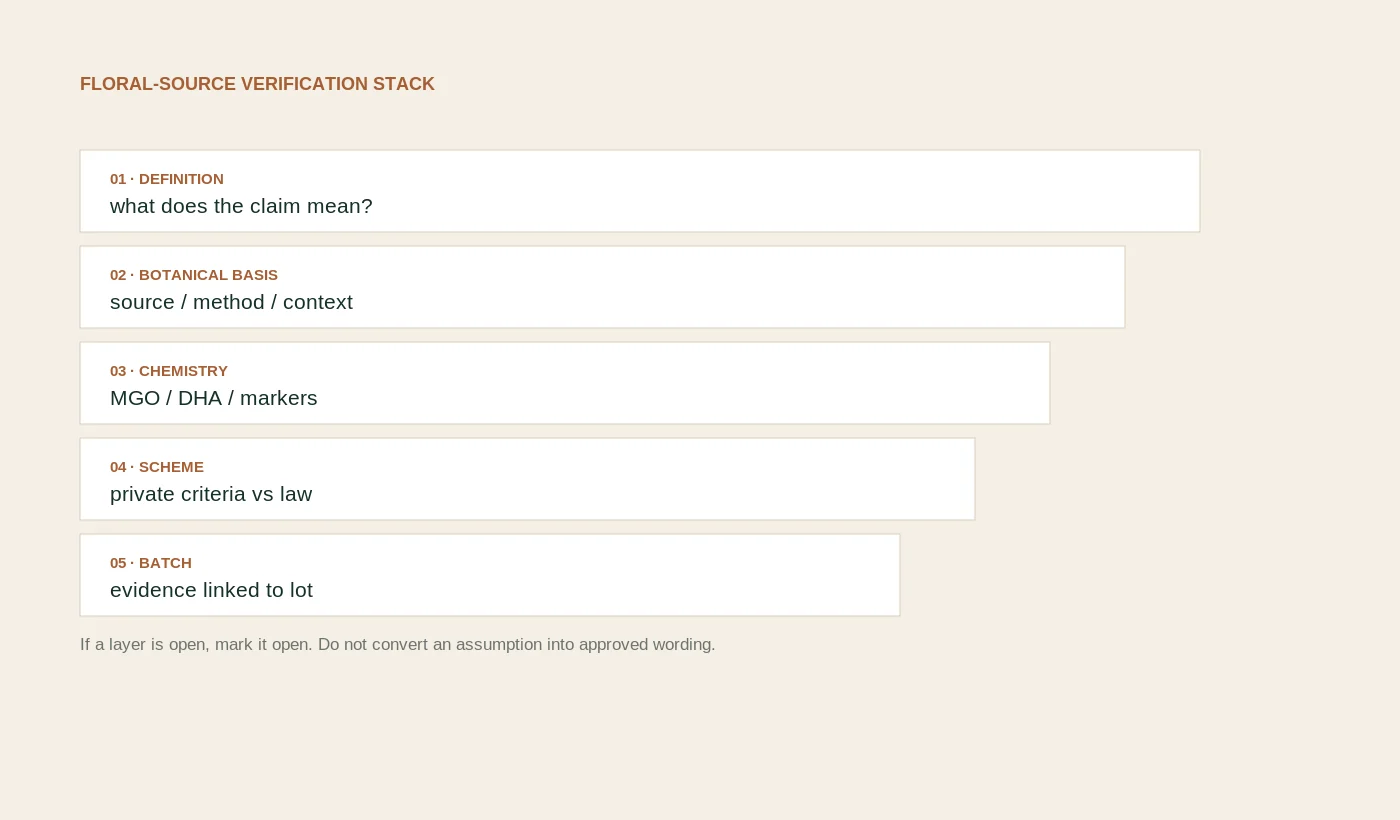
MGO, DHA and other naturally occurring compounds can support the scientific characterisation of Leptospermum honey, and some industry schemes use defined marker combinations. But a buyer should ask what the marker is intended to prove. A grade result is not automatically an origin test; an origin marker is not automatically a monofloral percentage; and a private authentication scheme is not automatically a government rule.
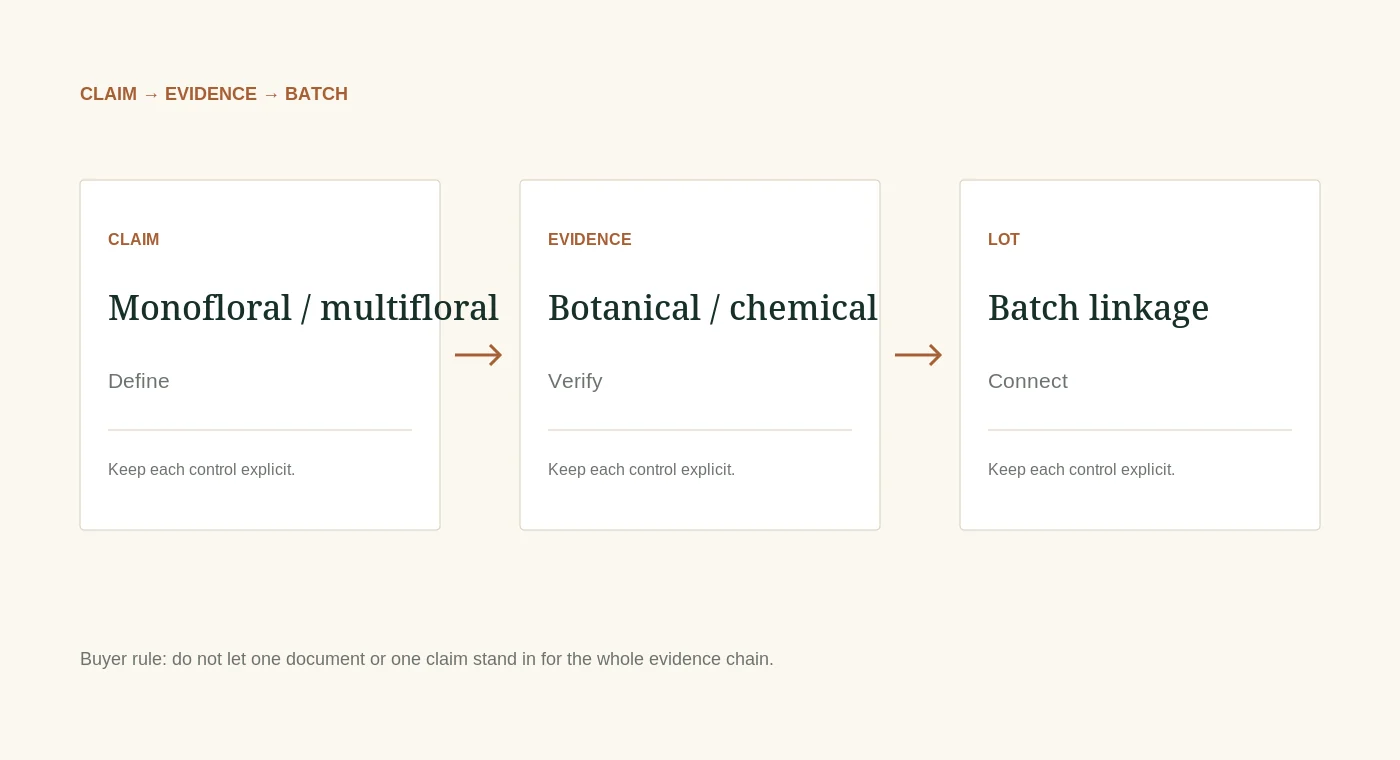
The most defensible approach is claim-specific. For “MGO 250+”, verify the batch-linked MGO evidence. For “Australian”, verify the origin chain. For “monofloral”, verify the botanical definition and evidence method being used. Keep the evidence packages connected but conceptually separate.
06 · Governance
Separate scheme definitions from legal requirements
Private industry schemes can be useful because they provide a defined vocabulary, test framework and licensing process. AMHA’s criteria and Mark of Authenticity are examples of such an Australian industry framework. If a supplier claims compliance with that scheme or displays the mark, the buyer can verify the scheme-specific requirements and licence status.
However, the buyer should avoid wording such as “Australian law requires all Mānuka honey to be monofloral under the AMHA definition” unless an applicable law actually says that. The specification should name the scheme or contractual definition explicitly, especially for export markets where local labelling rules may treat floral-source statements differently.
07 · Batch control
The claim must be linked to the lot being supplied
A general brochure showing one botanical analysis from a previous season does not necessarily substantiate the current commercial lot. The buyer should record which batch, bulk lot or production lot the evidence relates to and whether blending, storage or repacking changed the identity represented by the source documents.
If the supplier cannot link the floral-source evidence to the lot being quoted, mark the claim Amber rather than silently accepting it. The same discipline used for MGO and COA review should apply to botanical claims.
08 · Commercial use
Use the classification only where it changes a real buyer decision
A floral-source claim may influence positioning, product naming, authentication evidence, specification wording or buyer education. But it should not be treated as a reason to create extra SKUs unless the channel and economics support that complexity. Adding both monofloral and multifloral products to an opening range can multiply MOQ, artwork and inventory exposure without proving incremental demand.
Where the claim matters commercially, request a comparable offer showing grade, pack, price, evidence basis and MOQ for each proposed product. That makes the premium, if any, visible instead of assuming that “monofloral” automatically earns a better margin.
09 · Red flags
Floral-source claim red flags
Red flags include “monofloral” with no stated definition; a pollen percentage presented without the laboratory method or botanical context; MGO used as the sole proof of floral source; a New Zealand authentication rule presented as if it were an Australian legal requirement; a scheme logo displayed without evidence of licence; or a supplier unable to connect the botanical evidence to the offered batch.
Another red flag is marketing copy that turns floral-source wording into a therapeutic or quality guarantee. Those are separate claims with separate evidence and regulatory consequences.
- Monofloral or multifloral wording with no definition.
- A pollen percentage with no method or botanical context.
- MGO used as the sole proof of floral source.
- A private scheme presented as Australian law.
- Evidence that cannot be connected to the offered lot.
10 · Buyer matrix
Verify the wording before approving the artwork
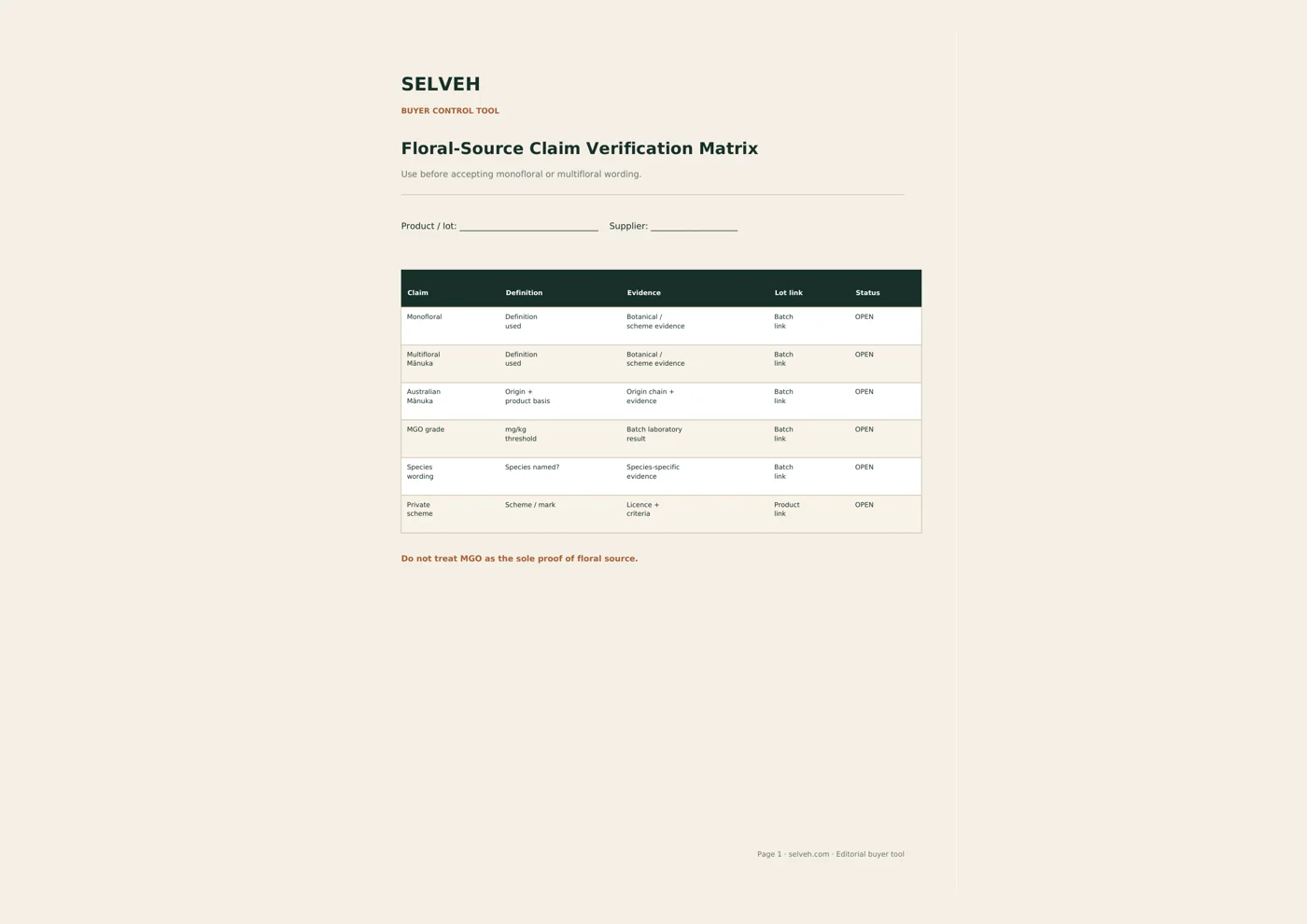
The downloadable matrix asks the buyer to capture six fields: proposed floral-source claim; definition used; evidence source; scheme or authority; batch or lot link; and buyer status. Green means the claim basis is defined and the evidence is relevant to the offered lot. Amber means the wording may be usable but an evidence or definition gap remains. Red means the current wording should not be approved.
This approach is deliberately more conservative than relying on a supplier’s product name. It makes the evidence boundary visible before the wording is repeated on packaging, quotations or destination-market registrations.
11 · SELVEH status
What SELVEH can say now - and what must wait
SELVEH can explain the difference between floral-source classification and MGO grading and can define the evidence questions it will ask suppliers. It can also use AMHA and peer-reviewed research to build an evidence framework.
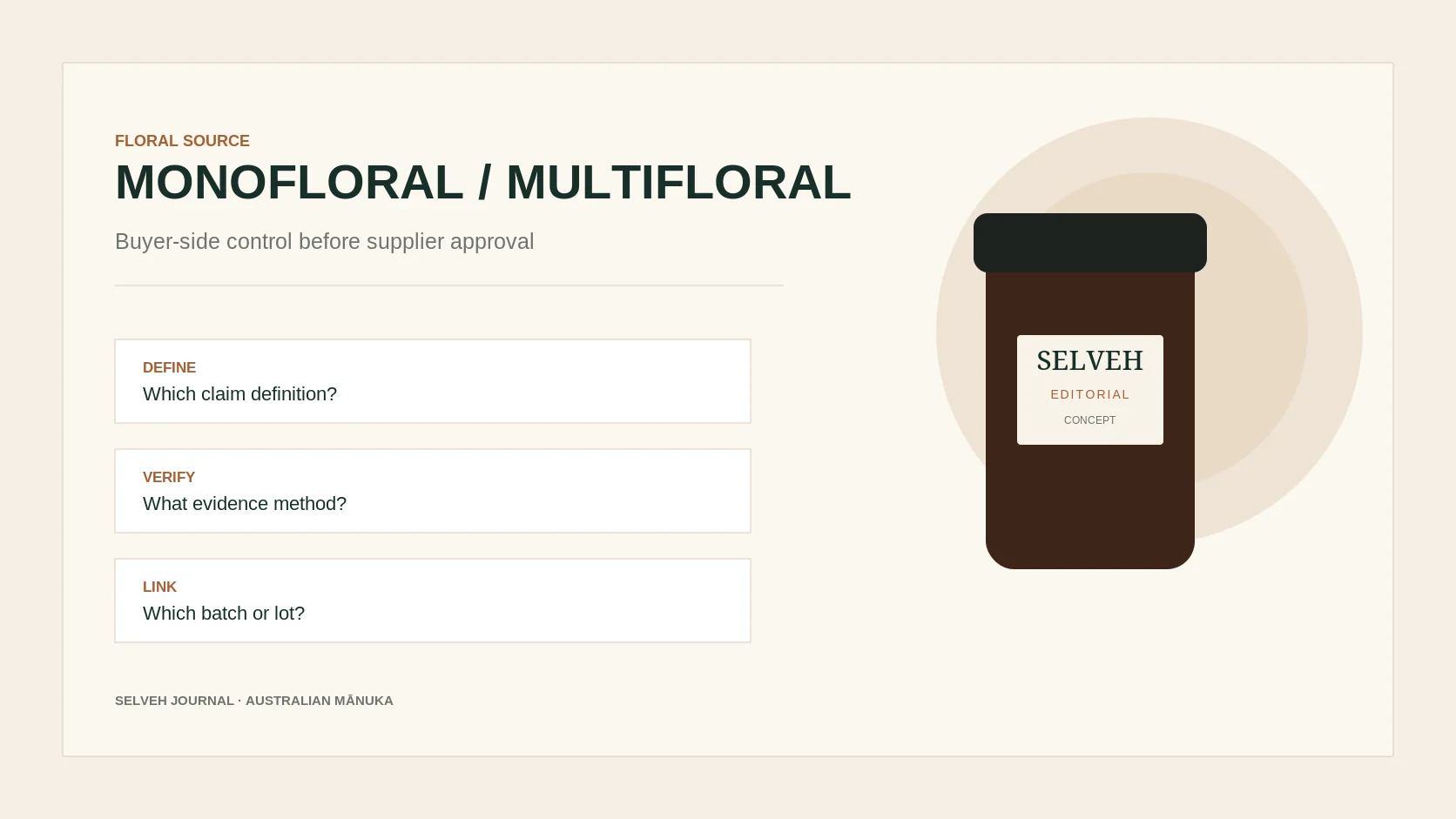
SELVEH should not state that its future honey is monofloral or multifloral, or imply a specific Leptospermum species, until the selected supplier and actual batch evidence support that wording. Current visuals are editorial and do not represent a verified SELVEH floral-source claim.
Sources
Sources and evidence notes
- Australian Mānuka Honey Association — Quality Standards / Criteria
- Australian Mānuka Honey Association — Criteria for defining Australian Mānuka Honey
- Cokcetin et al. — The Antibacterial Activity of Australian Leptospermum Honey Correlates with Methylglyoxal Levels
- Williams et al. — Dihydroxyacetone Production in the Nectar of Australian Leptospermum Is Species Dependent (PubMed)
- McDonald et al. — Using chemical and DNA marker analysis to authenticate a high-value food, manuka honey
Editorial boundary: This page distinguishes current regulatory or scheme information from SELVEH buyer-side recommendations. Where supplier, batch, licence or destination evidence is not yet verified, the article keeps the status open rather than implying a final SELVEH capability.
Trade planning
Need to verify floral-source wording in a supplier offer?
SELVEH is developing its Australian Mānuka supply programme. Floral-source wording, species basis, MGO grade and authentication evidence remain subject to supplier and batch verification.
Start a trade enquiry