01 · Decision map
The private-label decision in one page
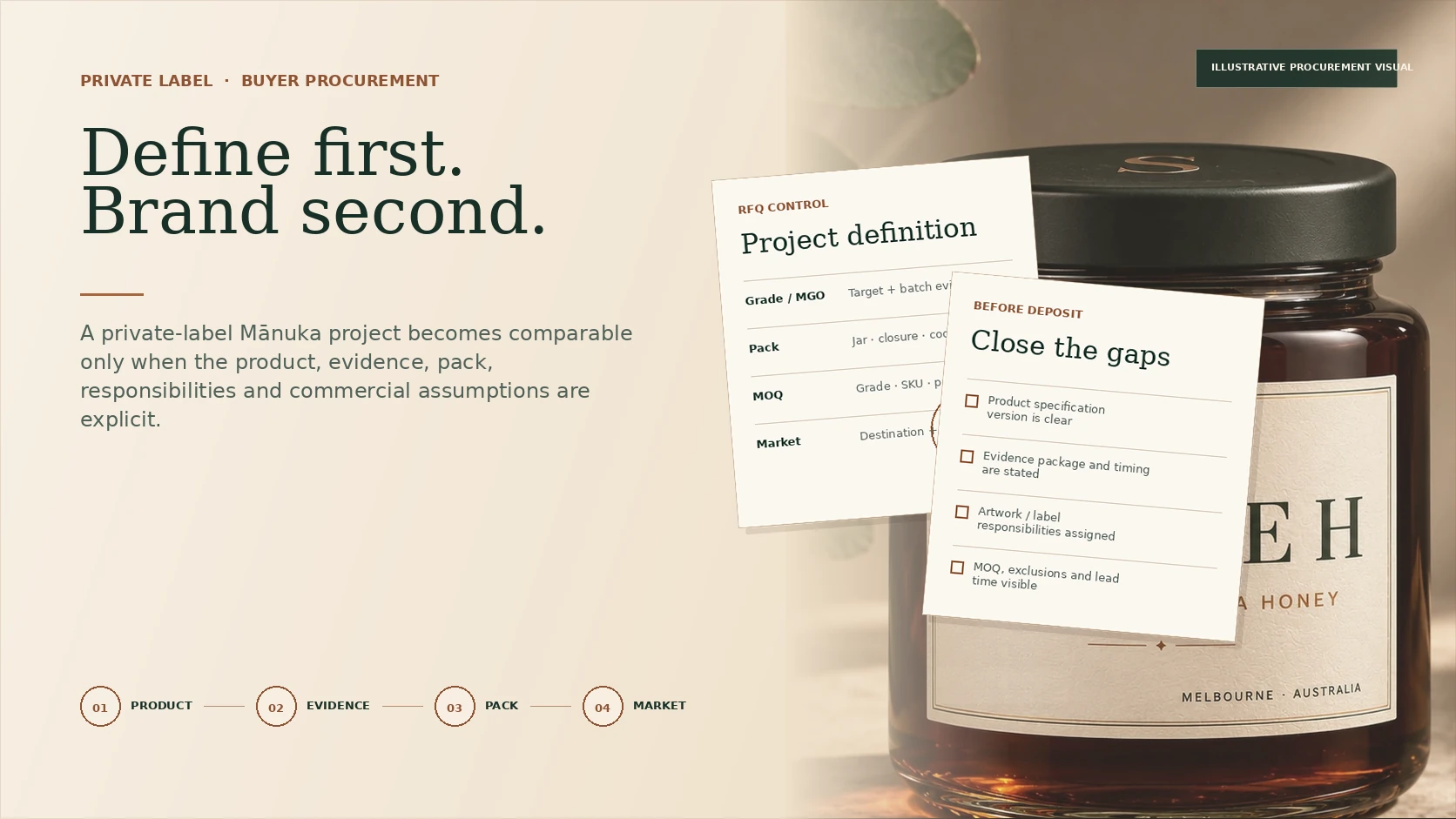
Before asking for a final price, lock these decision areas. If one remains open, the quotation should show the assumption rather than hiding it.
| Decision area | What should be explicit before commitment |
|---|---|
| 1. Product | Origin/source position, product description, intended MGO grade or analytical target, retail-ready or bulk. |
| 2. Pack | Net weight, jar/container, closure, tamper control, label format, carton and coding. |
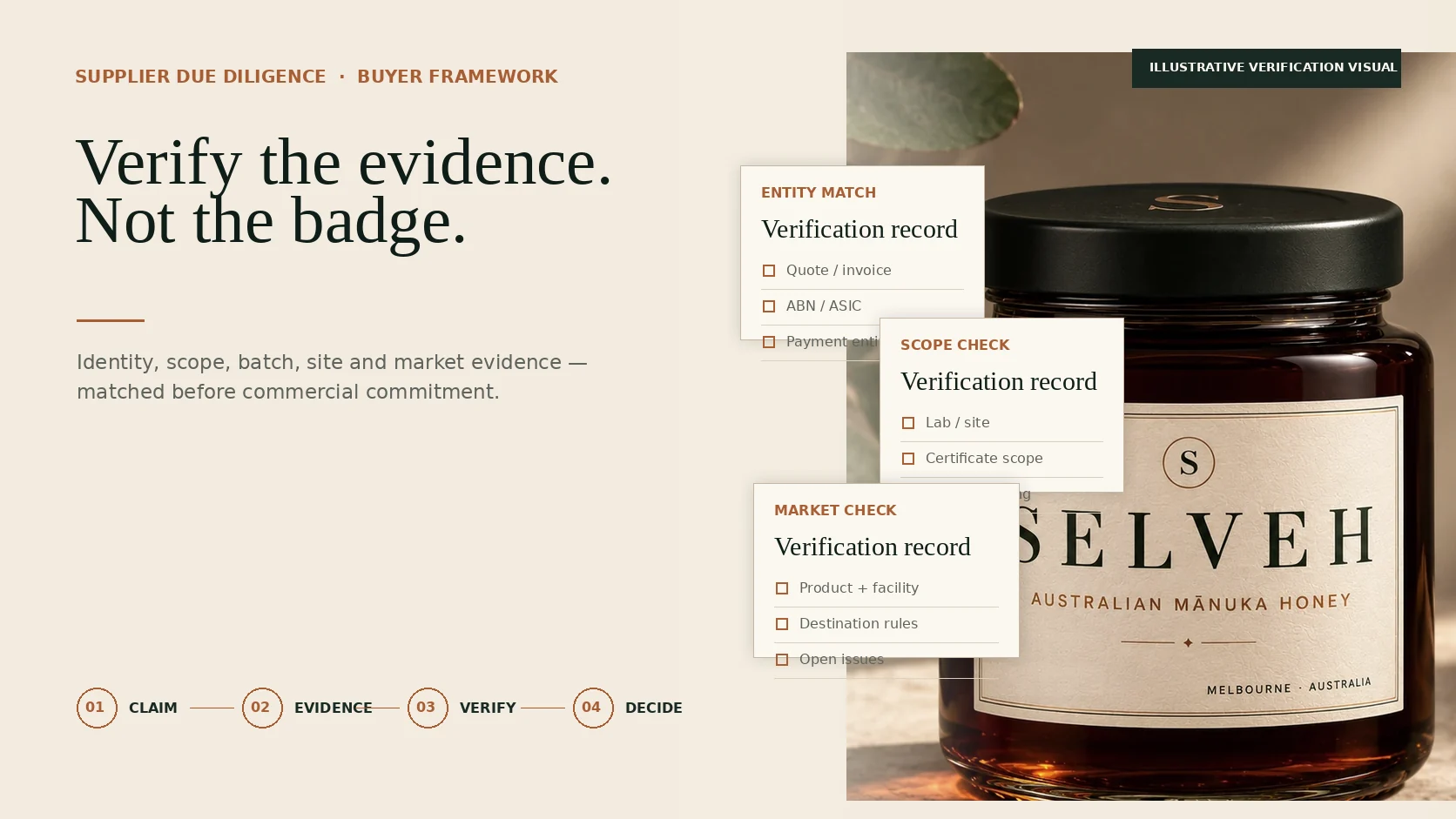
| 3. Evidence | Specification, batch identity, COA/test report, origin/traceability records and release documents. |
| 4. Responsibility | Who supplies honey, who packs, who approves artwork, who checks destination requirements, who releases the batch. |
| 5. Commercials | MOQ basis, mixed-SKU rules, price basis, setup/tooling charges, payment milestones and lead-time assumptions. |
| 6. Market | Destination, importer, sales channel, label language, registration/certification requirements and shipping pathway. |
02 · Scope the commercial model
Define “private label” before relying on the term
Private label, white label, OEM, contract packing and bulk supply are used inconsistently across the food trade. Treat them as commercial shorthand, not as a specification.
Private label: A product sold under the buyer’s brand, with the exact division of sourcing, testing, packing, artwork and market-compliance work defined by the agreement.
White label: Often used for a more standardised product or pack that can be branded for multiple customers, but usage varies by supplier.
Contract packing: A service focused on filling, closing, coding, labelling or secondary packing. The packer may or may not own or supply the honey.
Bulk supply: Honey supplied as an ingredient or larger-format lot for later packing or manufacturing. It is not automatically a finished private-label programme.
Buyer rule: define the scope in the RFQ. Do not assume the phrase “private label” tells you who owns product, packing, testing, artwork, compliance or export responsibilities.
Use the white-label versus private-label decision guide when the buyer must choose the operating model before drafting the RFQ.
03 · Define before pricing
Define the product before requesting a comparable quote
A quote is only comparable when suppliers are pricing the same commercial object. Start with a product brief that is specific enough to remove avoidable assumptions but does not pretend decisions have already been validated.
- Australian origin/source requirement and the evidence expected to support the exact origin wording.
- Product type and any floral-source wording that is actually intended; do not adopt “monofloral”, “authentic”, “organic” or similar claims without the evidence and scheme/legal basis required for the exact statement.
- Intended MGO grade or analytical target, and whether the commercial requirement is a label tier, a measured minimum at release, or both.
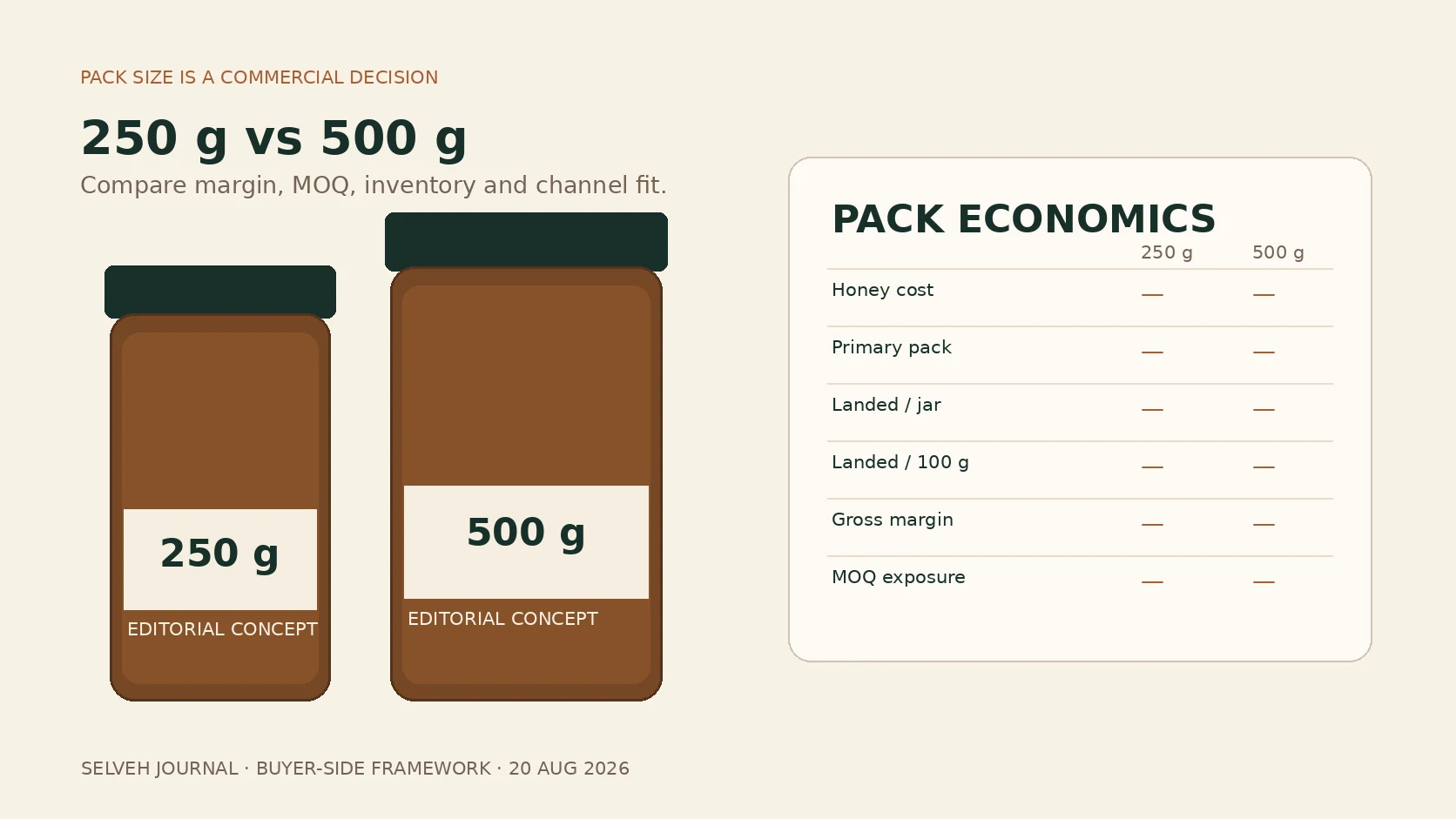
- Net weight and SKU count - for example, one 250 g SKU is commercially different from four grade/size combinations.
- Finished retail pack in Australia versus bulk/part-finished supply for destination packing.
- Destination country and sales channel, because label, importer, documentation and logistics requirements can change by market.
- Target launch or delivery window, stated as a planning requirement rather than an assumed supplier promise.
Why this matters: asking one supplier for “MGO 250+, 250 g glass, retail-ready UAE pack” and another for “private-label Mānuka, best price” does not produce two quotes that procurement can meaningfully compare.
04 · Grade control
Define what the MGO requirement is supposed to control
MGO is useful only when its commercial meaning is written down. A buyer should separate the marketing tier from the measured batch evidence. If the offer says “MGO 250+”, procurement should know what document, batch identity, analytical result and acceptance rule support that statement.
Do not overload the private-label RFQ with a full chemistry review. Use the dedicated SELVEH MGO buyer guide for interpretation of MGO and grade language. In this procurement guide, the key point is narrower: the grade requirement must be traceable to the product specification and the batch evidence that will be released.
A grade label is not a substitute for a batch-linked result. A batch-linked result is not, by itself, proof of every other quality, origin or market claim.
05 · Evidence package
Define the evidence package before production, not after a problem
The buyer should state what evidence is required, when it will exist and what it must be linked to. Some documents can be reviewed before production; others only exist once a real batch has been produced, packed or tested.
| Evidence item | Procurement purpose |
|---|---|
| Product specification | Defines the intended product, grade/acceptance criteria, pack and revision. |
| Batch/lot identity | Connects the offered and packed goods to the records. |
| COA / laboratory report | Shows measured results for the identified sample/batch, with method, unit, report identity and laboratory details where relevant. |
| Origin / source records | Support the origin wording actually being used; a generic provenance story is not a batch record. |
| Packing / coding record | Links the filled retail units/cartons back to the relevant bulk or production lot. |
| Market / shipment records | Only those required by the actual destination and transaction; no single universal export-document list applies everywhere. |
For deeper document review, use the COA, batch testing and traceability core guide, the COA reading guide and the batch documentation guide.
06 · Responsibility map
Separate honey supply from packing capability
A polished private-label offer can hide several different operating roles. Procurement should identify them explicitly because evidence, accountability and lead time can sit with different parties.
Producer / beekeeper network: Origin/source records and incoming honey identity may begin here.
Honey supplier / aggregator: May consolidate, hold, blend or sell lots; confirm how source and batch identity are preserved.
Packer / contract manufacturer: Controls filling, closure, coding, label application, secondary packing and production records within its actual scope.
Laboratory: Tests submitted samples; it does not automatically certify the entire commercial supply chain or approve a label.
Exporter / freight party: Coordinates shipment and documents within the contracted scope.
Importer / local market party: Often owns or participates in destination registration, customs, label review and local release depending on the market and contract.
The buyer should ask whether the named supplier performs each activity itself, controls it through an approved contractor, or expects the buyer/importer to arrange it. The correct answer can be any of these; the risk is leaving the division implicit.
07 · Pack specification
Turn packaging preferences into a pack specification
Before fixing the manufacturing route, compare the evidence, responsibility, yield and local packing exposure in the source-packed versus destination-packed importer guide.
“Premium glass jar” is a design preference, not a production specification. A private-label pack must be defined far enough for a packer to quote it, test it and reproduce it.
| Pack layer | What to define |
|---|---|
| Primary container | Material, nominal capacity, food-contact suitability, shape/finish and approved supplier or equivalent rule. |
| Closure | Cap/lid system, liner, torque/closure method where relevant, and tamper-evident feature. |
| Label | Material, finish, size, adhesive, print method and application position/tolerance. |
| Coding | Batch/lot code, date marking where required, and legibility/placement. |
| Secondary pack | Carton size, dividers/cushioning, units per carton and label/marking. |
| Retail/logistics identifiers | Barcode or retailer identifiers where required by the chosen channel. |
| Pallet / shipment configuration | If in scope: cartons per layer/pallet, restraint and any route-specific protection. |
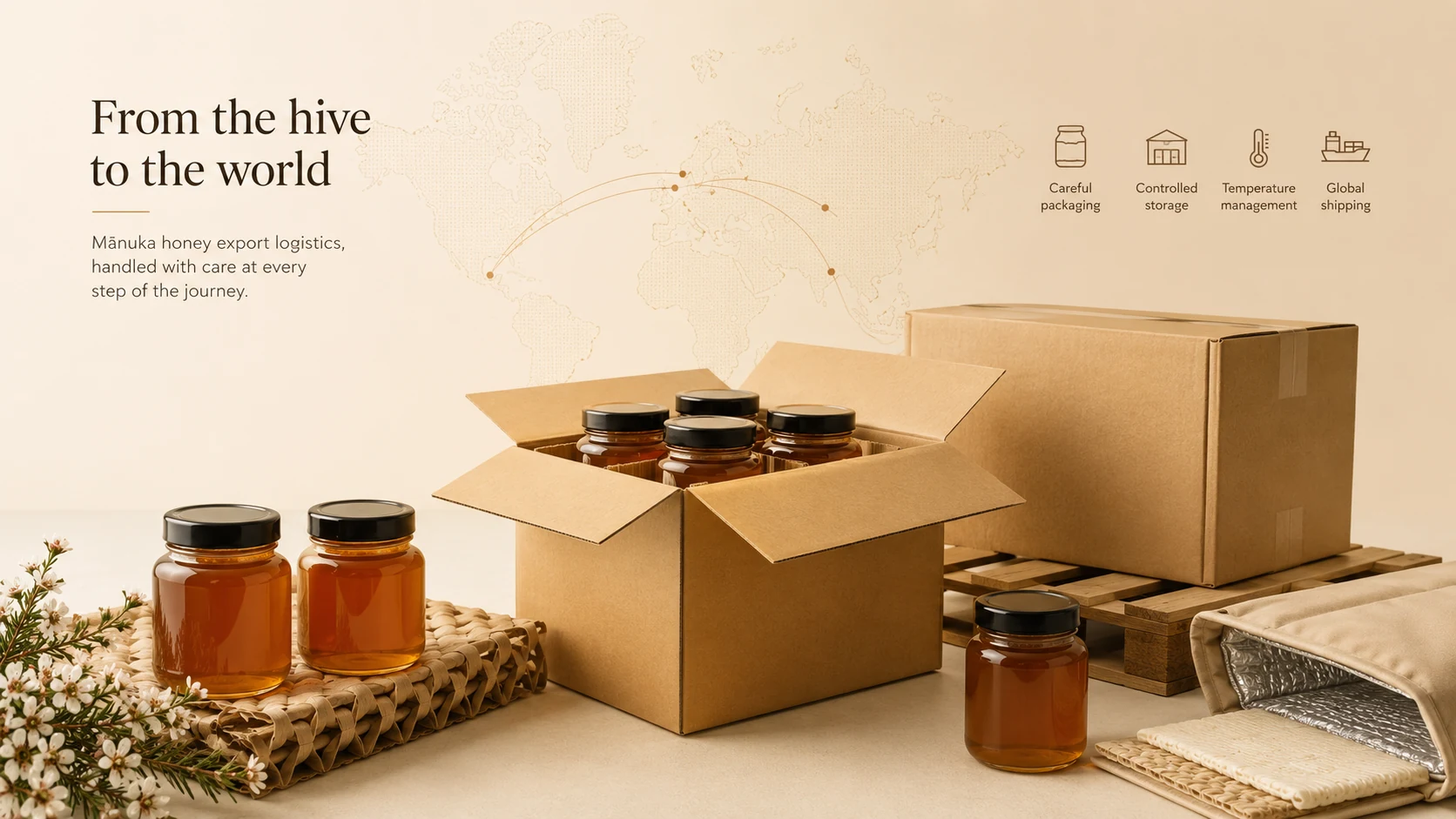
Packaging requirements should also be reconciled with the actual export route. The SELVEH export logistics guide explains why primary pack, secondary pack, handling, heat exposure and receiving controls form one transport system rather than separate purchasing decisions.
08 · Artwork & compliance
Resolve label responsibility before artwork approval
A supplier saying “we can print your label” does not establish that the artwork is legally acceptable in every destination. Printing capability and regulatory responsibility are different questions.
For products sold in Australia, FSANZ sets food labelling standards through the Australia New Zealand Food Standards Code, including general information requirements. Country-of-origin food labelling is governed separately under the Australian Consumer Law framework, with the ACCC country-of-origin food labelling framework.
If nutrition or health claims are proposed, the risk rises. FSANZ states that Standard 1.2.7 sets requirements for nutrition and health claims. A high MGO number is not permission to write therapeutic or disease-treatment claims on a food label.
For export, destination rules may differ. DAFF’s Micor guidance covers known importing-country requirements for certain non-prescribed goods such as honey, while noting that not every market requirement is necessarily captured there. The importer and competent destination authority therefore remain essential verification points.
- Who produces the first artwork and who owns the master file?
- Who checks mandatory food information for the intended market?
- Who substantiates origin wording, MGO/grade wording and any voluntary claims?
- Who confirms language, importer details, registration identifiers or local marks where applicable?
- Who approves the final print proof before a large label run?
- Who pays if artwork must change because the market, product or evidence changes?
Buyer rule: approve artwork only after the product specification, evidence wording and destination responsibility map agree with each other.
09 · MOQ logic
Ask what the MOQ applies to
“What is your MOQ?” is too blunt for a multi-SKU private-label project. MOQ can be driven by different constraints, and the binding minimum may not be the honey itself.
- Honey grade or source lot
- Jar or closure purchase quantity
- Label print run
- Carton print or manufacturing run
- Packer production run
- Each SKU rather than the combined project
- Each destination-market artwork version
- Shipment or freight economics
Ask the supplier to identify the binding MOQ and whether quantities can be mixed across grades, pack sizes or artwork versions. Record any conditions in the quote. Do not publish or rely on a generic “industry MOQ” when the commercial constraint is supplier- and format-specific.
10 · Quote normalisation
Normalise the quotation before comparing unit prices
A low jar price can be a poor quote if key project costs are excluded. Compare total scope, not only the number beside “unit price”.
| Quote component | Clarify | Included? |
|---|---|---|
| Honey / filled product | Price basis, grade/specification, included batch evidence. | Yes / No / TBC |
| Primary packaging | Jar, closure, liner/seal, tamper feature. | Yes / No / TBC |
| Labels / decoration | Print, embellishment, plates/dies/setup, application. | Yes / No / TBC |
| Secondary packaging | Cartons, dividers, carton labels/printing. | Yes / No / TBC |
| Testing / release | What is included, what is optional, and when results are issued. | Yes / No / TBC |
| Samples / development | Sample cost, courier, artwork/proofing, pilot or setup charges. | Yes / No / TBC |
| Freight / delivery | Incoterm or delivery basis, named place, included/excluded legs. | Yes / No / TBC |
| Market-specific work | Registration, translation, label review, certification or other services only where actually offered. | Yes / No / TBC |
If the buyer cannot explain why two quotes differ, the quotes are not yet normalised. Ask for the assumptions to be made visible before selecting on price.
11 · Lead-time map
Break lead time into stages
Specify
Product, grade, pack, market and intended channel.
Quote
Normalize scope, MOQ, exclusions, payment and delivery basis.
Evidence
Define batch documents, origin support and release criteria.
Artwork
Assign label, claim and destination-review responsibilities.
Produce
Lock approvals, materials, coding and production dependencies.
Release
Confirm the actual batch, documents and shipment handover.
“Lead time: 6 weeks” is not enough unless the start point, approvals and dependencies are clear. A private-label project normally contains several separate clocks.
- Product brief / supplier qualification
- Sample availability and evaluation
- Commercial quotation
- Artwork development and regulatory review
- Jar/closure/label/carton procurement
- Production scheduling
- Filling, packing and coding
- Batch testing and release
- Export documentation / freight booking
- Destination clearance and receiving
Ask which activities can run in parallel, which require buyer approval, and what restarts the clock. If a label cannot be printed until a registration step is complete, or a batch report cannot exist until production/testing occurs, the timeline should say so.
12 · Destination gate
Check the destination before mass printing or production
Private-label projects fail expensively when market requirements are treated as a final shipping task. Destination decisions should influence the pack and evidence plan before labels and cartons are committed.
Australian honey and apiary products are handled within Australia’s non-prescribed goods export framework. That does not make every shipment automatically “export ready”. Micor publishes known importing-country requirements for relevant markets; government certification may be needed where the importing country requires it.
SELVEH already maintains a market-specific guide for the UAE import pathway. Future market guides should own the detailed regulatory intent for other destinations rather than duplicating changing customs, registration and label rules inside this general procurement page.
Do not mass-print a destination pack solely because an Australian pack looks compliant. Confirm the actual destination pathway, responsible importer and current official requirements first.
If the target market is the UAE, compare the proposed grade, pack and price architecture with the dated UAE Mānuka retail and channel landscape before locking the assortment.
13 · Deposit gate
Set a deposit-release gate
A deposit should release a defined project, not convert unanswered questions into hidden risk. The exact commercial threshold will vary, but procurement should be able to close or deliberately accept the following before paying a material production deposit:
- Product description and target grade are written and version-controlled.
- Pack size, primary packaging and artwork path are defined enough for the quoted scope.
- MOQ and mixed-SKU rules are written.
- Price basis, currency, taxes if applicable, setup charges and quote validity are clear.
- The evidence package and the timing of batch-specific documents are stated.
- Sample/approval process is defined; sample approval is not silently treated as proof of the later production lot.
- Label and destination-compliance responsibilities are assigned.
- Lead-time start point and buyer approval dependencies are known.
- Delivery basis / Incoterm and named place are stated where relevant.
- Cancellation, change-control and rework consequences are understood for material items such as printed labels or custom packaging.
14 · RFQ structure
Use an RFQ that forces comparable answers
A strong RFQ does not need to be long. It needs to force suppliers to answer the same commercial questions. A useful structure is:
1. Buyer / target market and intended channel
2. Product definition and grade
3. Pack size, SKU count and packaging direction
4. Indicative quantities and forecast assumptions
5. Required evidence and testing scope
6. Artwork, label and market-compliance responsibility
7. Sample and approval process
8. MOQ and mixed-SKU rules
9. Price basis, currency and exclusions
10. Lead time and production dependencies
11. Delivery basis and destination
12. Required attachments / example documents for qualification
SELVEH’s downloadable readiness matrix converts these areas into a one-page control table plus a responsibility and deposit-release sheet. It is intentionally a buyer-education template, not a quotation, certificate, purchase order or government checklist.
15 · Original buyer tool
Original buyer tool - Private-Label RFQ Readiness Matrix
Use one copy per proposed supplier / product configuration. Mark an item OPEN rather than filling the gap with an assumption.
Buyer worksheet
Private-Label Mānuka RFQ Readiness Matrix
Two-page working template covering project definition, responsibility ownership, quote normalisation and a deposit-release gate.
TEMPLATE / ILLUSTRATIVE ONLY · Not a quotation, purchase order, certificate, regulatory approval or SELVEH transaction record.
16 · Procurement red flags
Four red flags that deserve clarification
- One price, no specification. A quote names a grade and jar but does not say what evidence, packaging or exclusions the price assumes.
- One party “handles everything” but roles are invisible. Supplier, packer, laboratory and importer responsibilities are not distinguishable.
- Artwork approval before evidence wording is settled. Origin, grade, claims or destination information may later force an expensive reprint.
- MOQ stated without the binding constraint. The buyer cannot tell whether the minimum comes from honey, labels, packaging, production scheduling or each SKU.
A red flag is not an accusation. It means the buyer needs a written answer before relying on the offer.
17 · Illustrative scenario
Illustrative buyer scenario
A buyer wants two retail products for a Gulf-market launch: one lower MGO tier and one higher tier, each in 250 g glass. Supplier A quotes a single low unit price but does not state whether printed labels, batch testing, cartons or mixed-SKU production are included. Supplier B is more expensive per jar but separately states the MOQ by SKU, evidence package, artwork workflow, packing scope and delivery basis.
The correct procurement response is not automatically “choose Supplier B”. It is to normalise Supplier A to the same scope. If Supplier A can close the gaps, the comparison may change. If it cannot, the apparent price advantage was never a like-for-like offer.
Illustrative scenario only. It is not a SELVEH supplier quotation, customer project or completed private-label transaction.
18 · Buyer FAQ
Buyer FAQ
Is private label the same as white label?
Not reliably. Commercial usage varies. Define the exact scope - product ownership, packing, artwork, evidence, compliance and delivery - instead of relying on terminology.
Can one MOQ be split across MGO grades and jar sizes?
Sometimes, but there is no universal rule. Ask which minimum is binding and obtain written confirmation of any mixed-SKU allowance.
Should a batch COA exist before I pay a deposit?
Not necessarily. A real production-batch COA may only exist after the batch is produced and tested. What should exist before the deposit is a written commitment defining which batch evidence will be issued, when, and what acceptance criteria apply.
Who is responsible for label compliance?
There is no safe universal answer. The contract and destination workflow should identify the responsible brand, supplier/packer, importer and any regulatory reviewer. Printing a label is not the same as legally approving it.
Does Australian origin make the product export-ready?
No. Origin is one part of the evidence. Destination-market import, label, certification and importer requirements can still apply and must be checked for the actual transaction.
Is a higher MGO grade always the better private-label choice?
No. The grade should fit the channel, price architecture, evidence strategy and buyer requirement. Higher numerical grade is not a substitute for a coherent product and commercial proposition.
Is sample approval enough to approve production?
No. A sample can support sensory, pack or preliminary specification decisions, but the production lot still needs the agreed identity, evidence and release checks.
19 · SELVEH evidence boundary
What SELVEH can state today
As at 19 August 2026, SELVEH is building a buyer-led procurement and evidence framework for its first Australian Mānuka range. This page is educational and does not represent that SELVEH currently has a final private-label supply programme.
- a contracted honey supplier or packer for the final range;
- confirmed commercial MGO grades or finished SKU list;
- confirmed 250 g / 500 g production pack specifications;
- a published supplier MOQ, mixed-SKU policy, lead time or price;
- a final label approved for a specific export market;
- a final laboratory/testing programme or certification portfolio;
- a completed SELVEH private-label production run or shipment.
When real supplier, batch, packaging and buyer evidence exists, this Core guide should be upgraded from L0 with permission-cleared first-party examples rather than rewritten to simulate experience.
20 · Decision rule
The buyer’s decision
Do not buy a “private-label package”. Buy a defined product, a defined evidence chain, a defined pack, a defined responsibility map and a quote whose assumptions are visible.
That discipline makes supplier quotes more comparable, reduces artwork and production surprises, and creates a cleaner handover from sourcing to batch release and shipment.
For importers, distributors & private-label buyers
Planning a private-label Australian Mānuka project?
Planning an Australian Mānuka programme? Bring the destination, intended grade, pack direction, approximate quantity, target timing and the importer’s current requirements. SELVEH will separate confirmed information from development-stage assumptions and identify what still needs evidence before a commercial offer can be represented as ready.
Start a trade enquiryPrimary and official sources
Source basis
- Food Standards Australia New Zealand (FSANZ) - Labelling
- FSANZ - Food Standards Code legislation (including Standards 1.2.1-1.2.10)
- Australian Competition and Consumer Commission (ACCC) - Country of origin food labelling
- FSANZ - Nutrition, health and related claims
- Australian Department of Agriculture, Fisheries and Forestry - Non-prescribed goods / determining a non-prescribed good
- DAFF Micor - Non-prescribed goods
- Australian Manuka Honey Association - Mark/criteria pages (scheme-specific context only; not universal Australian law)
Editorial note: General buyer education only. Not legal, regulatory, customs, laboratory, food-safety, tax or financial advice. Requirements and supplier capabilities change. Verify the actual product, supplier, destination and transaction before commitment.