
01 · Define the risk
Residue testing answers a different question from authenticity
A batch can have a valid MGO result and still need separate consideration of pesticide, veterinary-medicine or environmental contaminant risk. MGO grading, floral-source evidence and syrup-adulteration testing do not automatically answer whether a chemical residue is below an applicable limit.
For a wholesale buyer, residue control should begin with the product, production context, destination market and customer specification. The correct panel is the one that tests relevant risks against the limits that apply to the transaction.
A long analyte list is not automatically better. A targeted, justified panel with suitable methods and reporting limits is more useful than an impressive certificate that does not match the buyer decision.
02 · Australian evidence
Use the National Residue Survey as industry-level context, not batch proof
Australia’s National Residue Survey (NRS) monitors honey for pesticides, veterinary medicines and environmental contaminants. DAFF reports that 157 honey samples were collected in 2023-24 and overall compliance with Australian standards was 99.36%.
The NRS honey program includes screening for antimicrobial groups, pesticides, organochlorines and selected metals, and DAFF states that analytical screens are developed with regard to Australian use patterns and overseas market requirements.
This is strong industry-level assurance context. It is not a substitute for a batch-specific result when a buyer, customer or importing market requires one.
03 · Limits
MRL does not mean “zero residue”
FSANZ describes a maximum residue limit (MRL) as the highest amount of an agricultural or veterinary chemical residue legally allowed in a food sold in Australia. The APVMA sets MRLs for registered agvet chemicals and FSANZ incorporates the relevant limits into the Food Standards Code.
A buyer should therefore avoid simplistic wording such as “chemical free” or “zero pesticides” unless the claim can be supported and is legally appropriate. A laboratory result below a reporting limit is also not the same statement as absolute zero.
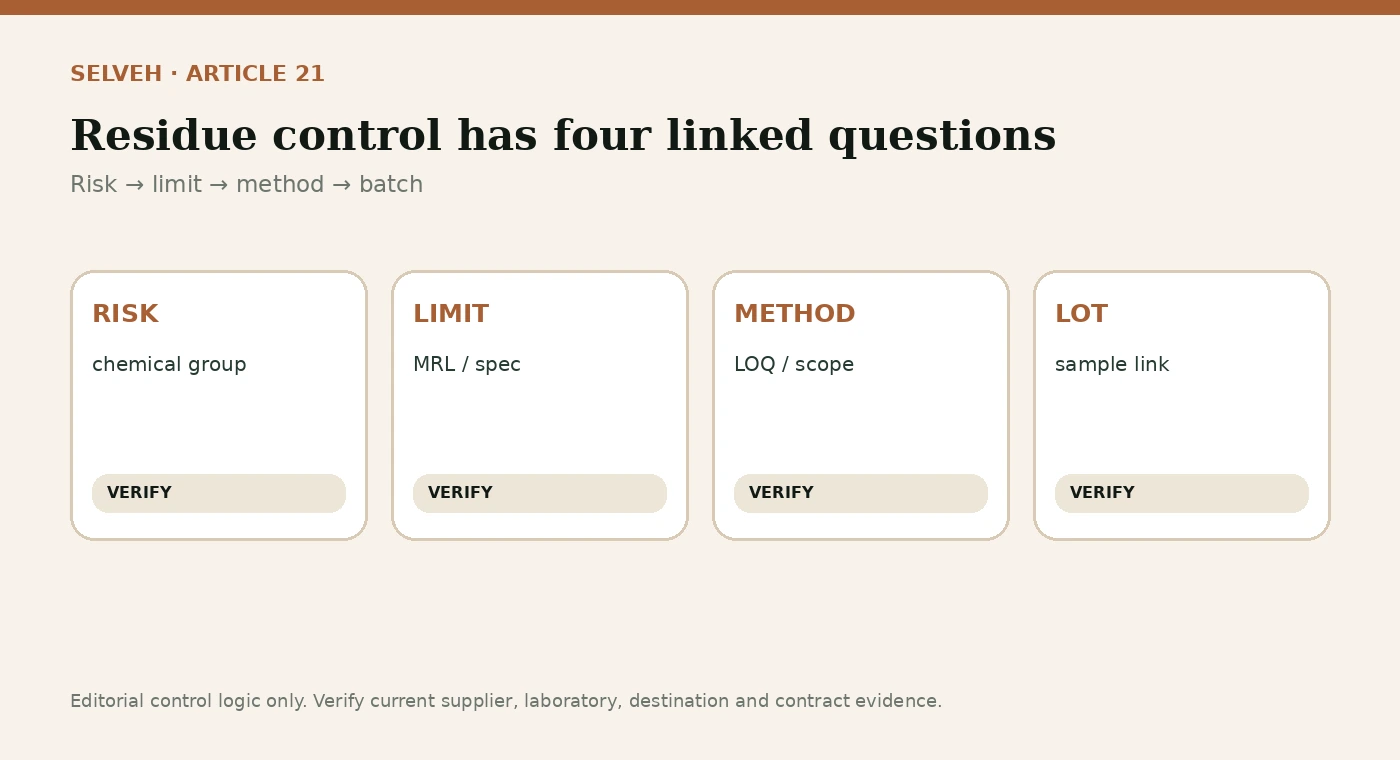
The commercial review is: analyte → applicable limit → method → reporting limit/LOQ → result → batch identity.
04 · Destination market
The importing market can change the acceptable limit or required panel
DAFF notes that importing countries sometimes require analyses for particular chemicals and that the NRS considers overseas market requirements. A batch that complies with Australian limits may still need a different check for a destination or customer specification.
For UAE, Singapore or any later market, the buyer/importer should confirm the current destination requirements at transaction time rather than relying on an Australian-only screen.
Do not hard-code a destination MRL into a generic article unless the exact commodity/analyte rule has been checked against the current official source.
05 · Panel design
Build the test panel from risk, not marketing language
A useful panel may consider pesticide exposure, veterinary medicines, environmental contaminants and customer-specific exclusions. The exact analytes should reflect production risk, prior results, supplier controls, destination requirements and the cost of a failure.
If a buyer asks for “antibiotic testing”, request the actual antimicrobial groups or analytes and the method/reporting limits rather than accepting a vague pass/fail statement.
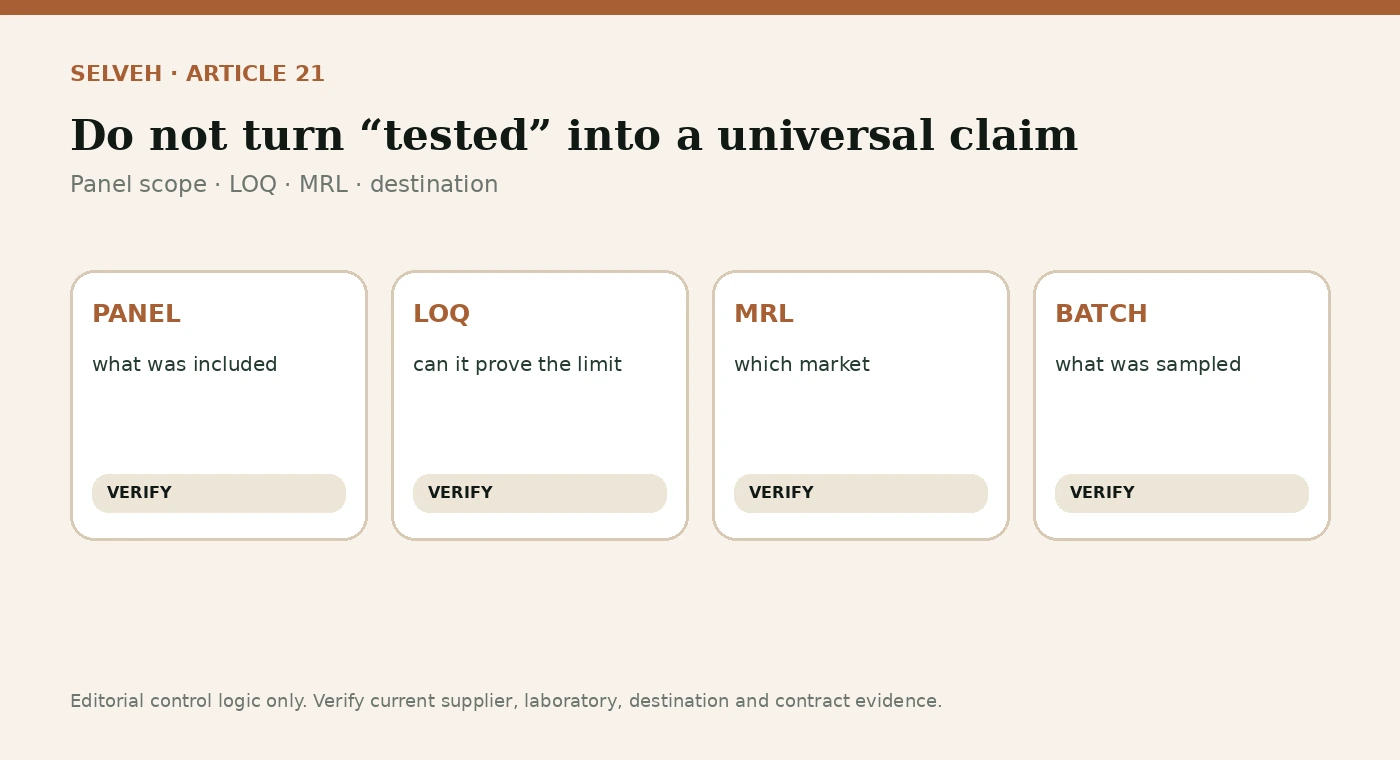
Likewise, “pesticide tested” should lead to a question about which compounds were included and whether the panel covers the risk the buyer is trying to control.
06 · Laboratory fit
Check ISO/IEC 17025 scope for the specific matrix and method
DAFF states that NRS contract laboratories must be accredited to ISO/IEC 17025, and NATA emphasises that accreditation is tied to a defined scope. A laboratory can be accredited without every analyte or method on a particular report being inside that scope.
Ask whether the honey matrix, target analytes and analytical method are within the laboratory’s current accreditation scope and whether the report identifies any results outside scope.
The word “accredited” is not enough by itself; the buyer needs fit-for-purpose scope.
07 · Reporting limits
The reporting limit must be useful against the decision limit
A result can only support compliance if the method is capable of measuring at a level appropriate to the relevant limit. Buyers should therefore record the limit of quantification or reporting limit where it matters, not only the words “not detected”.
If the laboratory reporting limit sits above a customer or destination threshold, the test may be unable to prove the required condition even if the report looks clean.
This is especially important when the buyer is comparing reports from different laboratories or panels.
08 · Sampling & lot identity
A clean result needs a defensible sample-to-batch link
Batch-specific residue evidence is only useful if the tested sample can be mapped to the bulk lot and packed lot being purchased. Record sample ID, batch/lot ID, sampling date, laboratory receipt date and report number.
Where sampling is commercially critical, agree who takes the sample and whether a retain sample is kept. A buyer should not assume a historical supplier result automatically applies to a later crop or packing run.
This connects residue testing to the existing SELVEH batch-documentation and traceability framework.
09 · Supplier controls
Supplier declarations and process controls still matter
Laboratory testing is one control layer. Buyers should also ask how the supplier manages chemical use, beekeeper declarations, source approval, contamination events and corrective action.
A strong control system can help determine sensible test frequency, while a weak or opaque supply chain may justify more testing. Testing should not be used to compensate indefinitely for missing traceability.
The objective is convergence between supplier controls, risk-based testing and batch evidence.
10 · Buyer request
Request a residue evidence package that can be audited
For a relevant batch, request the laboratory name, report number, sample identity, analyte panel, method, result units, reporting limits, applicable specification/MRL basis and accreditation-scope status.
If a destination or customer requires a specific panel, capture that requirement before production or shipment rather than asking the laboratory to solve the commercial question afterwards.
Any result that is OPEN, out of specification or difficult to interpret should have a named disposition owner.
11 · Buyer tool
Use a Residue Testing Request Matrix before ordering analysis
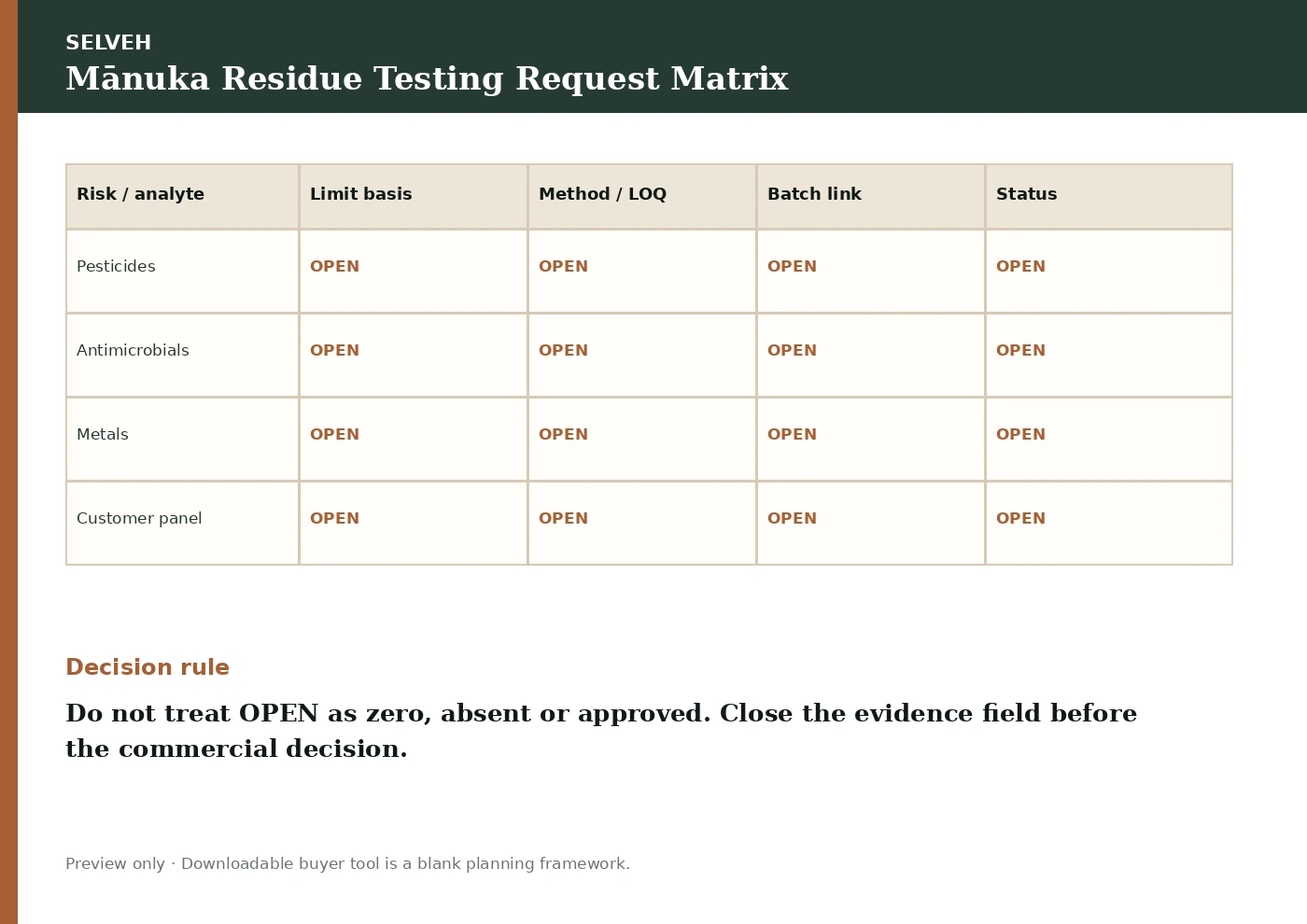
The downloadable matrix separates the risk question, analyte/panel, applicable limit, reporting limit, laboratory scope, batch identity and decision status. It is designed to stop buyers from treating “tested” as a complete evidence statement.
It is not a laboratory specification for every shipment and does not imply that SELVEH has completed the listed tests on a commercial batch.
12 · Red flags
Investigate these residue-testing statements
- “Pesticide free” based only on a limited screen.
- “No antibiotics” without the analytes, method or reporting limits.
- “NATA accredited lab” without checking whether the specific honey test is in scope.
- An old report with no link to the offered lot.
- An Australian compliance result assumed to satisfy every export market automatically.
13 · SELVEH status
What SELVEH can state today
SELVEH can define a risk-based residue evidence request and use Australian NRS data as industry context.
SELVEH should not claim that a future SELVEH batch is pesticide-free, antibiotic-free, residue-tested or compliant with a destination-specific MRL until the exact batch evidence and applicable requirements have been verified.
Sources
Sources and evidence notes
- DAFF - National Residue Survey 2023-24 Honey
- DAFF - Residue and residue testing
- FSANZ - Chemicals in food: maximum residue limits
- NATA - Choosing the right laboratory
- NATA - ISO/IEC 17025 laboratory accreditation
Editorial boundary: Current official, technical and public commercial information is separated from SELVEH recommendations. Public supplier terms are examples only and no open supplier, batch, importer, price, MOQ or contract evidence is represented as confirmed SELVEH evidence.
Trade planning
Need to define a residue-testing request?
Tell SELVEH the destination, buyer specification and evidence concern. The testing question can then be scoped before a commercial batch is represented as compliant.
Start a trade enquiry