01 · Why verification matters
Why supplier due diligence needs a verification framework
Wholesale Mānuka procurement combines premium pricing, grade claims, food-safety controls, batch testing, origin representations, packing operations and export-market requirements. These are different evidence domains. Treating them as one generic question — “Is this a reputable supplier?” — makes the review subjective and easy to influence with marketing language.
A better approach separates three layers. First is the claim: what the supplier says it can provide. Second is the evidence: the document, record or certificate that supports the claim. Third is independent verification: a public register, accreditation scope, destination requirement or other primary source that helps the buyer test whether the evidence means what it appears to mean.
This distinction matters because a document can be genuine and still be irrelevant. An active ABN confirms a current registration, not Mānuka expertise. A laboratory may be accredited, while the test on a particular report sits outside the relevant scope. A food-safety certificate may be valid, but issued to another site or for another activity. A COA may be authentic, but tied to a different batch. Due diligence is therefore a matching exercise, not a document-counting exercise.
02 · Verification model
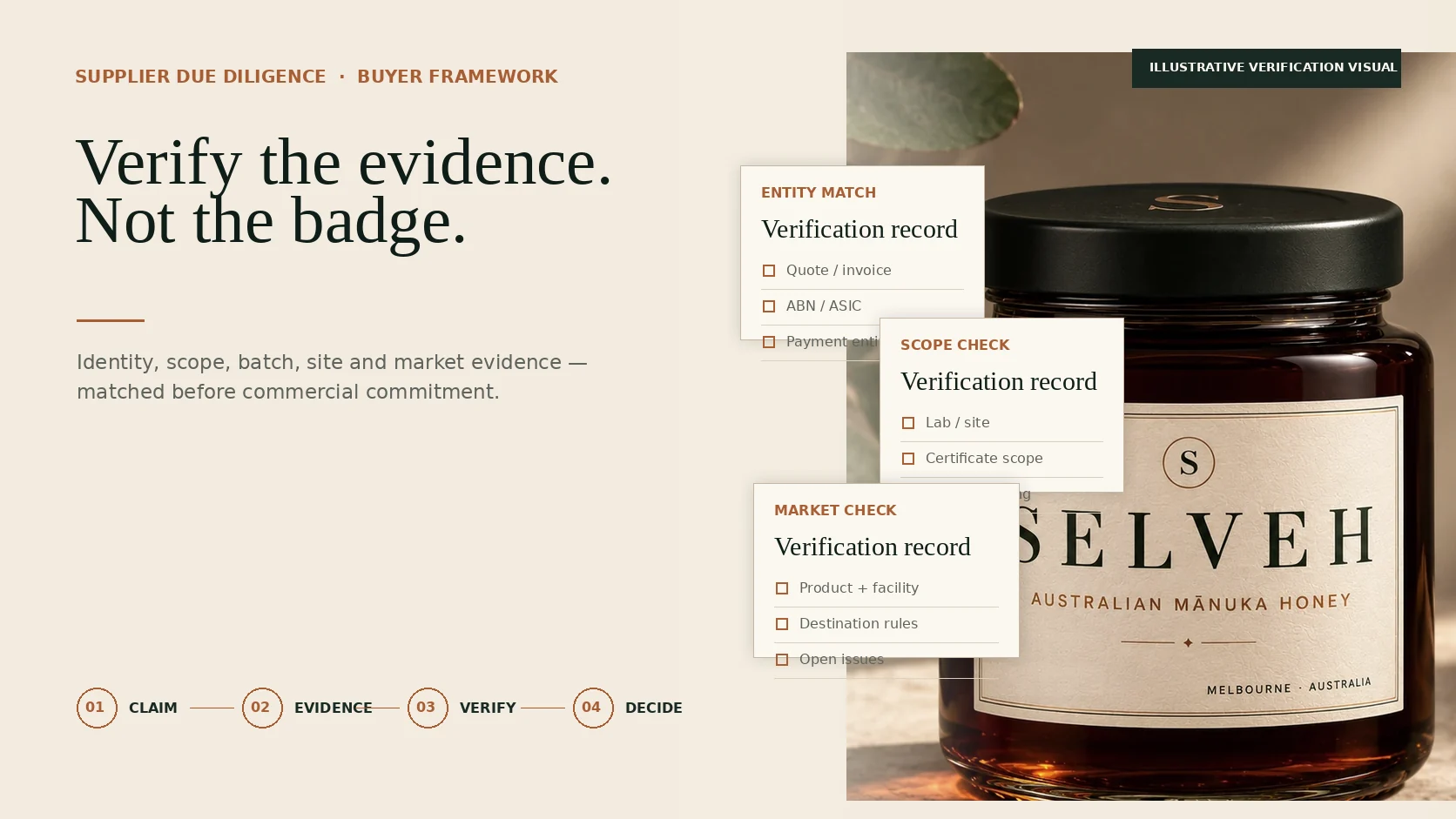
The SELVEH supplier due-diligence model: Claim → Evidence → Verification → Decision
For every material supplier statement, write down four things: the claim being made; the evidence requested; the source used to verify it; and the commercial decision if the evidence does not match. This prevents the review from becoming a collection of PDFs with no decision logic.
Use Green only when the material evidence is current, relevant and internally consistent. Use Amber when the claim is plausible but an important point remains unresolved. Use Red when the evidence is missing, expired, mismatched, outside scope, linked to another batch or site, or contradicted by a primary source. A Red rating is not an accusation of wrongdoing; it is a signal that the buyer does not yet have enough verified information to rely on the claim.
Supplier claim
Write the exact statement being relied upon.
Evidence
Request the document, record or certificate supporting it.
Independent check
Match the evidence to a register, scope, batch, site or current rule.
Risk decision
Record Green, Amber or Red and the unresolved point.
| Claim | Evidence | Independent check | Decision |
|---|---|---|---|
| “Australian Mānuka” | Origin / source records | Record continuity + relevant claim rules | Green / Amber / Red |
| “Batch tested” | COA / test report | Laboratory identity + scope + batch match | Green / Amber / Red |
| “Certified facility” | Current certificate | Register / holder / site / scope | Green / Amber / Red |
| “Export ready” | Market evidence | Current destination requirements | Green / Amber / Red |
03 · Eight gates
The supplier review in one view
Do not collapse supplier due diligence into a single reputation score. Review eight evidence domains separately, because strength in one gate does not compensate for a material mismatch in another.
04 · Gate 1
Gate 1 — Verify the legal counterparty
Start with the entity that will quote, invoice, contract and receive payment. Record the legal entity name, any trading or business name, the ABN provided, the company number where relevant, and the address shown on commercial documents. Then compare those details across the quotation, invoice instructions, certificates and public registers.
ABN Lookup provides public information from the Australian Business Register. Its status field can show whether an ABN is current or cancelled. ASIC also provides searchable business-name and company or organisation registers. These tools are useful for identity matching, but they are not quality accreditations. An active ABN does not prove food-safety competence, export capability, ownership of a packing site or the ability to supply a particular MGO grade.
would the entity receiving your deposit be immediately recognisable from the evidence pack? If the website brand, quotation name, bank beneficiary, certificate holder and invoice entity differ, ask for the relationship to be explained in writing before treating the file as complete.
05 · Gate 2
Gate 2 — Identify what the supplier actually controls
The word supplier can hide several operating models. One business may own apiaries and pack honey. Another may aggregate bulk honey from beekeepers, use a third-party packer and act primarily as a commercial exporter. A private-label provider may control artwork and customer service while production, storage or packing occurs elsewhere.
None of these models is automatically inferior. The risk is an unknown control boundary. Ask who sources or owns the honey, who receives and stores bulk product, whether blending occurs, who packs the finished jars, who applies batch codes, who commissions laboratory testing, who releases the batch, and which entity appears on export or shipping documentation.
The objective is to build an operating-role map. Where an activity is outsourced, request the name or role of the responsible facility and the evidence relevant to that activity. Do not force disclosure of commercially sensitive supplier networks that are unnecessary to your risk decision; require enough information to establish accountability and traceability.
06 · Gate 3
Gate 3 — Verify Australian-origin and Mānuka claims
Separate origin from Mānuka grading. “Australian”, “Australian Mānuka” and a specific MGO statement are not interchangeable claims. Each needs evidence appropriate to the representation being made.
For origin, test whether source, production, packing and finished-lot records form a coherent chain rather than relying on front-label wording alone. The ACCC states that businesses must not make false or misleading representations and that country-of-origin representations must be truthful and based on reasonable grounds. In practical procurement terms, a buyer should ask what records support the origin statement on the finished product.
The Australian Mānuka Honey Association’s Mark of Authenticity is one possible industry evidence signal. AMHA states that products carrying its Mark must be produced in Australia and tested by an independent approved laboratory against its scheme criteria. This framework does not treat AMHA participation as a universal legal prerequisite for an Australian Mānuka supplier. If a supplier uses the Mark or refers to the scheme, verify that specific claim rather than assuming the logo applies to every product or batch.
For a deeper review of provenance, packing location and chain of custody, use SELVEH’s Australian Mānuka Honey Origin & Traceability guide rather than duplicating that analysis here.
07 · Gate 4
Gate 4 — Verify the testing system, not just the COA
“COA available” is not a sufficient due-diligence outcome. The buyer needs to know which laboratory issued the report, which lot or batch it applies to, which analytes were measured, the result units, the test date and whether the report identity can be mapped to the offered stock.
Where a supplier describes the laboratory as NATA accredited, verify the organisation in NATA’s public directory and review the relevant scope. NATA explains that accreditation is granted for a specific scope, representing the organisation’s accredited capabilities. The buyer should therefore avoid converting the general statement “this lab is accredited” into the stronger conclusion “this exact test on this exact report is covered” without checking the scope.
Also distinguish independent testing from independent interpretation. A third-party laboratory may produce a valid analytical result, while the supplier still decides how that result is presented commercially. The report should be read as a batch-linked analytical record, not as a blanket endorsement of every claim on the sales page.
For field-by-field COA interpretation, use SELVEH’s dedicated guide, How to Read a Mānuka Honey COA.
08 · Gate 5
Gate 5 — Verify food-safety certifications correctly
Food-safety certificates can be valuable, but buyers should verify the certificate rather than the logo. Record the certificate holder, certified site, scheme or standard, certificate number, certification body, scope, issue or expiry information where shown, and whether the activities relevant to your product are included.
JAS-ANZ operates an online register for certifications issued by accredited conformity-assessment bodies and lists multiple food and biological schemes, including schemes such as SQF and FSSC 22000. Where a supplier presents a certificate that is expected to be independently searchable, use the relevant scheme or accreditation register and confirm the certificate belongs to the site and activity being relied upon.
Do not turn this into a blanket rule that every Australian Mānuka supplier must hold the same certification. Applicable legal requirements, customer specifications, facility activities and destination-market expectations can differ. The due-diligence question is narrower: what food-safety system supports the activity being offered, and can the evidence be verified?
09 · Gate 6
Gate 6 — Test traceability with a real batch example
A statement such as “full traceability from hive to jar” is too broad to approve without testing the chain. Ask the supplier to demonstrate, using a real but redacted or otherwise commercially safe example, how one finished lot connects backwards to the relevant bulk or production lot, packing record and analytical report.
The exact record set will vary by operating model. What matters is continuity. A buyer should be able to follow the identifier changes rather than encountering unexplained jumps between source records, testing and finished stock. If a supplier uses multiple facilities or combines lots, the mapping should show where those transitions occur.
Do not demand personal beekeeper information or commercially sensitive details unless they are necessary for compliance. The purpose is to prove continuity of identity, not to extract the supplier’s confidential network.
For the detailed record architecture, use SELVEH’s Batch Documentation and Origin & Traceability guides.
10 · Gate 7
Gate 7 — Verify commercial capability, not just product availability
A supplier can provide a technically acceptable sample and still be unsuitable for repeat commercial supply. Capacity due diligence asks whether the offered grade, pack format and timing can be delivered consistently enough for the buyer’s business model.
Request written clarification of the indicative volume available at the target MGO grade, whether the supply is recurring or opportunistic, normal production or packing lead time, minimum run constraints, mixed-SKU limitations, packaging dependencies and what happens when the requested grade is temporarily unavailable. Where continuity is critical, ask how substitution, delay or re-quotation would be handled rather than assuming an equivalent lot will always exist.
Avoid asking for unnecessary confidential information such as complete customer lists, proprietary sourcing arrangements or detailed internal cost structures. The buyer needs evidence of capability and constraints, not unrestricted access to the supplier’s business.
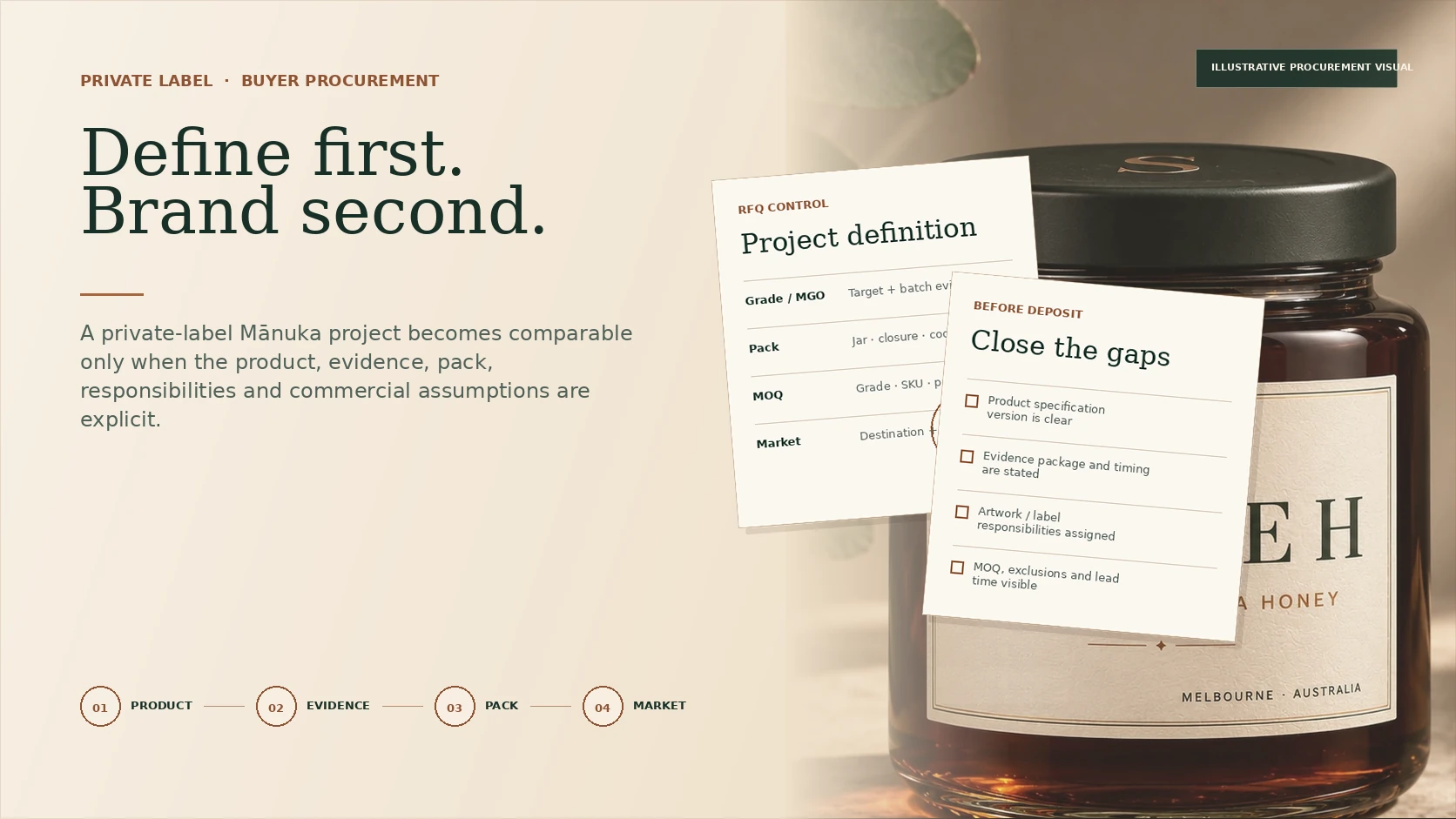
This gate complements, rather than duplicates, SELVEH’s Private-Label Australian Mānuka Honey procurement guide, which focuses on defining the RFQ and project requirements before supplier comparison.
11 · Gate 8
Gate 8 — Verify destination-market readiness for the exact shipment
A supplier’s statement that it is “export ready” should not be treated as universal approval for every market. The Australian Department of Agriculture, Fisheries and Forestry’s Micor system lists known importing-country requirements for non-prescribed goods including honey and other apiculture products. Requirements differ by destination and can include establishment conditions, certificates, declarations, labelling or other controls.
The better question is: can this product, from this production or packing pathway, with this evidence package, enter the intended destination under the current requirements? That question forces the review to connect the supplier, facility, product and market rather than relying on historical export experience to another country.
Before a deposit or production commitment, identify who owns destination compliance: the importer, exporter, supplier, regulatory adviser or a combination. Confirm requirements against current official sources and the importer’s instructions. A shipment that worked last year or entered a different market is not sufficient evidence for the present transaction.
Use SELVEH’s UAE and Singapore import guides, and the Australian Mānuka Honey Export Logistics guide, for market-specific and shipment-level detail.
For UAE-facing offers, the UAE Mānuka market landscape provides a dated retail snapshot to complement regulatory and supplier verification checks.
12 · Red flags
Supplier red flags that deserve resolution before commitment
A red flag is a reason to investigate, not a verdict about the supplier. The most useful red flags are evidence mismatches: the legal entity on the quote does not match the certificate or payment beneficiary; the supplier cannot explain who physically packs the product; an MGO claim is not linked to the offered batch; a laboratory is described as accredited but the relevant scope has not been checked; a certificate is expired, issued to another site or covers a different activity; a COA maps to another lot; traceability exists only as a verbal assurance; or “worldwide export ready” is asserted without reference to the destination.
Commercial red flags include a quotation that hides the assumptions behind grade, pack size or minimum run; a supplier that will not state what happens when the target grade is unavailable; and destination-compliance guarantees made before the supplier knows the importer, label or market pathway.
The correct response to an Amber or Red item is usually a targeted clarification request. Escalate only the evidence that matters to the purchasing decision. Due diligence should reduce uncertainty, not create paperwork for its own sake.
- Quote / invoice / certificate / payment entity mismatch
- Unclear producer, packer or exporter role
- MGO claim not linked to the offered lot
- Accreditation claimed without checking relevant scope
- Certificate expired, wrong site or wrong activity
- COA belongs to another batch or cannot be mapped
- Traceability is verbal only, with no demonstrable chain
- “Worldwide export ready” used without destination-specific evidence
- Commercial constraints hidden until after deposit
13 · Buyer tool
How to use the Supplier Due-Diligence Scorecard
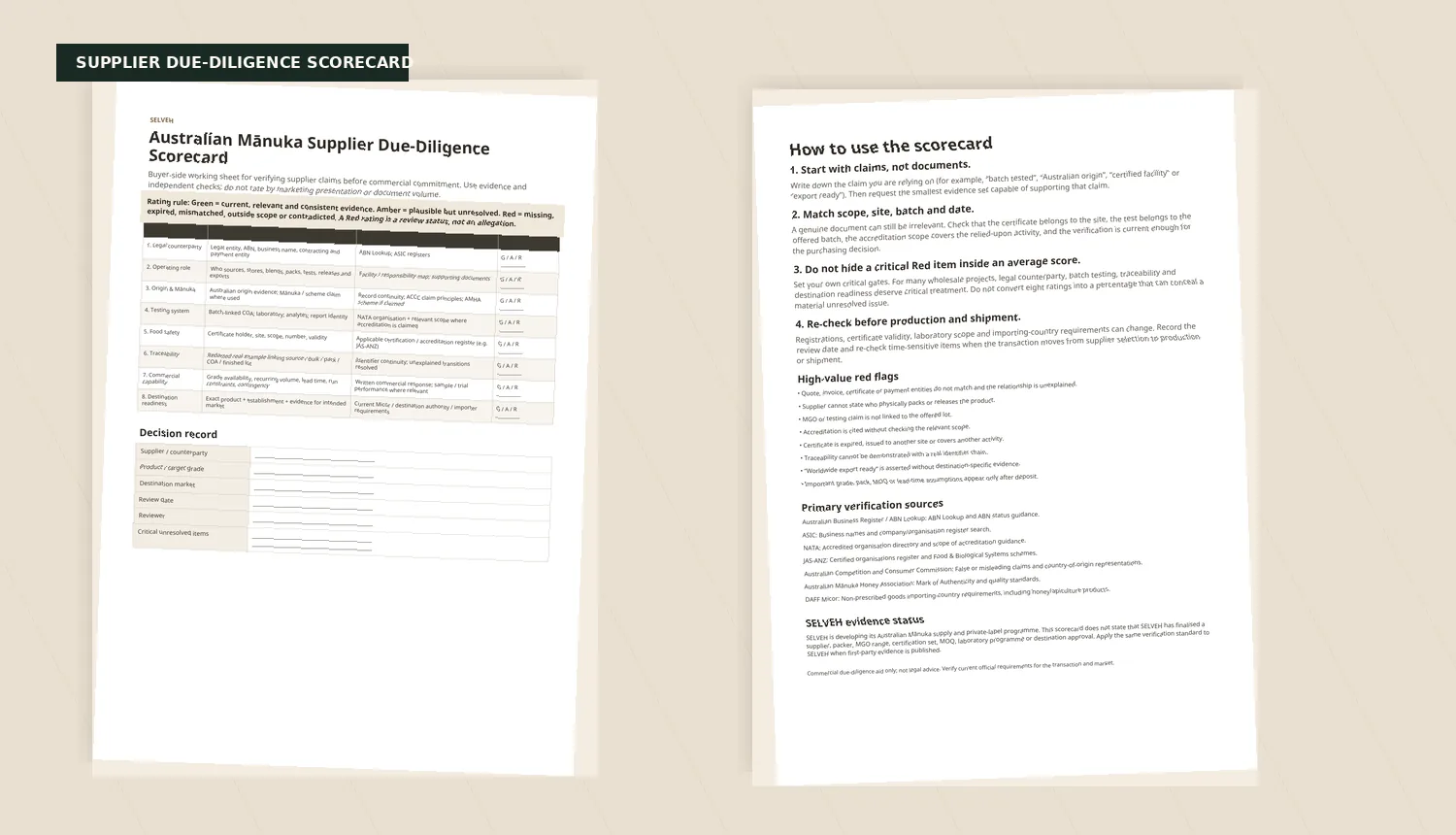
The downloadable SELVEH Australian Mānuka Supplier Due-Diligence Scorecard converts the eight gates into a review record. For each gate, capture the supplier claim, evidence received, independent verification source, review date, unresolved issue and Green/Amber/Red rating.
Do not average ratings into a single percentage that can hide a critical failure. A supplier with seven Green items and one unresolved legal-entity mismatch is not necessarily “87.5% approved”. Instead, define critical gates for your transaction. For most wholesale projects, legal counterparty, batch testing, traceability and destination readiness are sensible candidates for critical treatment, but the buyer should set its own risk policy.
Re-check time-sensitive evidence before production or shipment. ABN status, certificate validity, laboratory scope and importing-country requirements can change. The scorecard should record the date of verification so a future reviewer can see what was actually checked.
14 · Evidence request
A practical supplier information request
After an initial commercial fit is established, a buyer can ask for a compact evidence pack rather than sending an open-ended request for “all certifications”. A proportionate request might include: legal entity and ABN details; a short description of the supplier/packer operating model; the product specification and target MGO grade; a representative batch COA or testing example; applicable food-safety certificate details; a redacted traceability example; indicative capacity and lead-time constraints; and destination-specific export or compliance evidence where relevant.
The evidence pack should be scaled to the value and risk of the proposed transaction. A small trial order does not require the same review depth as an exclusive multi-market private-label programme. The underlying principle remains the same: ask for enough evidence to support the claims that materially affect product identity, compliance, continuity and payment risk.
15 · Frequently asked questions
Frequently asked questions
Is an active ABN enough to prove a supplier is legitimate?
No. An active ABN is useful identity evidence showing that the registration is current, but it does not prove product quality, food-safety competence, ownership of facilities, export approval or Mānuka authenticity.
Does a NATA-accredited laboratory mean every test on its reports is accredited?
Not automatically. NATA accreditation is granted for a specific scope. Check the organisation and the relevant scope rather than relying only on the laboratory name or logo.
Should every Australian Mānuka supplier have the AMHA Mark of Authenticity?
This framework does not use AMHA participation as a universal pass/fail requirement. If a supplier uses the Mark or makes a claim tied to the AMHA scheme, verify that claim against the scheme criteria and the applicable product evidence.
Can a supplier be credible if packing is outsourced?
Yes. Outsourcing is not itself a failure. The buyer needs visibility of responsibility, applicable certifications, batch mapping and release controls across the outsourced step.
What is the single most important due-diligence question?
There is no universal single question, but the highest-value habit is to ask: what evidence supports this specific claim, and can that evidence be independently verified or matched to the exact batch, site or market being relied upon?
16 · SELVEH evidence boundary
SELVEH evidence status
SELVEH is developing its Australian Mānuka honey supply and private-label programme. This article is an independent buyer framework and does not imply that SELVEH has finalised a supplier, packing facility, MGO range, certification set, minimum order quantity, laboratory programme or export approval for any destination. Those claims should only be published when first-party evidence exists for the relevant product and operating model.
Where SELVEH later publishes supplier, batch, laboratory, packing or certification information, the same verification principles in this framework should be applied to SELVEH’s own evidence rather than used only to assess third parties.
For a live destination-market reference, compare the supplier offer against the Singapore Mānuka market and channel landscape, then test whether the supplier’s grade, pack and evidence architecture fits the target channel.
Primary official / scheme sources
Source basis
- Australian Business Register / ABN Lookup — public ABN details and status
- ABN Lookup FAQ — active vs cancelled status
- ASIC — Business Names Register
- ASIC — Company and organisation registers
- NATA — Search accredited organisations
- NATA — Choosing the right lab: scope defines the limits
- JAS-ANZ — Certified Organisations Register
- JAS-ANZ — Food & Biological Systems
- ACCC — False or misleading claims
- ACCC — Country of origin claims
- Australian Mānuka Honey Association — Mark of Authenticity
- Australian Mānuka Honey Association — Quality standards
- Australian Government Micor — Non-prescribed goods
Verification note: Registry, accreditation, certification and importing-country information was re-checked against current primary sources on 20 August 2026. Regulatory, registry, accreditation and scheme information can change. Verify time-sensitive evidence against the current primary source at the point of supplier approval, production and shipment. This guide is commercial due-diligence information, not legal advice.
For importers, distributors & private-label buyers
Need to turn a supplier offer into an evidence review?
Bring the proposed supplier, product/grade, pack format, destination and the evidence already received. SELVEH will separate what is confirmed from what remains assumption or supplier representation before a commercial offer is treated as ready.
Start a trade enquiry