01 · Start with document type
A COA is not the same thing as every other certificate
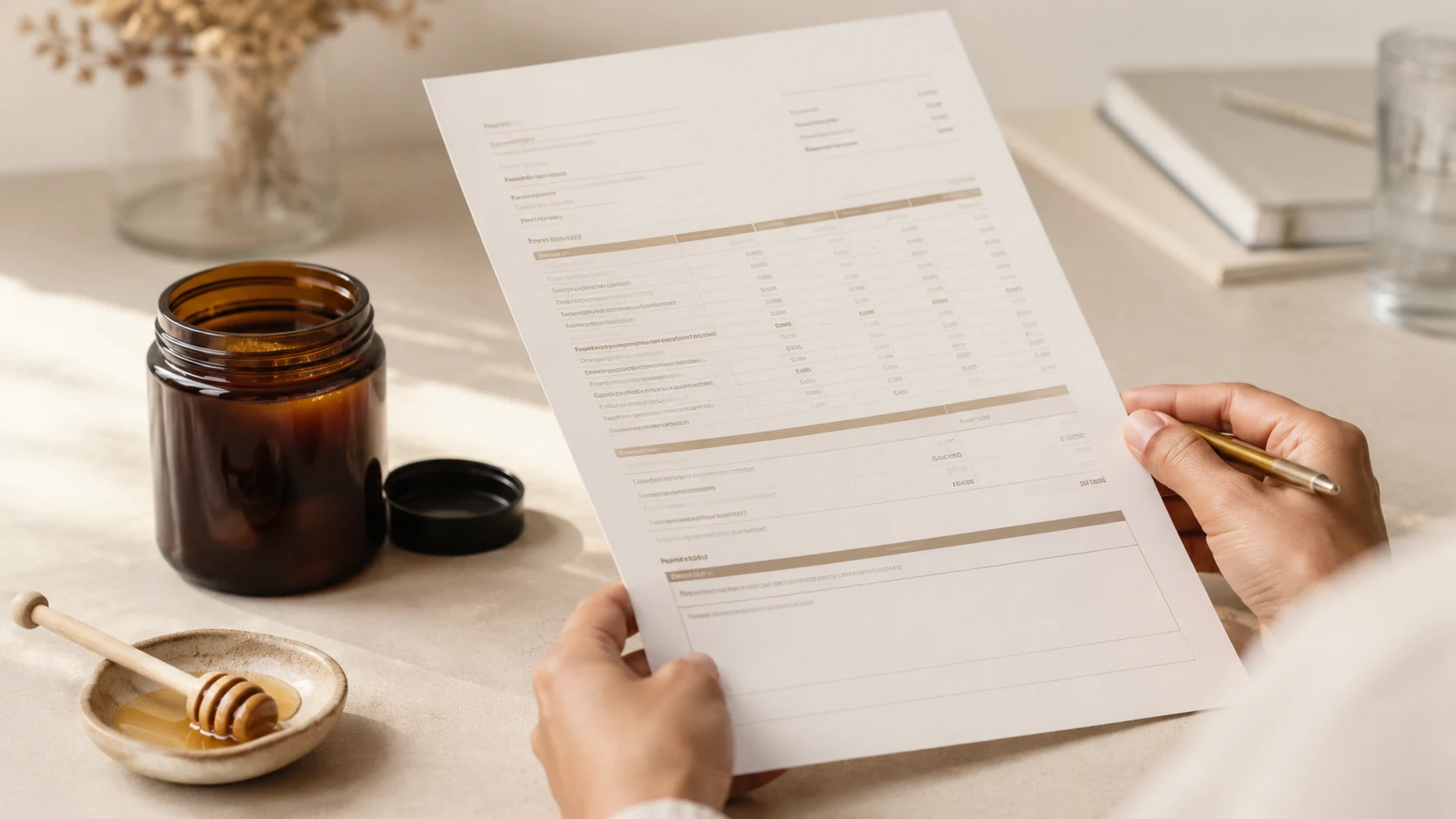
The term Certificate of Analysis (COA) is used widely in trade, but buyers should not assume every document carrying that title has the same status. You may receive an independent laboratory test report, a supplier-issued COA summarising results, a product specification, a batch-release document, a private-scheme certificate or a regulatory/export document. They answer different questions.
NATA describes reports from accredited organisations as documents that describe the activities performed, their results and, where needed, information required to interpret those results. That is different from a product specification, which defines what the product is required to meet. See NATA — Test Reports Explained.
| Document | Primary question answered |
|---|---|
| Product specification | What must the product meet? |
| Laboratory report / COA | What was reported for the identified sample? |
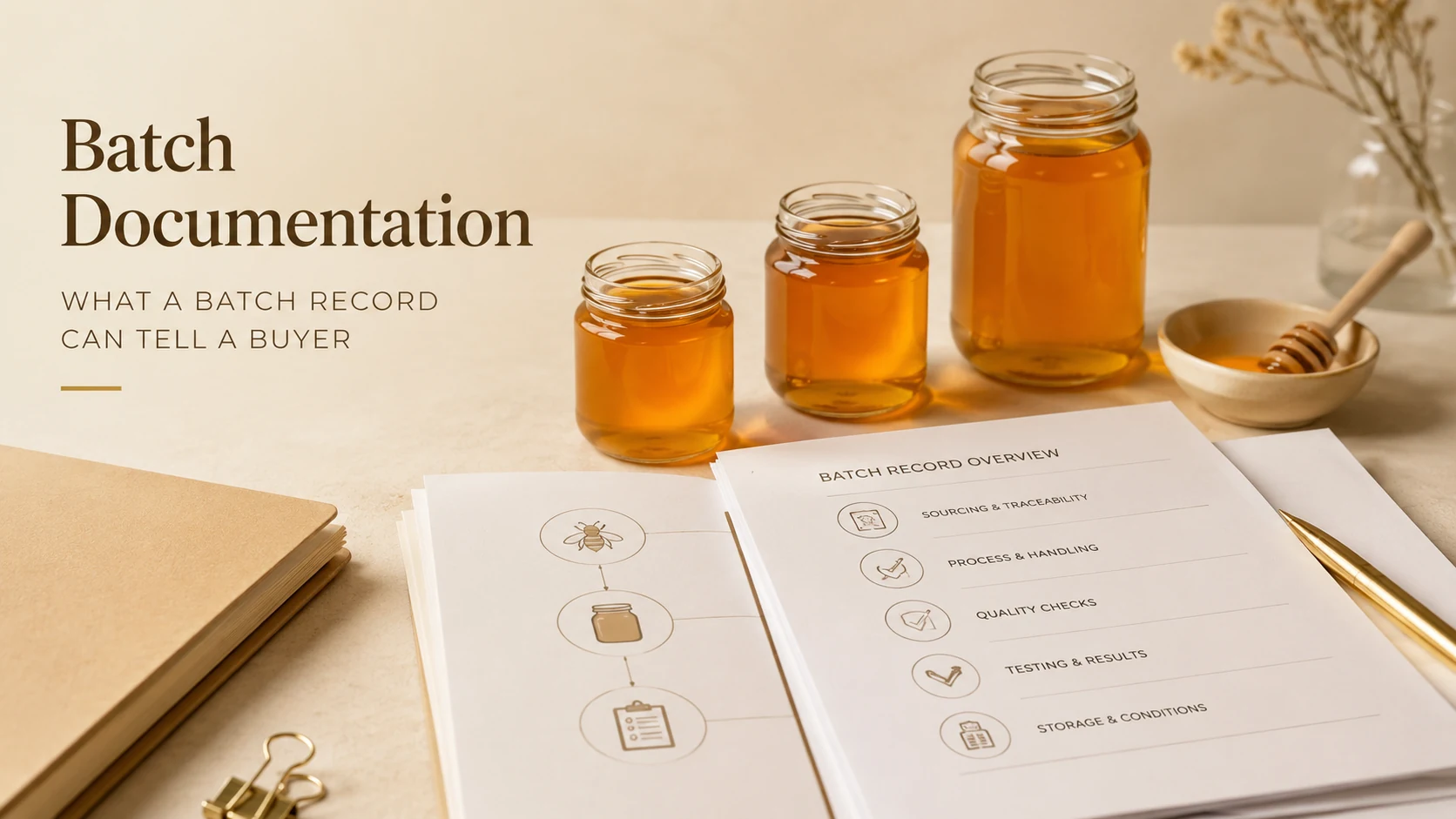
| Batch record | How is the material / packed lot identified and linked? |
| Traceability records | How is identity supported through the supply chain? |
| Private-scheme certificate / mark | What status has been granted under a defined scheme? |
02 · Check identity before chemistry
Can the tested sample be connected to the lot you are buying?
For wholesale procurement, the most important part of COA review is often not the chemistry. It is identity. A useful report should let the buyer identify the laboratory, report number, client or submitter, sample description, sample ID, relevant dates and authorisation.
Then connect the sample to the transaction:
If the report refers to Batch A but the offer is for Batch B, the result does not automatically transfer. Repacking, splitting, blending and private-label packing make this mapping more important, not less. For the operational lot-control layer, see Mānuka Honey Batch Documentation: What Buyers Should Verify.
03 · Read result, unit and specification together
Never evaluate an analytical number in isolation
Suppose a report shows MGO at 286 mg/kg and the agreed specification is MGO ≥250 mg/kg. On its face, the result is numerically consistent with that minimum. The buyer still needs to confirm that the method is appropriate, the unit matches the specification, the result belongs to the correct sample and any relevant qualification or reporting note is understood.
| Parameter | Reported result | Unit | Illustrative specification | Initial read |
|---|---|---|---|---|
| MGO | 286 | mg/kg | ≥250 mg/kg | Numerically above minimum; identity and method still need review. |
Do not assume two results are comparable until the units and methods are clear. And do not confuse a minimum specification with an actual test result: the first is a requirement, the second is evidence about an identified sample.
04 · Keep analytes in their lane
What the MGO and DHA lines can - and cannot - tell you
MGO (methylglyoxal) and DHA (dihydroxyacetone) are analytically distinct. A buyer should read each line as: analyte → result → unit → method → sample identity → applicable specification.
The Australian Manuka Honey Association’s current Mark of Authenticity framework illustrates why one number should not carry every conclusion. AMHA publishes minimum MGO and DHA requirements for its own marks together with Australian production, independent testing and identity controls. Those are AMHA scheme requirements, not a universal government grading law and not a claim that SELVEH currently holds the mark. Review the current scheme directly at AMHA — Criteria for defining Australian Manuka Honey.
For detailed MGO interpretation, see MGO Grades in Australian Mānuka Honey: A Buyer’s Guide. For origin evidence, see Australian Mānuka Honey Origin & Traceability.
05 · Avoid the universal-panel trap
HMF, moisture and other results answer different questions
A honey report may include moisture, HMF, sugars, acidity, diastase, contaminants, residues, microbiological parameters or other contractual tests. Codex CXS 12-1981 provides an international honey standard covering composition, quality and labelling factors, while Australia’s Food Standards Code includes Standard 2.8.2 for honey. See Codex — Standard for Honey (CXS 12-1981) and FSANZ — Food Standards Code legislation.
That does not mean every Mānuka COA should contain one universal panel. The appropriate tests depend on the agreed product specification, the destination market, any applicable private scheme and the risk being controlled. A long report is not automatically a strong report; relevance matters.
06 · Check the laboratory, not just the logo
“Accredited laboratory” is not enough - check the relevant scope
ISO/IEC 17025 accreditation is a recognised framework for demonstrating laboratory competence and supporting confidence in testing and calibration results. NATA explains that the framework covers areas including method validity, staff competence, measurement traceability, equipment, sample handling, quality control and reporting. See NATA — ISO/IEC 17025 Testing & Calibration.
The procurement question is not simply “Is this laboratory accredited?” It is “Is the relevant test within the laboratory’s accredited scope?” NATA notes that its endorsement is generally not permitted on reports of testing outside scope. A buyer should therefore check the accreditation body, laboratory identity, scope and whether any critical result is explicitly identified as outside accredited scope.
International recognition also needs nuance. ILAC explains that results from bodies accredited by ILAC MRA signatories are more likely to be recognised across markets, but acceptance by every regulator or commercial counterparty is not guaranteed. See ILAC — Frequently Asked Questions.
07 · Read methods, qualifiers and limits
A result is easier to trust when you can see how it was obtained
A critical analytical line should ideally let the buyer identify the test method or enough method information to evaluate relevance. You do not need to become an analytical chemist; you do need to know what was tested, by which method, by which laboratory, on which sample.
Also read the report legend. Terms such as ND, <LOD or <LOQ do not necessarily mean absolute zero. Their meaning depends on the method and the laboratory’s reporting conventions. If a specification depends on that distinction, clarify it instead of guessing.
08 · Put the fields together
An illustrative COA walkthrough
Consider this fictional example:
| Commercial offer | Australian Mānuka Honey - MGO 250+ |
|---|---|
| Finished lot | AU-MH-2608-01 |
| Laboratory sample ID | AU-MH-2608-01 |
| MGO result | 296 mg/kg |
| DHA result | 410 mg/kg |
| Report date | 15 August 2026 |
| Method | Identified on report |
What can the buyer reasonably conclude? The identified sample produced the stated analytical results under the reported methods. If the agreed commercial specification requires MGO ≥250 mg/kg, the MGO result is numerically consistent with that minimum.
What can the buyer not conclude from this table alone? It does not independently prove Australian origin, complete botanical authenticity, all destination-market compliance, organic status, absence of every possible contaminant, shelf-life performance, therapeutic efficacy or that future batches will be identical.
09 · Original-value asset
The SELVEH 12-point COA Review Matrix
| # | Verification question |
|---|---|
| 01 | Is the laboratory or issuer clearly identified? |
| 02 | Is the report / reference number identifiable? |
| 03 | Is the tested sample uniquely identified? |
| 04 | Does the sample ID map to the exact lot being offered? |
| 05 | Are the relevant analytes clearly named? |
| 06 | Are results and units stated together? |
| 07 | Are critical analytical methods identifiable? |
| 08 | Is the report date relevant to the transaction? |
| 09 | Do critical results meet the agreed specification? |
| 10 | Is relevant accreditation / scope understood? |
| 11 | Are reporting limits, qualifiers or non-accredited results understood? |
| 12 | Can the COA be connected to the wider batch / traceability evidence chain? |
A missing answer does not automatically mean “reject supplier”. It means do not assume. Record the gap, ask a precise question and decide whether the response is sufficient for the transaction risk.
Original-value asset · Template / buyer resource · No email gate
Mānuka COA Review Worksheet
A two-page worksheet for recording report identity, sample-to-batch mapping, analytical results, laboratory context, twelve decision checks and follow-up questions.
10 · Know when to pause
COA red flags procurement teams should investigate
- Cropped screenshot: report identity, method, sample ID or notes are hidden.
- No lot mapping: the report cannot be connected to the product being quoted.
- Missing units: a result appears without a defined unit.
- Historical result carried forward: one old sample is used to represent unrelated future lots.
- Accreditation blur: a laboratory is called accredited but the relevant test scope is not established.
- One analyte proves everything: MGO is presented as proof of origin, complete authenticity and regulatory compliance.
- Internal document presented as independent: supplier-issued paperwork is described as a third-party laboratory report.
- COA presented as regulatory approval: an analytical report is used as if it were a government registration or import approval.
- Unexplained edits: missing pages, inconsistent identifiers or altered document fields are not explained.
A red flag is not proof of misconduct. It is a reason to ask a more precise question and preserve the response in the procurement record.
11 · Questions buyers ask most
COA questions for procurement teams
Does every Mānuka honey COA need the same tests?
No. The appropriate panel depends on the agreed specification, applicable scheme, destination requirements and risk being controlled.
Is a COA the same as a product specification?
No. A specification sets requirements; a COA or laboratory report records results for an identified sample.
Does ISO/IEC 17025 accreditation make every result on a report accredited?
Not necessarily. Check whether the relevant test sits within the laboratory’s accredited scope and whether any result is marked outside scope.
Can an accredited Australian report automatically be used in every export market?
Do not assume so. ILAC arrangements support international recognition, but regulators and counterparties can still set their own acceptance requirements.
Does an MGO result prove the honey is authentic Australian Mānuka?
Not by itself. MGO is one analytical parameter. Origin, botanical identity and any private-scheme requirements may involve additional evidence.
Can one COA support every shipment?
Only if there is a defensible reason the document applies to the supplied material. Do not automatically carry one historical sample result across unrelated lots.
Should a buyer verify the laboratory directly?
For higher-value or higher-risk transactions, verifying laboratory identity, accreditation status, scope or report authenticity can be appropriate.
12 · Make the request precise
Five questions to send with a COA request
- Please provide the current COA or laboratory report for the exact lot being offered.
- Please confirm how the laboratory sample ID maps to the bulk and/or packed lot.
- Please identify the current product specification against which the results should be reviewed.
- Please confirm which critical tests were performed within the laboratory’s accredited scope, where applicable.
- Please identify any additional origin, authenticity, packing or shipment records that support this lot.
This is more useful than asking only: “Please send certificate.”
13 · Current-stage disclosure
What SELVEH can state today
As at 18 August 2026, SELVEH’s first Australian Mānuka range remains in development. This guide does not claim that SELVEH currently has a released commercial batch, final MGO grade, appointed testing laboratory, specific COA, final supplier, certification or established every-batch testing programme.
When those elements are finalised, analytical statements should be tied to the evidence for the relevant product and release. The broader evidence-chain framework is covered in Australian Mānuka Honey COA, Batch Testing & Traceability.
For importers, distributors & private-label buyers
Reviewing an Australian Mānuka offer?
Tell us your destination market, intended grade, pack format, initial volume, timing and documentation requirements. We will separate confirmed evidence from development-stage assumptions and identify the open questions.
Start a trade enquiryPrimary references
- NATA — Test Reports Explained
- NATA — ISO/IEC 17025 Testing & Calibration Accreditation
- ILAC — Frequently Asked Questions / MRA recognition
- Australian Manuka Honey Association — Criteria for defining Australian Manuka Honey
- Codex Alimentarius — CXS 12-1981 Standard for Honey
- FSANZ — Food Standards Code legislation
Source review: Official and primary sources were reviewed on 18 August 2026. Re-review is triggered by a material source, law, scheme or regulatory change, or when new first-party SELVEH supplier, batch, laboratory or buyer evidence becomes available.
This article is general educational information for trade and quality conversations. It is not legal, regulatory, scientific, medical or certification advice and does not certify any SELVEH product, batch, supplier or laboratory. Requirements and private-scheme criteria can change; verify the current official source before a commercial or regulatory decision. Read our Editorial Standards.