
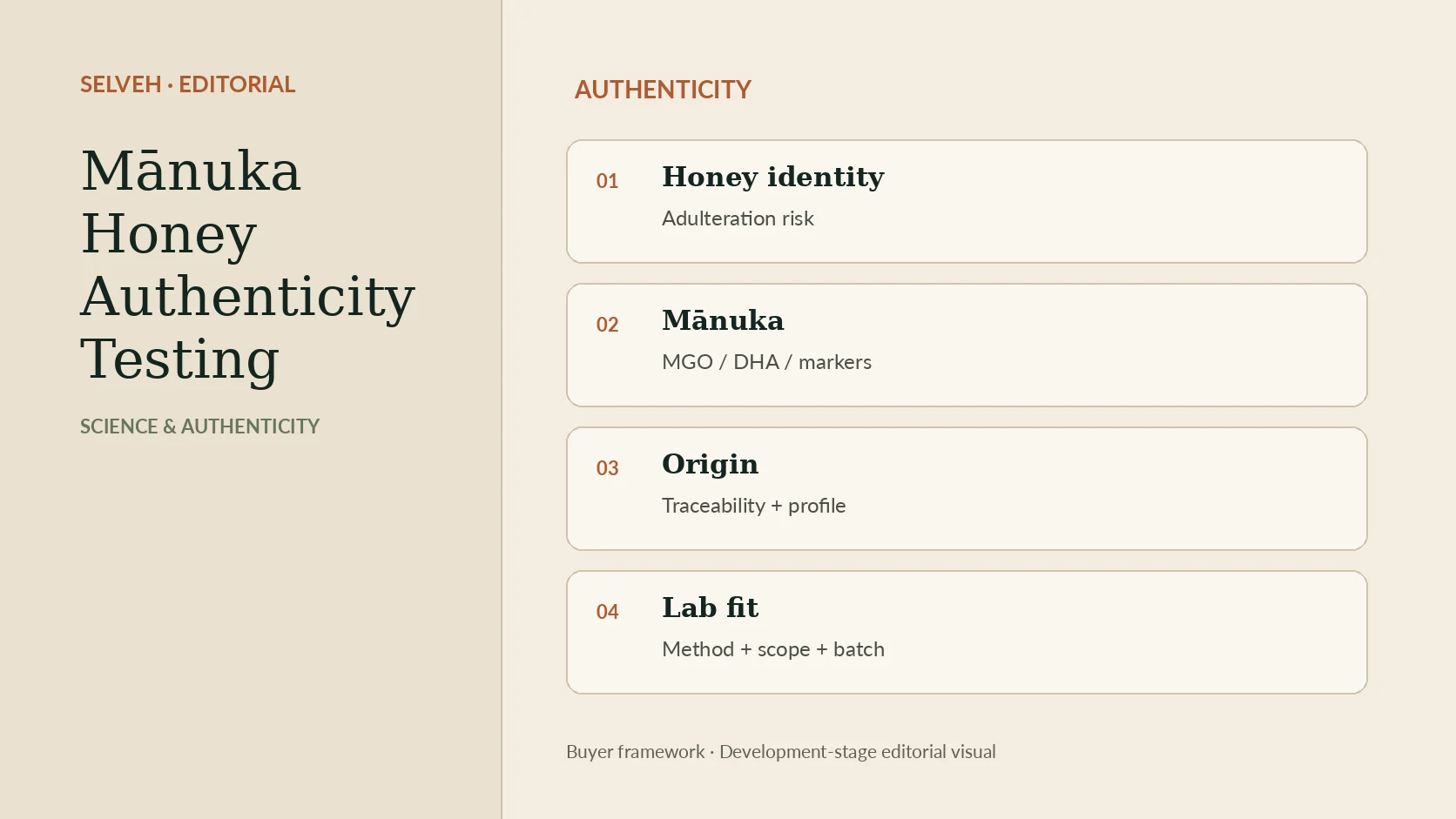
01 · Define the question
“Is it authentic?” is not one laboratory question
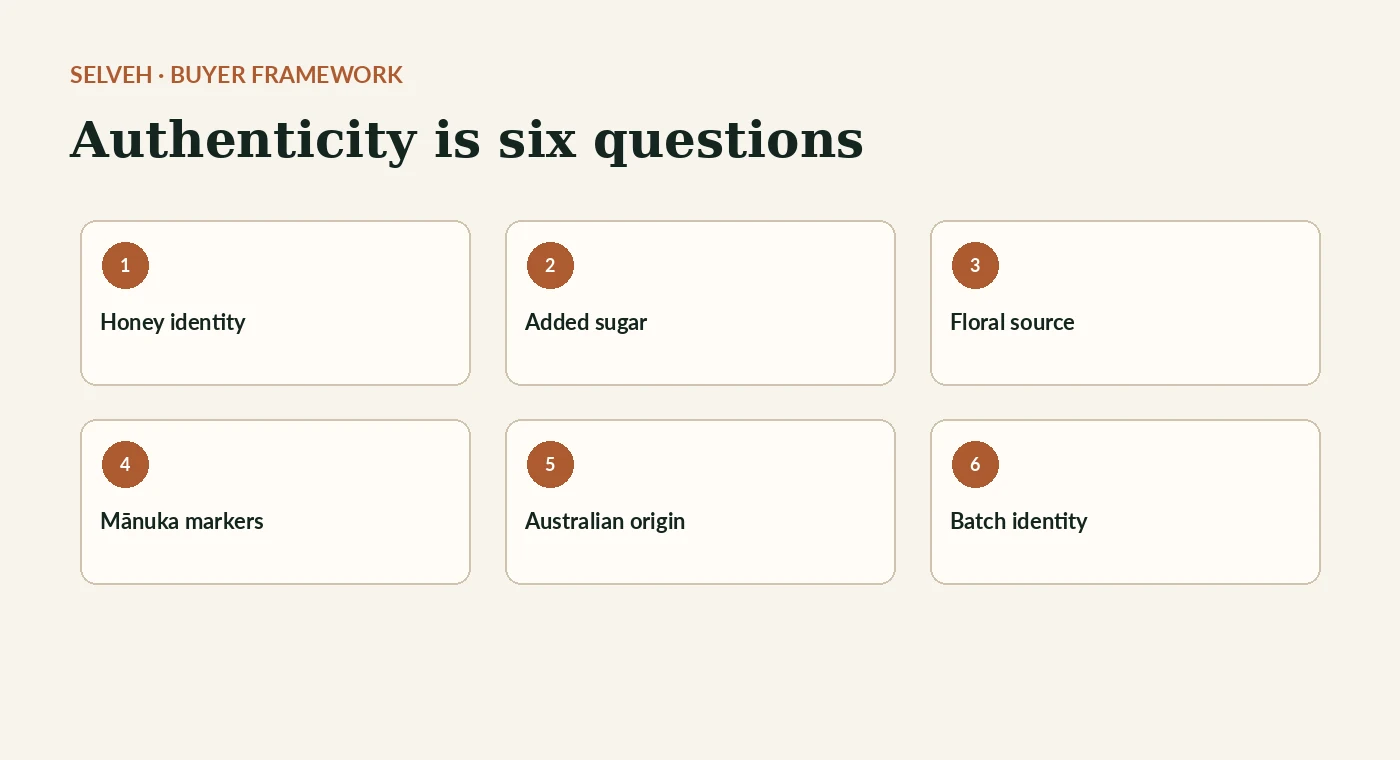
For a wholesale buyer, authenticity should be broken into separate claims. Is the material genuine honey without undeclared syrup addition? Does the floral-source wording have a defensible basis? Is the honey genuinely Australian in origin? Does the stated MGO grade belong to the offered batch? Can the tested sample be connected to the packed lot?
No single number answers all of those questions. A strong evidence package therefore begins by naming the claim and then selecting evidence capable of testing that claim.
This distinction prevents a common procurement error: treating an impressive MGO result, pollen count or private mark as if it independently proves every aspect of authenticity.
02 · Honey identity
Start with the ordinary identity of honey
Codex CXS 12-1981 provides the international baseline for honey composition and quality. The standard defines honey as the natural sweet substance made by honey bees and does not treat undeclared added food ingredients as part of ordinary honey identity.
For a buyer, that means premium Mānuka authenticity begins with a simpler question than MGO: is the material itself consistent with honey and with the agreed product specification? Mānuka-specific markers do not make general adulteration risk disappear.
A report that measures only MGO may be commercially useful for grade verification but is not automatically an adulteration screen.
03 · MGO and DHA
MGO and DHA answer a Mānuka-strength question, not every authenticity question
MGO and DHA are important analytical features in Mānuka honey. AMHA uses minimum MGO and DHA criteria within its own Australian Mānuka Mark of Authenticity framework, together with Australian production and identity controls.
But a buyer should not reason backwards from “MGO present” to “no added sugar”, “Australian origin proven” or “monofloral proven”. MGO/DHA evidence belongs in the Mānuka-activity and scheme-definition lane.
The practical review is still analyte → method → result → unit → laboratory scope → sample identity → applicable specification.
04 · Added-sugar risk
Adulteration testing is method-specific
Honey-adulteration literature describes a range of methods because different fraud scenarios leave different analytical signatures. Stable-isotope approaches can detect certain added sugar syrups, while LC-IRMS extends the capability to some C3 and C4 sugar-adulteration problems. NMR can provide broader compositional fingerprints and support classification work.
The buyer implication is not “always order NMR” or “IRMS catches everything”. It is to define the suspected risk, destination/customer requirement and laboratory capability first. A method that is powerful for one adulterant may be weak for another.
If a supplier markets a single test as a universal fraud detector, ask what adulteration types the method is actually validated to detect.
05 · Fingerprinting
NMR and chemometric fingerprints can add context - but databases matter
NMR-based honey authentication can examine a broad chemical profile and, when combined with validated reference datasets and statistical models, may support botanical/geographical classification and detection of anomalous samples. Its value depends heavily on reference quality, method validation and the question being asked.
A buyer should therefore ask what the laboratory is comparing the sample against, whether the model is validated for the relevant honey population and what conclusion the report is actually authorised to make.
A fingerprinting result should not be paraphrased into a stronger marketing claim than the method and report support.
06 · Floral source
Pollen and chemical markers are evidence lanes, not magic proof
Floral-source claims may draw on production records, pollen analysis, chemical markers, sensory characteristics or scheme-specific rules. The relative weight of each evidence type depends on the definition being applied.
AMHA’s current Australian Mānuka framework explicitly combines analytical criteria with production/identity management and notes that flow diaries, colour, flavour, chemical markers and pollen analysis can contribute to identity control. That is a private-industry scheme, not a universal government definition for every Australian Mānuka product.
For monofloral versus multifloral questions, use the dedicated floral-source guide rather than trying to infer floral source from MGO alone.
07 · Leptosperin
Treat Leptosperin as a marker with scheme-specific limitations
AMHA describes Leptosperin as a Mānuka-associated marker and states that it investigates Leptosperin when reviewing allegations of adulterated product, while not requiring Leptosperin testing on every batch under its current standard.
That is an important buyer nuance. The presence or absence of one marker should be interpreted within the relevant method, scheme and reference context; it should not be turned into a universal “pass/fail Mānuka test” without support.
If a supplier makes a specific Leptosperin claim, ask for the method, result, laboratory and the definition against which the result is being interpreted.
08 · Geographic origin
Australian origin needs chain-of-custody evidence as well as chemistry
Geographic-origin authentication can use analytical profiling, but commercial origin also depends on documentary and traceability evidence. A laboratory profile is not a substitute for knowing where the honey was harvested, processed, packed and transferred through the supply chain.
This is why SELVEH keeps origin and traceability as a separate evidence lane. A buyer should be able to map supplier declarations, lot records, packing records and any analytical evidence to the same material.
The strongest position is convergence: chemical evidence does not contradict the claim, and the documentary chain supports the same origin story.
09 · Laboratory fit
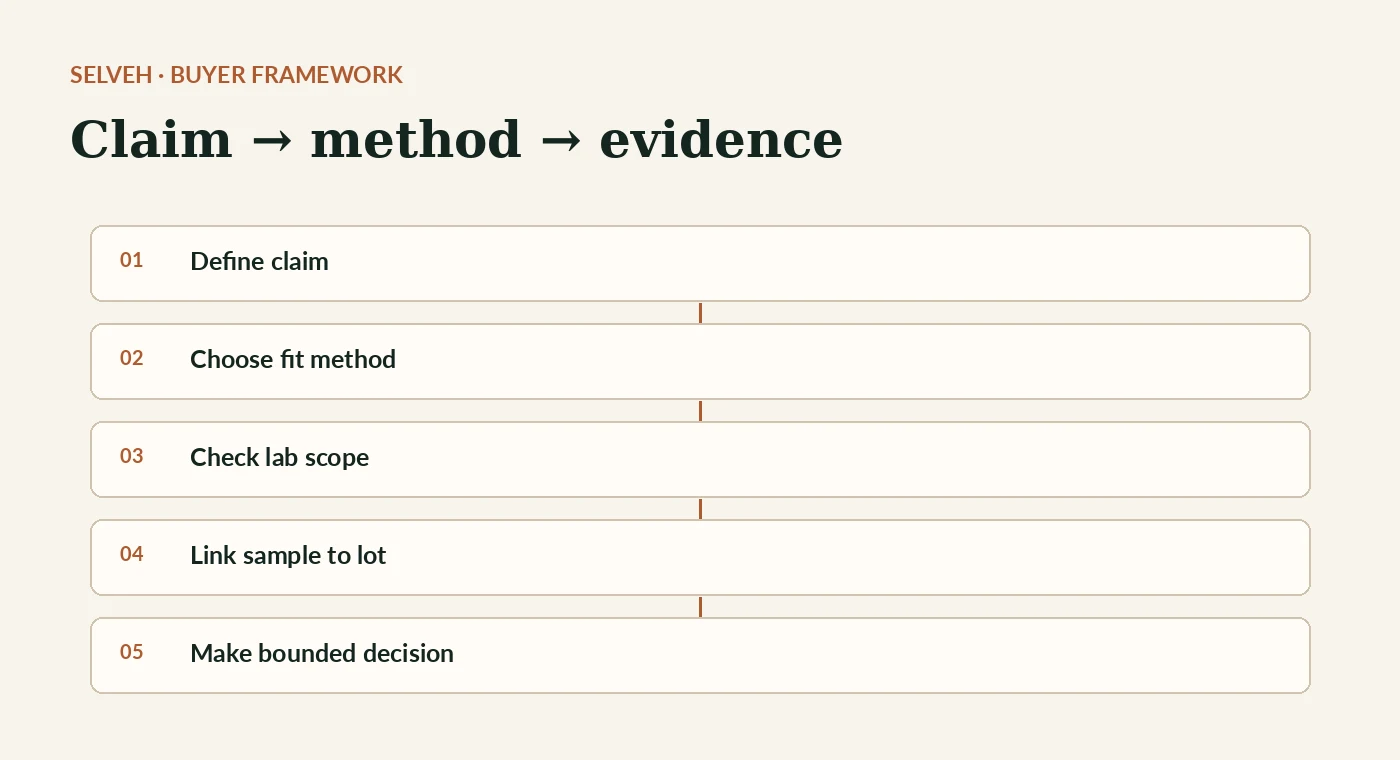
Check the laboratory scope for the exact test and method
NATA cautions that accreditation is tied to a defined scope. A laboratory may be accredited in a broad field but not for every specific analyte, matrix or method a buyer needs.
For authenticity work, ask whether the relevant test is inside the laboratory’s current scope, whether the reported result is covered by the accreditation endorsement and whether the method is appropriate for honey and the decision being made.
The word “accredited” should never replace method review.
10 · Batch identity
An authenticity result is only as useful as the sample-to-lot link
A sophisticated authenticity test can still be commercially irrelevant if the sample cannot be connected to the material being bought. The report should identify the submitted sample and dates, and the supplier should map that sample to the source/bulk lot, packed lot and offered product.
Retesting frequency should be risk- and contract-based. A historical test on one crop is not automatic evidence for every future batch.
This is where COA review, batch documentation and supplier due diligence connect to authenticity testing rather than being replaced by it.
11 · Buyer tool
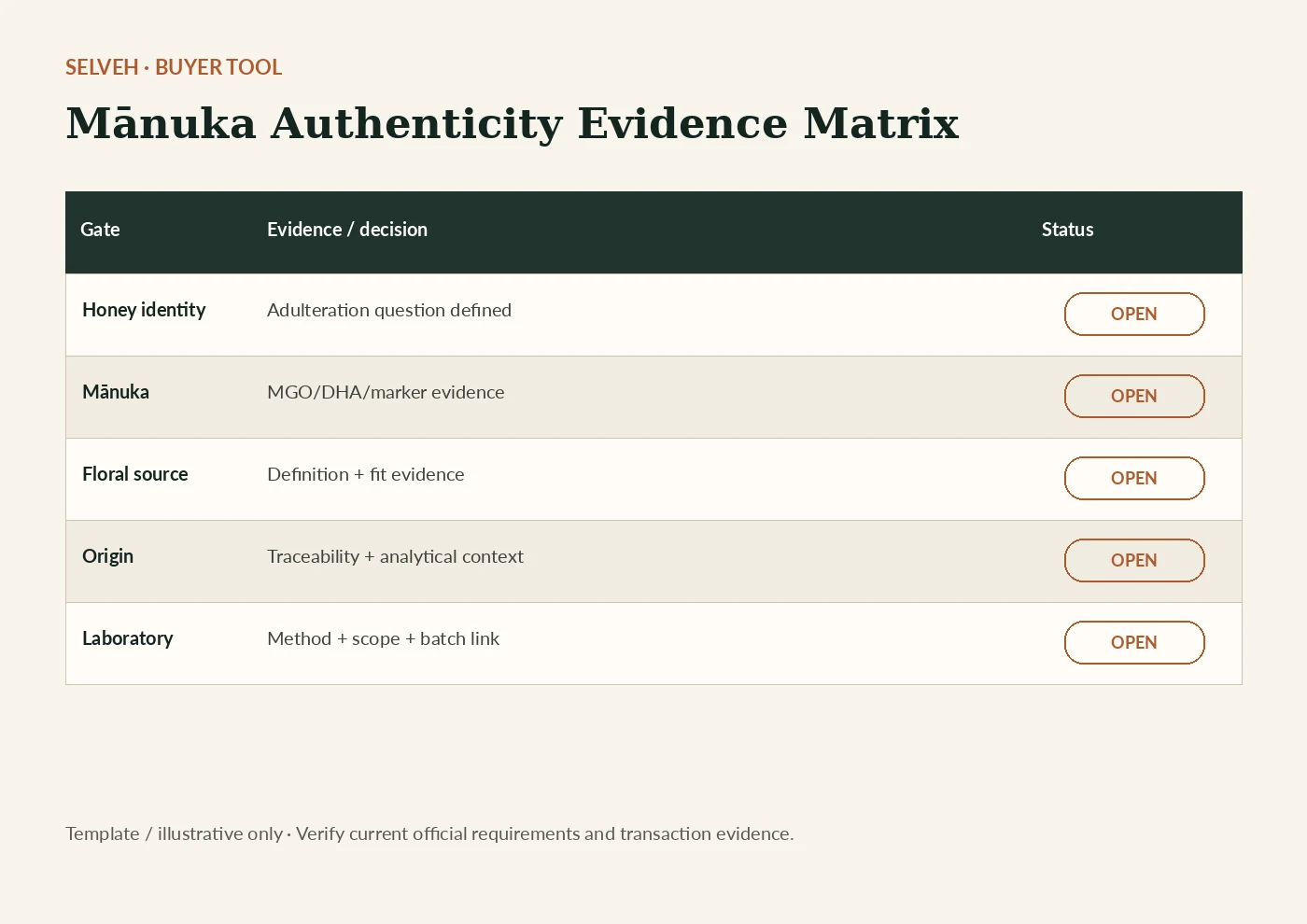
Build an authenticity evidence matrix, not a one-test rule
The downloadable matrix separates six questions: honey identity/adulteration, floral source, Mānuka-specific analytical evidence, Australian origin, laboratory/method fit and lot identity. Buyers can record what claim is being made, what evidence is expected and whether the evidence is Confirmed, Open or Blocked.
The tool is designed to stop evidence leakage - for example, using an MGO result to “prove” Australian origin or using a traceability declaration to “prove” absence of added syrup.
It is a procurement framework, not a laboratory method, certification scheme or SELVEH batch-authentication record.
12 · Red flags
Investigate these authenticity statements
- “High MGO proves the honey is not adulterated.”
- “Pollen alone proves geographic origin.”
- “Leptosperin is mandatory on every Australian Mānuka batch.”
- “The laboratory is NATA accredited, so every result on the report is covered.”
- “One historical test authenticates all future production.”
- “A private authenticity mark is the same as government certification.”
13 · SELVEH status
What SELVEH can state today
SELVEH can define an evidence architecture and require that future authenticity claims be matched to fit-for-purpose testing, documentary traceability and the exact batch being offered.
SELVEH should not claim that it has completed authenticity testing, NMR/IRMS profiling, Leptosperin testing, AMHA approval or a validated first-party authentication dataset until those records exist.
When real batch evidence becomes available, this article should be upgraded with permission-cleared examples and the current laboratory scope used for the commercial product.
Sources
Sources and evidence notes
- Codex Alimentarius — Standard for Honey (CXS 12-1981)
- Australian Mānuka Honey Association — Quality criteria
- Australian Mānuka Honey Association — Mark of Authenticity
- NATA — Choosing the right laboratory
- NATA — ISO/IEC 17025 laboratory accreditation
- PubMed — NMR and LC-IRMS for honey authenticity
- PubMed — Analytical methods in tracing honey authenticity
Editorial boundary: Current official, technical and scheme information is separated from SELVEH recommendations. Open supplier, batch, importer or contract evidence is not represented as confirmed.
Trade planning
Need to turn authenticity claims into an evidence request?
Tell SELVEH which origin, grade, floral-source or authenticity claims matter to the buyer. Evidence can then be requested in the correct lane rather than relying on one headline test.
Start a trade enquiry