
01 · Scope
Incoterms allocate delivery obligations - they do not run the whole export deal
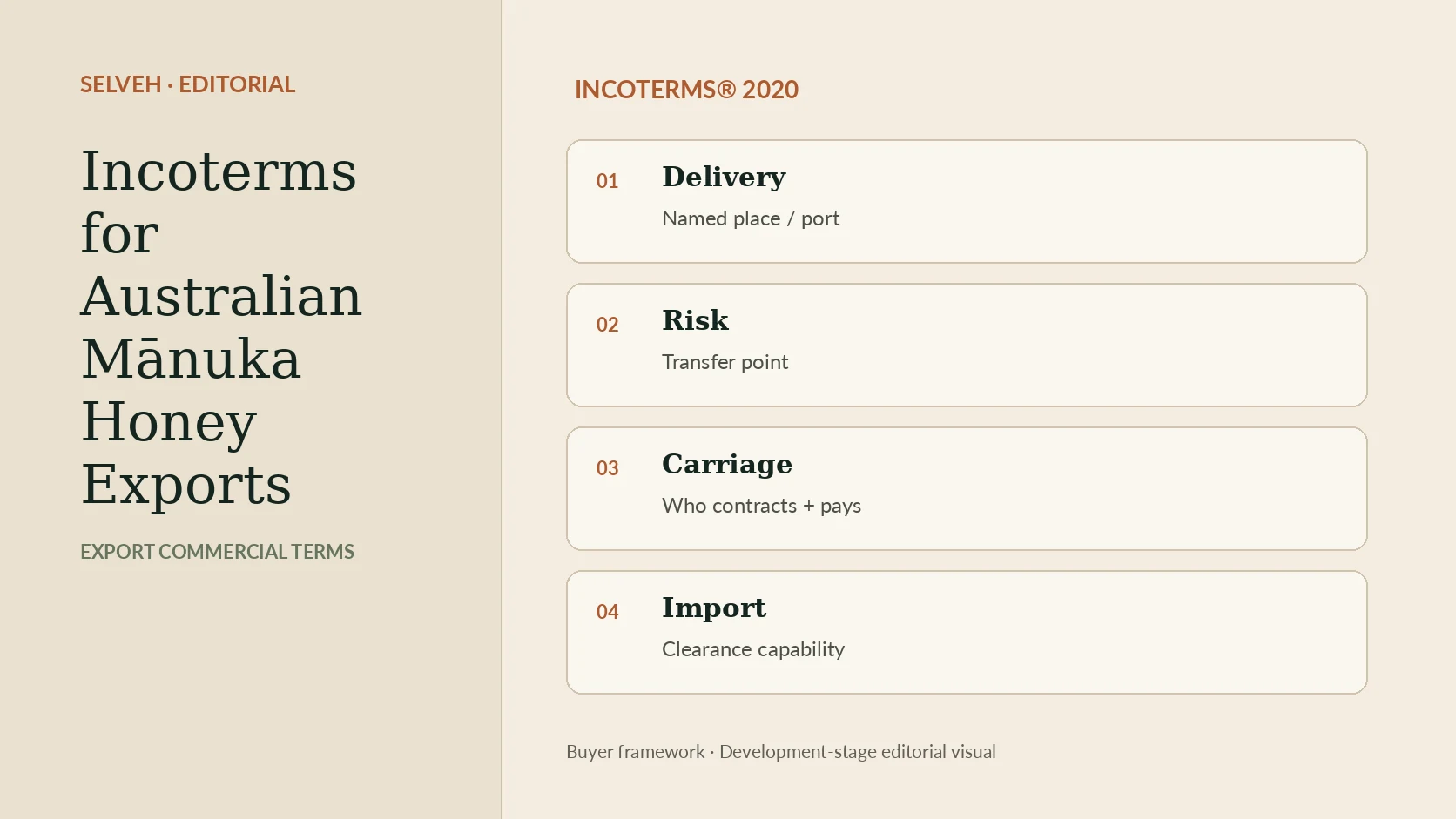
Incoterms® 2020 rules are standard trade terms published by the International Chamber of Commerce. They allocate defined seller/buyer obligations around delivery, risk, carriage, export/import formalities and certain costs. They are powerful because they make the handover structure explicit.
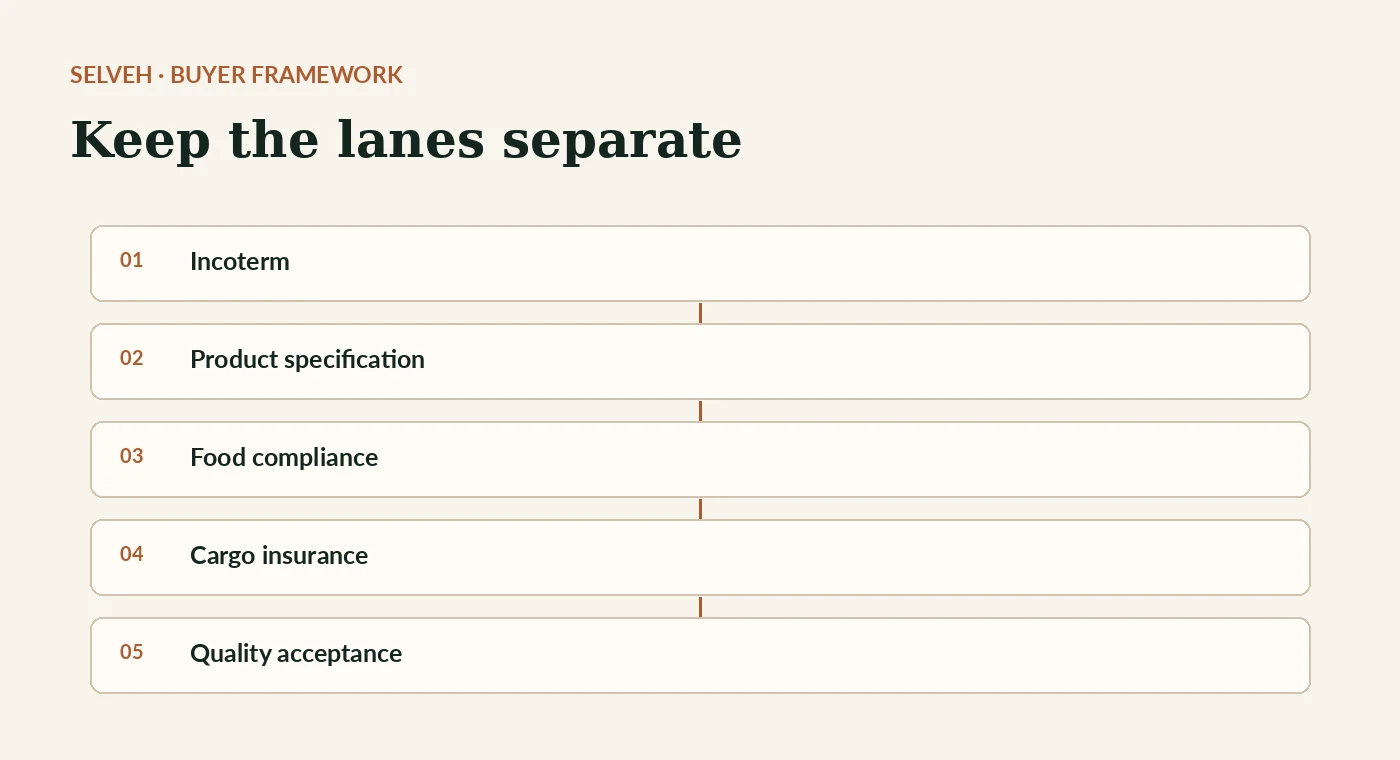
They do not by themselves set the product specification, transfer legal title, set payment terms, guarantee cargo condition, approve a food label, create an importer registration or replace a quality agreement. Those issues belong in the surrounding sale contract and compliance workflow.
For Mānuka honey, the safest approach is to choose the Incoterm after the product, destination, importer and logistics pathway are understood - not as a three-letter shortcut pasted onto a quotation.
02 · Named place
The place or port after the rule is part of the decision
“FCA”, “CIP” or “DAP” without a precise named place is incomplete commercial drafting. ICC’s explanatory notes repeatedly emphasise the importance of identifying the delivery/destination point accurately because that point affects risk, cost and operational responsibility.
A quotation should therefore use a format such as “FCA [named facility/terminal], Incoterms® 2020” or “DAP [named destination], Incoterms® 2020”, with enough precision that the logistics team can identify the handover.
Avoid vague terms such as “FOB Australia” or “DDP Middle East”. They hide the point at which obligations actually change.
03 · EXW vs FCA
FCA is often easier to control for an export handover than a loose EXW quote
Under EXW, the seller makes the goods available at the named place and does not have to load the collecting vehicle or clear the goods for export. That can create practical friction when the buyer is overseas and export formalities are easier for the Australian seller to manage.
FCA can be used for any mode. Depending on the named place, delivery occurs when the seller loads the buyer-arranged vehicle at the seller’s premises or when the seller brings the goods to another named place ready for unloading and at the disposal of the carrier/buyer-nominated party.
The buyer should choose between EXW and FCA based on who can practically control loading, export clearance and first-carrier handover - not simply because one price looks lower.
04 · CPT and CIP
Paid freight does not mean the seller carries risk to destination
CPT and CIP are “C” terms. The seller contracts and pays carriage to the named destination, but risk transfers earlier when the goods are delivered to the carrier in the manner defined by the rule. This separation between freight cost and risk is one of the most commonly misunderstood features of Incoterms.
CIP adds seller-arranged insurance for the buyer’s benefit. Under Incoterms® 2020, CIP generally requires broader insurance cover than CIF, subject to the rule and any agreement between the parties.
For a buyer, the question is therefore two-part: who pays the freight, and where does risk transfer? Never infer the second from the first.
05 · DAP and DDP
Destination delivery terms create very different import obligations
Under DAP, the seller carries risk to the named destination and makes the goods available on the arriving means of transport ready for unloading; the buyer handles import clearance. Under DDP, the seller also takes on import clearance and applicable import duties/taxes, making it the rule with the highest seller obligation under Incoterms® 2020.
ICC cautions that foreign sellers may face practical difficulty completing import clearance under DDP in some countries. For food products, this matters because the local importer may need registrations, licences or product approvals that an Australian seller cannot simply assume.
A DDP price should therefore never be offered before the seller has verified that it can legally and operationally act across the destination import/tax pathway.
06 · Sea-only terms
FOB, CFR and CIF are sea/inland-waterway rules - not universal container terms
FOB, CFR and CIF are intended for sea or inland-waterway transport. ICC’s guidance notes that where goods are handed to a carrier at a container terminal and multimodal transport is involved, an any-mode rule such as FCA, CPT or CIP may be more appropriate depending on the transaction.
Under CFR and CIF, risk transfers when the goods are on board the vessel even though the seller pays freight to the named destination port. CIF also requires the seller to arrange insurance, but the required insurance level differs from CIP under the 2020 rules.
The practical buyer question is not “we use FOB because exports go by sea”. It is “where is the actual delivery to the carrier, and does the chosen rule match that physical handover?”
07 · Insurance
Incoterms insurance is not a substitute for a cargo-risk decision
Only CIF and CIP contain seller insurance obligations. The buyer and seller can still agree additional cover under other rules, and even where insurance is mandated the policy, exclusions, insured value, claims process and route risks need to be understood.
Premium honey in glass retail packs may have breakage, leakage and heat-exposure concerns that are not solved merely by stating “insured”. Cargo insurance is a financial-risk tool; packaging, route control and quality acceptance remain separate controls.
The logistics specification should identify who receives insurance documents and who owns the claim process if loss or damage occurs.
08 · Compliance
An Incoterm does not make a food shipment admissible
Australian honey is a non-prescribed good under the export framework, but destination-market requirements can still require government certificates, establishment listing, importer registration, label approvals or other evidence. Incoterms decide who handles certain export/import formalities; they do not waive the underlying law.
For example, DAP may leave import clearance to the buyer, but the seller still needs to provide the product and export evidence required by the sale and applicable market rules. DDP may allocate import clearance to the seller, but that is only workable if the seller can lawfully complete the destination process.
Use the market-entry guide for the destination country alongside the Incoterm, not instead of it.
09 · Product quality
Risk transfer is not the same as product acceptance
Incoterms risk transfer concerns loss or damage to the goods under the trade term. A buyer’s commercial acceptance criteria can still require correct batch identity, intact packaging, specified remaining shelf life, agreed analytical results and review of any temperature-monitoring data.
The sale contract should state what happens if a shipment arrives damaged or outside specification, including inspection windows, evidence, rejection/claim process and who may dispose of or rework affected goods.
This is why the logistics core guide says an Incoterm does not replace a product specification, shipping instruction or quality agreement.
10 · Buyer decision
Choose the rule by operational reality
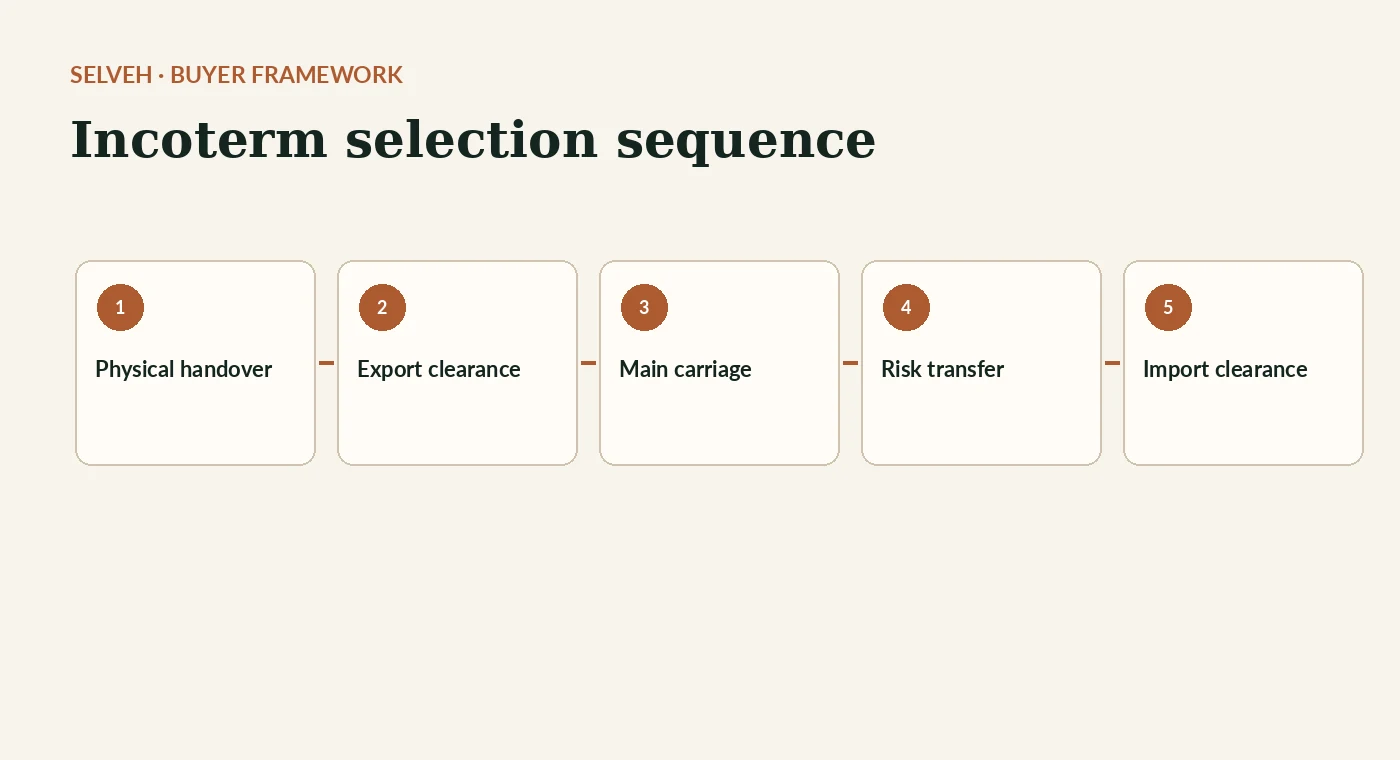
A useful buyer sequence is: identify the real pickup/delivery points → decide who can control export clearance → decide who contracts main carriage → decide where risk should transfer → decide whether seller-arranged insurance is required → decide who can lawfully handle import clearance → name the exact place/port → document the rule as Incoterms® 2020.
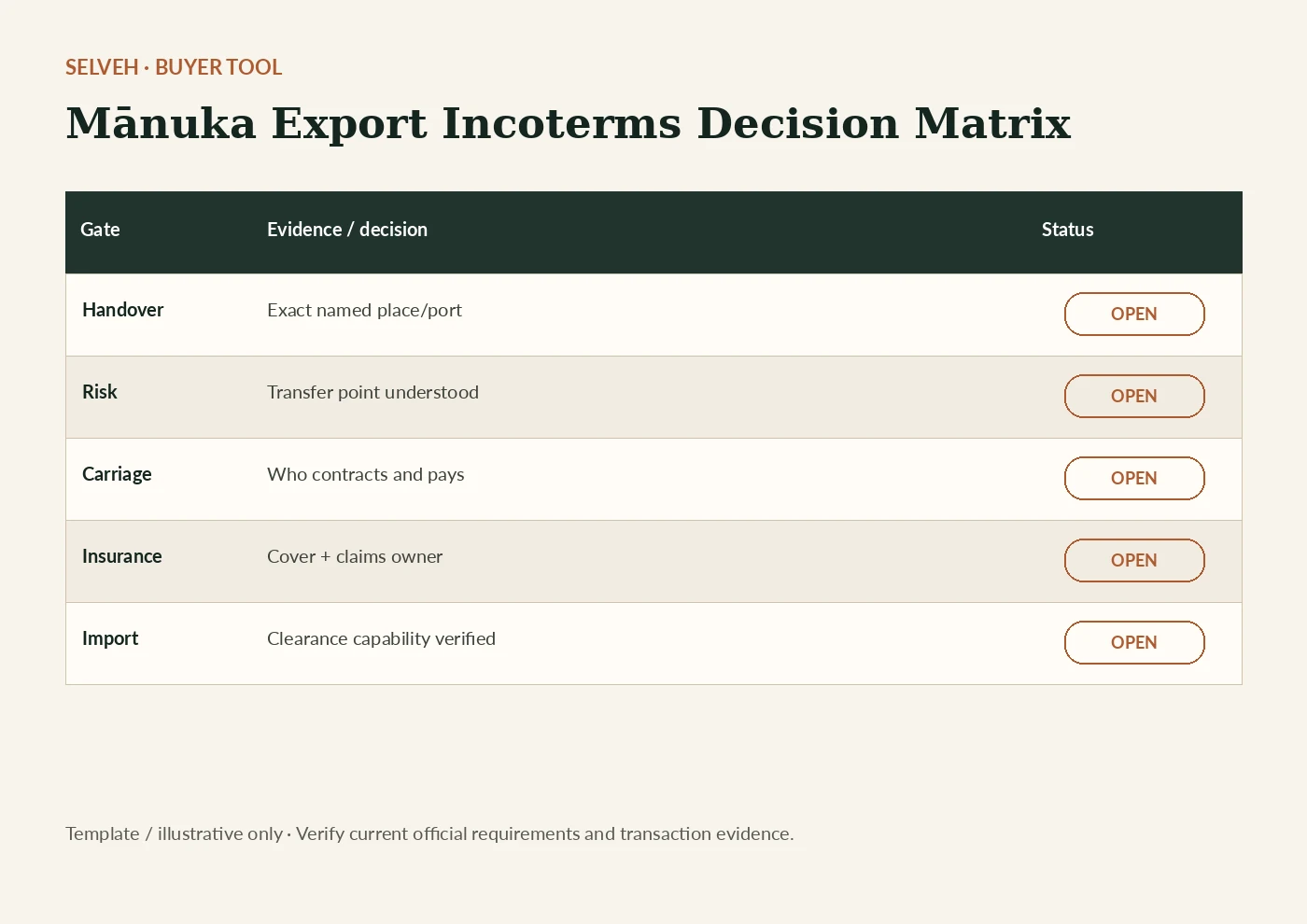
The downloadable matrix compares the relevant responsibility lanes without pretending there is one “best Incoterm” for Mānuka honey. The correct rule depends on route, shipment mode, importer capability, bargaining position and the surrounding contract.
If the commercial team cannot explain where delivery and risk transfer occur, the term is not ready to go on the quote.
11 · Illustrative scenario
Why “CIP Singapore” and “DAP Dubai” require different control thinking
Imagine an Australian private-label shipment in cartons. Under a correctly named CIP term, the seller may pay carriage and arrange insurance to the destination while risk transfers earlier at carrier handover. Under DAP, the seller retains risk to the named destination but the buyer remains responsible for import clearance.
Neither term says whether the MGO result is acceptable, whether the label is registered, whether the importer is licensed, whether a temperature excursion is a rejection event or whether broken jars may be salvaged.
Those issues stay in the product, compliance and quality agreements. The scenario is illustrative only and is not a SELVEH shipment or recommendation of a particular Incoterm.
12 · Red flags
Investigate these Incoterms statements
- “CIF means the seller carries risk all the way to destination.”
- “FOB is the standard term for every container shipment.”
- “DDP means the buyer does not need an importer or product registration.”
- “Incoterms decide who owns the goods.”
- “Insurance under the Incoterm guarantees every quality loss is covered.”
- “EXW is always the cheapest and therefore best option.”
13 · SELVEH status
What SELVEH can state today
SELVEH can define a disciplined Incoterm-selection process and can require future quotes to include the exact named place/port and Incoterms® 2020 reference.
SELVEH should not claim a default EXW, FOB, CIF, DAP or DDP policy until the supplier, route, importer capability, insurance approach and destination requirements are confirmed for the commercial offer.
When real freight quotations and buyer contracts exist, this guide should be upgraded with anonymised first-party examples showing how delivery, cost, risk and compliance were allocated in practice.
Sources
Sources and evidence notes
- ICC — Incoterms® 2020 rules for any mode
- ICC — Incoterms® 2020 sea and inland-waterway rules
- ICC — Introduction to Incoterms® 2020
- ICC Academy — Practical guide to C and D rules
- ICC Academy — DAP or DDP?
- Australian Government Micor — non-prescribed goods
Editorial boundary: Current official, technical and scheme information is separated from SELVEH recommendations. Open supplier, batch, importer or contract evidence is not represented as confirmed.
Trade planning
Need to define a clearer export handover and quote basis?
Tell SELVEH the destination, shipment mode, pack format and buyer/importer capability. Delivery terms can then be separated from product, compliance and quality responsibilities.
Start a trade enquiry