01 · Design the chain before booking freight
Export logistics starts with the product specification, not the container
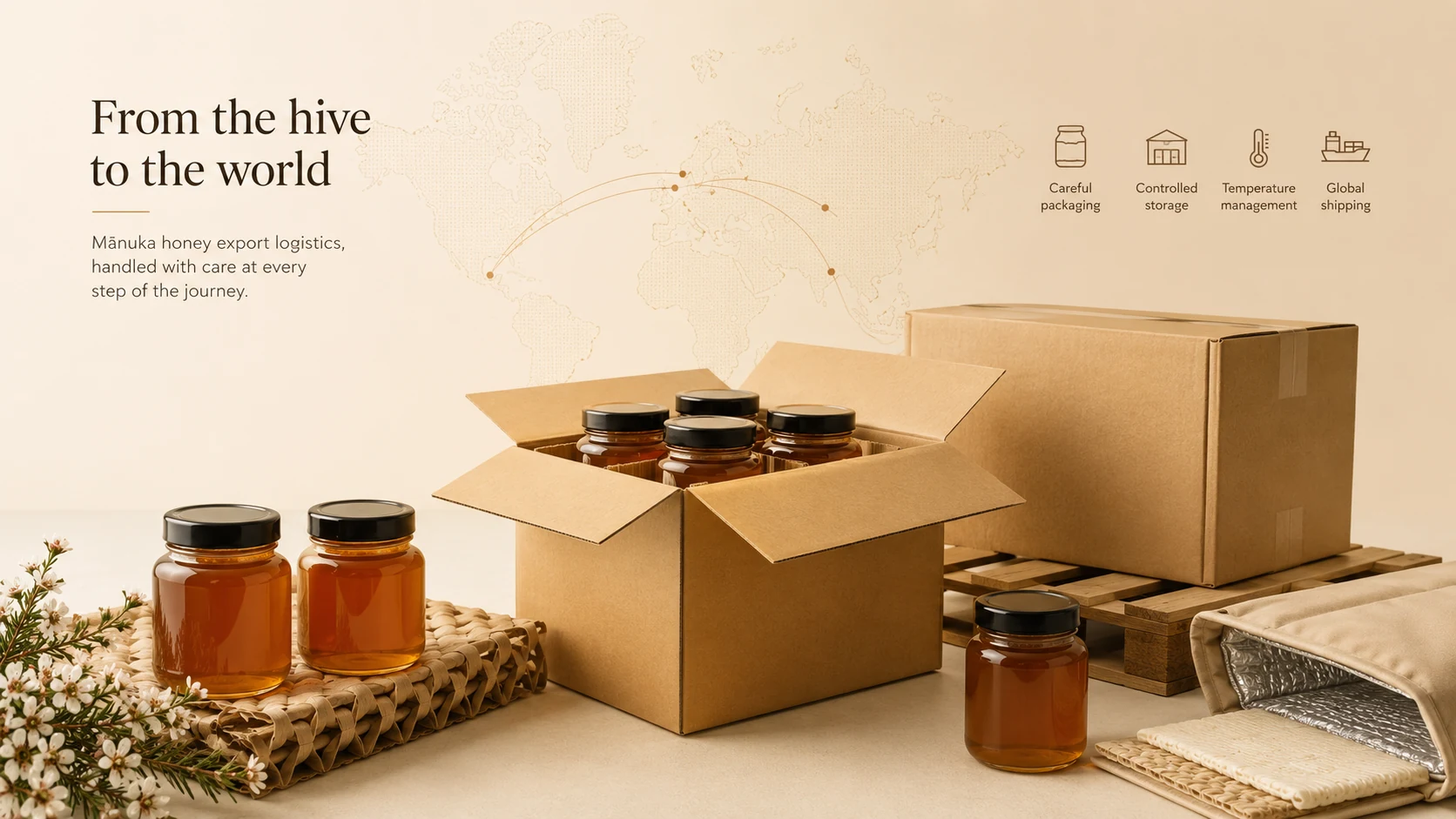
A premium honey shipment is a chain of custody and condition. The practical sequence is released batch → primary pack → secondary pack → pallet/unit load → origin transport → terminal → main carriage → destination terminal → importer receiving.
Australia treats honey and apiary products as non-prescribed goods under the export framework. That does not mean there are no requirements: the Australian Department of Agriculture, Fisheries and Forestry says exporters must meet the importing country’s conditions and should check Micor and the importer before export. DAFF — exporting non-prescribed goods ↗
For procurement teams, the key control is therefore to make every handover explicit. Who owns the product at that point? Who can inspect it? Who receives temperature data? Who decides whether a damaged or heat-exposed shipment is acceptable?
02 · Packaging is part of the transport control
Choose packaging for the route, not only for shelf appearance
FSANZ requires Australian food businesses to use packaging that is fit for its intended purpose, is not likely to contaminate food, and does not introduce contamination during packaging. Its current guidance also notes that storage conditions such as time, temperature and humidity can affect packaging suitability. FSANZ — food packaging ↗
For Mānuka honey, the logistics question is broader than “glass or plastic?”. Buyers should consider the whole pack system:
| Layer | Buyer question | Typical risk to control |
|---|---|---|
| Primary pack | Jar, pail, drum, IBC/tote or other food-contact container? | Compatibility, leakage, seal integrity, contamination |
| Closure | How is the lid/cap secured and tamper evidence managed? | Loosening, leakage, unauthorised opening |
| Secondary pack | What carton/divider/cushioning system protects the primary pack? | Glass breakage, abrasion, jar-to-jar impact |
| Unit load | How are cartons/pails/drums restrained on pallet or in container? | Movement, crushing, collapse, puncture |
| Environmental protection | Does the route need insulation, solar protection or active temperature control? | Heat exposure and packaging deformation |
SELVEH should not advertise a particular bulk format until the actual supplier/packer capability is confirmed. In B2B trade, food-grade pails, drums and larger IBC/tote systems are possible formats, but the precise fill weight, liner, closure and handling method are supplier-specific.
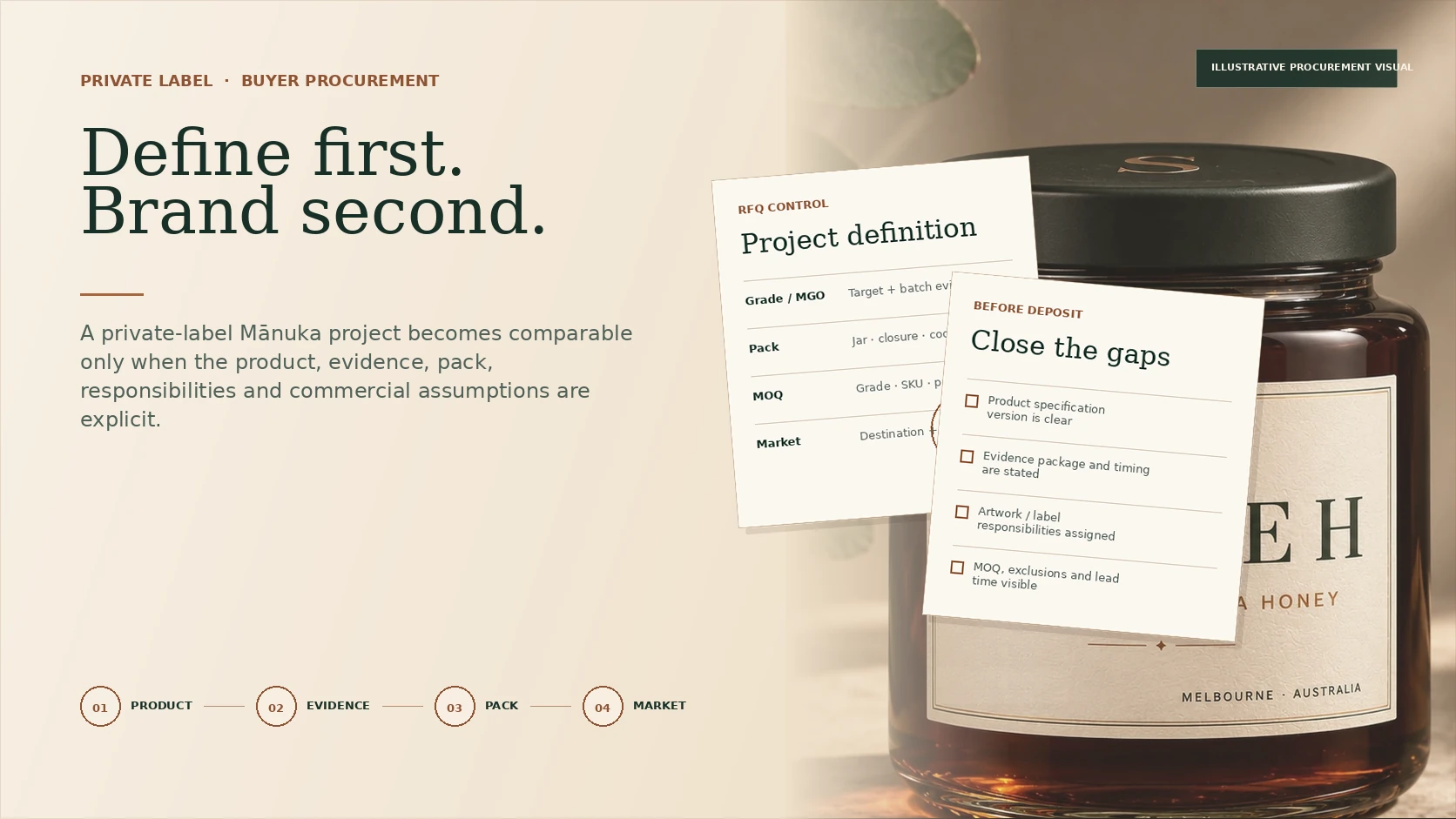
For project-level sourcing decisions before a quote or deposit, use the private-label Australian Mānuka procurement guide to define product, evidence, pack, MOQ and responsibility assumptions before logistics is booked.
03 · Retail jars and bulk honey create different logistics problems
The “best” format depends on where value is added
For the complete operating-model decision, use the source-packed versus destination-packed Mānuka honey guide.
Retail jars can preserve the finished brand presentation before export, but they increase the number of individual units exposed to breakage, label damage and carton compression. Bulk formats can reduce unit-count handling and allow destination-market packing, but they shift more responsibility to the receiving packer and increase the importance of bulk-lot identity, food-contact compatibility and the mapping from bulk lot to finished retail lot.
A buyer should decide early whether the commercial model is:
- Finished retail export — jars are packed and labelled in Australia.
- Bulk export for destination packing — honey is shipped in a larger food-grade container and packed later.
- Hybrid/private label — the exact division of filling, labelling and secondary packaging is contract-specific.
That choice affects traceability, registration, label control, freight economics and which party owns the final pack-quality risk.
04 · Separate food-safety temperature from product-quality temperature
Honey logistics is not a generic chilled-food problem
FSANZ’s transport guidance requires food to be protected from contamination and, for potentially hazardous foods, to be held at safe temperatures. The familiar 5°C-or-colder and 60°C-or-hotter controls apply to potentially hazardous foods, not as a universal setpoint for every food shipment. FSANZ — transporting food safely ↗
For premium honey, the export specification should therefore distinguish two different questions:
- Food safety/suitability: Is the product protected from contamination and transported in a way that keeps it safe and suitable?
- Quality preservation: Is heat/time exposure likely to move HMF, MGO, DHA, colour, texture or other agreed attributes outside the commercial specification?
This distinction matters because “use a reefer” is not automatically the correct answer, and “honey is shelf stable” is not a reason to ignore thermal exposure.
05 · Heat exposure is cumulative
HMF is a quality-control reason to manage time and temperature
The Codex Standard for Honey includes hydroxymethylfurfural (HMF) as a quality factor. The Codex text provides a general maximum of 40 mg/kg after processing and/or blending, with a higher allowance for declared tropical-origin honey and blends. Codex — CXS 12-1981 Standard for Honey ↗
Primary research also shows why a logistics team should think about time × temperature, not just a single peak. Experimental honey studies report higher HMF formation with higher storage temperature and longer exposure. That does not turn HMF into a “shipping thermometer”; initial HMF, honey composition and prior processing also matter. It means uncontrolled heat can consume part of the product’s quality margin before the buyer even receives it.
06 · Mānuka chemistry can continue to evolve
Temperature can change the MGO/DHA profile - not always in a simple direction
Mānuka honey creates an additional complication because DHA can convert to MGO over time. A controlled study of New Zealand mānuka honeys stored from 4°C to 37°C found that increasing storage temperature accelerated DHA loss and the initial formation of MGO, while MGO loss became more evident at the highest temperature later in storage. Grainger et al., Food Chemistry — PubMed ↗
Australian Leptospermum research also found that low-temperature dark storage preserved non-peroxide activity over long periods, while HMF increased with age. Cokcetin et al., PLOS ONE ↗
The commercial implication is important: a shipper should not assume that “cooler always means higher MGO” or that a single temperature limit can be copied across every batch. The correct objective is to protect the released grade and agreed quality profile through the journey, using batch-specific evidence where required.
07 · Choose the thermal-control level deliberately
Ambient, passive protection and reefer are different tools
| Option | What it does | When buyers should investigate it |
|---|---|---|
| Ambient dry freight | No active temperature setpoint. | When route exposure is acceptable against the product specification and packaging plan. |
| Passive thermal protection | Insulation/liners/blankets can reduce the rate of heat transfer but do not actively hold a setpoint. | When solar/terminal exposure is a concern but full active control is not justified. |
| Reefer / temperature-controlled container | Actively controls container temperature within equipment capability. | When the product specification or route-risk assessment requires active control. |
| Air freight | Shorter main transit, but multiple ground-handling stages can still create exposure. | High-value, urgent or smaller shipments where time reduction offsets higher freight cost. |
Commercial carriers describe reefers as temperature-controlled equipment for sensitive cargo. Hapag-Lloyd, for example, states that its reefer fleet can maintain controlled setpoints across a wide temperature range and provides monitoring options. That capability does not mean Mānuka honey automatically requires a reefer; it means active control is available when the product and route justify it. Hapag-Lloyd — reefer cargo overview ↗
08 · Monitoring is useful only when an acceptance rule exists
A temperature logger without a specification is just a graph
If the commercial risk justifies monitoring, define the logger plan before dispatch:
- device ID and status;
- placement inside the shipment;
- recording interval;
- acceptable range or excursion rule;
- who receives the data;
- who investigates an excursion;
- what product evidence determines release or rejection after an excursion.
A single short spike should not automatically trigger rejection unless that rule was scientifically or contractually defined. Conversely, an unmonitored shipment should not be declared “temperature controlled” simply because it travelled in a particular container type.
09 · Route risk is often concentrated at handovers
The hottest part of a shipment may not be the ocean leg
Procurement teams should map exposure at each stage: packer loading bay, road transfer, origin terminal, container yard, trans-shipment, destination terminal, inspection, and final delivery. A long sea voyage may be predictable while a few hours of unshaded terminal dwell in a hot climate becomes the more relevant thermal event.
That is why the original-value worksheet accompanying this article includes a route heat-risk and handover planner, rather than only asking “reefer yes/no”.
10 · Incoterms allocate delivery obligations - not product compliance
FOB, CIF and EXW do not replace a logistics specification
ICC’s Incoterms® 2020 rules allocate delivery, risk, cost and certain transport/customs obligations between seller and buyer. For example, EXW places the goods at the buyer’s disposal at the named place and does not require the seller to load the collecting vehicle or clear the goods for export; FOB and CIF belong to the rules for sea and inland waterway transport. ICC — Incoterms® 2020 rules ↗
But an Incoterm does not tell the carrier:
- which batch is being shipped;
- what packaging must be used;
- what temperature/quality conditions are acceptable;
- which documents constitute product release;
- who investigates damage or excursion.
Those controls belong in the commercial specification, shipping instructions and quality agreement. A future SELVEH supporting article will address Incoterms in more depth rather than overloading this Core guide.
11 · Build a shipment evidence pack
Physical movement and documentary movement should match
A strong shipment file should let a buyer connect the physical goods to the commercial and analytical evidence. Depending on destination and contract, that may include:
| Evidence category | Examples |
|---|---|
| Commercial | Purchase order, commercial invoice, Incoterm + named place, freight booking |
| Packing | Packing list, carton/pallet configuration, lot identity, seal information |
| Quality | Product specification, COA/lab report, batch-release record |
| Traceability/origin | Origin evidence, batch mapping, certificates/declarations where applicable |
| Transport condition | Shipping instruction, logger data or carrier monitoring where specified |
| Market-specific | Export health certificate, registration, customs/import documents as required by destination |
No universal document list is valid for every market. DAFF specifically tells exporters of non-prescribed goods to check importing-country requirements and Micor before export. DAFF — current exporter guidance ↗
12 · Receiving is a formal quality gate
Do not end the control plan at “delivered”
At destination, the importer should inspect the shipment before distributing or repacking it. Useful checks include:
- lot and seal identity;
- carton/pallet damage;
- jar breakage, leakage or cap movement;
- evidence of water/condensation contamination;
- temperature-monitoring data where specified;
- document set completeness;
- remaining shelf life;
- any agreed analytical or batch-release follow-up.
FSANZ’s Australian storage guidance similarly emphasises keeping food protected from contamination, using food-safe containers/packaging and avoiding warm, humid or direct-sunlight storage where those conditions could make food unsafe or unsuitable. FSANZ — storing food safely ↗
13 · Crystallisation is not the same as spoilage
Appearance changes need a commercial response, not a false safety claim
Honey can become partly or fully crystallised; Codex’s definition of honey recognises that its consistency can be fluid, viscous, partly crystallised or entirely crystallised. The presence of crystals is therefore not, by itself, evidence that honey is unsafe or fraudulent. Codex — Standard for Honey ↗
However, crystallisation can matter to the buyer’s expected retail presentation, pourability and consumer perception. If a brand requires a particular visual/texture profile on arrival, that should be treated as a product-specification issue and validated against the expected route and storage conditions rather than “fixed” by uncontrolled heating.
14 · Original buyer tool
The SELVEH Mānuka Export Logistics Readiness Matrix
The downloadable matrix converts the logistics plan into explicit pre-shipment decisions across product/lot identity, packaging, palletisation, route, thermal strategy, monitoring, quality limits, Incoterms, documents and handover responsibility.
Buyer worksheet
Mānuka Export Logistics Readiness Matrix
Two-page planning template with a pre-shipment control matrix, route heat-risk map and temperature/quality monitoring record.
TEMPLATE / ILLUSTRATIVE ONLY · Not a carrier instruction, government checklist, certificate or SELVEH shipment record.
15 · Illustrative procurement scenario
Why “ship it ambient” and “use a reefer” can both be weak answers
Imagine an identified Mānuka lot has passed its release specification and is destined for a hot-climate market in retail glass jars.
Supplier A says: “Honey is shelf stable, so ambient freight is always fine.”
Supplier B says: “Premium honey must always travel in a reefer at 4°C.”
Neither statement is sufficiently controlled.
A stronger process would ask:
- What are the batch’s release values and arrival acceptance limits?
- What is the route and expected dwell exposure?
- How robust are the primary and secondary packs?
- Does passive protection manage the risk, or is active control justified?
- Will the shipment be monitored?
- Who owns the excursion decision?
This scenario is illustrative. It is not a SELVEH shipment or validated transport protocol.
16 · Procurement red flags
Investigate these logistics claims before relying on them
- “Honey never needs temperature consideration.”
- “All Mānuka must ship refrigerated.”
- “A reefer guarantees the product stayed at setpoint door-to-door.”
- “A data logger proves the shipment passed” when no acceptance rule exists.
- Bulk-format capability is advertised without confirmed food-contact container/packer evidence.
- An Incoterm is used as if it assigns regulatory compliance or product-release responsibility.
- A carrier booking is treated as proof that destination import requirements are complete.
- Damaged cartons are accepted without checking jar/lot/document condition.
A red flag does not automatically mean the shipment fails. It means the control or evidence is incomplete.
17 · Buyer FAQ
Common questions about exporting premium Mānuka honey
Does Mānuka honey need refrigerated shipping?
There is no universal rule that every Mānuka shipment must use a reefer. The correct control depends on the released product specification, route, duration, ambient exposure, pack format and commercial quality limits. Active temperature control is one option, not an automatic requirement.
Is 4°C the “correct” shipping temperature?
No universal 4°C export setpoint should be copied from research storage studies. Mānuka chemistry can evolve with temperature, and a commercial shipping setpoint should be validated for the actual product and objective.
Why worry about heat if honey is shelf stable?
Because food safety and premium quality are different questions. Heat/time exposure can influence HMF and Mānuka chemistry even when the product does not require a chilled-food cold chain.
Can a thermal blanket replace a reefer?
Passive insulation can reduce heat transfer but does not actively maintain a temperature setpoint. Whether it is sufficient is a route-specific risk decision.
Should buyers request a temperature logger?
When thermal exposure is commercially material, monitoring can be useful. But define the acceptable condition and excursion rule before using a logger; otherwise the data may be difficult to interpret.
Are drums or IBCs better than retail jars?
Neither is universally better. Bulk and finished-retail models shift cost, handling, breakage, traceability, registration and packing responsibility differently. Confirm actual supplier/packer capability before specifying a format.
Do Incoterms decide who is responsible for product quality?
Incoterms allocate defined delivery, risk, cost and transport/customs obligations. They do not replace a product specification, quality agreement, shipping instruction or destination compliance plan.
18 · SELVEH evidence boundary
What SELVEH can state today
As at 19 August 2026, SELVEH’s first Australian Mānuka commercial range remains in development.
This article does not claim that SELVEH currently has:
- a validated transport temperature or thermal profile;
- a contracted freight forwarder or ocean/air carrier;
- a confirmed bulk drum/IBC capability;
- a completed export shipment;
- a real SELVEH transport logger dataset;
- a fixed Incoterm for all buyers;
- a validated shelf-life study for a final commercial SKU.
When those elements exist, this Core guide should be upgraded with permission-cleared first-party route data, packaging tests, temperature records and operational lessons.
19 · The buyer’s decision
Do not buy “freight”. Buy a controlled handover plan.
The strongest logistics offer does not simply say:
“We can ship worldwide.”
It can answer:
“Which batch is moving, in which pack system, on which route, under which delivery term, with what thermal/handling controls, with what evidence, and who owns the decision if something deviates?”
That is the difference between freight booking and procurement control.
For importers, distributors & private-label buyers
Planning an Australian Mānuka shipment?
Tell SELVEH your destination, intended grade, pack format, quantity, target timing and importer requirements. We will separate confirmed information from development-stage assumptions and identify the logistics evidence still required before a commercial shipment is represented as ready.
Start a trade enquiryPrimary and technical sources
Source basis
- Australian Department of Agriculture, Fisheries and Forestry — Exporting non-prescribed goods
- Food Standards Australia New Zealand — Food packaging
- Food Standards Australia New Zealand — Transporting food safely
- Food Standards Australia New Zealand — Storing food safely
- Codex Alimentarius — CXS 12-1981 Standard for Honey
- Grainger et al. — Kinetics of DHA to MGO conversion in mānuka honey
- Cokcetin et al. — Australian Leptospermum honey chemistry and long-term storage
- International Chamber of Commerce — Incoterms® 2020
- Hapag-Lloyd — Reefer cargo overview
Editorial note: This guide is general buyer education, not transport engineering, carrier, customs, food-safety, laboratory or legal advice. Shipping conditions and import requirements can change. Validate the actual product, route, carrier and destination requirements before release.