

01 · Cost boundary
Define where landed cost starts and stops
“Landed cost” is often used as if it were a standard accounting line. It is not. One buyer may stop the calculation at the destination port; another may include customs clearance, storage, local delivery and losses through to the warehouse receiving bay.
Write the boundary before entering numbers: product ready at the packer, export port, destination port, customs-cleared warehouse or retailer distribution centre. Then name the shipment, destination, currency, Incoterm and receiving point.
The decision number for SELVEH should normally be the cost per saleable jar at the agreed receiving point. That is the number that can support channel margin and order-size decisions.
02 · Quote basis
Normalise the commercial offer before adding freight
If the offers use different packing locations, first normalise the additional filling, yield and evidence interfaces with the packing-location decision guide.
A supplier quote may include honey, jar, closure, label application, case packing, batch testing and delivery to a named place - or only some of them. A low jar price is meaningless until the inclusions and exclusions are mapped.
Record the exact Incoterm and named place, quote validity, currency, payment timing, MOQ, SKU split, pallets, gross weight, cubic volume and included documents. If the term is FOB Melbourne, identify the terminal and confirm which origin charges are included. If it is EXW, the buyer may face collection, export handling and clearance costs that are absent from the supplier line.
Do not “adjust later” in your head. Put every missing item on an open-cost list with an owner and due date.
03 · Unit base
Calculate ordered, shipped and saleable units separately
The denominator can distort the result more than a small freight-rate change. Ordered units may differ from shipped units after production tolerances, and shipped units may differ from saleable units after breakage, leakage, label damage, customs sampling or retailer rejection.
Record jars per case, cases per pallet, pallet count, ordered jars, expected shipped jars and a documented allowance for non-saleable units. Use the final saleable-unit estimate for commercial planning, while retaining the physical shipment quantities for freight and customs reconciliation.
| Unit view | Used for | Control question |
|---|---|---|
| Ordered units | Purchase commitment | What quantity appears on the purchase order? |
| Shipped units | Invoice, packing and transport | What physically left the packer? |
| Saleable units | Unit economics | What can realistically enter the intended channel? |
04 · Cost stack
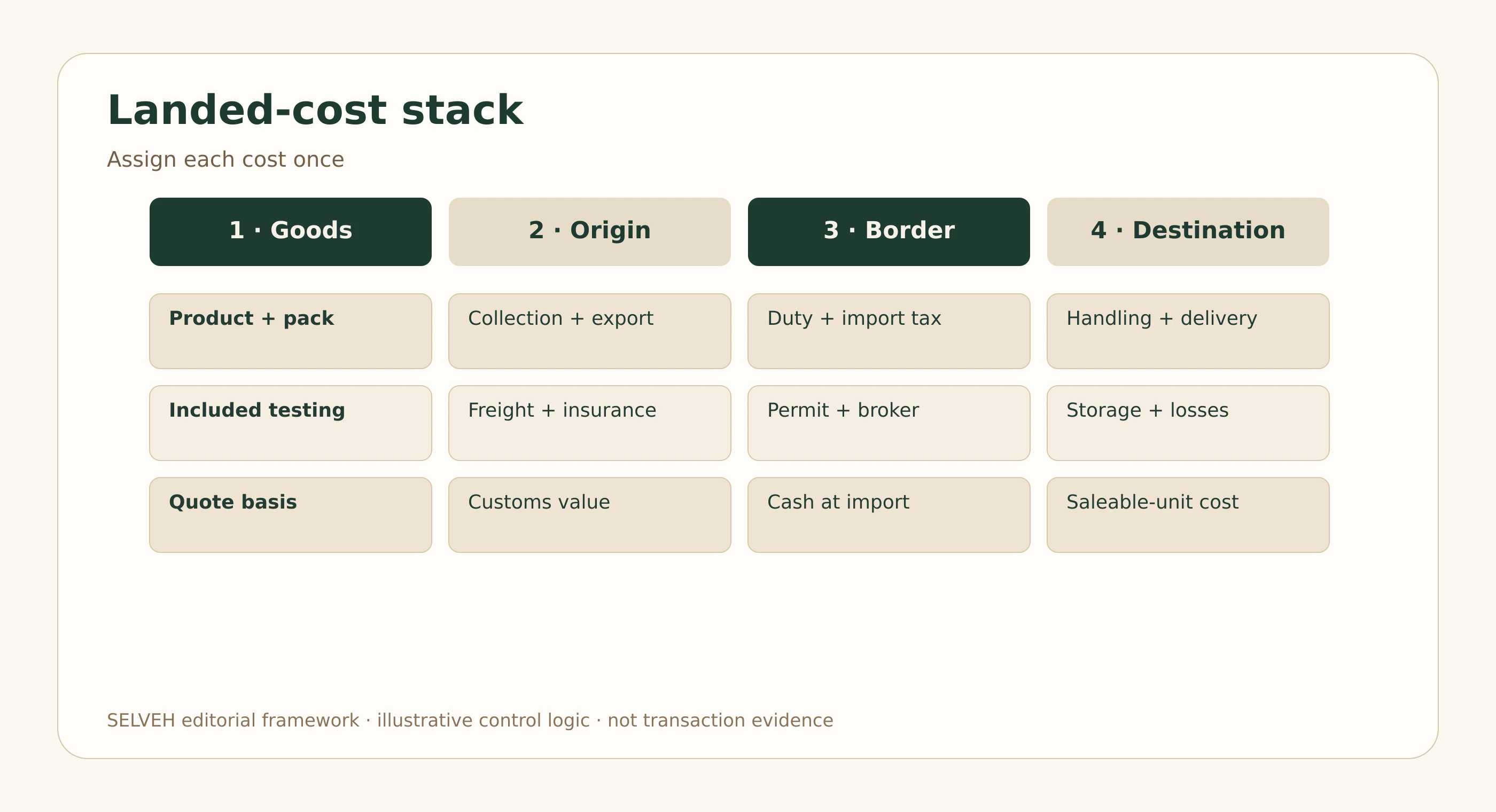
Build the cost stack without double counting
Start with the price paid or payable for the goods and the packaging/services included in that price. Add only the costs that sit outside the quoted term. Typical lines include origin collection, export documentation, terminal handling, international freight, insurance, destination handling, customs broker, permits, inspection, storage and local delivery.
Separate one-off project costs - such as initial artwork or plate charges - from recurring shipment costs. Decide whether a one-off cost should be expensed against the trial order or amortised across a defensible production horizon. Showing both views is more honest than hiding the treatment.
05 · Customs value
Do not confuse customs value with total landed cost
Customs value is a regulatory valuation base. Landed cost is a commercial decision model. They can share inputs but they answer different questions.
Singapore Customs states that the transaction value method is its primary method and bases customs value on the CIF value, with relevant adjustments such as packing, assists and charges incidental to sale and delivery. Customs may use another valuation method if the transaction-value conditions are not met.
Your landed-cost worksheet should therefore show the declared customs value and its supporting components separately from post-border commercial costs. Never change an invoice value simply to make the worksheet produce a preferred result.
06 · UAE scenario
Model UAE tariff preference as conditional, not automatic
Dubai Customs describes the general customs duty as 5 per cent of CIF value for ordinary goods. DFAT states that the UAE’s 5 per cent duty on honey was eliminated from 1 October 2025 under the Australia-UAE CEPA for qualifying Australian goods.
The correct landed-cost model is not “Australian honey equals zero duty”. Create a preference field that closes only when the product satisfies the agreement’s origin rule and the importer confirms the proof route. If the evidence is open, run both a preferential and non-preferential scenario.
UAE VAT is generally 5 per cent for taxable supplies and imports, but the importer or tax adviser should confirm the actual import-VAT base, accounting treatment, recoverability and any emirate-specific clearance charges. Keep recoverable VAT visible as cash required at import and separate it from economic cost.
07 · Singapore scenario
For Singapore, separate non-dutiable status from GST and fees
Singapore Customs identifies four broad dutiable categories: intoxicating liquors, tobacco, motor vehicles and petroleum products or biodiesel blends. Other goods are non-dutiable, although GST can still apply.
Singapore Customs states that GST on imported goods is calculated at the prevailing rate on customs value or, where relevant, the last selling price, plus duties. IRAS states that the current GST rate is 9 per cent. The customs-value model must still include the relevant cost, insurance and freight components.
Non-dutiable does not mean cost-free. Add the declaring agent, permit, terminal, delivery, inspection, storage and any importer handling costs actually quoted. Confirm whether import GST is recoverable by the importer rather than assuming it belongs inside margin.
09 · Calculation
Use a transparent per-jar formula
| Step | Calculation | Buyer control |
|---|---|---|
| 1. Goods basis | Product + included packing/services | Match quote version and PO |
| 2. Pre-border additions | Origin + freight + insurance | Exclude items already in term |
| 3. Border cash | Duty + import tax + permit/clearance | Separate recoverable tax |
| 4. Post-border | Handling + storage + local delivery | Use named receiving point |
| 5. Unit result | Total / estimated saleable jars | Record loss assumption |
Keep at least three outputs: cash required to land, economic landed cost excluding recoverable tax, and landed cost per saleable jar. A margin model can then add local warehousing, fulfilment, distributor margin, retailer margin, promotions and returns without pretending those are import costs.
10 · Scenario control
Test volume, freight, FX and preference together
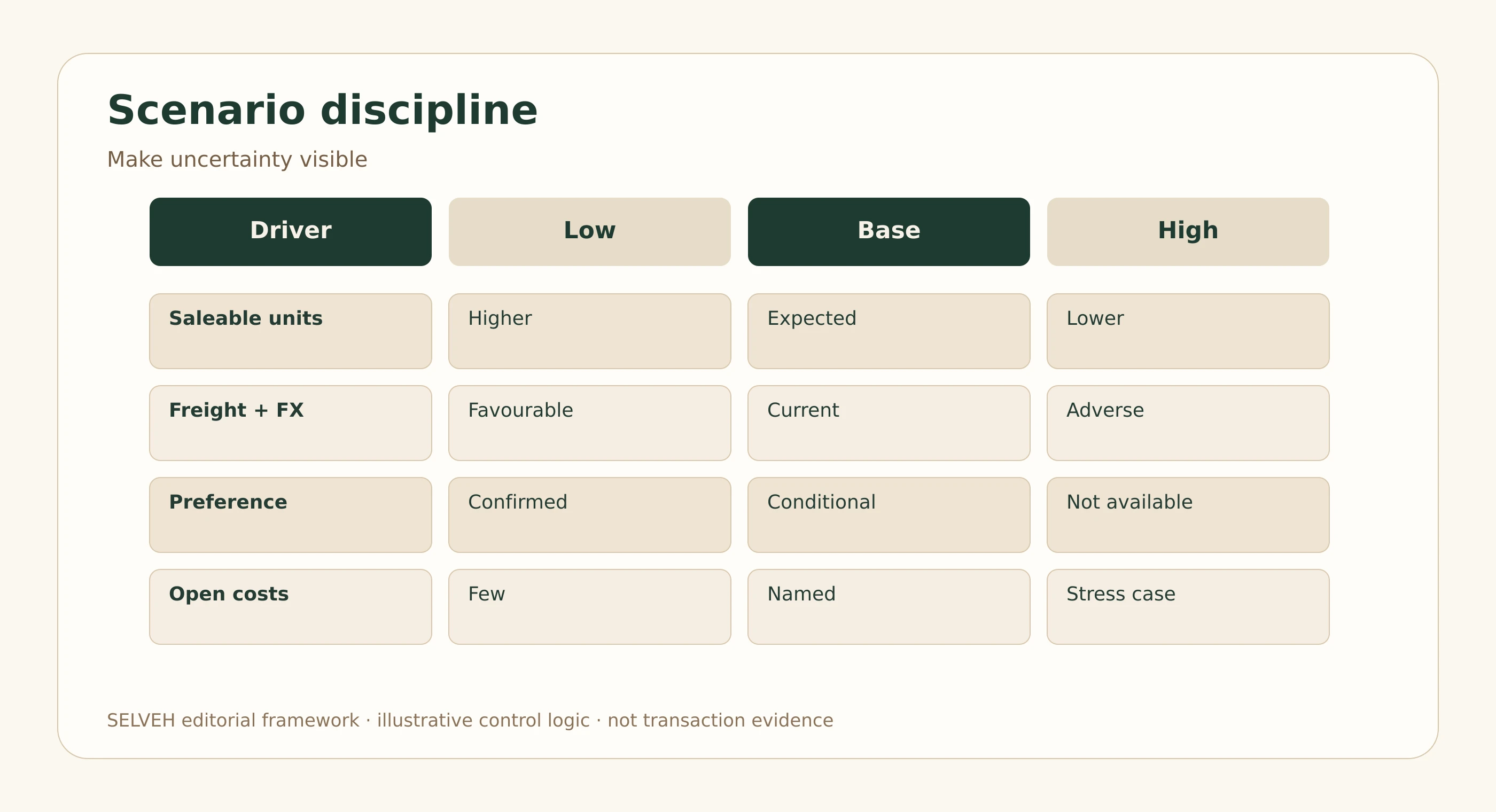
A base case alone is fragile. Build a low, base and high case using the same shipment structure. Vary only named drivers: saleable units, freight, exchange rate, clearance exposure and tariff-preference status.
A small order may reduce inventory exposure but carry a high freight and documentation cost per jar. A larger order may reduce unit logistics cost while increasing working capital and shelf-life risk. The best order is not automatically the cheapest freight-per-jar result.
11 · Buyer tool
Use a landed-cost worksheet that preserves the assumptions
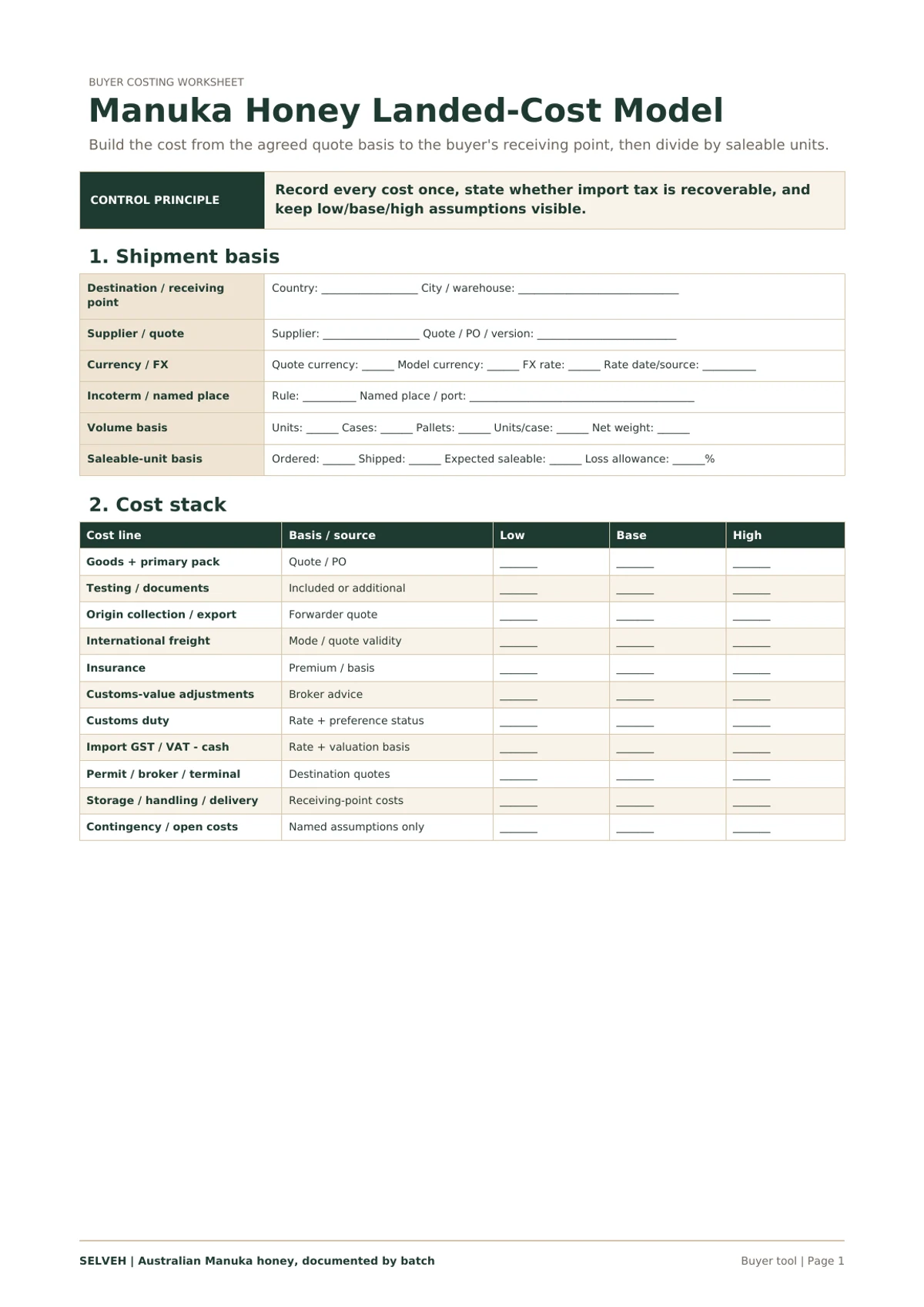
The downloadable worksheet records the quote basis, Incoterm, shipment geometry, currency, customs-value inputs, tax treatment, operational costs and saleable-unit denominator. Its second page compares three scenarios and links open assumptions to an owner and due date.
This is a commercial planning aid, not a customs valuation, tax calculation, broker instruction or binding freight quotation.
12 · Red flags
Investigate these landed-cost models
- The supplier’s unit price is used without the exact Incoterm and named place.
- CIF, customs value and landed cost are treated as synonyms.
- GST or VAT is either omitted or counted as permanent cost without checking recoverability.
- Tariff preference is assumed before origin eligibility and proof are confirmed.
- The model divides by ordered jars while ignoring breakage, samples or rejected stock.
- Destination charges are represented by one unexplained “miscellaneous” percentage.
13 · Buyer FAQ
Frequently asked questions
Is landed cost the same as cost of goods sold?
No. Landed cost usually stops at a defined receiving point. Cost of goods sold and channel contribution may also include local storage, fulfilment, sales commissions, promotions, returns and other costs.
Should import GST or VAT be included?
Show it in the cash requirement. Whether it remains an economic cost depends on the importer’s registration, entitlement and accounting treatment. Obtain destination advice.
Does CIF include destination clearance?
No. CIF allocates seller cost for carriage and minimum insurance to the named destination port under the term, but the buyer still needs to model destination clearance, taxes and onward costs.
Can SELVEH publish a landed price now?
Not credibly. A real landed price requires confirmed supplier, pack, order quantity, freight route, currency, importer and destination charges.
14 · SELVEH status
What SELVEH can state today
SELVEH can define a landed-cost method and use it to compare future supplier and freight offers on a consistent basis.
SELVEH should not publish a confirmed unit cost, freight rate, duty outcome, tax treatment, importer charge, target margin or delivered price until the actual transaction inputs and first-party records exist.
Sources
Official customs and tax sources
- Singapore Customs - Establishing customs value and methods
- Singapore Customs - Goods and Services Tax on imports
- IRAS - Current GST rates
- DFAT - Australia-UAE CEPA key benefits
- Dubai Customs - Customs duty FAQ
- UAE Federal Tax Authority - Taxable supplies and imports
Source review: Official sources reviewed 24 August 2026. Rates, valuation practice and administrative charges can change; verify the actual shipment with the importer, broker and tax adviser.
Trade planning
Need to compare the real cost of an Australian Mānuka offer?
Tell us the destination, pack, order size and preferred receiving point. We will separate confirmed cost, open assumptions and destination-dependent charges before a commercial decision.
Start a trade enquiry