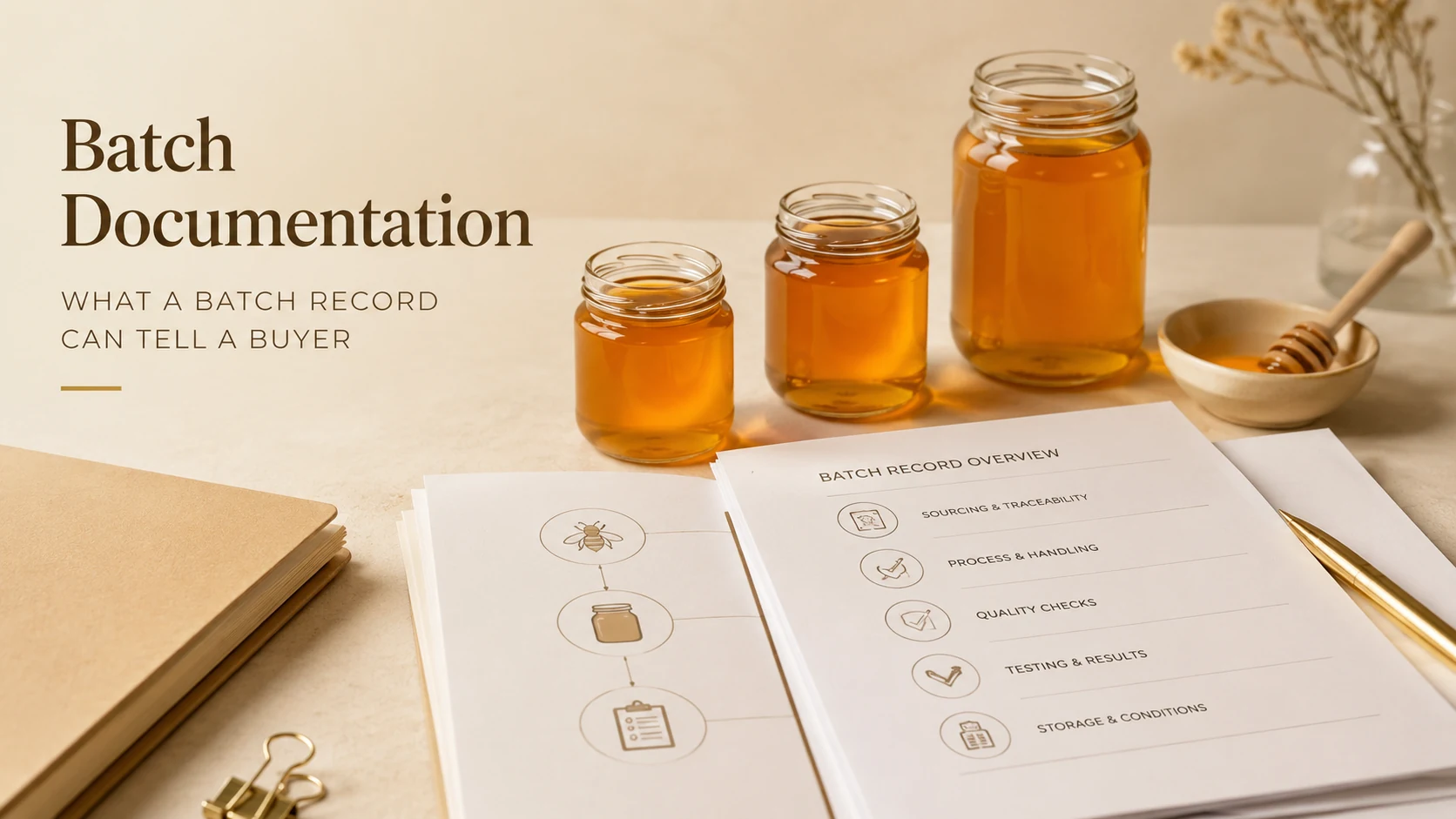

01 · Start with scope
What a Certificate of Analysis is—and is not
A COA is best treated as a report about a particular submitted sample. It usually records what was tested, how it was tested, the reported result and identifying information supplied by the client or laboratory. The exact format differs between laboratories, customers, schemes and destination markets. “COA” is therefore a practical commercial label, not a promise that every document with those three letters contains the same fields or has the same legal status.
The most important first question is not “Does a COA exist?” It is “What sample does this report describe, and how does that sample connect to the product being offered?” If the report number is real but the sample identity cannot be tied to the offered lot, the report may be accurate while still being commercially irrelevant to your purchase.
A COA also has boundaries. It does not, by itself, establish where the honey was produced, who owned it at each stage, whether a retail label complies in the destination country, whether every contractual specification was met, or whether the whole shipment is homogeneous. It should not be extended into a health or therapeutic claim. Those questions may require other records, an agreed sampling plan, further testing or destination-specific advice.
Independent laboratory work can strengthen confidence in a measured result. In Australia, NATA describes ISO/IEC 17025 accreditation as a framework supporting the validity and reliability of testing and calibration outputs. But accreditation is not a blanket statement that every method offered by a laboratory is accredited. Check the facility and the relevant activity in the current NATA scope listing, or the applicable accreditation body in the laboratory’s jurisdiction.
02 · Separate the documents
The five records a buyer may need to distinguish
Buyers sometimes ask for “the certificate” when they actually need several different forms of evidence. Treating them as separate documents makes gaps easier to see. The list below is a buyer framework, not a universal legal pack. A contract, retailer protocol, certification scheme or importing authority may require more, less or different evidence.
| Record | Primary purpose | What should match | Main limitation |
|---|---|---|---|
| Certificate of Analysis | Reports analytical findings for an identified sample. | Report, sample or batch ID, analyte, method, unit, result and date. | Does not automatically prove origin, label compliance or the whole shipment. |
| Product specification | Defines the product promised and the agreed acceptance criteria. | Product name, grade, parameters, limits, pack and revision. | A target is not evidence that a particular batch achieved it. |
| Origin evidence | Supports a production or country-of-origin statement. | Producer, location, lot identity and the claim intended for label or trade documents. | One document may not establish the full chain or satisfy every market. |
| Packing or release record | Connects bulk material to the finished packed lot and release decision. | Input lot, packed lot, date, line, quantity and authorised release. | Does not replace analytical evidence. |
| Shipment document | Identifies the goods and quantities moving in a transaction. | Lot, SKU, quantity, invoice, packing list and consignee details. | Describes the consignment; it is not a chemistry report. |
Origin deserves particular care because the meaning of “grown in”, “produced in”, “made in” and “packed in” is not interchangeable. The ACCC identifies honey as a priority food for Australian country-of-origin labelling and states that origin claims must be true, accurate and based on reasonable grounds. That is a labelling and substantiation question; a chemistry result alone is not a substitute for the origin evidence behind the claim.
Likewise, the Australia New Zealand Food Standards Code is legislation, while private association criteria and buyer specifications are different layers. A private scheme may add useful requirements, but it should be named accurately rather than described as “the law”.
03 · Read the whole page
How to read a COA line by line
Begin at the top and work down. Do not jump straight to the largest number or a marketing grade. Each field answers a different verification question, and qualifiers in a footer can materially change the meaning of a result.
Authorisation, scope statement, reporting limits, uncertainty, comments and terms would be read from the complete laboratory report.
| Field | Question to ask |
|---|---|
| Laboratory identity | Can the facility be independently found, and does the report show the correct location? |
| Report number and status | Is this the complete, current and authorised report rather than a draft, crop or superseded version? |
| Client and sample description | Who submitted the sample, and is the description laboratory-observed or client-supplied? |
| Sample or batch identity | Does it match the lot on the offer, product, packing record and shipment? |
| Dates | When was the sample received, tested and reported, and is that timing relevant to the intended release? |
| Analyte or parameter | What exactly was measured? Do not substitute a tier name for the analyte. |
| Method and scope | What method was used, and is the relevant activity covered where accreditation is claimed? |
| Result and unit | Read the numerical value with its unit, qualifier and reporting limit. |
| Acceptance statement | Which named specification, scheme or regulatory requirement is used for any pass or fail? |
| Authorisation and notes | Who authorised the report, and what conditions, uncertainty or limitations apply? |
Where the result is near an acceptance limit, ask how measurement uncertainty and rounding are handled in the decision rule. Where the report says “not detected” or “below reporting limit”, do not translate that into absolute absence without understanding the method’s reporting limit. If a report carries a conformity statement, identify the exact standard or customer specification behind it.
04 · Keep chemistry proportionate
What MGO, DHA, leptosperin and HMF can—and cannot—tell you
MGO. Methylglyoxal is a measurable chemical constituent that may be reported as a concentration, commonly in milligrams per kilogram. For a buyer, the disciplined approach is to compare the analyte, method, unit, result, date and batch with the agreed specification or named grading scheme. A concentration should not be converted into an unapproved medical promise, and one batch result should not be assumed to describe future batches.
DHA. Dihydroxyacetone occurs in Leptospermum nectar chemistry and can form MGO over time. A peer-reviewed Australian study investigated the DHA-producing capability of 55 of the 84 Leptospermum species native to Australia. That is a study of species-level nectar chemistry; it is not a statement that every Australian honey, every harvest or a future SELVEH product has a particular result.
Leptosperin. Leptosperin is used as a chemical marker in some research and authenticity frameworks. Its presence or concentration should be read within the method and the named scheme applying it. The Australian Manuka Honey Association notes that it investigates leptosperin in some authenticity work but does not require leptosperin testing on every member batch. That is AMHA’s scheme position, not a universal law or a claim of SELVEH participation.
HMF. Hydroxymethylfurfural is a quality parameter associated with heating and storage history in honey analysis. The Codex Standard for Honey lists HMF in an annex of additional composition and quality factors. Crucially, the Codex document says that annex is intended for voluntary application by commercial partners, not governments. A buyer should therefore confirm the applicable destination law, contract and method instead of treating a Codex annex value as an automatic Australian legal pass or fail.
These parameters answer different questions. A high or low number for one analyte does not by itself establish the full botanical origin, absence of adulteration, country of origin, shelf-life, safety, compliance or suitability for a particular claim. Decide first what the commercial or regulatory question is, then select the evidence and method capable of answering it.
05 · Match identity across the release
Matching the chain: COA → batch → specification → label → shipment
The most useful traceability review is not a pile of documents; it is a sequence of matching identifiers and approved facts. The following buyer verification framework shows one way to test the chain. It is not presented as a universal statutory record set.
Offered product
SKU, grade, pack and commercial description.
Lot or batch
The identity that follows the specific product quantity.
COA sample
Report and sample ID tied to the relevant lot.
Specification
Agreed parameters, limits and current revision.
Label & pack
Lot code and claims consistent with approved evidence.
Shipment
Invoice, packing list and quantities tied to the same release.
Work both directions. Starting from the shipment, can you reach the packed lot and the relevant COA? Starting from the COA sample, can you reach the specification and the actual goods? If a supplier blends, repacks or relabels product, ask how the original lot identity maps into the new packed lot. If several lots are combined, ask what sampling and release rule supports the finished batch.
For private schemes, inspect the scheme owner’s current rules and status rather than relying on a logo in a slide deck. AMHA states that its member suppliers maintain independent third-party COAs for all Mānuka honey batches they produce and market, together with batch traceability records. That statement is specific to AMHA member standards; it must not be generalised to every Australian supplier or to SELVEH.
Finally, identify which party controls each link. The laboratory controls its report. The producer or packer may control batch and packing records. The brand owner controls approved artwork. The exporter and importer control transaction records and destination compliance activities. A clean hand-off requires names, revision dates and responsibility—not just files in a shared folder.
06 · Know when to pause
Red flags before relying on a report
- Identity mismatch: the batch on the COA differs from the lot in the offer, label, packing record or shipment.
- Incomplete image: a cropped screenshot hides the report number, method, authorisation, scope statement or conditions.
- Missing unit or method: a number is promoted without the unit and analytical method needed to interpret it.
- Unverifiable laboratory: the facility, accreditation status or relevant scope cannot be independently confirmed.
- Undefined pass/fail: the report says “complies” without naming the specification, scheme, contract or law used.
- One result for every batch: a result from one sample is represented as permanent proof for other lots or future production.
- Origin by implication: chemistry, imagery or a packing location is used to imply an origin claim without the supporting chain.
- Scheme and law blurred: private membership, a mark or a customer protocol is described as mandatory government certification.
- Therapeutic leap: an analytical concentration is turned into a disease, treatment or individual health claim.
- Dates do not make sense: the report predates the relevant batch, follows shipment without explanation or refers to a stale specification.
A red flag is a prompt to investigate, not automatic proof of misconduct. Ask for the complete report, identify the missing link and record the response. If the issue affects food law, import eligibility, claims, safety or contract acceptance, use the relevant regulator, laboratory, accredited consultant or legal adviser for the destination market.
07 · Make the review repeatable
Buyer checklist before commitment
A repeatable checklist helps purchasing and QA teams reach the same questions before commercial pressure builds. At minimum, capture the offered product, lot identity, complete report, method and unit, applicable specification, laboratory scope, origin support, packing link, label status, destination requirements and unresolved evidence gaps.
Original-value asset · Buyer resource · No email gate
Mānuka Honey COA Buyer Checklist
Two print-ready pages covering batch identity, report reading, laboratory scope, connected records, destination gaps and red flags.
Use the checklist as a conversation framework, then adapt it to your organisation’s risk, contract and market. For example, a retailer may require a supplier approval pack, an importer may need specific official certificates, and a private-label buyer may need artwork controls and change-notification terms. Do not assume a generic COA satisfies any of those obligations.
08 · Questions buyers ask most
Practical COA questions for procurement teams
Is a COA the same as a product specification?
No. A product specification defines what has been agreed for the product; a COA or laboratory report records findings for an identified submitted sample. A buyer should compare the result with the applicable specification rather than treating the two documents as interchangeable.
Does a laboratory logo prove that every reported test is within an accredited scope?
No. Where accreditation matters to the transaction, verify the laboratory, facility and relevant activity or method in the accreditation body’s current scope. Accreditation should not be inferred from branding alone.
Can one COA support several finished packed lots?
Potentially, but not automatically. The buyer needs a documented relationship between the tested sample and the relevant bulk or finished lots, together with a sampling and release approach appropriate to the parameter, contract and destination requirements.
Does a COA prove Australian origin?
No. A COA may contain analytical results, but country of origin is a separate claim that needs supporting provenance and traceability evidence. Chemistry, packing location and brand ownership should not be used as substitutes for origin records.
09 · Current-stage disclosure
What SELVEH can state at the current development stage
As at 17 August 2026, SELVEH’s first collection remains in development. This article is an educational buyer guide, not a product release document. SELVEH is not using it to claim a final SKU, MGO grade, batch specification, pack, price, supplier, laboratory, every-batch testing program, completed certification, export-ready shipment or available stock.
When a final product is selected, any public analytical or origin statement should be tied to the relevant evidence and batch. Until then, placeholders, concept imagery and buyer frameworks must remain visibly separate from real product records. The illustrative COA above contains no laboratory logo, signature, batch number or test result for exactly that reason.
Our publishing process, sourcing rules, correction pathway and boundary between education and product claims are set out in the SELVEH Editorial Standards. The intended product-documentation principles are described separately in Our approach, without treating future intent as a completed capability. Related journal notes explain how to verify batch documentation, how to verify Australian origin and traceability and how to interpret MGO grades without overstatement.
For importers, distributors & premium retail
Evaluating an Australian Mānuka range for your market?
Tell us your destination, channel, intended volume and timing. We will separate confirmed information from open development questions.
Start a trade enquiryFor a line-by-line method for reading report identity, sample mapping, results, units, laboratory scope and qualifiers, use How to Read a Mānuka Honey Certificate of Analysis (COA): A Buyer’s Guide.
Primary references
- NATA — ISO/IEC 17025 testing and calibration accreditation
- NATA — Search accredited organisations and scopes
- FSANZ — Food Standards Code legislation
- ACCC — Country of origin food labelling
- Australian Manuka Honey Association — Quality standards
- Australian Manuka Honey Association — Mark of Authenticity
- Codex Alimentarius — Standard for Honey, CXS 12-1981
- Williams et al. (2018) — Dihydroxyacetone production in Australian Leptospermum nectar
- Cokcetin et al. (2016) — Australian Leptospermum honey chemistry and in-vitro antibacterial activity
Source review: Primary and official sources were reviewed on 17 August 2026. Re-review is triggered by a material source, law, scheme or regulatory change, or when new first-party SELVEH supplier, batch, packing or buyer evidence becomes available.
This article is general educational information for trade and quality conversations. It is not legal, regulatory, scientific or medical advice; it does not prescribe a universal document set; and it does not certify any SELVEH product, batch, supplier, laboratory or scheme status. Destination requirements and source pages can change, so verify the current rules before a commercial decision. Read our Editorial Standards.