01 · Start with the measurement
What MGO actually measures
MGO is shorthand for methylglyoxal. In honey analysis it is reported as a concentration, commonly in mg/kg. It is not a percentage, a score out of a maximum or a universal quality grade.
If a laboratory report states an MGO result of 287 mg/kg, that means the tested sample contained 287 milligrams of methylglyoxal per kilogram of honey under the reported method and conditions. If the agreed commercial specification requires MGO ≥250 mg/kg and the sample belongs to the offered lot, that result may support an MGO 250+ commercial statement. The analytical result and the marketing grade are related, but they are not the same thing.
| Layer | Buyer question |
|---|---|
| Label or offer | What MGO tier is being represented? |
| Product specification | What minimum result has been agreed for that SKU or grade? |
| Laboratory report | What MGO concentration was actually measured, in what unit and by what method? |
| Batch identity | Does the tested sample belong to the lot being purchased? |
02 · Read the plus sign carefully
What MGO 100+, 250+ or 400+ is intended to communicate
Commercial MGO tiers are usually threshold-style statements: the “+” is intended to indicate that the product meets at least the stated concentration rather than containing exactly that number. A buyer should still identify the governing specification or scheme instead of assuming every supplier assigns and verifies grades in exactly the same way.
For procurement, four items should agree: the grade on the offer, the minimum in the current specification, the actual laboratory result and the batch identity. A polished label cannot resolve a mismatch between those records.
It is also worth separating a minimum specification from an actual test result. If the specification is MGO ≥250 mg/kg and the batch tests at 312 mg/kg, the commercial tier may still be MGO 250+. The 312 mg/kg result is evidence about that sample; it does not automatically create a new permanent grade for future production.
03 · Understand the precursor
How DHA relates to MGO
Dihydroxyacetone, or DHA, occurs in the nectar of some Leptospermum species and can convert non-enzymatically to MGO after nectar becomes honey. Australian research has shown that DHA production varies substantially by Leptospermum species, which is one reason analytical profiles can vary between botanical sources and harvests.
A peer-reviewed Australian study of 55 native Leptospermum species reported wide variation in nectar DHA production. Separate research on Australian Leptospermum honeys found MGO concentrations varied substantially across samples and were strongly associated with non-peroxide antibacterial activity in the studied honeys.
The procurement implication is simple: MGO is a batch parameter, not a permanent attribute of a supplier or brand. Harvest, floral source, starting composition, maturation and storage history can affect the analytical profile. A strong result from one lot does not prove the same result for the next lot.
Read the underlying studies at PubMed — Williams et al. (2018) and PubMed — Cokcetin et al. (2016).
04 · Keep grading systems distinct
MGO and NPA are related, but they are not the same measurement
MGO is a chemical concentration. NPA, or non-peroxide activity, is an activity measurement. Research has reported a strong relationship between MGO concentration and NPA in Australian Leptospermum honey samples, but the terms remain analytically different.
That distinction matters when comparing supplier documents. Do not convert an MGO number into NPA, UMF or another proprietary grade simply because online conversion tables exist. Where a private grading or authenticity scheme is used, review the current rules published by the scheme owner and determine exactly which tests, thresholds, licensing conditions and labels apply.
05 · Do not let one number carry too much meaning
A high MGO result does not, by itself, prove authenticity or origin
This is the most important limit to understand. MGO answers a specific analytical question. It does not independently establish botanical authenticity, Australian origin, chain of custody, absence of adulteration, regulatory compliance, shelf-life, packaging quality or suitability for a health claim.
The Australian Manuka Honey Association’s own Mark of Authenticity framework illustrates why. Under its published criteria, honey carrying the relevant AMHA marks must be Australian-produced and independently tested against scheme criteria that include both MGO and DHA, together with identity controls. Those are AMHA scheme requirements, not a universal legal definition and not a claim that SELVEH currently holds the mark.
AMHA currently publishes minimum MGO and DHA thresholds for its “Authorised” and “Authentic” marks and describes additional identity controls. Buyers should verify the current scheme directly rather than relying on an old screenshot, distributor slide or third-party summary: AMHA — Criteria for defining Australian Manuka Honey.
06 · Read the laboratory evidence
A six-field check before relying on an MGO result
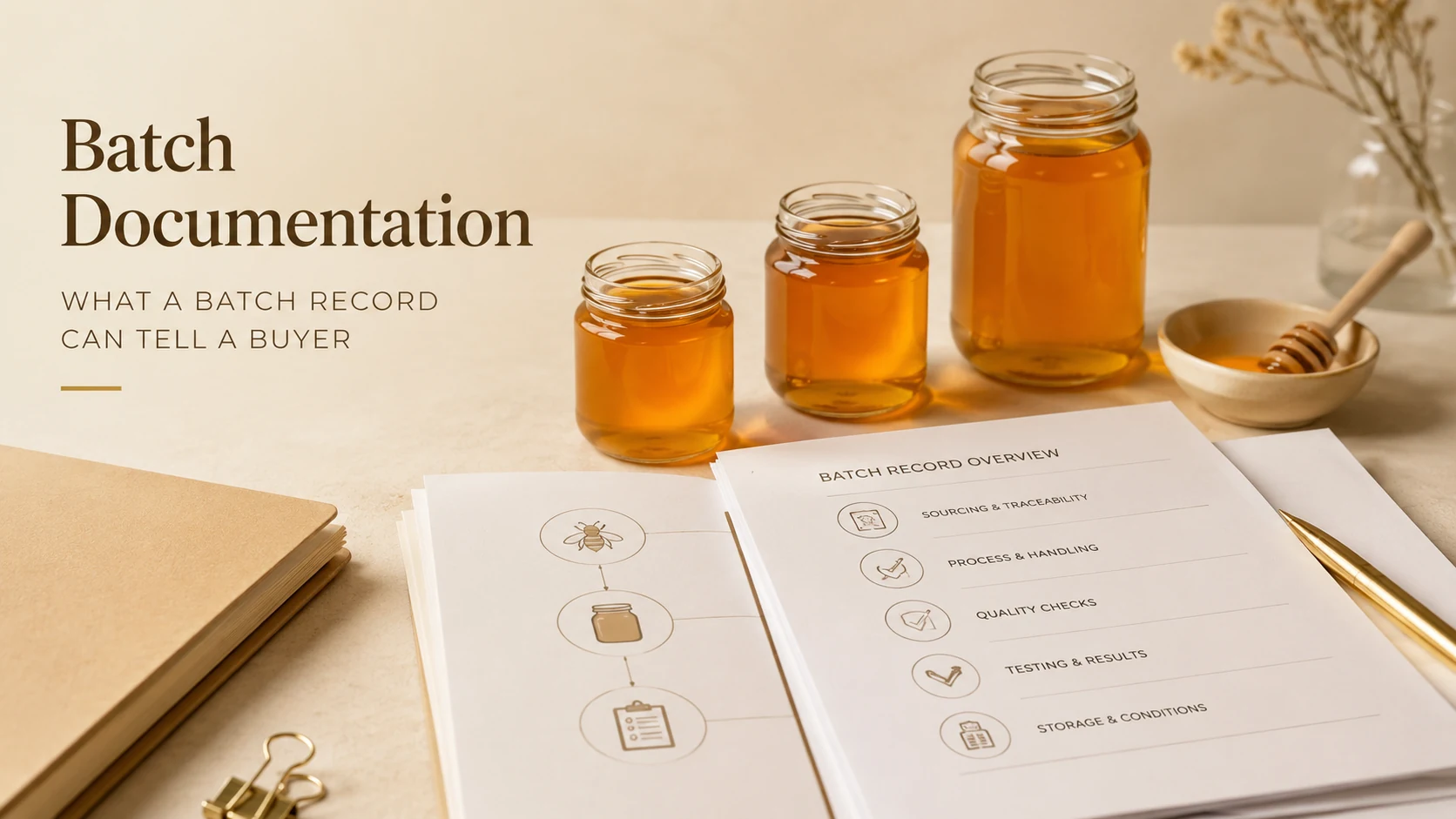
For a trade purchase, read the complete laboratory report rather than a cropped result or front-label claim. The detailed COA workflow belongs in our COA, Batch Testing & Traceability buyer guide; for MGO specifically, start with these six fields.
| Field | What to verify |
|---|---|
| Analyte | Does the report explicitly identify methylglyoxal / MGO? |
| Result | What numerical concentration was measured? |
| Unit | Is the result reported in mg/kg or another clearly defined unit? |
| Method | What analytical method was used and what does the report say about scope or limitations? |
| Sample identity | Which sample, lot or batch was submitted? |
| Dates | When was the sample received, tested and reported? |
If accreditation is material to the purchase, verify the laboratory and the relevant scope rather than assuming every activity performed by an accredited organisation is automatically covered. NATA explains ISO/IEC 17025 testing and calibration accreditation and provides a searchable organisation directory.
For a line-by-line COA review covering sample identity, methods, units, accreditation scope and report qualifiers, use How to Read a Mānuka Honey Certificate of Analysis (COA): A Buyer’s Guide.
07 · Compare like with like
How procurement teams should compare two MGO offers
Two suppliers can both write “MGO 250+” while presenting very different levels of evidence. Supplier A may provide a current specification, an identified lot and a complete laboratory report. Supplier B may provide a lower price and an old certificate that cannot be tied to the offered stock. The headline grade is the same; the procurement risk is not.
Record at least: offered grade → actual result → lot identity → laboratory/report → current specification → origin support → pack format → quantity → price → lead time → unresolved evidence gaps.
| Question | Offer A | Offer B |
|---|---|---|
| Stated grade | MGO 250+ | MGO 250+ |
| Actual result shown | Yes, current report | Yes, historical report |
| Result tied to offered lot | Clear | Unclear |
| Specification supplied | Current revision | Not supplied |
| Next action | Continue commercial review | Resolve evidence gap before comparison |
The example is deliberately simplified. It shows why price-per-jar comparisons become unreliable when the underlying evidence is not equivalent.
Original-value asset · Template / buyer resource · No email gate
MGO Offer Comparison Worksheet
A two-page side-by-side worksheet for comparing grade claims, actual MGO results, batch identity, laboratory evidence, origin support, MOQ, price date and unresolved gaps.
08 · Know when to pause
Red flags when evaluating an MGO offer
- Only a front-label image: no underlying analytical result is supplied.
- No unit: an MGO number appears without mg/kg or another defined unit.
- Cropped certificate: report identity, sample identity, method, authorisation or notes are hidden.
- Batch mismatch: the report refers to a different or unidentified lot.
- Historical result used indefinitely: one sample is presented as proof for future batches.
- “Government certified MGO” language: a private grade or laboratory result is blurred with law or official certification.
- Authenticity by one analyte: MGO alone is presented as complete proof of Australian origin or botanical identity.
- Unexplained conversions: MGO is automatically converted into another grading system without naming its rules.
- Therapeutic leap: a concentration result is turned into a disease-treatment or individual health promise.
A red flag is a prompt for clarification, not automatic proof of misconduct. Request the complete record, identify the exact missing link and document the response.
09 · Questions buyers ask most
Practical MGO questions for procurement
Is a higher MGO number always better?
Not automatically. A higher result means more MGO was measured in the tested sample. Whether that is commercially preferable depends on product positioning, target customer, price, supply consistency, specification and market requirements.
For a focused portfolio decision, compare the commercial roles, pack economics and inventory exposure in the MGO 100+ versus MGO 250+ wholesale buyer guide.
Does MGO prove the honey is Australian Mānuka?
No. Australian origin and botanical identity require their own supporting evidence. Private authenticity schemes may apply multiple analytical and traceability criteria.
Are MGO and DHA the same thing?
No. DHA is a precursor found in the nectar chemistry of some Leptospermum species; MGO can form from DHA in honey over time. Both can be measured independently.
Can one COA support every future batch?
No. A laboratory report describes the submitted sample identified on that report. The buyer should connect that sample to the relevant lot and avoid carrying the result forward without evidence.
Should a buyer ask for the actual laboratory report?
For a material procurement decision, the underlying report is more informative than a marketing tier alone. Review it together with the batch identity, specification and other transaction evidence.
10 · Current-stage disclosure
What SELVEH can state today
As at 17 August 2026, SELVEH’s first Australian Mānuka collection remains in development. This guide does not claim a final MGO grade, supplier, batch, laboratory, certification, inventory position or every-batch testing programme for SELVEH.
When a final product and lot are confirmed, any analytical statement should be tied to the evidence applicable to that release. Until then, illustrative examples remain visibly separate from real batch records. Our broader documentation framework is set out in Australian Mānuka Honey COA, Batch Testing & Traceability; the operational role of lot identity is covered in Mānuka Honey Batch Documentation; and origin evidence is covered in Australian Mānuka Honey Origin & Traceability.
For importers, distributors & premium retail
Evaluating MGO grades for your market?
Tell us your destination, intended grade, pack format, initial volume and timing. We will separate confirmed evidence from open development questions.
Start a trade enquiryPrimary references
- Australian Manuka Honey Association — Criteria for defining Australian Manuka Honey
- Australian Manuka Honey Association — Quality standards
- Williams et al. (2018) — DHA production in Australian Leptospermum nectar
- Cokcetin et al. (2016) — Australian Leptospermum honey chemistry and in-vitro antibacterial activity
- NATA — ISO/IEC 17025 testing and calibration accreditation
Source review: Primary and official sources were reviewed on 17 August 2026. Re-review is triggered by a material source, law, scheme or regulatory change, or when new first-party SELVEH supplier, batch, packing or buyer evidence becomes available.
This article is general educational information for trade and quality conversations. It is not legal, regulatory, scientific or medical advice and does not certify any SELVEH product, batch, supplier, laboratory or private-scheme status. Scheme criteria and destination requirements can change; verify the current source before a commercial decision. Read our Editorial Standards.