
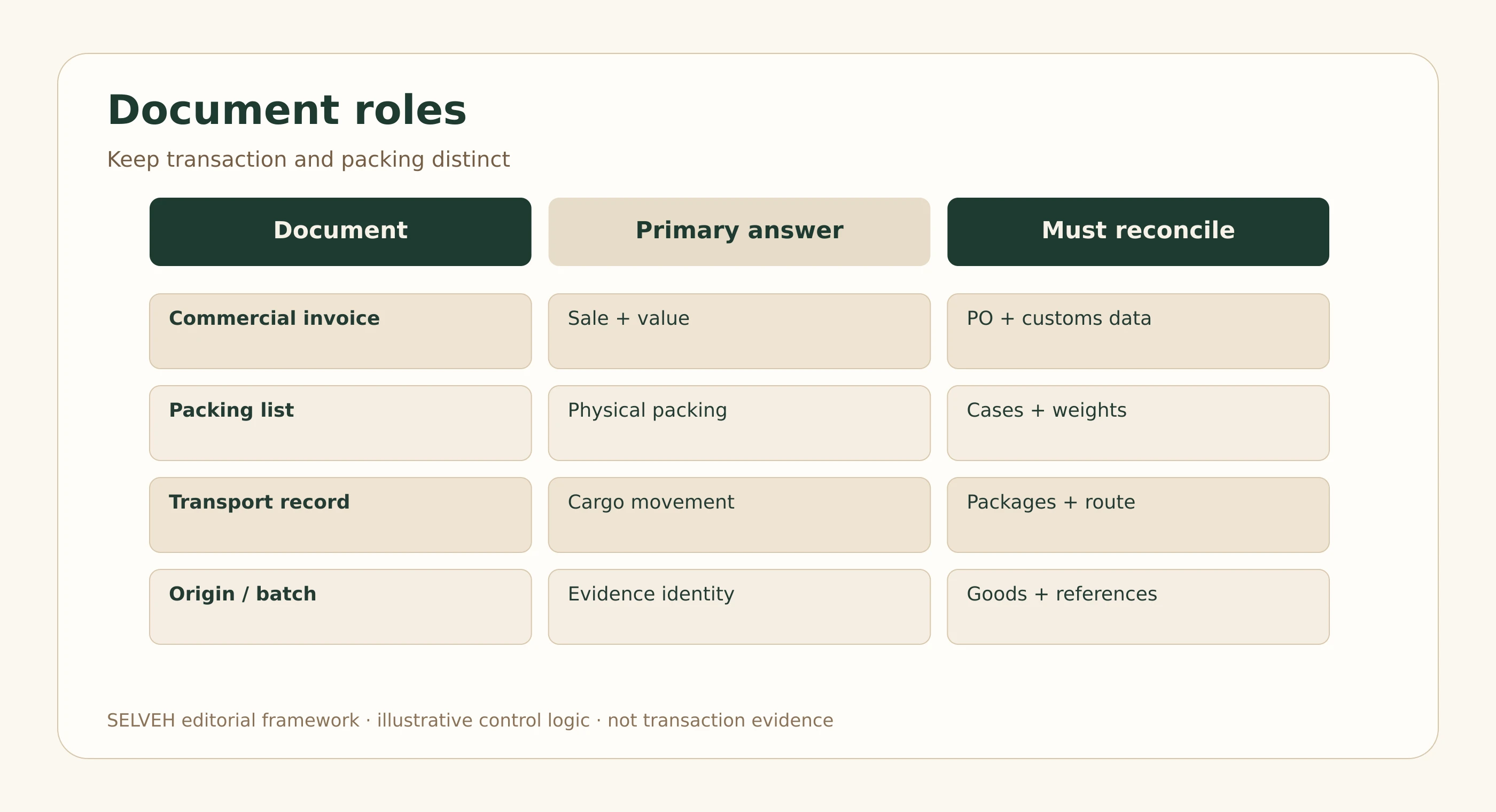
01 · Document roles
Keep the commercial invoice and packing list separate
A commercial invoice records the sale or declared transaction: seller, buyer, consignee where relevant, goods, quantity, price, currency, terms and value. A packing list records the physical arrangement: cases, pallets, dimensions, net and gross weights, marks and item allocation.
Combining both into one page can be convenient, but the fields still answer different questions. Customs, the importer, freight forwarder, bank and warehouse may each rely on a different part of the set.
02 · Shipment master
Create one source of truth before drafting documents
Set up a shipment master containing the purchase-order number, seller, buyer, importer, consignee, notify party, product/SKU codes, descriptions, MGO claim, pack size, units per case, case count, pallets, lot or batch references, Incoterm and named place, currency, unit price, total value, dates and transport booking references.
Every downstream document should draw from that controlled master. Manual retyping invites small differences that become material at clearance: “250 g” versus “0.25 kg”, a former importer address, an old invoice number or a case count copied from the quotation rather than final packing.
Name an owner for commercial data and an owner for physical packing data. Both must approve the final set.
03 · Commercial invoice
Make the commercial transaction legible
The invoice should identify the issuer and customer, invoice number and date, purchase-order reference, consignee where different, product description, quantity and unit, unit price, total line value, currency, Incoterm with named place, payment terms, origin statement where appropriate and authorised contact or declaration where required by the route.
Descriptions should be specific enough for the buyer, broker and customs declaration. “Food products” is weak. A controlled description might identify Australian Mānuka honey, retail jar size, declared grade, units and case configuration without inserting unsupported promotional claims.
Do not use “no commercial value” for a commercial shipment. For samples, state an honest value for customs purposes and follow the destination’s sample rules.
04 · Packing list
Show exactly how the goods are packed
The packing list should identify the shipment and invoice, package numbering, marks, SKU allocation, units per case, case count, pallet count, package type, net weight, gross weight, dimensions and totals. Where batches are split across cases or pallets, show the mapping needed for receiving and traceability.
Net weight can mean honey content, net product weight or weight excluding transport packaging depending on the context. Label the field. Gross weight should reflect the physical shipment used for transport planning, not a design estimate.
| Field | Invoice focus | Packing-list focus |
|---|---|---|
| Quantity | Sold units and pricing unit | Units by case and pallet |
| Weight | May support item description/value | Net and gross transport totals |
| Batch | Where required for transaction/control | Physical lot-to-package map |
| Value | Unit and total transaction value | Usually not the primary role |
05 · Value & classification
Align invoice value, customs value and HS data without pretending they are identical
The commercial invoice provides key evidence of the price paid or payable. Customs valuation may require additions or another method under the destination’s rules. Singapore Customs states that a valid transaction-value case requires evidence of a sale, such as a commercial invoice, sales contract or purchase order.
Record the agreed HS classification separately and make sure the plain-language description supports rather than contradicts it. Business.gov.au notes that HS codes are used on commercial invoices, bills of lading and customs documents.
Do not manipulate the invoice to equal an internal landed-cost sheet. The broker should be able to trace every customs adjustment to supporting data.
06 · Batch connection
Connect commercial documents to the actual Mānuka lot
For Mānuka honey, the document set should allow the buyer to connect the finished jars to the applicable product specification, batch or lot, COA and packing record. The invoice and packing list do not prove MGO or authenticity, but they should not break the identity chain.
If several lots or grades share a shipment, separate them by SKU and case or pallet reference. Do not use one broad description that makes the COA-to-goods mapping impossible.
Where the Certificate of Origin, export certificate or import permit uses a particular goods description, reconcile the wording before release. Similar meaning is not always sufficient when codes, quantities or origin criteria differ.
07 · Australian export
Reconcile the document set to the export declaration
Australian Border Force states that export goods must be reported using an Export Declaration or exemption code, and that mandatory declaration fields must be completed before export. Relevant documentation must be retained for five years.
The exporter or agent should check that consignor, consignee, goods description, value, currency, quantity, destination and transport details agree with the commercial documents and booking. Changes should be amended through the correct declaration process.
The commercial invoice is not the Export Declaration, and the packing list is not an authority to deal. Keep the statuses separate.
08 · Singapore clearance
Give the Singapore importer a clearance-ready set
Singapore Customs lists the commercial invoice, packing list and bill of lading or air waybill among supporting documents used for clearance of conventional cargo. Its guidance also requires traders to retain commercial invoices, transport documents, packing lists, certificates and other transaction records.
Before permit submission, the importer or declaring agent should confirm importer identity, UEN, HS classification, customs value, GST treatment, product description, quantities and relevant SFA requirements. The exporter should not guess how the importer wants fields declared.
Send a draft set early enough for broker review, then issue controlled finals after physical packing.
09 · UAE clearance
For Dubai, keep invoice, packing and origin documents aligned
Dubai Customs lists invoice, packing list, Certificate of Origin and permits from restriction entities among documents for customs declaration. That does not make the documents interchangeable.
The invoice value and Incoterm should support customs valuation; the packing list should support quantities and physical inspection; the origin proof should support its defined origin purpose; and the food importer should close any product or authority permit requirements.
If UAE CEPA preference is intended, ensure the origin document, invoice and goods description can be reconciled before the importer makes the claim.
10 · Reconciliation
Run field-by-field checks before cargo handover
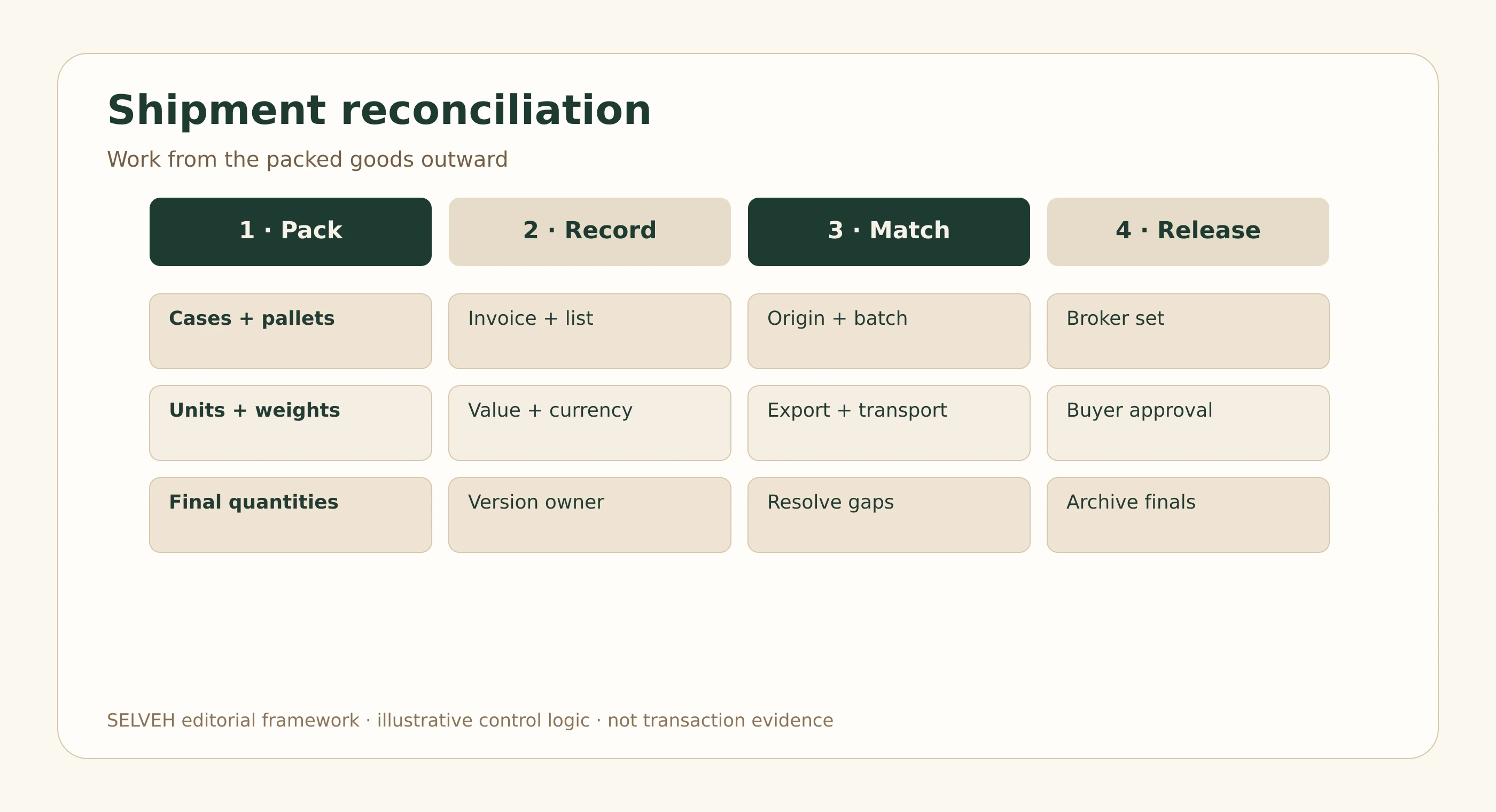
Compare invoice, packing list, purchase order, specification, batch record, COA, Certificate of Origin, export declaration and transport document. Check parties, addresses, references, product, HS code, pack size, grade, batch, cases, units, net and gross weight, value, currency, Incoterm, origin and shipment dates.
11 · Corrections
Control drafts, finals and post-release amendments
Mark drafts clearly. Use unique invoice and packing-list numbers or revisions, retain the issue date and record the person authorised to release each final. Superseded documents should remain traceable but unavailable for operational use.
If packing changes after document issue, stop and assess every affected record. A case-count change may alter weight, value, Certificate of Origin quantity, export declaration and transport booking.
Do not send an informal spreadsheet and a signed PDF with different totals. The buyer, broker and carrier need one current set.
12 · Buyer tool
Use a reconciliation checklist tied to the physical shipment
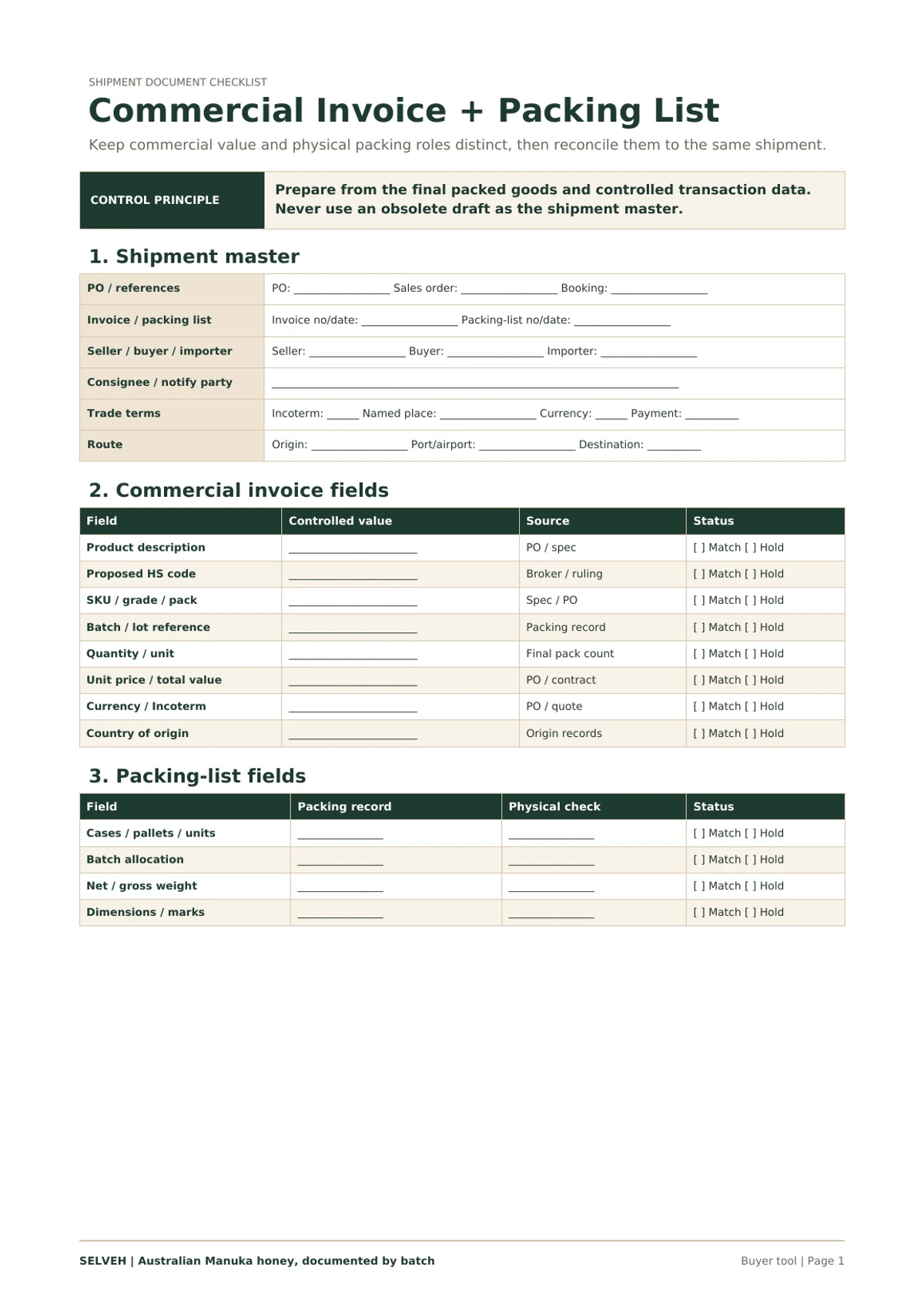
The downloadable checklist separates transaction, packing, batch, origin, export and transport fields. It records matches, discrepancies, owners, corrections and final release status.
This tool is not a commercial invoice, customs declaration, packing instruction, tax invoice or substitute for destination broker advice.
13 · Red flags
Investigate these document sets
- The invoice and packing list use different product descriptions or quantities.
- The goods are described only as “samples” or “food products” without adequate identity.
- The packing list was prepared from the order rather than final packed quantities.
- Net and gross weights are copied from estimates and never verified.
- The invoice value is changed to match a desired duty result.
- A corrected PDF is issued without updating the broker, origin or transport documents.
14 · Buyer FAQ
Frequently asked questions
Can the invoice and packing list be combined?
They can share a document, but the transaction and physical-packing fields must remain clear and complete for the actual route.
Should batch numbers appear on both documents?
Include them where required by the buyer, destination or control system. At minimum, the document set must preserve a reliable link from shipment to batch evidence.
Is a pro forma invoice enough for customs clearance?
A pro forma invoice supports quotation or pre-shipment processes; the actual customs and banking route may require a final commercial invoice. Confirm with the importer and broker.
Who should issue the documents?
The legal and operational issuer depends on the transaction structure. The seller/exporter, packer, agent and importer should agree ownership before shipment.
15 · SELVEH status
What SELVEH can state today
SELVEH can define the fields and reconciliation controls it intends to use for future export documents.
SELVEH should not publish a real invoice, packing list, exporter declaration, shipment number, importer identity, customs value, batch allocation or clearance result until the actual transaction and controlled documents exist.
Sources
Official export and customs sources
- Business.gov.au - Documents for exporting
- Business.gov.au - Freight and logistics
- Australian Border Force - Export declaration
- Australian Border Force - Export requirements
- Singapore Customs - Documents for clearance of goods
- Singapore Customs - Retaining trade documents
- Dubai Customs - Submit Customs Declaration
Source review: Official sources reviewed 24 August 2026. Document fields and clearance practice depend on the shipment, broker, transport mode and destination; confirm the final set before release.
Trade planning
Need a clean buyer document set for a planned shipment?
Tell us the destination, pack, order structure and delivery term. We will map the transaction, packing and evidence fields that should reconcile before release.
Start a trade enquiry