

01 · Governance
Use the agreement to control responsibilities
A product specification can define composition, MGO criterion, packaging, coding and evidence. It does not necessarily say who approves a deviation at 4 pm before dispatch, who informs the importer of a material change or who owns the investigation after a claim. A quality agreement closes those operational gaps.
It may sit beside a supply agreement and transaction documents. It should be reviewed by appropriate quality and legal advisers for the actual parties and markets. It is not a universal statutory form and does not replace food law, recall obligations or the commercial contract.
02 · Document hierarchy
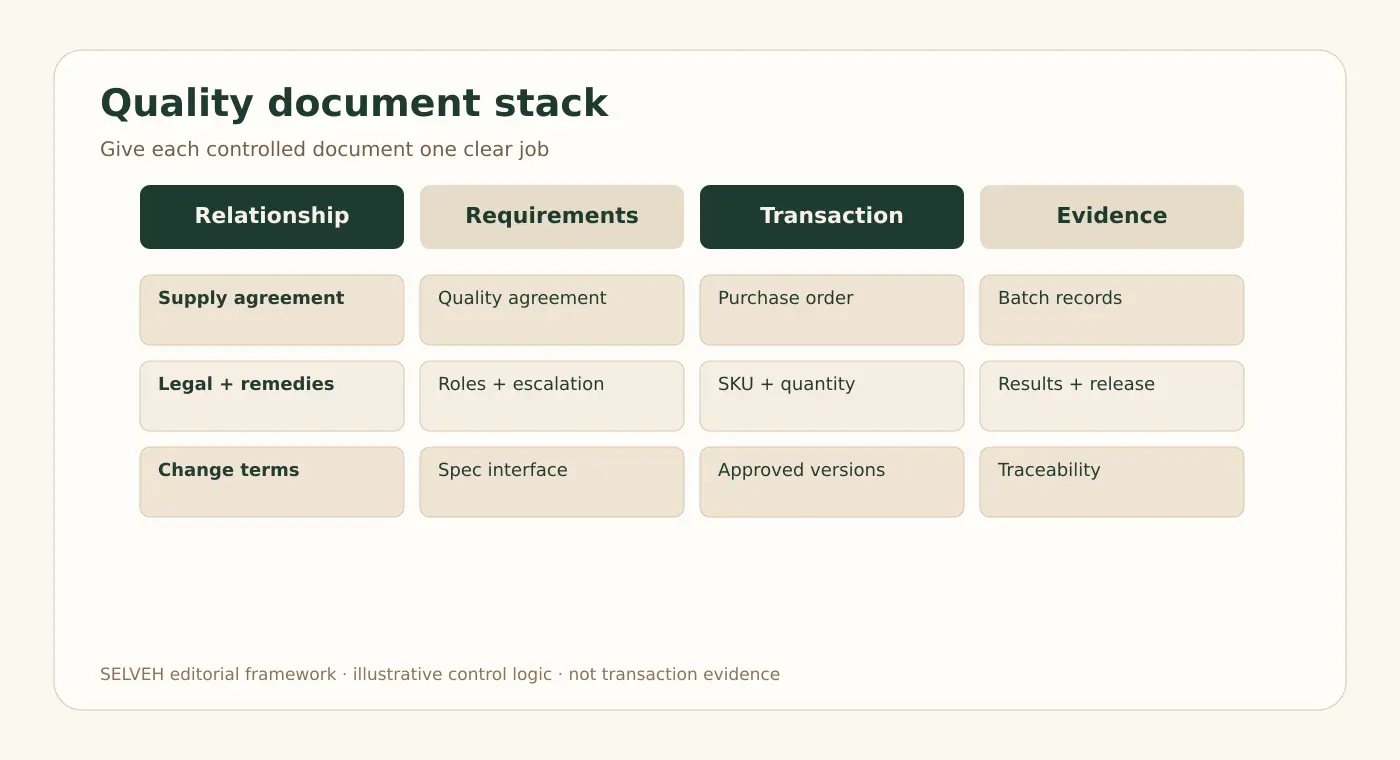
Separate the documents and define precedence
| Document | Primary question | Control |
|---|---|---|
| Supply agreement | What governs the relationship and remedies? | Executed terms and amendments |
| Quality agreement | Who controls quality events and evidence? | Roles, timing, authority and escalation |
| Product specification | What must the product and pack meet? | Versioned requirements and criteria |
| Purchase order | What is being ordered now? | SKU, quantity, term and references |
| Batch records / COA | What happened for this batch? | Identifiers, results and release |
State the precedence rule if documents conflict. “Latest specification” is unsafe language unless the version and approval route are controlled.
03 · Responsibility map
Name owners, deputies and response times
Identify quality, regulatory, operations and commercial contacts for both parties, including deputies and after-hours routes for urgent safety matters. Define who can approve specifications, artwork, suppliers, laboratories, batch release, deviations, rework, destruction, credit and recall communications.
A responsibility matrix should distinguish who performs, reviews, approves, is consulted and is notified. Avoid shared language such as “the parties will manage” where a time-critical decision needs one accountable owner.
Record escalation times in hours or business days and define the applicable time zone.
04 · Specification interface
Turn important requirements into evidence
For every material criterion, name the requirement, method or record, sampling or inspection basis where relevant, acceptance limit, timing and decision owner. Requirements may cover product identity, MGO evidence, net quantity, packaging components, artwork, coding, case configuration and shipment records.
A generic certificate is not automatically evidence for a shipped batch. Identifiers should reconcile across the product, COA, release record, cases, invoice and packing list. If the buyer requires a particular laboratory, method or report format, agree it before production.
Use the product specification guide to define the “what”.
05 · Change notification
Control changes before they affect saleable stock
Define which changes require notification, risk review or prior approval. Examples may include honey source, formulation or blending approach, manufacturing site, significant process, test method, laboratory, jar, closure, seal, label material, case, coding method, storage route or approved specification.
The change notice should state reason, affected SKUs and batches, old and new state, evidence, regulatory assessment, inventory impact and proposed effective date. The buyer then approves, rejects or sets conditions under the contractual authority.
Emergency changes need a documented temporary route and retrospective closure; urgency should not erase traceability.
06 · Batch release
Define release gates and hold authority
State whether the manufacturer, brand owner, exporter or buyer performs each release review and whether buyer approval is required before dispatch. List mandatory evidence and the consequences of missing, late or inconsistent records.
Separate manufacturing completion from quality release and commercial shipment approval. Finished jars may exist while evidence remains on hold. No team should infer release merely because a freight booking or customer deadline exists.
The batch-to-dispatch checklist can support the transaction record.
07 · Deviation control
Approve exceptions before using them as precedent
A deviation is a documented departure from an approved requirement or procedure. Record what changed, why, affected product, risk assessment, evidence, proposed disposition, authority and expiry. A concession for one batch should not silently rewrite the specification for later orders.
Do not use a deviation to bypass a legal requirement or make unsupported label claims. Determine whether the issue affects food safety, legality, identity, agreed quality, packaging function, traceability or commercial presentation.
Where the decision depends on destination law, obtain advice from the appointed importer or qualified adviser.
08 · Non-conformance
Contain first, then classify the issue
When a possible non-conformance appears, identify and preserve the affected stock and evidence. Apply hold or quarantine where appropriate, stop further use or dispatch when necessary and record batch, quantity, location and reporter. Avoid relabelling, mixing or destroying evidence before an authorised decision.
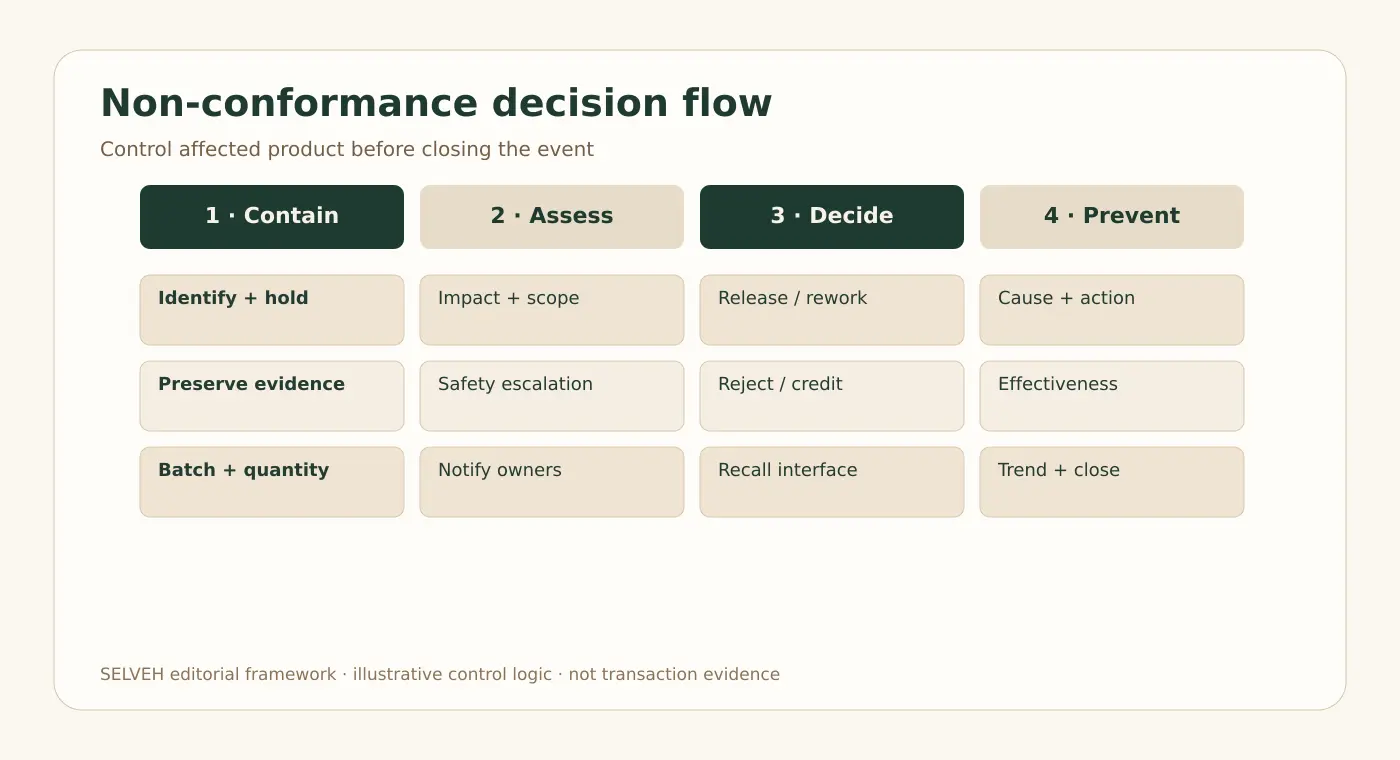
Classify the potential impact and notification urgency. A damaged outer case, a coding mismatch, missing batch evidence and a possible safety issue require different escalation even if all are called “non-conformance”.
09 · Investigation
Require evidence, cause and corrective action
An investigation should distinguish the observed condition from an assumed cause. Preserve photographs, samples where appropriate, records, timelines and custody. Compare the affected batch and documents against the approved specification and process evidence.
Record immediate correction, root-cause analysis where proportionate, corrective action, preventive control, owner, due date and effectiveness check. Closing a complaint with a replacement shipment may settle the commercial symptom without controlling recurrence.
Trend recurring defects, late evidence, transport damage and coding errors by supplier, SKU, component, batch and route where data supports it.
10 · Buyer claims
Define the claim notice and decision route
The agreement should define the claim window, notice channel, minimum evidence, affected-quantity preservation, inspection access and response times. It should also connect possible outcomes—release, rework, replacement, credit, rejection, destruction or another agreed disposition—to authorised commercial terms.
Acceptance criteria must be objective. A buyer should not rely on subjective dissatisfaction to reject conforming stock, and a seller should not use delivery acceptance to erase a latent or safety-related issue where the contract or law provides otherwise.
Keep payment treatment aligned with the payment-terms framework so a claim does not create an undefined finance dispute.
11 · Safety escalation
Connect complaints, withdrawal and recall
Not every quality issue is a recall, but the escalation path must allow rapid safety assessment. FSANZ describes a food recall as action to remove unsafe food from distribution, sale and consumption. Its protocol sets out roles, steps, legal requirements and important elements of a recall plan.
Australian food businesses engaged in manufacture, importation or wholesale supply must have a written recall system under the applicable Food Standards Code requirement described by FSANZ. A private quality agreement should identify how parties notify and support one another; it should not pretend to replace the responsible business’s recall plan or regulator contact.
Define who can initiate a hold, who contacts the relevant authorities and direct customers, and how public communications are approved. Safety escalation must not wait for a commercial blame decision.
12 · Records
Make affected product findable
FSANZ guidance says traceability should enable a business to know where food came from and where it goes. Relevant records include supplier and customer details, transaction and delivery dates, batch or lot identifiers, quantities and production information.
The agreement should define record owners, formats, access, retention basis, backup and retrieval time. Distribution records must distinguish countries, customers and quantities so an affected scope can be calculated rather than guessed.
Test the system periodically with a mock trace or recall exercise appropriate to the business. Record gaps and close them.
13 · Information control
Protect evidence without blocking action
Quality records can contain commercially sensitive supplier, formulation, test, customer and distribution information. Define confidentiality, permitted use and secure exchange while preserving necessary access for regulators, advisers and emergency response under the applicable terms.
Control originals and versions. Email attachments with the same file name can produce conflicting evidence. Use a stable identifier, revision, approval date and superseded-record archive.
Data access must be fast enough for investigation or recall. Confidentiality should not become a reason that the responsible team cannot locate affected stock.
14 · Buyer tool
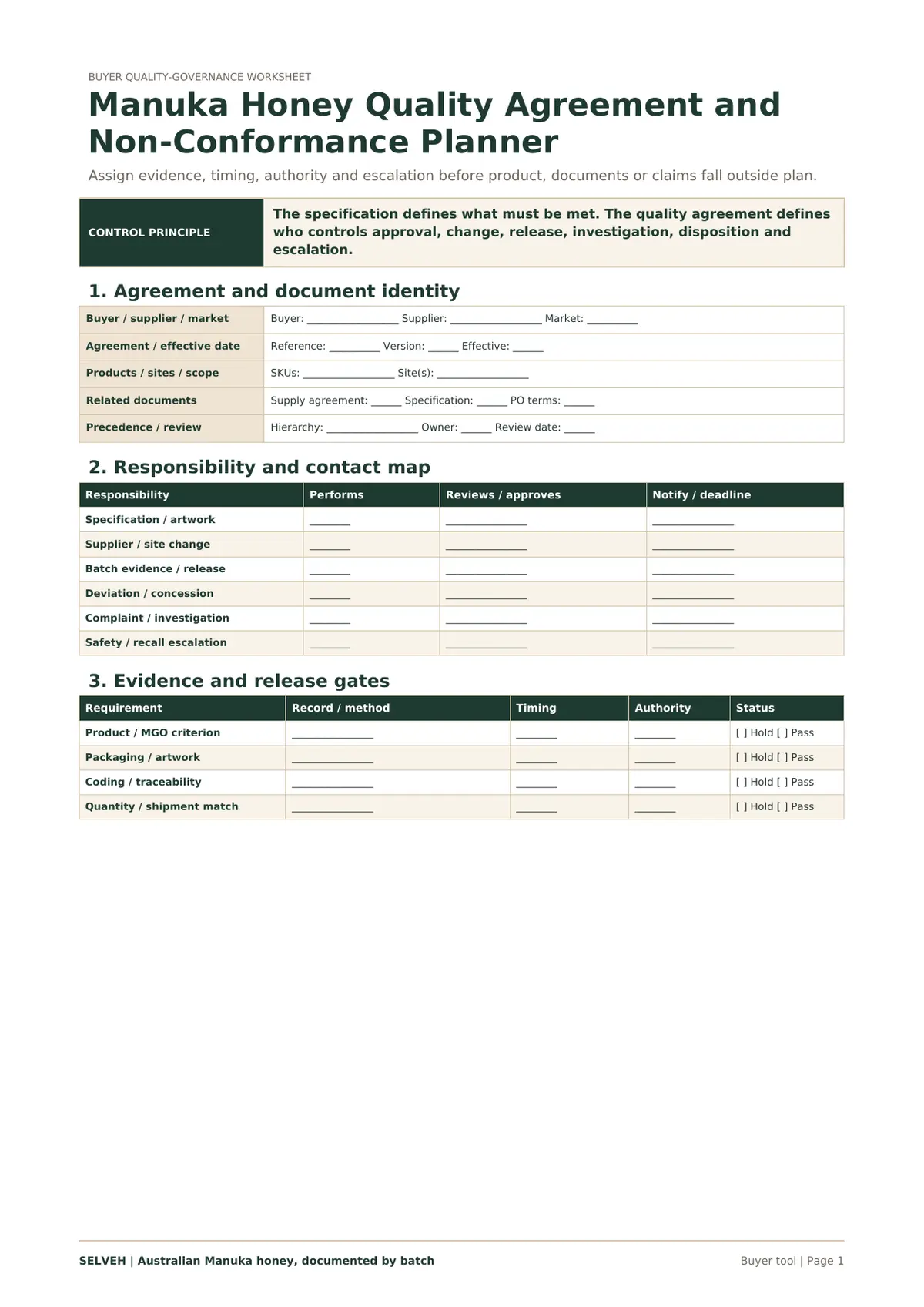
Download the quality agreement planner
The two-page planner captures document hierarchy, contacts, responsibilities, specification and batch evidence, change notification, non-conformance triage, investigation, disposition, claims, traceability and recall interfaces.
Use it to prepare an agreement or supplier discussion. It is not a legal contract, certification, audit, recall plan, regulatory approval or proof that a supplier or SELVEH currently operates the listed controls.
15 · Review triggers
Investigate these quality arrangements
- The agreement repeats specifications but assigns no decision owners.
- “Notify promptly” has no event, deadline, channel or contact.
- Supplier or component changes can occur without risk review.
- Finished goods are treated as released before required evidence is approved.
- Non-conforming stock has no identification, hold or disposition record.
- A commercial credit closes the issue without cause or recurrence review.
- Recall responsibility is buried inside a routine complaint process.
- Batch and customer distribution records cannot be retrieved quickly.
16 · Buyer FAQ
Frequently asked questions
Is a quality agreement legally required for every order?
Not as a universal named document. Its value is operational clarity. Applicable food, contract and recall obligations still require separate review.
Can the product specification replace it?
No. The specification defines requirements; the agreement assigns responsibilities, communication, authority and response.
Who decides whether stock can be reworked or released?
The authorised roles and criteria should be agreed in advance, subject to law and the governing contract.
Does every complaint require a recall?
No. Complaints need triage. A potential safety issue requires prompt escalation to the responsible parties and current recall process.
17 · SELVEH status
What SELVEH can state today
SELVEH can define the quality questions, evidence map and decision controls expected before a future wholesale programme. It can distinguish specification requirements from supplier evidence and open approvals.
SELVEH should not claim an executed supplier quality agreement, approved manufacturing site, released batch, validated recall system, completed audit, resolved claim or active certification until the corresponding first-party record is held.
Sources
Official quality, traceability and recall sources
- FSANZ — Food traceability
- FSANZ — Food Industry Recall Protocol
- FSANZ — Recall templates and written recall systems
- FSANZ — Food safety standards
- Business.gov.au — Suppliers and supply contracts
- ACCC — Contracts
Source review: Official guidance reviewed 26 August 2026. Food, recall and destination requirements can change; verify the parties, market and product with qualified advisers.
Trade planning
Need to map quality responsibilities for a wholesale programme?
Share the destination market, proposed SKU, pack, evidence needs and buyer quality requirements. SELVEH will map the document hierarchy, open approvals and non-conformance controls before a commercial commitment.
Start a trade enquiry