
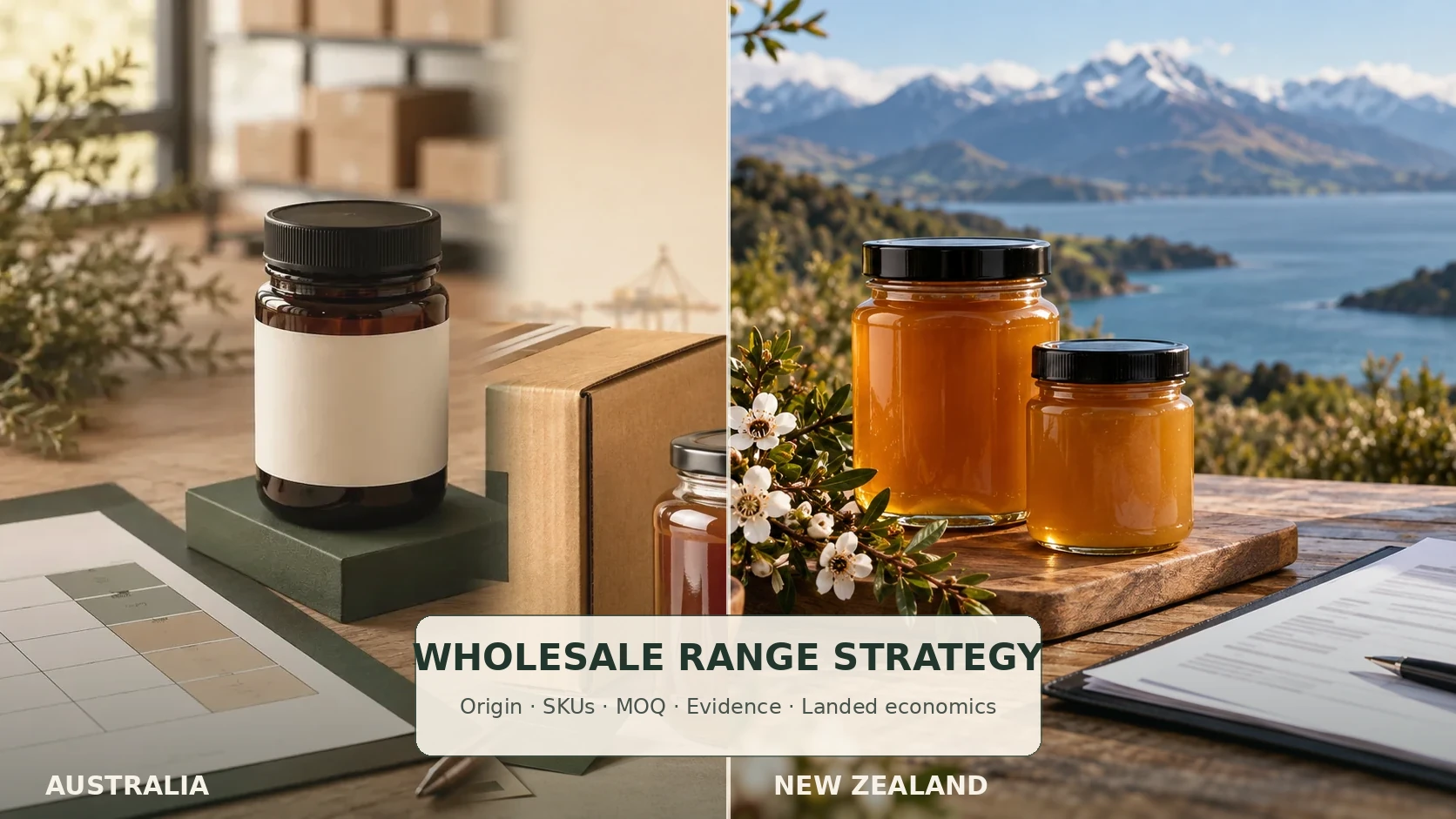
Five controls:
- keep origin explicit at SKU level;
- separate Australian and New Zealand supplier/evidence pathways;
- avoid duplicated grades and pack sizes without a buyer reason;
- normalise landed economics before comparing routes; and
- treat MOQ as cash and inventory exposure, not just a supplier number.
Intent boundary
What this article is — and is not
This is a wholesale range-architecture guide, not an Australia-versus-New-Zealand quality comparison. For authentication systems, export definitions and assurance differences, use the separate Australian vs New Zealand Mānuka Honey buyer comparison.
This guide answers a different procurement question: once a buyer is considering Mānuka, how should origin, MGO grade, pack size, MOQ, inventory exposure and landed margin be assembled into a range that can actually be purchased and repeated?
01 · Commercial role
Start with the job the SKU must perform
The weak starting question is “Australian or New Zealand?” The stronger question is “What job must this SKU perform in the buyer’s range, and which validated route can perform that job with the least unsupported complexity?”
An importer may need an accessible MGO 100+ product for a broad retail audience. A premium retailer may want a 250 g higher-MGO step-up. A distributor may care more about mixed-SKU flexibility and working-capital exposure than country story. Another account may already carry New Zealand Mānuka and want a clearly differentiated Australian-origin alternative.
Those are different buying problems. Origin matters, but it should be connected to a commercial role rather than used as the organising principle by itself.
02 · Origin control
Separate company location from product origin
A Melbourne-based company can sell Australian-origin Mānuka, New Zealand-origin Mānuka, or both. Those facts should never be collapsed into one another.
For every buyer-facing SKU, the chain should make clear where the honey originates, which supplier or packing route applies, where the product is packed, and what evidence supports the origin statement. In Australia, the ACCC lists honey as a priority food under the country-of-origin food-labelling framework. That makes origin communication a product-level control, not a branding shortcut.
Practical rule: state origin at SKU level and do not ask the buyer to infer it from a Melbourne address, colour palette, national imagery or company story.
03 · Evidence architecture
Keep Australian and New Zealand evidence pathways distinct
New Zealand and Australian Mānuka should not be presented as if they sit inside one universal authentication or export framework.
MPI states that all honey labelled as Mānuka for export from New Zealand must be tested by an MPI-recognised laboratory against the New Zealand Mānuka definition. That definition uses five attributes—four chemical attributes and one DNA marker—and distinguishes monofloral and multifloral Mānuka honey. MPI export guidance also places traceability, processor/exporter requirements and destination-market rules inside the export pathway.
Australian-origin honey follows its own supplier, origin, food-labelling and assurance pathway. Australian country-of-origin controls should not be represented as the New Zealand MPI system, and New Zealand export terminology should not be copied onto an Australian SKU.
Buyer control: compare evidence packages within the correct origin framework before comparing labels or marketing claims.
04 · Supplier architecture
Build supplier lanes before product lines
A dual-origin catalogue requires two defensible supply lanes, not one commercial assumption duplicated across two country names.
| Control | Australian route | New Zealand route |
|---|---|---|
| Declared origin | Australia | New Zealand |
| Supplier / packer | Route-specific | Route-specific |
| Mānuka / origin evidence | Applicable Australian supplier and origin evidence | MPI export-definition evidence where applicable |
| MGO evidence | Batch-linked result or specification | Batch-linked result or specification |
| Pack format | Confirmed for route | Confirmed for route |
| MOQ / mixed-SKU rule | Supplier-specific | Supplier-specific |
| Lead time / payment | Supplier-specific | Supplier-specific |
| Freight origin | Actual Australian pickup point | Actual New Zealand pickup point |
| Landed cost | Destination-specific | Destination-specific |
A freight quote from one city cannot be transplanted to another supplier. The same rule applies to carton dimensions, labels, pack availability, MOQ, documentation and lead time.
05 · Launch discipline
One origin is usually enough for the first commercial test
A larger catalogue can look more complete while creating more artwork, label, sample, carton and inventory exposure than the buyer has asked for.
A four-SKU architecture from one validated origin can already cover two grades and two pack sizes—for example MGO 100+ and MGO 250+/263+ in 250 g and 500 g formats. Mirroring all four positions in a second origin can double the commercial decisions before demand proves that the duplication earns its keep.
Ask one question first: Can one origin and a small SKU set answer the first buyer need? If yes, prove the route before widening it.
06 · Expansion trigger
Add a second origin only when it solves a documented problem
Buyer requirement
Some accounts will explicitly request one origin. Others will be open to either if evidence and economics work. Record that distinction rather than assuming an origin preference.
Portfolio differentiation
A buyer already carrying several New Zealand Mānuka brands may have a genuine reason to assess an Australian-origin line. Another buyer may need a New Zealand route because of its own customer, category or procurement requirements.
Supply resilience
Two qualified routes can reduce dependence on one supplier pathway. An unverified second supplier is not resilience.
Price architecture
Two origin routes may produce different landed-cost positions. That difference is useful only after the quotes have been normalised to the same commercial scope.
07 · SKU control
Do not duplicate SKUs without a buyer reason
An Australian MGO 250+ 250 g jar and a New Zealand MGO 250+ 250 g jar may be different in origin yet still occupy almost the same shelf role.
Before carrying both, identify the intended customer, the reason the buyer would stock both, the evidence or price distinction, and the additional working-capital requirement. If those answers are weak, the second SKU is range inflation rather than range strategy.
08 · MOQ
Model MOQ as cash and inventory exposure
MOQ is not one number. A dual-origin route can introduce honey minimums, packing-run minimums, per-SKU quantities, label-print minimums, carton requirements, setup fees, sample costs and freight minimums.
A supplier that allows grade and pack-size mixing inside one practical order can be commercially very different from a supplier that requires a minimum for every SKU.
The decision variable is therefore the cash and inventory exposure required to create the saleable range.
09 · Economics
Normalise landed economics before comparing origins
Do not compare one ex-works jar price with another route that already includes packing, export handling or freight. Build both on the same basis.
Price, pack, MOQ, inclusions and Incoterm.
Actual pickup, handling, freight and export scope.
Arrival charges, applicable tax/duty treatment and local delivery.
Wholesale price, margin and inventory exposure.
Normalise first. Decide second.
10 · Batch evidence
Evidence should travel with the exact SKU and batch
A certificate library has limited value if the buyer cannot connect the proposed SKU to the evidence behind it. A defensible chain links declared origin → product specification → batch or lot → relevant laboratory or assurance evidence → packed product → shipment documents.
This matters whenever an MGO grade is buyer-facing. The commercial question is not merely whether a supplier can show an MGO result, but whether the result can be linked to the batch that will be supplied.
11 · Packaging
Preserve packaging continuity where it reduces risk
Two origins do not automatically require two unrelated packaging systems. Where supplier capability permits, a common jar family, closure logic, label dimensions and master-carton architecture can reduce purchasing complexity while origin-specific artwork keeps the products distinct.
The objective is operational continuity without origin blur.
12 · Buyer signal
Capture origin preference explicitly
A wholesale enquiry should let the buyer choose Australian Mānuka, New Zealand Mānuka, or “open to either”. That turns origin preference into usable commercial data.
If a buyer is open to either, compare validated routes on evidence, scope and economics. Do not silently substitute one origin after the buyer has selected another.
13 · Decision tool
Use a range architecture matrix before release
The matrix should place Australian and New Zealand routes side by side and force every major unknown into view before a buyer-facing offer is released.
| Area | Minimum buyer-side control |
|---|---|
| Product | MGO grade, pack size, origin wording and specification |
| Evidence | Origin evidence, batch identity, MGO evidence, applicable authentication/assurance evidence |
| Commercial | Unit price, MOQ, mix flexibility, setup costs, lead time and payment terms |
| Logistics | Actual pickup point, freight mode, weight/volume, destination charges and Incoterm |
| Buyer fit | Channel, current Mānuka range, origin preference, target price position and documentation requirements |
| Risk | Inventory exposure, supplier dependency, packaging dependency, compliance gaps and unsupported assumptions |
Download the Mānuka Wholesale Range Architecture Matrix
A blank CSV template for comparing Australian and New Zealand routes without mixing verified facts, unknowns and commercial assumptions.
Download the CSV matrix14 · Failure modes
Common dual-origin mistakes
- Letting company location imply honey origin. Brand location and product origin are different facts.
- Treating AU and NZ evidence as interchangeable. Keep assurance pathways origin-specific.
- Mirroring every SKU across both origins. Range size is not commercial validation.
- Comparing supplier quotes before normalising scope. Incoterms and exclusions can reverse an apparent advantage.
- Using one supplier’s freight or packaging assumptions for another. Route-specific inputs must stay route-specific.
- Calling an unverified second supplier a backup. A backup route must actually be usable.
15 · Decision rule
Build the range in the right sequence
Define the channel problem or range role.
Select a route with defensible evidence and terms.
Confirm grade, pack and comparable landed cost.
Release only what can be documented, priced and repeated.
A strong range does not need a national “winner”. It needs a documented job for every SKU.
FAQ
Mānuka wholesale range planning questions
Should a wholesale buyer launch both Australian and New Zealand Mānuka at the same time?
Not by default. A second origin should solve a documented buyer, portfolio, evidence, pricing or supply-risk problem. If one validated origin can satisfy the first commercial need, proving that route first normally reduces inventory and execution complexity.
Can the same MGO number be treated as the same wholesale product across both origins?
No. The numerical MGO grade may describe methylglyoxal concentration, but origin, supplier route, authentication requirements, batch evidence, packaging, landed cost and buyer role can still differ. Compare the complete SKU and evidence package rather than the grade number alone.
How many SKUs should a new Mānuka wholesale range start with?
There is no universal number. Start with the minimum set that answers a real buyer need and can be supported by verified supply, evidence and economics. Duplicating every grade and pack size across two origins before demand is demonstrated creates avoidable complexity.
What should be verified before a Mānuka SKU is buyer-facing?
At minimum: declared origin, supplier/packer route, batch or lot traceability, MGO evidence where claimed, applicable origin or authentication evidence, pack format, MOQ, lead time, payment terms, pickup point, freight basis and landed economics.
What if the buyer is open to either Australian or New Zealand Mānuka?
Compare only validated routes on the same commercial basis. Normalise quote scope, freight origin, destination charges, documentation and inventory exposure before deciding which origin to propose. Do not silently substitute one origin for another.
SELVEH status
What SELVEH can state today
SELVEH is a Melbourne-based premium Mānuka brand developing distinct Australian and New Zealand origin pathways for trade buyers. That does not mean that both origins, every MGO grade or every pack size is commercially available.
Final availability should follow supplier qualification, batch evidence, packaging confirmation, route-specific logistics and commercial validation. The operating principle is: one brand, distinct origins, no origin blur.
Sources
Primary official sources
- New Zealand Ministry for Primary Industries — Ensuring Mānuka honey is authentic
- New Zealand Ministry for Primary Industries — Steps to exporting honey and bee products
- Australian Competition and Consumer Commission — Country of origin food labelling
Source review: 30 September 2026. Destination-market requirements and supplier evidence should be rechecked for the actual transaction before commercial release.
Trade planning
Building a Mānuka range for wholesale or distribution?
Share the destination market, channel, origin preference, MGO grade, pack size and expected volume. SELVEH can structure the discussion around a clearly separated origin, evidence and commercial pathway without treating unknowns as confirmed terms.
Start a trade enquiry