01 · Decision rule
Start with the buyer decision, not a national winner
“Australian or New Zealand?” sounds like a product question, but for a wholesale buyer it is a bundle of decisions about origin, claim architecture, grading, certification, supply, packaging, channel recognition and landed economics. Reducing that bundle to “which country is better?” creates a weak procurement brief.
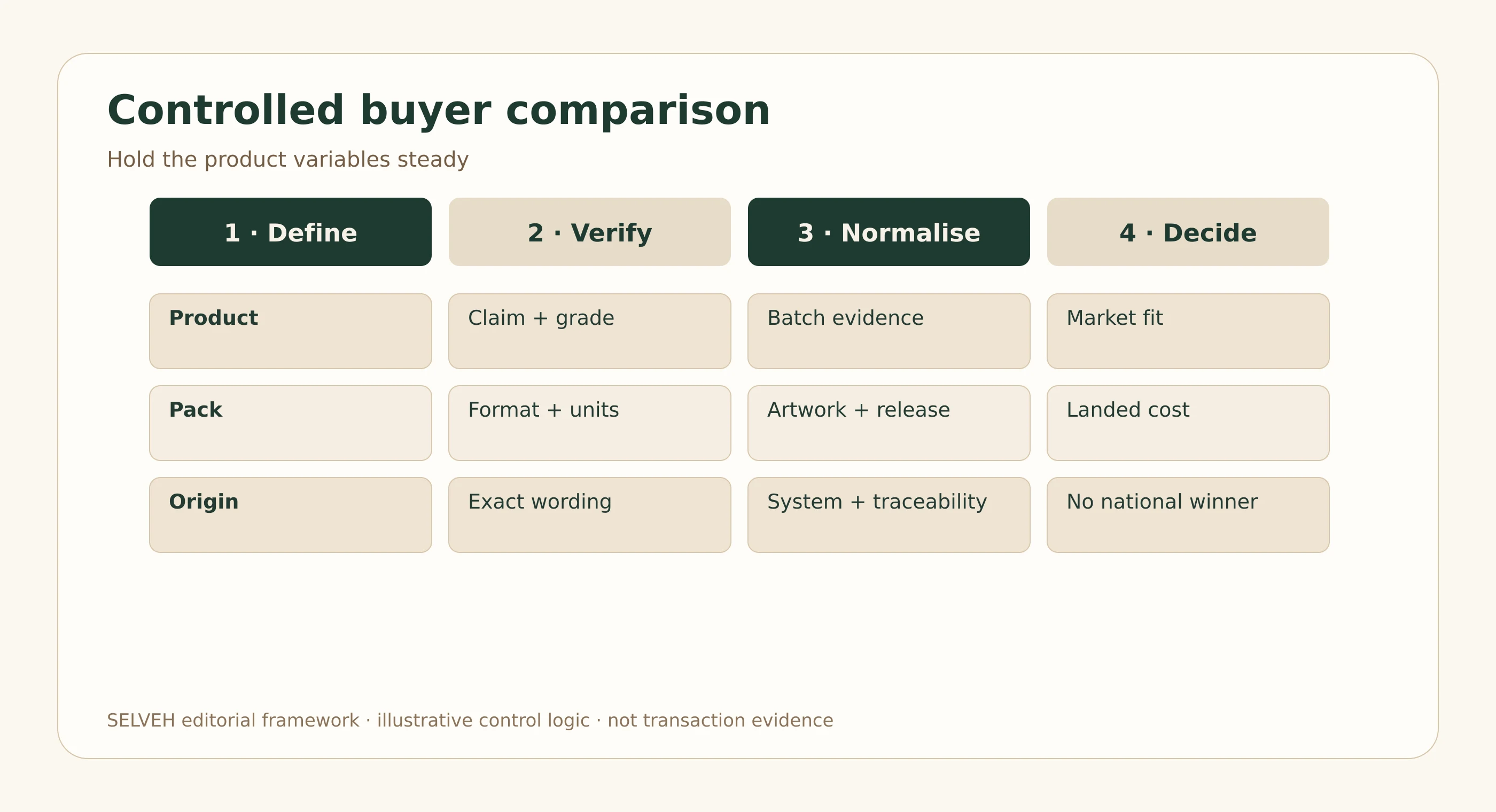
A credible comparison holds the commercial variables steady. Compare the same pack size, an equivalent declared MGO level, a defined floral-source claim, current batch evidence, comparable order quantities and the same destination. If one offer is a finished UMF-licensed New Zealand retail pack and the other is an unverified Australian bulk sample, the comparison is not controlled.
The useful question is: which documented offer fits the buyer's channel, risk threshold and price architecture? Origin matters, but it does not replace the product specification.
02 · Assurance architecture
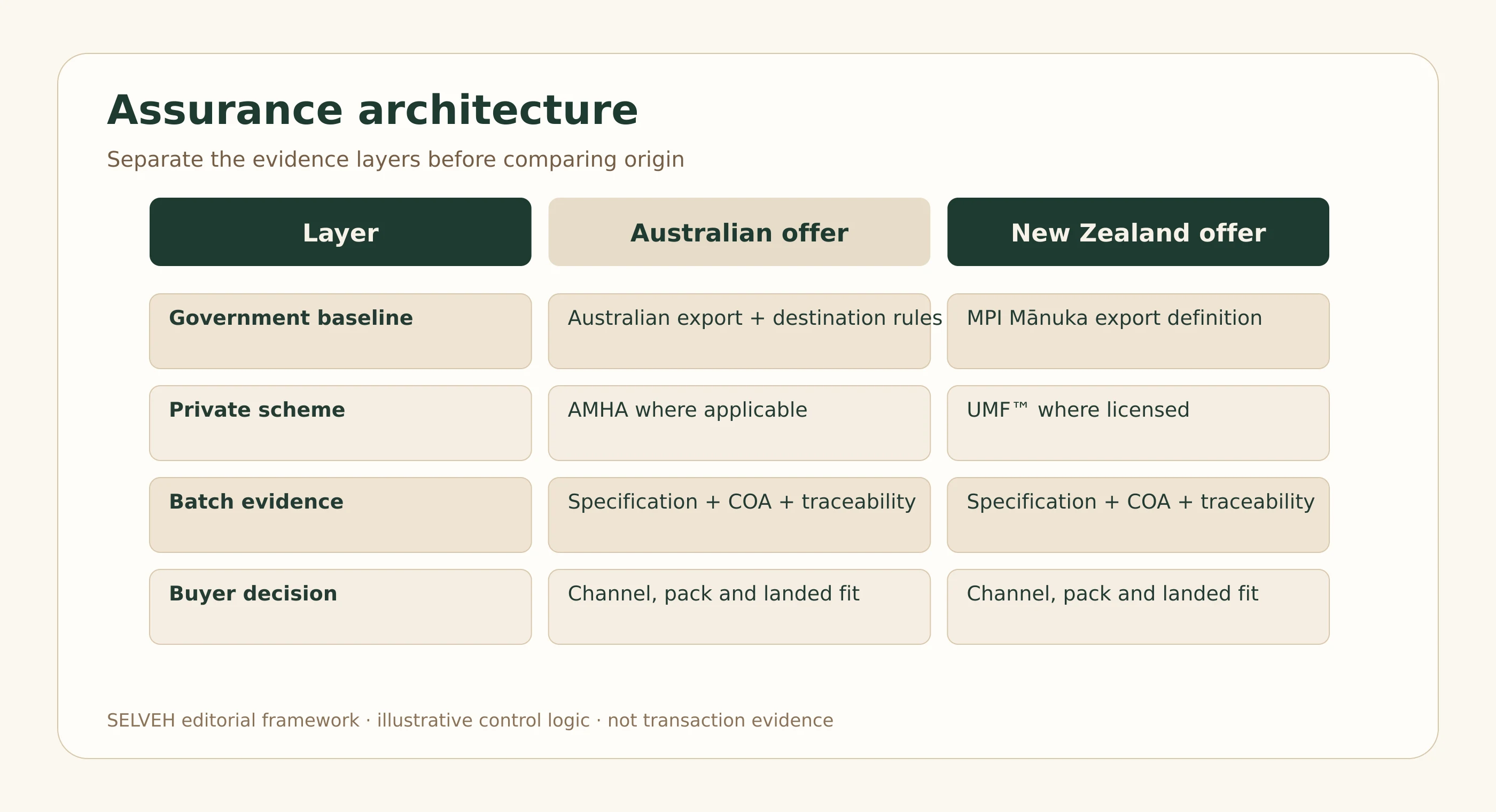
The same category name sits inside different assurance systems
New Zealand applies a government science definition to honey labelled as Mānuka for export. The Ministry for Primary Industries states that exported honey labelled as Mānuka must be tested by an MPI-recognised laboratory and meet the applicable monofloral or multifloral definition.
Australia does not use that New Zealand export definition. The Australian Mānuka Honey Association operates a private industry scheme with criteria for products carrying its marks. Those criteria and marks can be useful evidence when they genuinely apply, but they should not be described as an Australian government certification.
This distinction is central: a government export condition, a private certification mark and a laboratory analyte are different evidence layers. Buyers should identify which layer supports each claim rather than treating every logo or number as interchangeable.
03 · At a glance
Compare the evidence architecture before the marketing language
| Buyer question | Australian offer | New Zealand offer |
|---|---|---|
| What supports the Mānuka identity? | Supplier evidence and the claim basis; AMHA scheme evidence where the mark is used. | MPI export definition for honey labelled Mānuka for export. |
| Is a private quality mark automatic? | No. AMHA marks apply through the association's scheme. | No. UMF™ applies to licensed participants and qualifying products. |
| Can MGO be stated? | Yes, when supported by relevant testing and safe label wording. | Yes; MGO can appear within or outside private grading systems when properly supported. |
| Does the origin alone prove the grade? | No. | No. |
| What must still be checked? | Batch identity, method, laboratory scope, specification, pack, shelf life, quantity, price basis, traceability and destination requirements. | |
04 · Grading
MGO and UMF are not two country scores
MGO is a measured concentration of methylglyoxal, commonly expressed in milligrams per kilogram. A declared MGO 250+ is intended to communicate a minimum concentration, subject to the evidence and label basis for the actual batch.
UMF™ is a private New Zealand quality and rating system. UMFHA describes its system as assessing multiple factors, including MGO, leptosperin, DHA and HMF. A UMF number is therefore not merely another label for an MGO result, and the UMF mark is not a generic grading term available to any Mānuka supplier.
For a cross-origin comparison, record the actual laboratory result and its batch identity. Do not convert a standalone Australian MGO value into a UMF grade and present the result as certification. A conversion chart cannot create a licence, scheme compliance or evidence that was never issued.
05 · Authenticity
A potency result is not a complete authenticity decision
A high MGO result does not, by itself, prove floral source, country of origin, absence of adulteration or compliance with a private scheme. Authenticity is a multi-evidence question that can involve chemical markers, traceability, supplier controls, batch records and the exact claim being made.
New Zealand's MPI definition and the AMHA criteria are not mirror images. Buyers should read each system on its own terms and avoid inventing a universal pass/fail rule from one marker.
Where a supplier claims membership or use of a scheme mark, verify the licence and product eligibility through the scheme's current source. Where no private mark is used, request the evidence supporting the actual wording on the offer and proposed label.
06 · Origin & traceability
Country of origin and supply-chain traceability answer different questions
“Product of Australia” or “New Zealand origin” is not the same record as a batch map. Origin wording concerns where the product is considered produced under the applicable rule. Traceability connects the offered goods to source lots, processing, packing, testing and shipment.
A buyer needs both. The origin statement should be supported, while the batch identity should remain continuous through the product specification, COA, packing record, label and commercial documents.
Blending, repacking or using a third-party packing facility does not automatically invalidate an offer. It does increase the need to define who controls each step and how the evidence follows the physical product.
07 · Export controls
The export pathway is not interchangeable across the Tasman
New Zealand exporters of Mānuka honey operate within MPI's bee-product export requirements, including the Mānuka definition and controls around the premises of final control. Australian honey exports follow Australian export and destination-country requirements, including Micor guidance and any required certification for the target market.
A buyer should not assume that a document issued in one country has an equivalent legal status in the other. Nor should a private mark be presented as a substitute for government export documentation where government documentation is required.
Map the route for the exact origin, packer, destination and product claim before artwork or purchase-order approval.
08 · Commercial comparison
Normalise the offer before comparing price
Origin premiums can become a distraction if the quotations are not otherwise comparable. Normalise honey grade, net weight, units per case, MOQ basis, packaging components, included testing, artwork costs, Incoterm and named place, payment timing, remaining shelf life and currency.
Then separate product cost from channel value. A buyer may value the international recognition of a licensed scheme, a differentiated Australian-origin story, a particular pack format or a lower working-capital entry point. Those are channel hypotheses that should be tested with the intended importer or retailer.
Do not pay an origin premium merely because a supplier says the market will accept it. Ask for evidence from the actual channel.
09 · Claim safety
Avoid national superiority and borrowed research claims
A safe comparison does not claim that one origin is inherently more potent, authentic, therapeutic, sustainable or premium. Those claims require defined evidence and may be misleading when applied across an entire national category.
Research conducted on one honey, species, grade or preparation should not automatically be transferred to every commercial product sharing the word Mānuka. Food claims also need to remain within the rules of the market in which the product is sold.
Use precise wording: identify the country, grade, scheme and batch evidence actually available. Precision is more credible than a national contest.
10 · Buyer tool
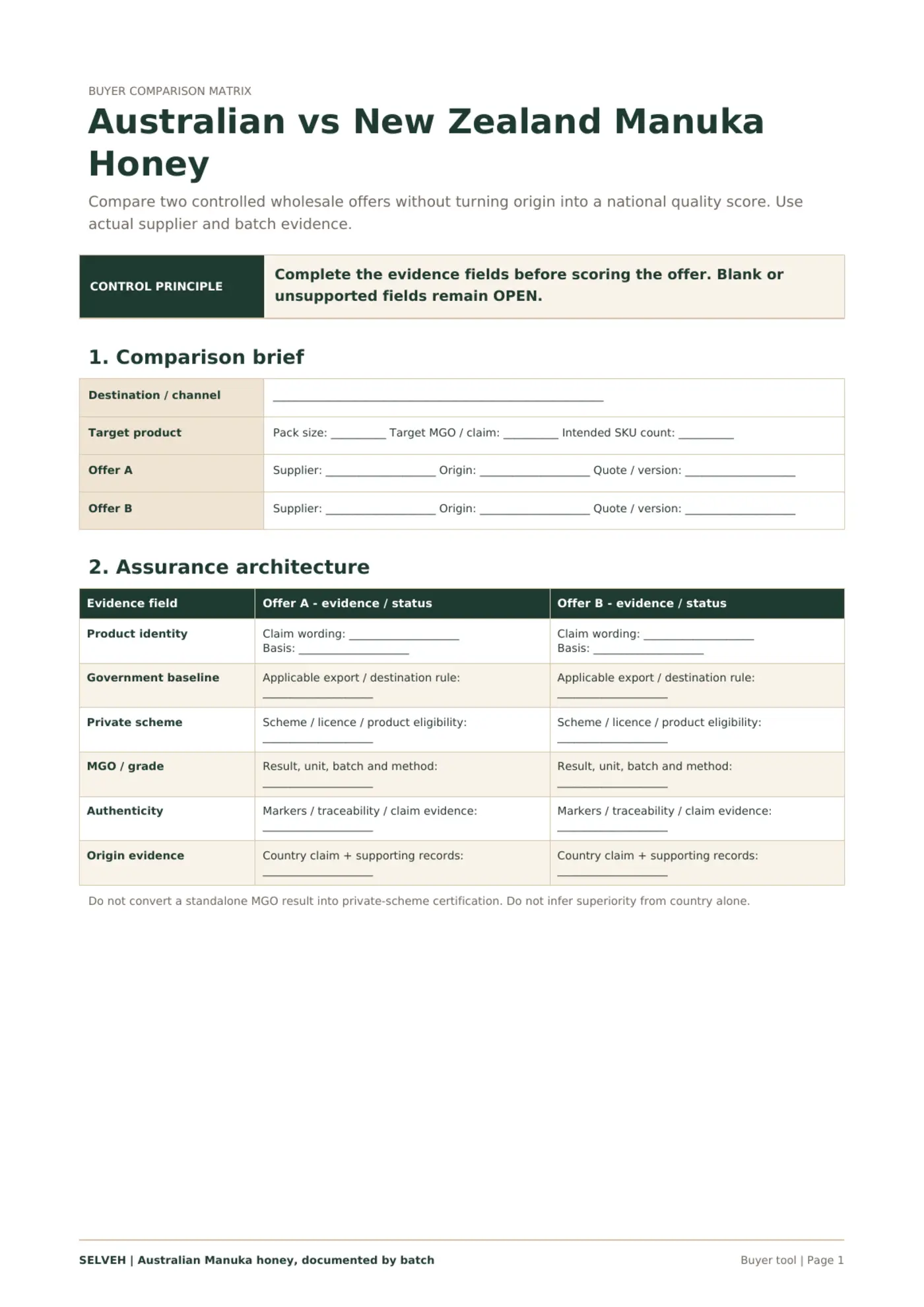
Use a controlled origin-and-offer matrix
The downloadable matrix separates origin-system evidence from the commercial offer. It allows two suppliers to be compared across identity, grade, batch documentation, traceability, packaging, MOQ, landed-cost basis and destination fit.
The matrix is a buyer-control tool, not a certification decision, laboratory interpretation or legal opinion.
11 · Buyer FAQ
Frequently asked questions
Is genuine Mānuka honey only from New Zealand?
Do not use a slogan as a procurement rule. New Zealand applies its MPI export definition, while Australian products may use Australian origin and AMHA scheme evidence where applicable. Evaluate the exact claim and evidence for the product being offered.
Can an Australian MGO result be converted into a UMF grade?
A numerical comparison does not create UMF certification. UMF™ is a licensed private scheme with multiple criteria. Do not present a converted number as a scheme grade.
Does higher MGO mean the product is the better wholesale choice?
No. Higher MGO can increase product cost and may change ticket price, channel fit and working-capital exposure. The right grade depends on the buyer's market and documented offer.
Is the AMHA mark mandatory for Australian Mānuka honey?
AMHA operates a private industry scheme. If a supplier uses its mark, verify current eligibility and supporting evidence; do not describe it as a universal government requirement.
Which origin should SELVEH choose?
SELVEH's current programme is being developed around Australian Mānuka. Final supplier, grade, scheme participation and batch evidence remain unconfirmed until first-party records exist.
12 · SELVEH status
What SELVEH can state today
SELVEH can explain how a buyer should compare Australian and New Zealand offers without claiming that either national category is uniformly superior.
SELVEH should not claim a final Australian supplier, AMHA participation, approved MGO range, packing facility, batch, New Zealand comparison result or destination acceptance until the relevant first-party evidence exists.
Sources
Primary and scheme sources
- New Zealand MPI - Ensuring Mānuka honey is authentic
- New Zealand MPI - Steps to exporting honey and bee products
- Australian Mānuka Honey Association - Quality criteria
- Australian Mānuka Honey Association - Mark of Authenticity
- UMF Honey Association - UMF grading system
- NATA - Test reports explained
Source review: Official government and scheme sources reviewed 22 August 2026. Recheck before a commercial decision because definitions, schemes and export requirements can change.
Trade planning
Comparing an Australian Mānuka offer for your market?
Tell us the destination, channel, target grade and pack format. We will separate origin-system evidence from the product and commercial questions that still need verification.
Start a trade enquiry