For a comparable wholesale enquiry, define at least:
- destination market and sales channel;
- retail-ready, private-label or bulk supply model;
- MGO grade or acceptable range;
- 250 g, 500 g or other pack requirements;
- quantity by SKU and expected reorder pattern;
- required COA, origin and traceability evidence;
- packaging, artwork, case and tamper requirements;
- delivery basis, target timing and payment constraints.
This page is a sourcing hub. The detailed controls sit in the linked SELVEH guides for private label, quote comparison, COA review, export logistics and pre-shipment release.
1 · Supply model
Choose the supply model before asking for a wholesale price
“Wholesale” can describe three materially different purchases. Retail-ready wholesale buys finished jars under an existing brand or agreed finished configuration. Private label buys a finished product under the buyer’s brand, with additional artwork, component and approval steps. Bulk supply moves honey in larger containers for later filling or manufacturing.
These models have different cost structures, facilities, evidence hand-offs, loss points and lead times. A supplier that is competitive for finished 500 g jars may not be competitive for bulk honey, and a bulk quote should never be compared directly with a retail-ready unit quote. If local filling is being considered, use the source-packed vs destination-packed framework before comparing numbers.
2 · RFQ brief
Write the buyer brief before the supplier writes the offer
An RFQ should reduce ambiguity, not invite the supplier to invent the project. Define the destination, intended channel, grade, pack size, quantity, target arrival window and required evidence. For private label, identify who owns artwork, which languages are required, whether existing jars are acceptable and whether tamper evidence or case configuration is constrained by the buyer.
Do not ask only for “your best wholesale price”. That produces quotes that look comparable but often exclude different things. A stronger RFQ asks the supplier to state assumptions, exclusions, MOQ rules, lead time, payment milestones, sample process, export-document scope and the exact point at which responsibility transfers.
The wholesale product specification guide is the next layer when the project moves from exploration to a controlled specification.
3 · Grade and pack
Build the MGO grade and pack architecture as one commercial decision
MGO is a measurable concentration, commonly expressed in mg/kg or ppm, and the Australian Mānuka Honey Association uses MGO as a central grading benchmark. A “100+” claim is intended to communicate a minimum threshold, not a guarantee that every batch contains the same exact concentration. Buyers should verify the current batch result and the basis for the label claim.
The commercial question is not simply whether MGO 250+ is “better” than MGO 100+. Higher analytical grade normally changes raw-material economics and retail positioning, while pack size changes shelf price, cash tied up per unit, carton economics and rate of sale. A two-grade, two-pack launch already creates four SKUs, each with its own forecast and reorder risk.
Use the dedicated MGO 100+ vs 250+ buyer framework and 250 g vs 500 g pack-size guide rather than assuming one grade or jar size is universally optimal.
4 · Evidence
Define the evidence package before comparing suppliers
A headline MGO number is not a complete procurement file. A wholesale buyer should decide what evidence must accompany the batch and which records are required before purchase, before packing and before dispatch. The exact package will vary by supplier, destination and claim set.
A useful baseline can include the batch or lot identifier, independent laboratory COA, MGO result, relevant supporting analyses, Australian origin evidence, traceability relationship, product specification, pack specification and any destination-specific documents. Where residue, authenticity, certification or scheme claims matter commercially, define the required report or certificate rather than accepting a marketing statement.
AMHA states that its member standards rely on independent third-party laboratory COAs and supply-chain traceability. That is a useful quality architecture, but the buyer still needs to verify the specific supplier, batch, claim and document scope being offered.
5 · Quote normalisation
Compare total offer architecture, not the first unit price
Normalise every quote to the same commercial point. Separate honey and filling, jar and closure, tamper component, label, carton, setup or artwork charges, testing, export documents, freight, insurance, duties, local clearance, payment timing and currency exposure. Where a supplier includes one of these costs, do not leave the equivalent line blank for another supplier; mark it as included, excluded or unknown.
Then compare the cost per accepted sellable unit at the same delivery point. This prevents an apparently cheap ex-works offer from winning against a more complete delivered proposal simply because the first quote hides more downstream cost.
The supplier quote-normalisation guide and landed-cost guide provide the detailed calculation layers.
6 · MOQ
Treat MOQ as a portfolio constraint, not a single number
A supplier may state MOQ by total kilograms, by honey grade, by jar size, by label print run, by carton, by production run or by a combination of these. The commercial consequence is different in each case. A mixable 200 kg honey MOQ can still create an uneconomic launch if each label design requires a large print quantity or if one grade cannot be mixed with another.
Ask exactly what can be mixed: MGO grade, pack size, label design, destination artwork and production date. Then translate the answer into units by SKU. The result should be tested against expected months of cover and cash exposure, not just whether the factory will accept the order.
For trial-order logic, use the private-label MOQ and trial-order planner.
7 · Lead time
Build a lead-time model from gates, not from one supplier number
“Five weeks” may refer only to production after final approvals. The buyer timeline can also include sample dispatch, sample review, artwork creation, regulatory label review, component procurement, label printing, production scheduling, batch testing, packing, release, export documents and freight.
Ask the supplier which event starts the quoted lead time and which approvals stop the clock. Record long-lead components separately. If the destination requires pre-registration, facility listing, special certification or importer approval, that can dominate the project timeline even when production itself is fast.
The private-label lead-time guide shows how to build the timeline by gate.
8 · Sample approval
Approve the sample that represents the intended buying decision
A generic honey sample can be useful for sensory review, but it may not represent the final grade, batch, jar, closure, label or production process. Define what the sample is intended to approve. If the buyer is evaluating MGO 250+ in a 500 g private-label jar, a different grade in a temporary jar should not be treated as final product approval.
Record the sample identifier, date, supplier, grade, batch relationship, packaging status and any differences from the planned production configuration. Where a pre-production or finished-pack sample is required, make that an explicit gate in the PO or quality agreement.
9 · Export and destination control
Verify the exact destination before calling the offer export-ready
Australian honey is generally treated as a non-prescribed good under Australian export controls. DAFF states that non-prescribed goods do not have mandatory export conditions under Australian export law, but exporters must meet the importing country’s requirements. Some markets may require certification, establishment listing or other controls.
The implication for a buyer is simple: “export-ready” is not a universal product property. Confirm the destination market, importer responsibilities, labelling requirements, required health or origin documents, facility status and any current market-access notices before production is locked.
Australian domestic food and origin requirements also matter where relevant to the finished product. FSANZ Standard 2.8.2 defines requirements for food sold as honey, while the ACCC identifies honey as a priority food for Australian country-of-origin labelling. Destination-market labels can require a different control set, so the responsible party should verify both the manufacturing basis and the import market.
10 · Purchase order
Convert the accepted quote into a controlled purchase order
The final PO should remove the commercial ambiguity that often survives the quotation stage. Identify the product and SKU, quantity, price basis, approved specification, artwork revision, packaging, batch or testing requirements, delivery term, requested date, documents, payment milestones and change-control rule.
If a material item remains “TBC”, assign an owner and deadline. Do not allow a quote attachment containing assumptions to conflict silently with the PO. For complex private-label projects, use a quality agreement alongside the commercial PO to define release, deviation, non-conformance and change responsibilities.
11 · Batch release
Release the batch, not the relationship
Supplier approval does not mean every future shipment should pass automatically. Before dispatch, reconcile the actual batch with the approved specification, COA, MGO claim, jar and closure, artwork version, date coding, case configuration, quantity and required export documents.
If the supplier substitutes a jar, label stock, honey batch, facility or transport condition, decide whether the change requires buyer approval or new evidence. A controlled release process is especially important when the commercial offer spans multiple MGO grades or destination labels.
12 · Sourcing sequence
Use one sourcing sequence from brief to dispatch
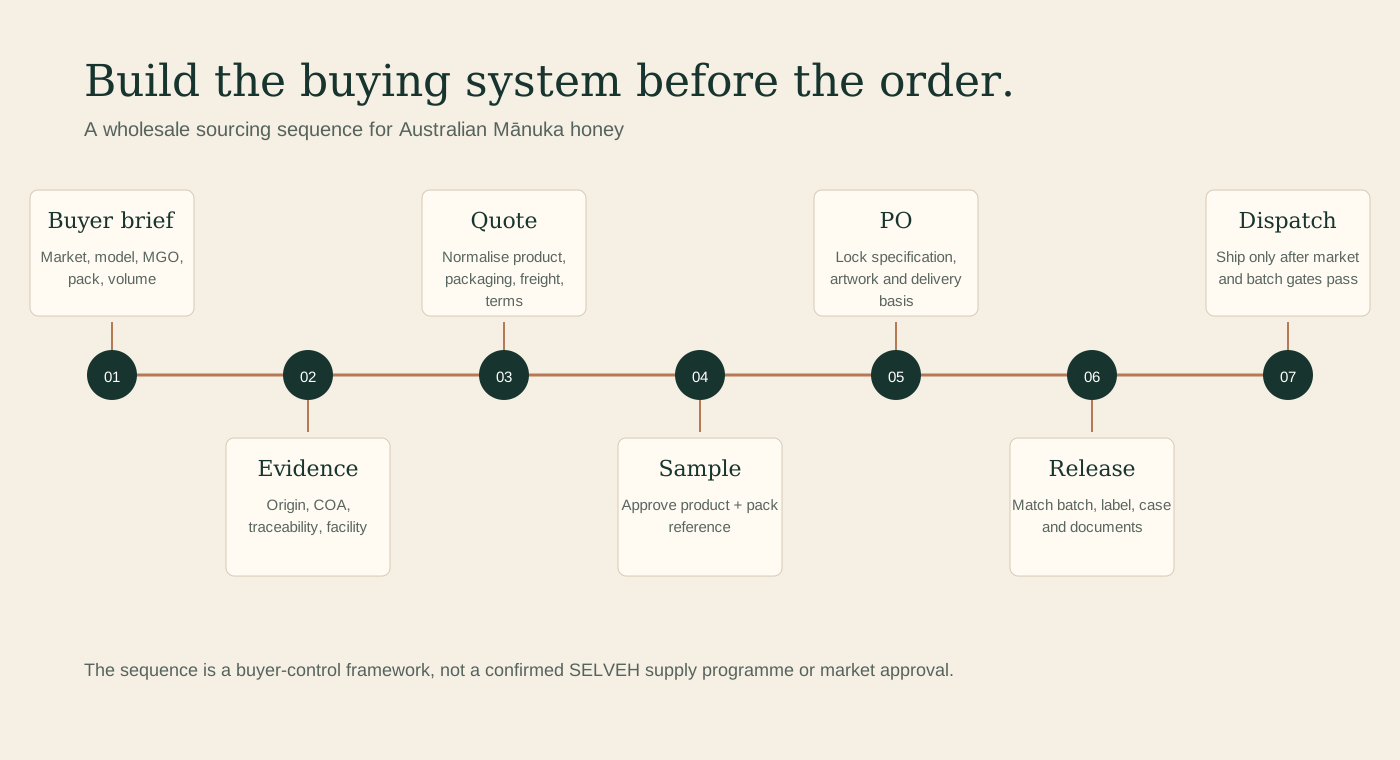
This sequence is deliberately conservative. It protects the buyer from the most common failure mode in premium food sourcing: committing commercially before the evidence, pack configuration and destination obligations are sufficiently defined.
13 · Buyer tool
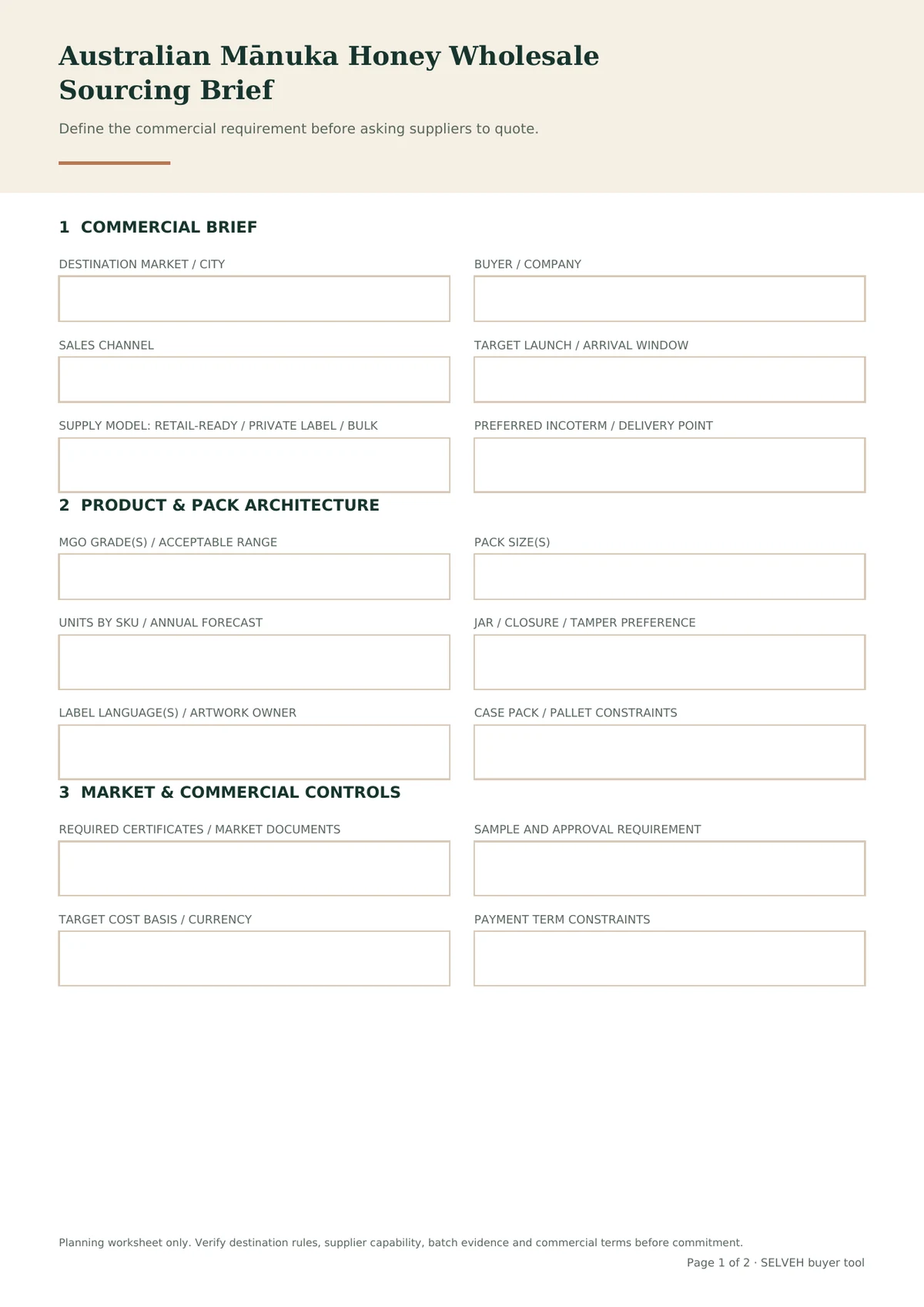
Download the Australian Mānuka wholesale sourcing brief
The two-page worksheet turns the article into an RFQ-ready buyer brief. Page one defines the market, supply model, MGO grade, pack architecture, quantity, timing, documents and payment constraints. Page two records supplier evidence, normalised cost inputs, MOQ, lead time, exclusions and the buyer decision.
Complete one copy per supplier or sourcing route. The worksheet is not a supplier approval, legal opinion, import approval or confirmed SELVEH commercial offer.
14 · Review triggers
Wholesale sourcing red flags
- A price is offered without a defined MGO grade, pack size or delivery basis.
- “Private label available” is stated but label MOQ, setup cost, artwork process and component ownership are undefined.
- The supplier cannot explain how the quoted batch will connect to its COA and origin records.
- An MGO number is used as if it proves origin, authenticity and every quality attribute by itself.
- MOQ is quoted only as total kilograms even though label or packaging minimums can create larger SKU commitments.
- Lead time starts only after an unspecified set of approvals and components.
- “Export-ready” is used without naming the destination or required market documents.
- The buyer cannot identify which costs remain outside the unit quote.
- Batch substitutions or packaging changes do not require notification.
- A supplier pushes for deposit before the essential product, evidence and commercial assumptions are written down.
15 · Buyer FAQ
Frequently asked questions
What is the best MGO grade for a first wholesale order?
There is no universal best grade. The decision depends on target customer, retail price architecture, competitor set, supplier economics and expected rate of sale. MGO 100+ and 250+ can serve different portfolio roles.
Is private-label Mānuka honey the same as wholesale Mānuka honey?
No. Private label is one wholesale supply model. Wholesale can also mean retail-ready branded product or bulk honey for later packing or manufacturing.
Should a buyer compare quotes per jar or per kilogram?
Use the measure that matches the sourcing model, then normalise all offers to the same commercial endpoint. For finished retail units, cost per accepted sellable unit is usually more decision-useful than raw honey cost alone.
Does an MGO COA prove the honey is Australian Mānuka?
No. MGO is an important analytical measure, but origin, authenticity and traceability require their own evidence architecture.
Can SELVEH provide a current wholesale price list?
This article does not publish a confirmed price list. A reliable quote requires the destination, grade, pack size, quantity, supply model and current supplier inputs to be verified first.
16 · SELVEH status
What SELVEH can state today
SELVEH can use this sourcing framework to structure buyer requirements, compare supplier inputs and identify the evidence and commercial assumptions that must be closed before a quotation or order is treated as firm.
SELVEH should not represent a specific supplier, MGO grade, private-label format, batch, MOQ, price, lead time, certificate, market approval or export route as confirmed until first-party documents and current commercial terms support that statement.
Sources
Primary Australian export, food, origin and Mānuka guidance
- DAFF — Exporting non-prescribed goods from Australia
- DAFF — How to export non-prescribed goods
- Federal Register of Legislation — Standard 2.8.2 Honey
- ACCC — Country of origin food labelling
- Australian Mānuka Honey Association — Quality standards
Source review: Official and industry guidance reviewed 9 September 2026. Recheck the exact destination, supplier, facility, batch and current market-access requirements before a transaction.
Wholesale sourcing
Building an Australian Mānuka honey wholesale brief?
Share the destination market, MGO grade, pack sizes, expected quantity and preferred supply model. SELVEH will structure the commercial and evidence inputs that need to be verified before a firm offer.
Start a trade enquiry