

01 · Grade meaning
Start with what the MGO number does and does not say
MGO refers to methylglyoxal measured in the honey. The Australian Manuka Honey Association describes MGO as directly measurable by high-performance liquid chromatography and central to its rating approach. A label such as MGO 100+ or MGO 250+ should be supported by evidence for the actual product and batch under the applicable specification and release process.
The number is not the entire identity or quality system. A wholesale buyer still needs product description, batch linkage, test method and laboratory information, packaging, net quantity, date and lot coding, storage basis, traceability and destination-compliant artwork.
Do not translate the grade into a disease, therapeutic or guaranteed consumer outcome. The MGO grade guide explains the analytical foundation; this article addresses the commercial choice between two range positions.
02 · Commercial comparison
Compare portfolio roles, not abstract superiority
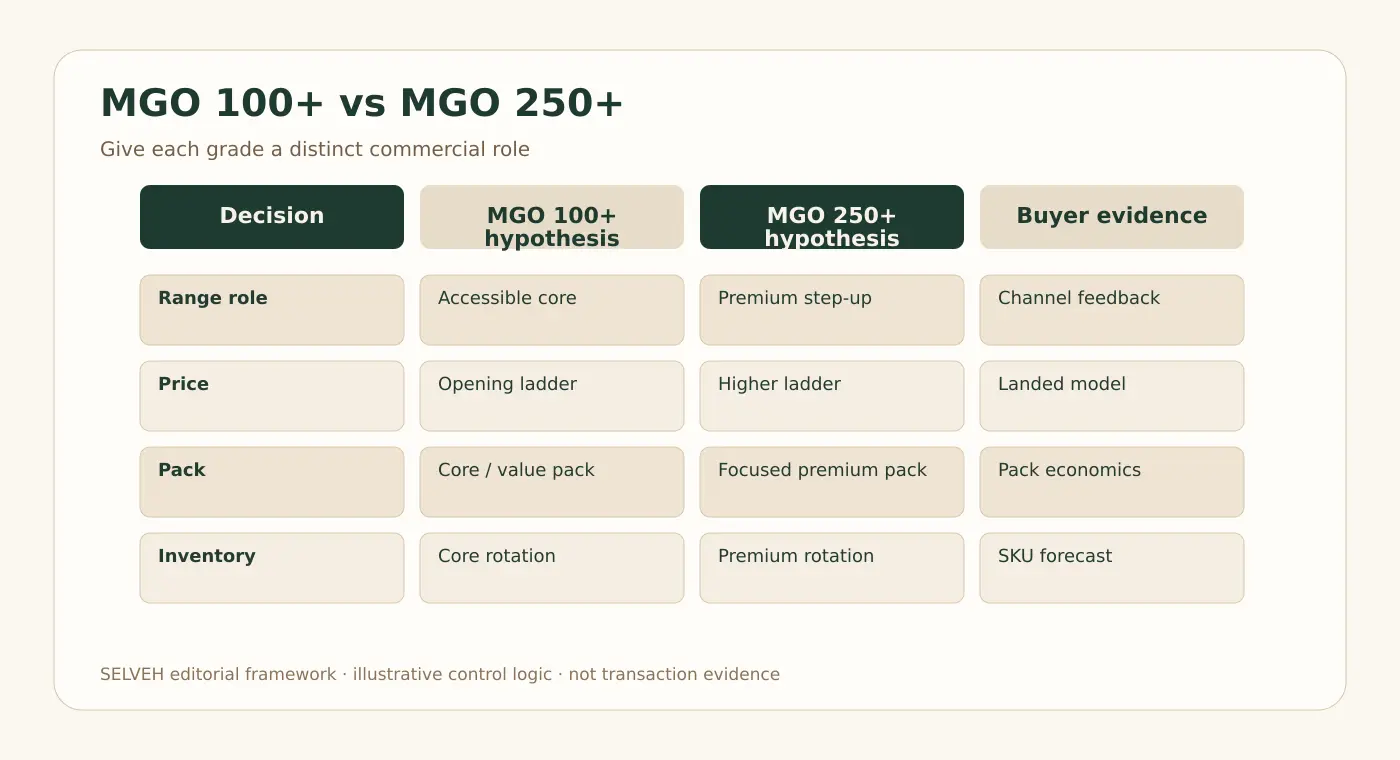
| Decision | Possible MGO 100+ role | Possible MGO 250+ role | Evidence needed |
|---|---|---|---|
| Range position | Accessible entry or core | Premium step-up | Channel and competitor review |
| Price ladder | Lower opening price hypothesis | Higher-value hypothesis | Actual landed-cost model |
| Pack strategy | Core pack or larger value pack | Smaller premium pack or focused SKU | Pack-specific economics |
| Demand | Potentially broader trial | Potentially narrower intent | Buyer orders and sell-through |
| Inventory | Core forecast exposure | Premium rotation exposure | MOQ, shelf life and replenishment |
The words “possible” and “hypothesis” matter. A premium pharmacy, gifting or specialist retail account may read the ladder differently from a broad grocery distributor. The buyer’s channel data should decide the role.
03 · Core-grade hypothesis
When MGO 100+ may fit
MGO 100+ may support an entry point for consumers encountering the category, a core everyday range position, a trade-up from ordinary honey or a price point that gives a distributor wider account coverage. It can also reduce the absolute cash committed per unit if the verified supply and packaging economics support that outcome.
It should not be treated as a generic low grade or budget product. Origin, authenticity, sensory profile, packaging, documentation and brand presentation still shape perceived and operational quality. Nor should a buyer assume demand will be automatically larger because the opening price is lower.
The commercial test is whether MGO 100+ gives a clear reason to list, a viable landed margin, acceptable minimums and repeatable supply for the intended channel.
04 · Premium-step hypothesis
When MGO 250+ may fit
MGO 250+ may create a visible step-up in a two-grade range, support specialist or premium positioning, give sales teams a clearer comparison story or provide an option for buyers already familiar with MGO. A higher declared criterion can carry higher input cost and may support a higher selling price, but neither relationship should be assumed without live quotations and market validation.
The premium step needs a defined customer. If the same buyer, occasion and price tolerance apply to both grades, the range may merely split demand. If MGO 250+ serves a distinct account type, gift tier, pack format or repeat-customer need, it has a stronger portfolio reason.
Never justify the higher grade with unapproved medical or therapeutic claims. Use accurate analytical language and destination-reviewed artwork.
05 · Customer and channel
Write a customer job for each SKU
For each grade, state the target buyer, channel, buying occasion, expected retail environment, price band, comparable products and reason the account should list it. “People who want premium honey” is too broad to guide a wholesale decision.
A distributor may need a core item with easier rotation and one premium item for specialist accounts. A retailer with limited shelf space may prefer one grade supported by strong education. An online brand may test a two-grade ladder because assortment can be explained without allocating another physical facing.
Validate the job through importer interviews, retailer feedback, small orders, search behaviour and repeat purchase—not through internal preference alone.
06 · Price architecture
Model the full price ladder
Start with supplier quotation and convert both grades to the same comparison basis: net honey weight, jar, closure, label, case, pallet, testing, documentation, inland transport, freight, insurance where applicable, duty, tax, importer cost, distribution margin and retailer margin. State the Incoterm, named place, currency and quotation date.
Then test the retail ladder. A higher MGO grade that costs more but cannot sustain a clear and acceptable shelf-price step may compress channel margin. A lower grade that needs heavy discounting may also underperform. The objective is not the largest gross margin percentage in a spreadsheet; it is a credible price that survives the route to market.
Use the wholesale price-architecture guide and do not invent a fixed price ratio between MGO 100+ and 250+.
07 · Pack architecture
Test grade and pack as one decision
Grade choice cannot be separated from pack size. A 250 g pack may lower the absolute shelf-price entry for a premium grade, while a 500 g pack may communicate value for a core grade. Those are hypotheses; jar, label, freight cube, case count and channel conventions can reverse the economics.
A four-SKU matrix of two grades by two pack sizes can look complete but multiply artwork, component, MOQ, testing, forecasting and inventory tasks before demand is known. The 250 g versus 500 g buyer guide helps test the pack dimension.
Begin with the minimum assortment that creates a meaningful choice. Add another pack only when it serves a separate price, channel or usage job.
08 · Range design
Choose one grade or a deliberate ladder
A single-grade launch concentrates demand, simplifies the buyer story and reduces operational fragmentation. Its weakness is that the brand has no internal trade-up or alternative opening price. A two-grade launch creates a ladder and can reveal willingness to pay, but it divides inventory and attention.
Write the decision rule before launch. For example: retain both only if each reaches its own account, margin and rotation threshold; otherwise concentrate on the stronger role. Do not preserve a weak SKU merely to make the range look broader.
Keep product names and visual hierarchy clear enough that buyers understand the difference without implying an unapproved benefit.
09 · MOQ and working capital
Expose SKU multiplication
Ask whether honey, filling, labels, jars and cases have separate minimums for each grade. A packer may allow a combined production run but require grade-specific honey allocation, testing and labels. Another may require a full minimum per finished SKU.
Calculate cash committed and months of cover by SKU, including buyer-specific packaging left after filling. A modest unit MOQ can still create excessive working capital if sales are split across grades, packs and markets.
A mixed-SKU trial, shared standard components or staged artwork print may reduce exposure when the supplier can support it. These are negotiation options, not current SELVEH promises. See the MOQ and trial-order planner.
10 · Inventory and rotation
Forecast each grade independently
Build a monthly forecast by customer type and grade. Record opening stock, confirmed orders, expected but unconfirmed demand, lead time, safety stock, expiry or best-before constraints, inbound quantity and reorder point. Do not use the combined range forecast to hide a slow premium SKU.
Rotation can be uneven. A premium grade may sell slowly but contribute well and support brand authority; a core grade may move quickly but require more working capital and service. Decide acceptable weeks of cover and review both contribution and inventory ageing.
The inventory and reorder guide provides the detailed control model.
11 · Batch evidence
Require grade evidence before release
For each MGO-labelled SKU, identify the honey batch, sampling point, test result, unit, method, laboratory, test date, specification criterion and reviewer. Confirm that the result and release decision apply to the finished product offered, not merely to an unrelated sample or marketing sheet.
Review names, batch codes and dates across the COA, specification, invoice, packing list and finished-unit code. Record how blend, storage, repacking or retesting is controlled where relevant.
Use the COA checklist and batch-record guide. An association mark or supplier statement should be described only when the actual product is eligible and evidence is available.
12 · Labels and claims
Keep analytical facts separate from benefits
The label should express the verified grade accurately and follow applicable market rules. FSANZ Standard 1.2.7 covers nutrition, health and related claims for food sold in Australia and New Zealand; destination-market controls must be checked separately. A grade comparison article is not evidence for a health claim.
Review product name, ingredient, net quantity, MGO expression, origin wording, business details, date and lot coding, storage, nutrition information and any voluntary claims as one artwork system. Retain the evidence and approval record for the exact version printed.
If sales teams use comparison sheets, marketplaces or distributor catalogues, control those statements too. Compliance does not end at the jar label.
13 · Pilot design
Test the commercial hypothesis with controlled evidence
Before a broad roll-out, define the smallest order that can produce useful evidence. Select accounts representative of the intended channel. Record units listed, sell-in, sell-through where available, realised price, discount, returns, damage, buyer questions, reorder time and stock remaining.
Keep MGO 100+ and 250+ results separate. If one grade receives more distribution or promotion, note the difference before interpreting demand. A short pilot cannot prove long-term velocity, but it can expose confusion, price resistance, document gaps and operational friction.
Use an approved sample and retain sample-to-production linkage. The sample approval guide maps that control.
14 · Decision gate
Stress-test a two-grade range
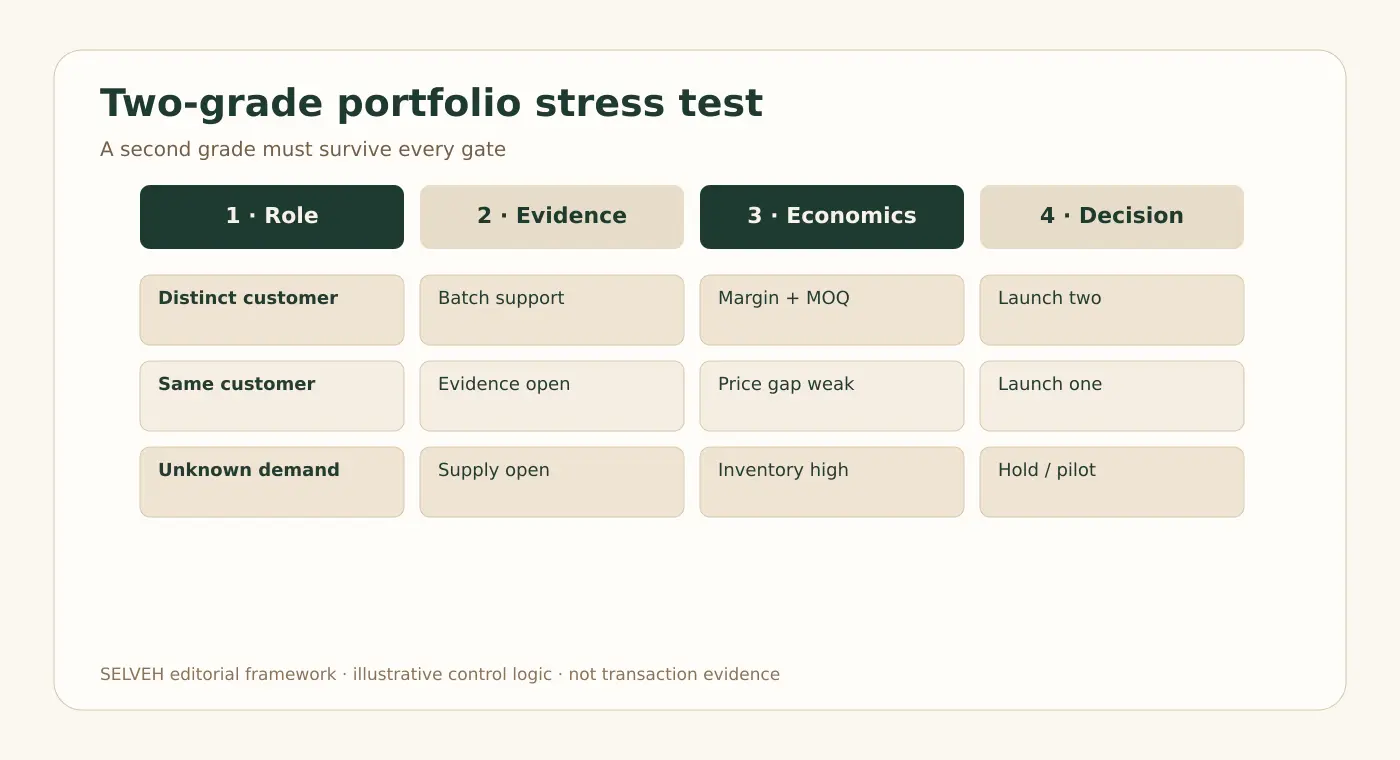
Start with a clear job for each grade. Then confirm supply and batch evidence, build the landed price ladder, test MOQ and working capital, and set pilot thresholds. Launch two grades only when each has a distinct role and the combined range remains operationally manageable.
Hold or simplify when the premium step has no validated customer, the price ladder collapses after channel margins, or inventory minimums create unacceptable exposure. A focused one-grade launch is not a weaker strategy when it creates better learning and service.
15 · Buyer tool
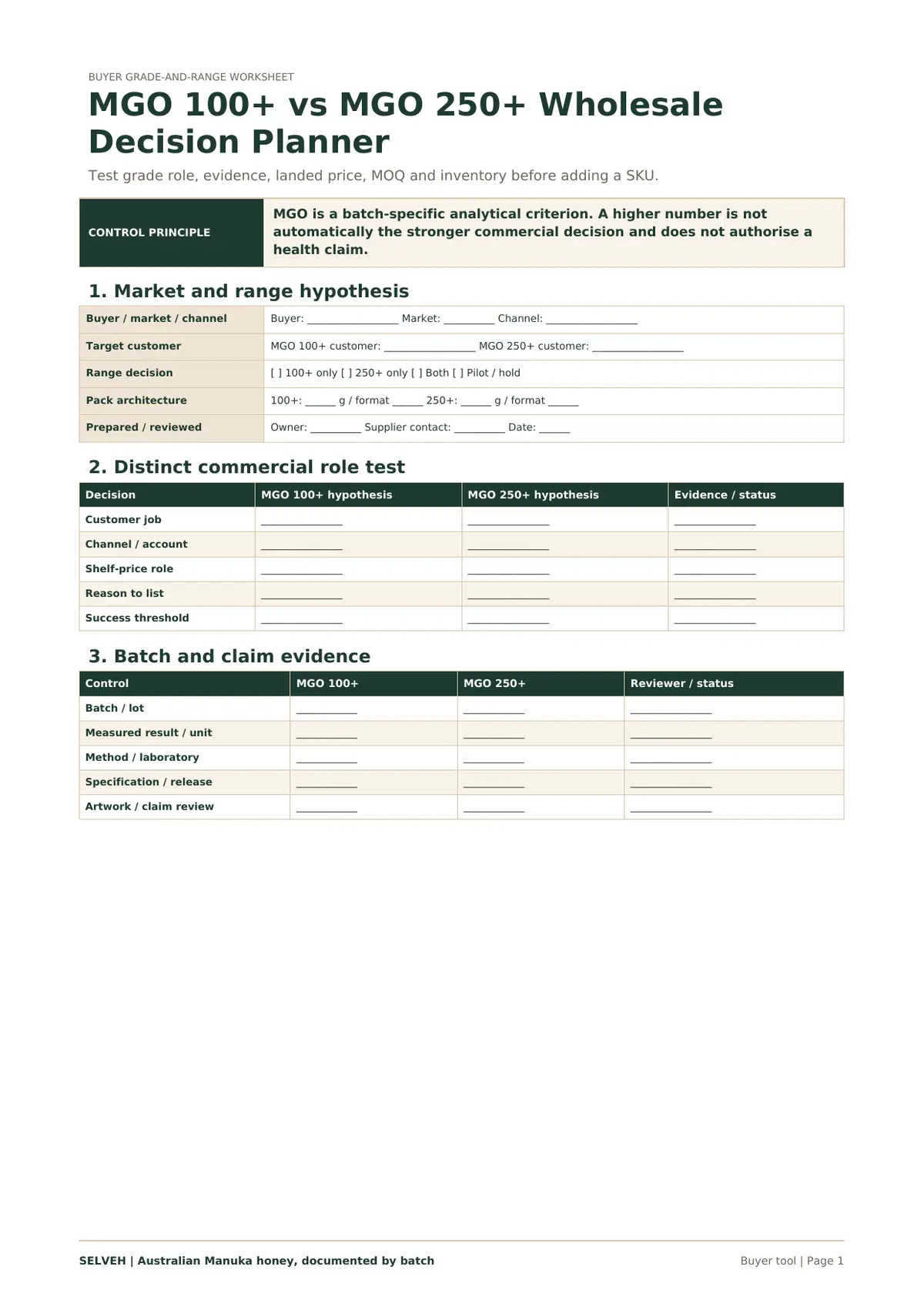
Download the grade decision planner
The two-page planner records market, customer, grade role, pack, evidence, landed cost, price ladder, MOQ, inventory, pilot measures and approval. Use actual supplier quotations and buyer feedback; label every estimate and unresolved input.
The planner is not a quotation, COA, product specification, health advice, regulatory approval or confirmed SELVEH supply offer. It structures the questions that must close before a range decision.
16 · Review triggers
Investigate these grade proposals
- A grade is marketed without batch-specific supporting evidence.
- MGO is converted into a disease or guaranteed health outcome.
- MGO 250+ is called commercially superior without a target customer and price test.
- The price comparison omits pack, testing, freight or channel margin.
- Two grades multiply MOQ without separate demand forecasts.
- The same customer job is assigned to both SKUs.
- COA and finished-product batch identifiers cannot be reconciled.
- Artwork, sales sheets or marketplaces use claims outside the approved evidence set.
17 · Buyer FAQ
Frequently asked questions
Is MGO 250+ always better for a premium brand?
No. It is a higher analytical grade criterion, but the commercial fit depends on buyer, evidence, price, pack, supply and rotation.
Should a launch include both MGO 100+ and 250+?
Only if each has a distinct role and the combined MOQ, working capital and operating load are justified.
Can a buyer compare grades using supplier price alone?
No. Normalise net weight, packaging, testing, delivery basis, freight, duties, channel margin and commercial terms.
Does SELVEH currently have both grades available?
This article does not represent availability. Supply, batch evidence, pack, quantity, timing and destination suitability must be confirmed for an actual enquiry.
18 · SELVEH status
What SELVEH can state today
SELVEH can use this framework to translate buyer demand into a grade-and-pack brief and identify the supplier, evidence, price and inventory inputs that remain open.
SELVEH should not claim current MGO 100+ or 250+ stock, a fixed price relationship, MOQ, lead time, test result, certification, health benefit or destination approval until verified for the actual product and batch. Enquiries help establish which commercial hypothesis should be tested first.
Sources
Official MGO and labelling guidance
- Australian Manuka Honey Association — Quality standards
- AMHA — Criteria for defining Australian Mānuka honey
- AMHA — Mark of Authenticity
- FSANZ — Food Standards Code legislation
- FSANZ — Labelling
- ACCC — Country of origin food labelling
Source review: Official guidance reviewed 26 August 2026. Specifications, batches, labels, market rules and commercial terms require current verification.
Trade planning
Need to test an MGO grade and pack architecture?
Share the market, target channel, intended pack, quantity and pricing position. SELVEH will map the evidence, supply and commercial assumptions that must be verified before an offer.
Start a trade enquiry