
01 · Comparison basis
Normalise the buying question before ranking suppliers
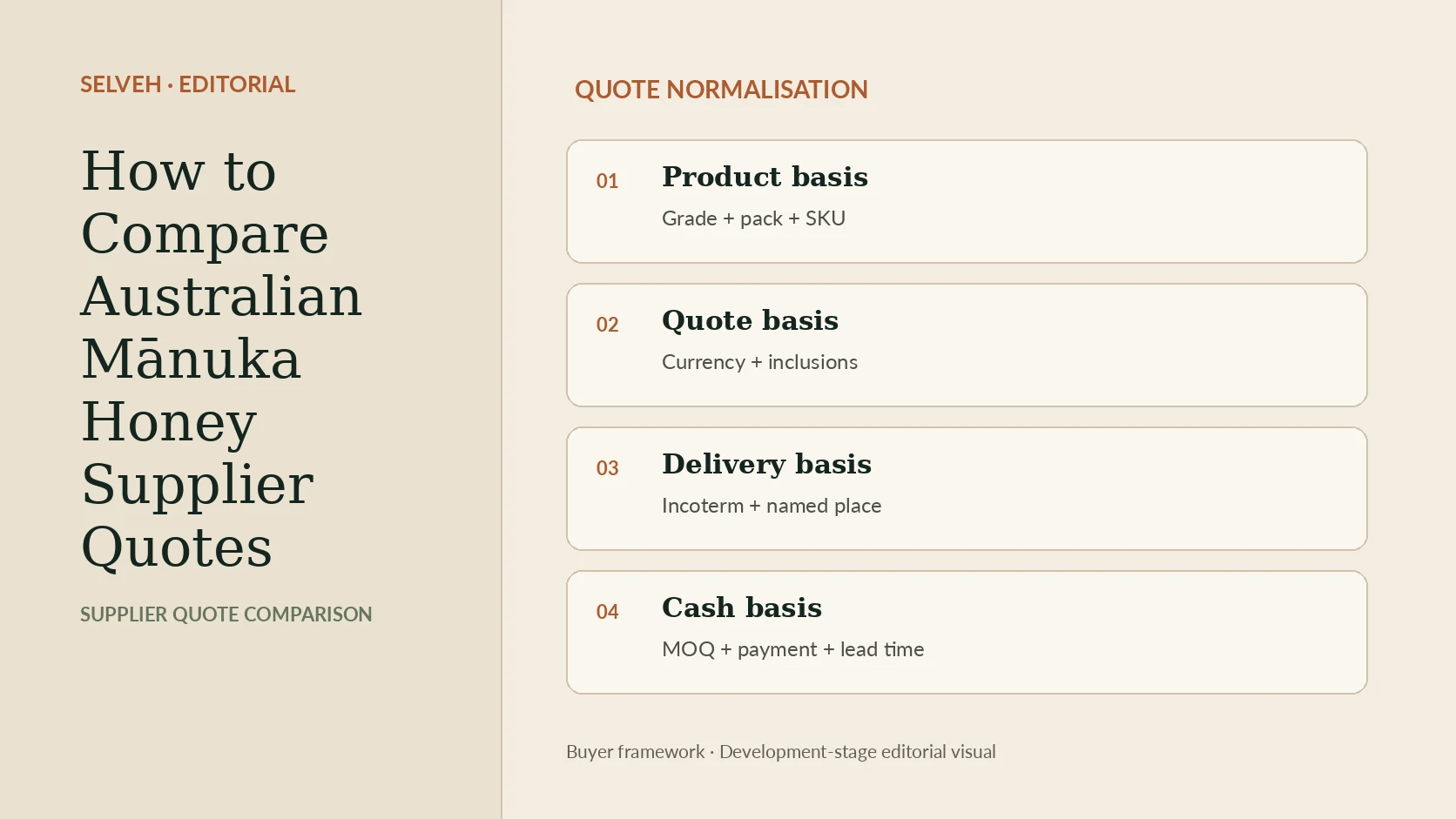
A supplier quote is only comparable when the commercial basis is comparable. A lower headline unit price can be meaningless if another quote includes a different MGO grade, pack specification, testing package, minimum run, delivery point or payment structure.
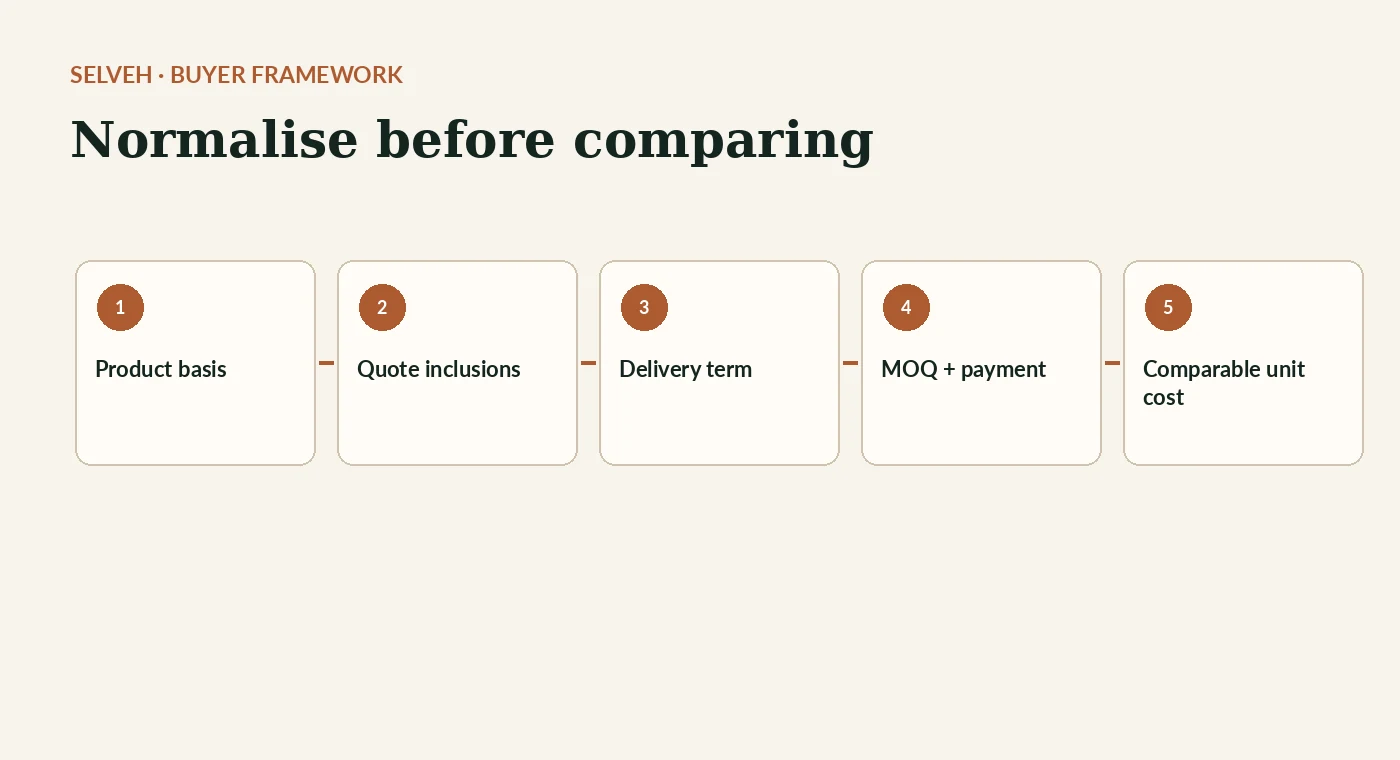
Before scoring suppliers, create one reference scenario: the same destination, grade, pack size, quantity or quantity band, evidence package, delivery term and target timing. Then map each supplier response to that scenario and mark anything that remains OPEN.
The objective is not to force every supplier into an identical business model. It is to separate genuine price differences from scope differences and unknowns.
02 · Product basis
Confirm that the quoted product is actually the same product
Normalisation starts with product identity. Record the honey description, Australian-origin wording, intended MGO grade, monofloral/multifloral wording if used, pack size, retail-ready versus bulk status and the number of SKUs included in the quote.
If Supplier A quotes MGO 250+ in a 250 g glass jar and Supplier B quotes a nearby grade in a 500 g PET pack, those are not competing prices yet. They are different offers and should stay in separate comparison rows until a common basis is defined.
Use the SELVEH product-specification framework to define the requirement before treating a quoted item as a match.
03 · Price basis
Write down exactly what the quoted number includes
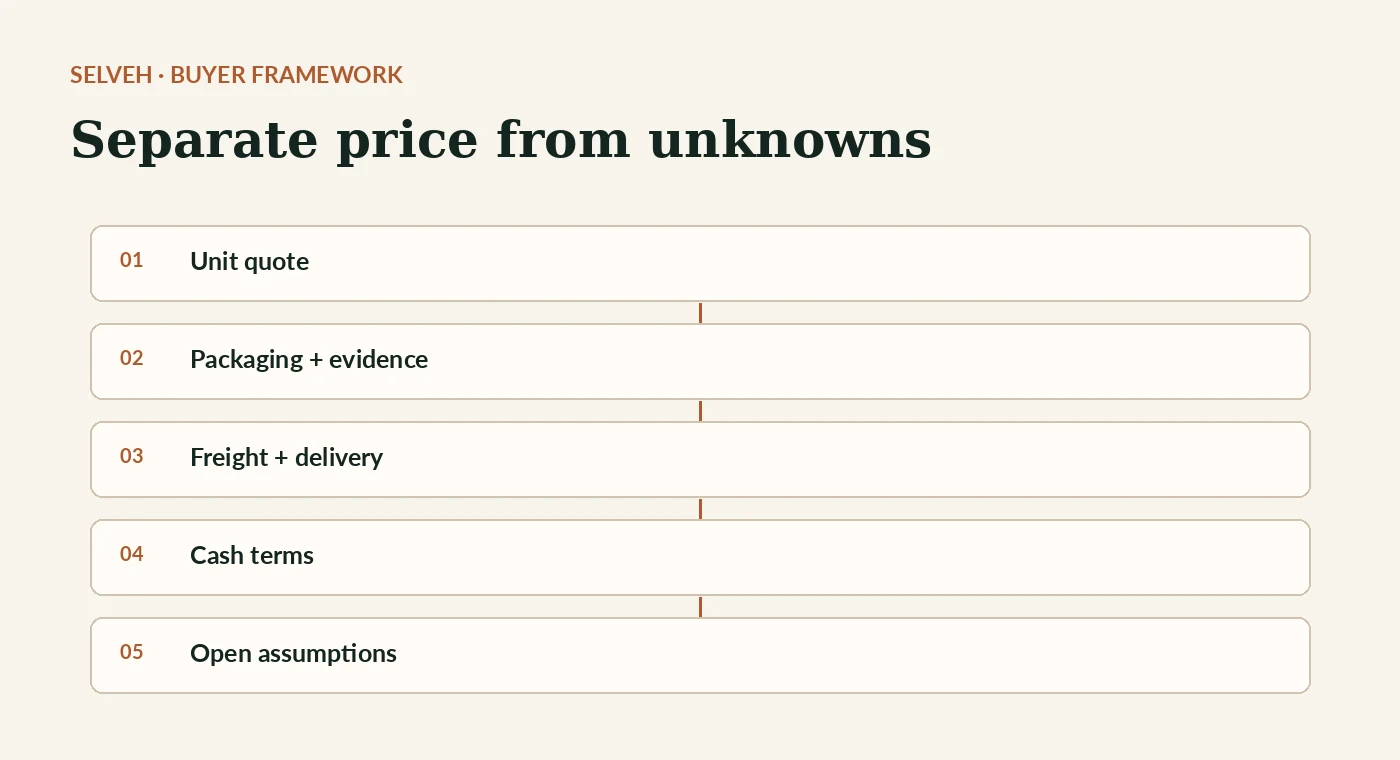
For each quotation, record the currency, unit basis and whether tax is included or excluded. Then separate honey, primary packaging, label/decoration, tamper evidence, secondary cartons, setup/artwork charges, testing, certificates, freight and any other explicit charges.
Do not silently treat an omitted cost as zero. If a component is not priced or its inclusion is unclear, mark it OPEN and request clarification before calculating a winner.
This also reduces the risk of relying on an incomplete commercial impression. ACCC guidance notes that price, shipping options, delivery timing and statements made in quotations should be accurate and not misleading.
04 · Packaging scope
Compare the physical pack and packing responsibilities line by line
Private-label quotes often look similar while assigning different packaging responsibilities. Record jar material and size, closure, seal or tamper evidence, label supply, coding, carton configuration, palletisation and any tooling or print minimums.
If the buyer supplies labels or components under one quote but the supplier supplies them under another, the headline packed-unit prices are not comparable until the buyer-supplied cost and handling exposure are added back.
Keep approved artwork and destination-label review separate from the printer’s ability to physically apply a label.
05 · Testing and documents
Price the evidence package as part of the offer
Ask what batch testing and documents are included in the quoted price: MGO or related analytical results, COA scope, origin and traceability records, product specification, packing records, export certificates where market-specific requirements apply, and any requested residue or authenticity work.
NATA advises buyers to check the laboratory’s scope for the exact activity or method required rather than relying on the word “accredited” alone. A quote that includes a fit-for-purpose test is not automatically equivalent to a quote that includes a generic laboratory report.
If evidence is optional, record both the base price and the fully evidenced price scenario rather than hiding the difference.
06 · MOQ and production run
Separate MOQ from minimum packaging and production constraints
“MOQ” can refer to several different limits: honey grade, finished SKU, jar/label print run, production batch or total order value. Ask the supplier to state which limit applies and whether grades or pack sizes can be mixed.
Then calculate the cash exposure created by the minimum. A quote that is cheaper per jar but requires materially more inventory may be commercially worse for a trial order.
For a multi-SKU launch, multiply the per-SKU constraints rather than assuming the total MOQ can be freely split.
07 · Incoterm and named place
Put every quote on a defined delivery handover
Every export quotation should identify the delivery rule and named place precisely enough to understand where delivery and risk transfer occur. “FCA Melbourne” and “DAP buyer warehouse” are not comparable price bases because the seller is carrying different freight, risk and formalities.
ICC Incoterms® 2020 rules separate delivery/risk from who pays carriage in ways that can surprise buyers. For example, under CPT and CIP the seller pays carriage to the named destination but risk transfers earlier when the goods are handed to the carrier.
If suppliers quote different Incoterms, either ask for a common term or add the missing logistics legs to a scenario model. Do not rank the headline prices as if they were delivered to the same point.
08 · Lead time
Compare the components of lead time, not one optimistic number
Ask the supplier to separate sample or pre-production approval, artwork approval, packaging procurement, packing/production, laboratory release and dispatch readiness. If the quoted lead time begins only after labels arrive or after a deposit clears, record that trigger.
Also distinguish indicative lead time from a committed production slot. A fast quoted timeline with unresolved packaging or evidence dependencies can be less reliable than a longer but clearly defined schedule.
For time-sensitive launches, record the latest buyer-approval date needed to protect the promised dispatch window.
09 · Payment terms
Normalise the cash-flow burden as well as the price
business.gov.au notes that payment terms form part of the sales contract and should state how and when payment is due. Export Finance Australia likewise expects export purchase orders/contracts used as transaction evidence to include payment terms, delivery terms and shipping details.
For each quote, record deposit percentage, timing of balance payment, any credit period, currency, bank fees if material and whether payment is linked to production, testing, dispatch or document release.
A lower unit price can be less attractive if it ties up substantially more cash earlier in the cycle. Compare initial cash exposure and payment timing alongside gross purchase value.
10 · Comparable cost
Calculate at least a comparable unit and landed scenario
Create a common unit basis such as cost per finished jar and cost per kilogram of honey-equivalent product. Then add known freight, insurance, export-document, brokerage, duty/tax and destination costs only where the comparison scenario legitimately requires them.
Keep quoted, estimated and unknown figures visibly different. A model should not turn an unconfirmed freight or customs assumption into a supplier fact.
The purpose is not to predict the final landed cost perfectly at RFQ stage. It is to show which quote is cheaper because of real economics and which only looks cheaper because more costs sit outside the quote.
11 · Risk adjustment
Do not award the cheapest quote before open assumptions are closed
Add an OPEN-items column beside the financial comparison. Typical open items include exact grade availability, laboratory scope, label responsibility, mixed-SKU MOQ, freight basis, importer-side requirements and the expiry/validity of the quotation.
A supplier with a slightly higher price but clear evidence, realistic lead time and fewer unresolved dependencies may carry lower execution risk. Conversely, a cheap offer with major assumptions should not be given an artificial precision score.
The decision should combine comparable price, evidence quality, execution readiness and cash exposure rather than using unit price alone.
12 · Red flags
Investigate these quotation patterns before selection
- “All inclusive” without a written list of inclusions and exclusions.
- An MGO grade or pack format that differs from the RFQ but is presented as directly comparable.
- One MOQ figure without stating whether it applies per grade, per SKU or per production run.
- “COA included” without the test scope, laboratory or batch relationship being clear.
- An Incoterm without a precise named place or destination point.
- A lead time with no stated start trigger or packaging dependency.
- Payment terms that are absent from the written quote or change after supplier selection.
- A price that assumes buyer-supplied packaging, labels or freight while another quote includes them.
13 · Buyer tool
Use one quote-normalisation matrix before shortlisting
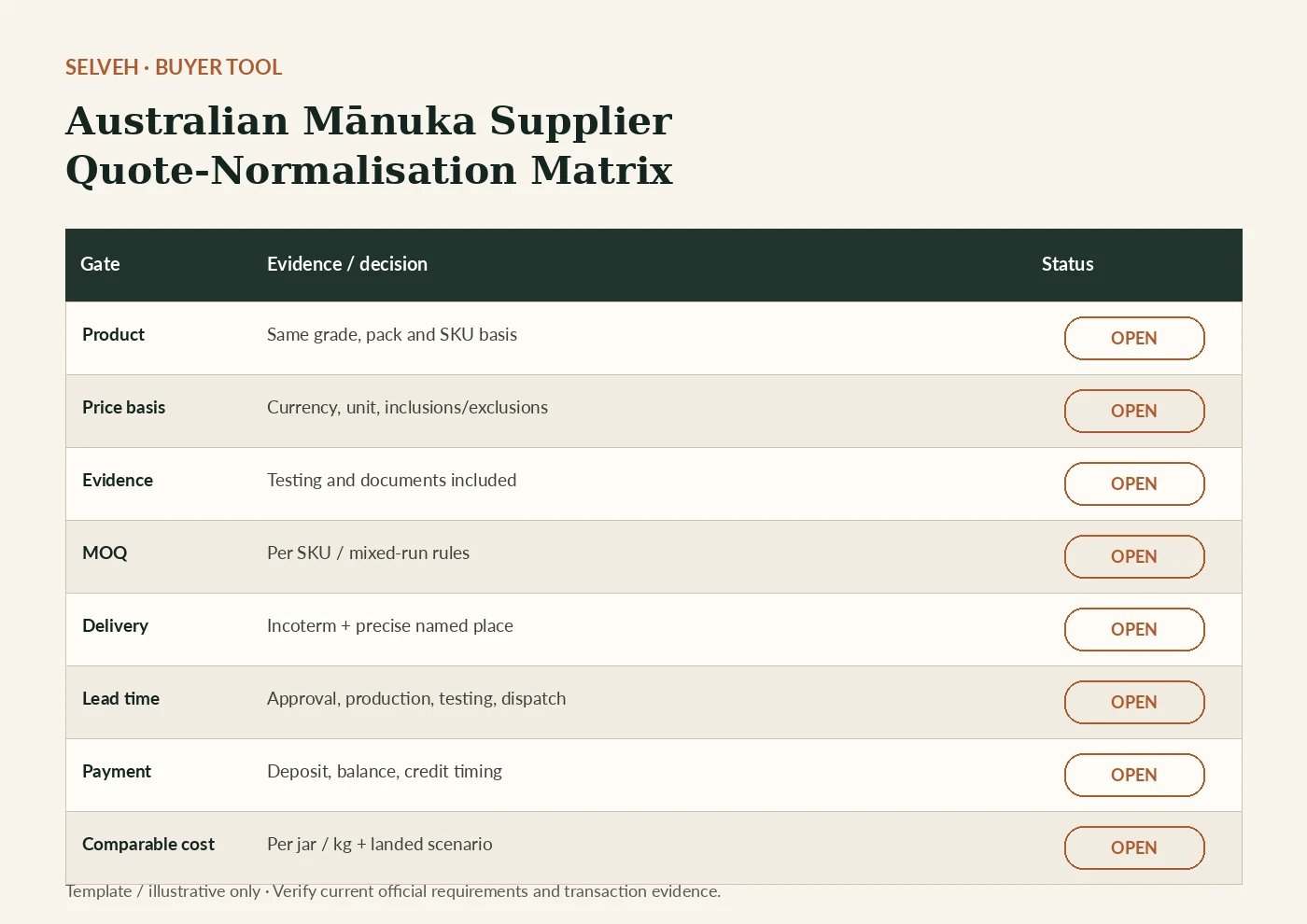
The downloadable matrix gives each supplier the same comparison columns: product/grade, pack, included evidence, MOQ and mixed-SKU rules, unit price basis, Incoterm and named place, lead time, payment terms, open costs and comparable-unit or landed scenario.
Use GREEN only where the commercial basis is confirmed in writing, AMBER where clarification or modelling is still required, and RED where the offer cannot currently meet a mandatory requirement.
The matrix is an evaluation aid, not a substitute for a contract, supplier due diligence, destination compliance review or final landed-cost calculation.
14 · SELVEH status
What SELVEH can state today
SELVEH can define a quote-normalisation structure and use it when supplier responses are received. It should not publish supplier rankings, prices, MOQ claims, landed costs or commercial capability as confirmed until written supplier evidence exists.
When real supplier quotations are available, this article can be upgraded with anonymised first-party comparison examples where confidentiality permits.
Until then, all numerical supplier economics remain OPEN rather than being filled with market guesses.
Sources
Sources and evidence notes
- ACCC — False or misleading claims
- business.gov.au — Payment terms
- Export Finance Australia — Export transaction / purchase-order requirements
- ICC — Incoterms® 2020 rules for any mode
- NATA — Choosing the right laboratory and checking scope
Editorial boundary: Current official, technical and scheme information is separated from SELVEH recommendations. Open supplier, batch, importer or contract evidence is not represented as confirmed.
Trade planning
Comparing Australian Mānuka supplier quotations?
Tell SELVEH the destination, intended grade, pack format and indicative quantity. The trade enquiry can then be structured around a common quote basis while supplier-specific prices, MOQ and evidence remain open until confirmed.
Start a trade enquiry