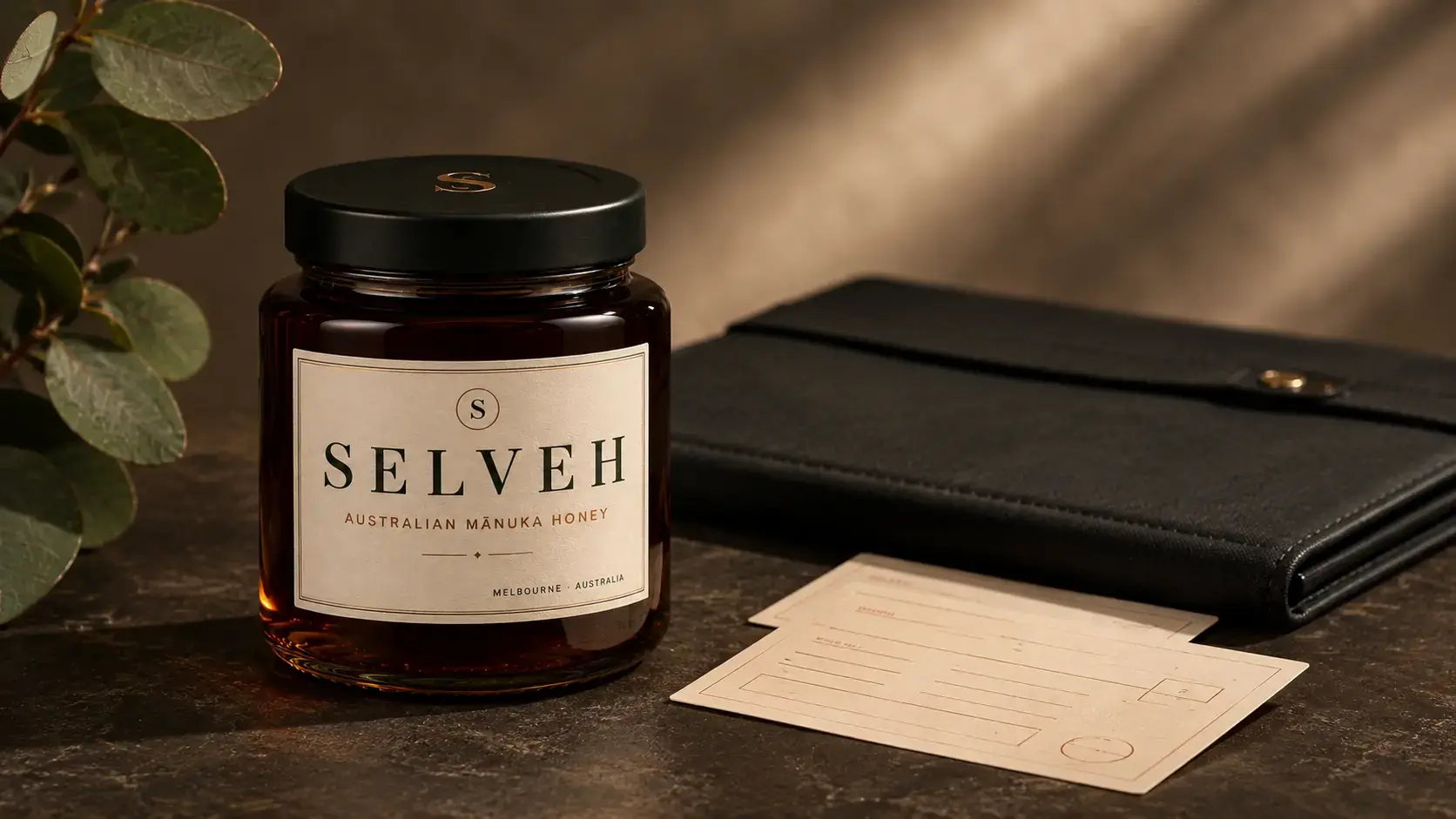
The shelf-side method
Read the jar in three passes, not one glance.
Rather than starting with the largest number, look at the front, then the country-of-origin information, then whatever allows the finished lot to be checked. You do not need a laboratory background to ask these questions. You do need to keep unlike forms of evidence separate.
| Pass | Look for | Do not conclude |
|---|---|---|
| Front | Mānuka description, any MGO figure, product and pack identification. | That a bigger MGO number establishes authenticity, medical value or overall superiority. |
| Origin | Actual country-of-origin statement, distinct from the seller’s postal address. | That an Australian brand always contains Australian honey—or a New Zealand brand always contains New Zealand honey. |
| Lot | Batch/lot reference and relevant laboratory or independent scheme evidence where claimed. | That a generic certificate, barcode or borrowed logo necessarily applies to the purchased jar. |
Pass 01 · Meaning before marketing
Start with MGO—but stop short of treating it as a promise.
MGO is methylglyoxal, commonly expressed as milligrams per kilogram of honey (mg/kg). When a product is described as MGO 100+, that normally conveys a minimum concentration threshold under a relevant product specification; it is not a percentage, an internationally uniform overall-quality score or a health outcome.
Two products can display the same MGO tier and still differ in country of origin, botanical identity documentation, batch records, pack format and certification status. The number matters, but cannot carry those other claims for the label. For the analytical background, read our more detailed MGO grades explainer.
The label should also identify the food being presented and its net content. For market-specific mandatory information, the actual destination-country and supply-channel rules still need checking. A design mockup is never substitute evidence for a compliant retail label.
Pass 02 · The source, not the slogan
Read the origin statement separately from the brand story.
SELVEH is based in Melbourne. That tells you where the company operates; it does not, by itself, tell you where the nectar was collected, where a future jar was packed, or what evidence would support its origin claim. The same distinction matters for any brand.
Australia and New Zealand have different identity and trade frameworks for Mānuka. For honey exported from New Zealand as Mānuka, the New Zealand Ministry for Primary Industries (MPI) definition requires testing against a combination of five attributes: four chemical markers and a pollen-DNA marker, using recognised laboratories. An MGO measurement is not a substitute for that export identity test.
In Australia, origin representations must be accurate and supported. The Australian Competition and Consumer Commission (ACCC) distinguishes origin claims such as grown, produced and made, and warns that imagery and wording can create misleading implied claims. Those are questions about a real product and its supply chain, not an opportunity for decorative flags.
For a deeper comparison of why these origins are not interchangeable, see Australian versus New Zealand Mānuka.
Pass 03 · Beyond the front label
Which lot is this—and what can actually be checked?
A batch or lot code helps connect a specific finished product to production and traceability records. It is not, by itself, a guarantee of purity or an independent laboratory result. A barcode generally identifies the trade item; it does not replace lot-specific identification.
Where a seller claims an independently measured MGO grade, ask whether the supporting result identifies the tested sample, date, testing laboratory, method, unit and relevant lot. A certificate displayed online can be helpful only if it is authentic, sufficiently current and actually connected to the product in question. Our COA reading guide explains the report-level questions.
On a consumer jar, some supporting documents may be available only through the producer, importer or retailer. Absence of a public QR code does not prove a product is false; conversely, the presence of one does not prove an unverified claim. The correct question is what the code leads to and whether the evidence matches.
Independent schemes have boundaries
Do not treat MGO, AMHA, MPI and UMF as interchangeable.
The Australian Manuka Honey Association Mark of Authenticity is a licensed product scheme for qualifying Australian Mānuka. Its authorisation is not automatically inherited by every Australian honey or by a brand considering an Australian collection. The mark should appear only where the specific product and licensee are entitled to use it.
The New Zealand MPI export Mānuka definition is a separate regulatory identity test. The UMF™ framework is yet another named scheme, with multiple factors; it is not simply the same number as MGO in a different font. Read the current rules for whichever mark a particular product actually carries.
SELVEH does not claim that the concept jars shown on this site carry an AMHA or UMF licence, an approved export identity report or finished-batch laboratory evidence. Visual studies and commercial specifications must not be confused.
The claim-to-document method · updated 16 Nov 2026
MGO versus UMF™: which document answers which question?
A prominent number can be useful, but it cannot stand in for all the product evidence. MGO and UMF™ are not interchangeable scales: the UMF Honey Association describes its rating as a multi-factor framework involving MGO, leptosperin, DHA and HMF. Check what the actual jar claims rather than using an approximate number-to-number conversion.
| What you see | Evidence to ask for | What it does not prove by itself |
|---|---|---|
| MGO 100+, 250+ or another grade | The measurement basis, laboratory result where applicable, and a clear connection to the proposed finished-product lot. | Country of origin, MPI export identity, a licensed certification mark, or retail availability. |
| UMF™ claim on a New Zealand product | Check current scheme entitlement, stated UMF™ grade and the relevant product or batch verification route with the scheme owner. | That every unrelated MGO-rated honey is UMF™ certified, or that an Australian product automatically qualifies. |
| “New Zealand mānuka” export identity | Where the New Zealand export requirements apply, look for support under MPI's five-attribute mānuka honey definition and the matching consignment or batch record. | A particular UMF™ grade or the exact MGO concentration of the final retail jar. |
For Australian-origin honey, keep the country-of-origin and any Australian Mānuka scheme claims separate from New Zealand-specific rules. A Melbourne business address cannot substitute for the product's own origin records.
Before relying on a label for a purchase or a listing, write down the exact claim, the supporting issuer or laboratory, the relevant lot, and the country-specific rule. The fuller certification buyer guide explains how to distinguish a licence, a laboratory result and a certification. For a visual overview, see SELVEH's MGO/UMF comparison.
Illustrative comparisons · Not real batches
Two labels can say “MGO 100+” yet mean different things to verify.
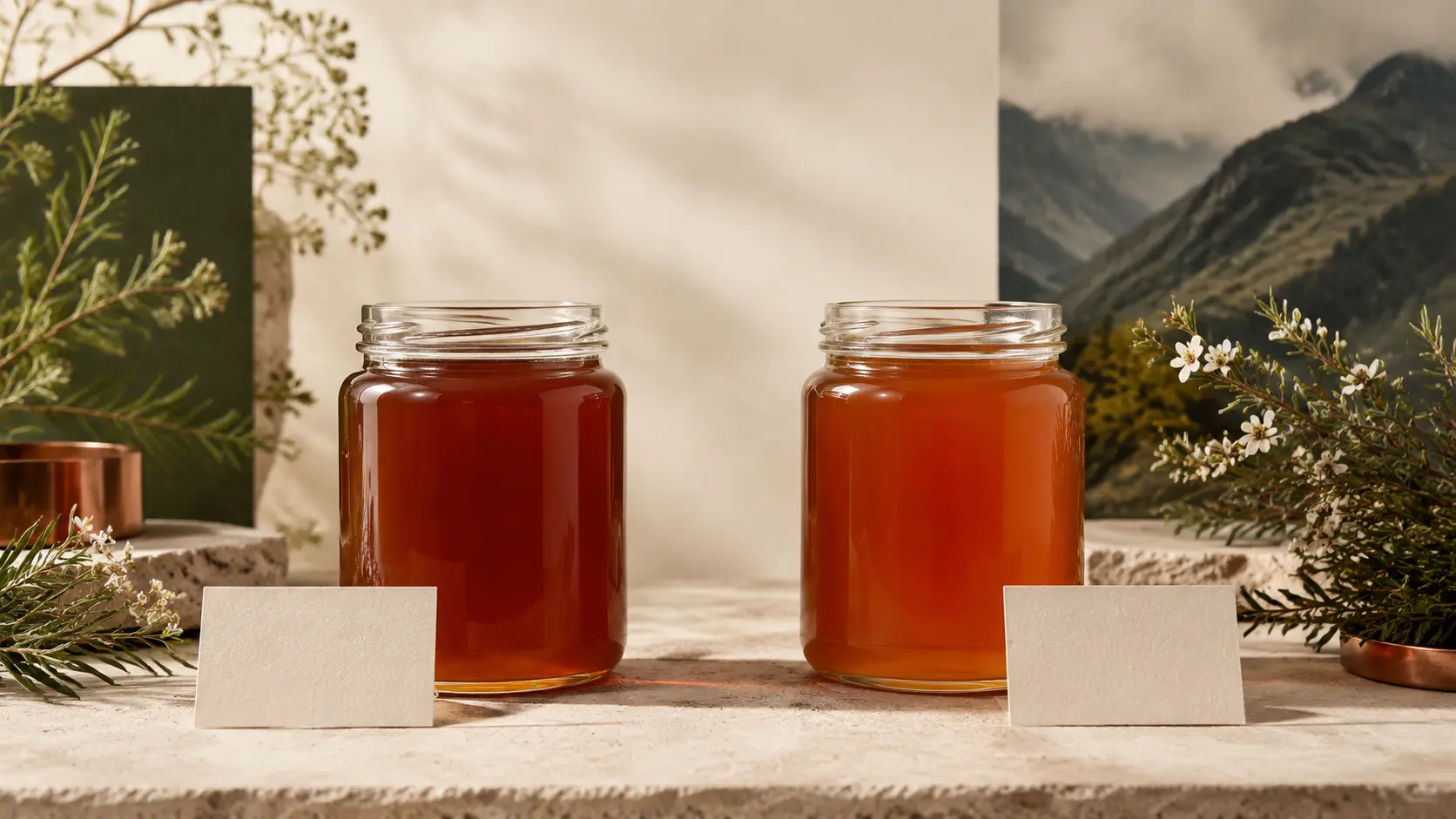
Concept A: An Australian-origin Mānuka design with MGO 100+ printed on the front. Before calling it a product, the company would need an actual supported origin claim, a specified tested lot and label/packaging compliance. It may not claim an AMHA mark merely because it is Australian-origin.
Concept B: A New Zealand-origin design with the same MGO 100+ wording. That number alone would not satisfy MPI’s five-attribute identity requirements for exported honey labelled as Mānuka. An actual finished product needs its own supporting testing and supply documentation.
The equal printed number says something narrow about the intended MGO tier. It does not establish equivalence of authenticity systems, sensory characteristics or availability. These are hypothetical examples, not SELVEH stock, tested batches or quotations.
For the category buyer
Why this also matters on a premium retail shelf
A credible retail listing connects a beautiful front-of-pack proposition to information a store can defend: the finished SKU, its genuine origin, truthful MGO and product description, legally appropriate claims, supply and traceability records, and a reliable route for questions or complaints. An attractive unverified design is a brand concept, not a retail-ready item.
Retailers who need a deeper product and document review can use our retail listing checklist or the authenticity evidence guide. For a specific prospective distribution conversation, visit SELVEH trade partnerships; any offer remains subject to verified origin, grade, packaging, availability and mutually agreed commercial terms.
Evidence and further reading · checked 5 Nov 2026
Primary sources behind this guide
- New Zealand MPI — ensuring exported Mānuka meets its five-attribute definition.
- Australian Manuka Honey Association — Mark of Authenticity and licensing conditions.
- ACCC — country-of-origin representations and substantiation.
- UMF Honey Association — the factors behind the UMF framework.
- SELVEH editorial standards and evidence boundaries.
These sources describe their respective systems. They are not evidence that SELVEH has obtained an independent mark, confirmed a particular finished product or passed importer-market requirements. This article is general consumer and retailer information, not medical, certification or legal advice.