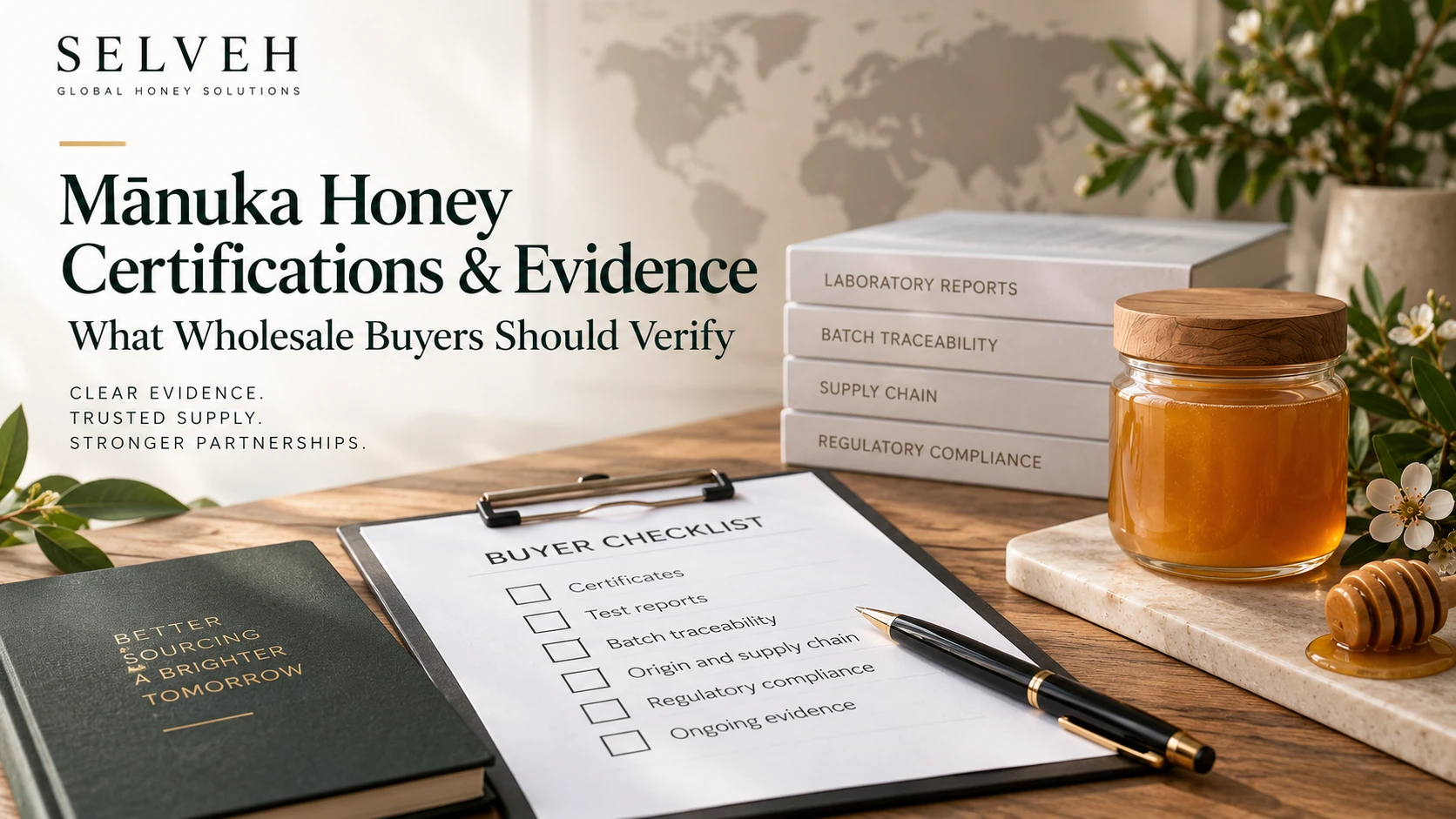
In a wholesale Mānuka honey transaction, several forms of evidence can appear side by side: a food-safety certificate, an accredited laboratory report, an industry quality mark, an origin document, a product specification and a batch release record. They do not answer the same question. The buyer’s job is to understand what each document can support, what it cannot support, and whether it applies to the exact product and transaction being evaluated.
This is deliberately narrower than general supplier due diligence. For the full supplier-screening workflow, use How to Evaluate an Australian Mānuka Honey Supplier. This guide focuses on the evidence itself.
01 · Evidence roles
Start by separating the evidence categories
The word certified is often used loosely. A stronger buyer process starts by naming the evidence type before assigning meaning to it.
| Evidence type | What it can support | What it does not prove by itself | Buyer check |
|---|---|---|---|
| Food-safety / management-system certificate | Assessment of a facility or system against defined requirements | Exact MGO grade, batch authenticity, origin or shipment release | Holder, site, scope, standard, status, issuing body |
| Laboratory accreditation | Competence for defined testing activities within an accredited scope | The result for your specific batch | Lab identity, scope, method or analyte coverage |
| Test report / COA | Results for the sample or batch identified on the report | Broader supplier certification or destination approval | Batch ID, sample ID, methods, dates, result, laboratory |
| Industry quality mark | Conformity with the mark owner’s scheme when licensed and valid | Every commercial or regulatory requirement | Licence holder, product eligibility, scheme rules, batch link where relevant |
| Origin / customs document | Origin or trade information within that document’s purpose | MGO grade, food-safety certification or batch release | Exporter, product description, country, shipment match |
| Destination-market approval / registration | A specific regulatory permission, registration or status where required | All product-quality attributes | Authority, legal entity, site/product, validity, market |
That separation prevents one strong-looking document from carrying more meaning than it should.
02 · Certification vs accreditation
Accreditation and certification are not the same control
JASANZ describes accreditation as an independent assessment of organisations that carry out certification, inspection, testing and verification. Certification bodies then assess products, services, systems or processes against specified requirements. JASANZ explicitly distinguishes the two and notes that it accredits the organisations performing conformity assessment rather than certifying products or management systems itself.
For a buyer, that creates two separate questions: Is the certificate genuine and relevant? and, where applicable, is the organisation behind that certificate appropriately accredited for the activity?
Do not stop at a logo. Where a public register exists, check the organisation, certificate or scheme information there and compare it with the document presented by the supplier.
03 · Scope matters
A genuine certificate can still be irrelevant to your order
The biggest certificate mistake is often not fraud. It is scope mismatch.
A certificate can be genuine while belonging to the wrong legal entity, the wrong site or an activity that does not cover the part of the supply chain you are buying. A supplier may operate several premises, outsource packing or sell through a related company. The certificate must still be mapped to the actual commercial pathway.
Before accepting a certificate as material evidence, check:
- legal entity name and trading entity;
- physical site address;
- certificate or licence number;
- standard, programme or scheme;
- scope wording and covered activity;
- issuing body and, where relevant, accreditation;
- issue date, expiry date and current status;
- whether the certified site actually performs the extraction, storage, blending, packing or release step relevant to the order.
A current certificate for a corporate parent does not automatically cover every subsidiary, site or outsourced packer. Treat holder, site, scope, activity and status as five separate verification fields.
04 · Food-safety systems
Use food-safety certification for the control it actually provides
Food-safety or management-system certification can be important evidence that a facility or system has been assessed against defined requirements. It can reduce uncertainty about how a site manages documented controls, but it should not be stretched into proof of an individual jar or batch.
A food-safety certificate does not, by itself, prove that a particular batch meets an MGO grade, that the honey is authentic Mānuka, that a country-of-origin statement is correct or that a shipment is ready to release.
Different suppliers and markets may use different recognised systems. The right buyer question is therefore not “Does every supplier have this exact scheme?” but “What system applies to this site and transaction, and can its current scope be independently checked?”
05 · Laboratory evidence
Laboratory accreditation is not the same thing as a batch result
NATA accredits laboratories and other facilities for defined scopes. NATA’s guidance makes an important buyer point: a facility’s accreditation may not cover every service it provides, and the detailed scope is the primary place to see what the laboratory has demonstrated competence to perform.
NATA also states that its endorsement is not permitted on reports for testing outside the accredited scope, subject to limited exceptions. For buyers, the practical control is simple: do not rely on “NATA accredited” as a blanket phrase. Check whether the relevant analysis is within scope and whether the actual report applies to the batch being offered.
For Mānuka honey, keep four layers separate:
- laboratory identity and accreditation;
- scope covering the relevant analysis or method;
- the actual report and result;
- the sample or batch identifier connecting that result to the goods.
For a field-by-field batch-report review, use How to Read a Mānuka Honey COA.
06 · Grade language
MGO is a product specification, not a certification
MGO is a measurable constituent used in Mānuka honey grading and product specifications. A commercial designation such as MGO 100+ or MGO 250+ should therefore be supported by appropriate evidence for the relevant batch, but the MGO number itself is not a certification scheme.
When comparing suppliers, ask the questions separately:
- What MGO grade is being offered?
- What report supports that grade?
- Which laboratory performed the test?
- Does an independent quality mark or certification apply in addition to the batch result?
- What origin and traceability records support the product representation?
This keeps a laboratory result from being presented as broader facility, origin or regulatory approval. For controlled purchasing language, see Mānuka Honey Product Specifications: What Wholesale Buyers Should Require.
07 · Australian Mānuka
Understand the AMHA Mark of Authenticity within its own scheme
The Australian Manuka Honey Association (AMHA) operates a Mark of Authenticity for Australian Mānuka honey under its published criteria and licensing conditions. AMHA states that honey carrying the mark must be tested and approved against its criteria, and its licence conditions restrict use of the mark to eligible licensed members and qualifying verified Australian Mānuka products.
That means the mark should be treated as a defined industry scheme with its own eligibility, testing and use conditions—not as a generic Mānuka logo.
If a supplier presents the mark, a buyer should check the relevant licensee, product eligibility and current conditions, and should still review the commercial specification, batch evidence, packing details and destination-market requirements separately. AMHA’s own licence terms also place responsibility on the licensee to determine whether the mark may be used in a particular destination country.
08 · New Zealand Mānuka
Use UMF™ only in the New Zealand context
The UMF Honey Association describes UMF™ as a quality mark and rating system for New Zealand Mānuka honey. Its certification search allows users to check a licence number and batch number, and the association states that UMF™ certified product is linked to licensed members and batch-specific testing.
For wholesale procurement, the important point is origin and scheme discipline: do not apply UMF™ terminology to Australian-origin honey, and do not treat an MGO number alone as equivalent to UMF™ certification.
Where UMF™ is relevant to a New Zealand-origin product, check the licensed brand or licence holder, the batch number and the available verification record using the association’s current tools and rules.
09 · Other marks and approvals
Halal, Kosher, Organic and market approvals are requirement-specific
Other certificates or marks may matter because of the buyer, retailer, channel or destination market. They should not be described as universally required for all Mānuka honey.
For any such evidence, verify the same fundamentals: certificate holder, site, scope, product coverage, validity, issuing organisation and destination/customer requirement. Keep private certification separate from government approval unless an official authority explicitly establishes that status for the specific product and market.
10 · Buyer matrix
Verify what the evidence proves—and what it does not
| Claim or evidence | Primary issuer / owner | Buyer should verify | Do not infer automatically |
|---|---|---|---|
| Food-safety certificate | Certification body / scheme | Legal entity, site, scope, validity, certificate body | Batch MGO, authenticity, origin, shipment release |
| NATA-accredited testing | NATA + accredited laboratory | Laboratory, scope, relevant analysis, endorsed report | That every service the lab offers is accredited |
| AMHA Mark of Authenticity | Australian Manuka Honey Association | Licensee, qualifying Australian product, current scheme conditions | Destination-market approval or every buyer requirement |
| UMF™ | UMF Honey Association | NZ licence holder, batch number, current verification | Applicability to Australian-origin honey |
| MGO grade | Product specification + batch test evidence | Grade, test result, batch match, laboratory | Certification, food-safety approval or origin by itself |
| Country-of-origin document | Relevant issuer / exporter / trade process | Product, shipment, exporter, country and document role | Quality grade or food-safety system certification |
11 · Verification flow
Move from claim to transaction match
Claim
Write the exact statement being relied upon: certified, tested, licensed, Australian, New Zealand, organic or market approved.
Document
Request the actual certificate, licence, test report, batch record or official registration that supports the claim.
Independent check
Verify holder, site, scope, validity, licence or laboratory capability against the relevant official source where available.
Transaction match
Confirm that the evidence connects to the product, batch, packer, origin and destination requirements of the order.
This sequence is stronger than asking for a certificate pack and filing it unread. The last step—matching evidence to the exact transaction—is where many commercially important mismatches become visible.
12 · Red flags
Evidence that deserves a second look
- Expired certificate: a previously valid certificate is presented without current status.
- Wrong site: the certificate covers a different facility from the one packing or releasing the goods.
- Scope gap: the certificate does not include the activity being relied upon.
- Logo without licence: a quality mark appears in marketing or artwork without clear evidence of current eligibility.
- Laboratory outside scope: the lab is accredited, but the relevant analysis is not shown within its scope or report endorsement.
- Parent-company mismatch: evidence belongs to a related entity but not the contracting or operating entity.
- Generic certificate used as batch proof: a facility certificate is offered in place of batch-specific analytical evidence.
- Private certificate presented as government approval: the document’s actual legal or regulatory status is unclear.
None of these points proves misconduct. They simply mean the buyer needs more precise evidence before relying on the claim.
13 · Evidence request
What to ask for before commercial commitment
A practical buyer evidence pack can include:
- current food-safety or quality-system certificates relevant to the operating site;
- certificate numbers, issuing bodies and scope details;
- laboratory identity and relevant accreditation/scope information;
- batch-specific test report or COA for the offered grade;
- batch/lot identity and traceability records appropriate to the stage of the order;
- evidence for any AMHA, UMF™, Halal, Kosher, Organic or other mark actually being claimed;
- origin records and any shipment-specific origin documents required by the transaction;
- destination-market registrations or approvals where applicable;
- confirmation of who packs, releases and exports the finished goods.
The purpose is not to collect the largest possible document folder. It is to collect the smallest set of evidence that closes the material risks for the actual order.
14 · FAQ
Frequently asked buyer questions
Does a certified facility prove the honey is authentic Mānuka?
No. A facility or management-system certificate can support the controls at a site, but product authenticity or grade needs product- and batch-relevant evidence.
If a laboratory is NATA accredited, are all of its tests accredited?
Not necessarily. NATA states that an accredited facility’s scope defines the activities for which competence has been demonstrated. Buyers should check the relevant analysis against that scope and report.
Is MGO a certification?
No. MGO is a measurable constituent used in Mānuka honey grading and specifications. A grade should be supported by appropriate batch evidence, but the number itself is not a certification scheme.
Can Australian Mānuka use UMF™?
UMF™ is presented by the UMF Honey Association as a quality mark for New Zealand Mānuka honey. Australian-origin product should not be presented using UMF™ terminology as though it were the Australian certification framework.
Does SELVEH currently claim AMHA, UMF™, NATA or another certification?
No certification, licence, laboratory relationship or destination approval is claimed on this page for a current SELVEH product. Any future product-specific claim must be supported by verified first-party evidence before it is used commercially.
Evidence status
What SELVEH can state today
This article is a buyer-education framework. It does not represent a final SELVEH supplier, batch, packing facility, quality mark, certificate, laboratory relationship or government approval. SELVEH’s product-specific evidence set will be published only when the relevant supply path and supporting records are confirmed.
Sources
Primary accreditation and scheme sources
- JASANZ — What is accreditation?
- JASANZ — accreditation and accredited-organisation search
- NATA — Testing & Calibration (ISO/IEC 17025) Accreditation
- NATA — Test reports explained
- Australian Manuka Honey Association — Mark of Authenticity
- Australian Manuka Honey Association — Licensing and Conditions
- UMF Honey Association — Mānuka Honey Quality Certification Search
- UMF Honey Association — UMF™ Quality Mark and assurance system
Source review: Official sources reviewed 15 September 2026. Scheme criteria, scopes, licence conditions and market requirements can change; verify the current official source before relying on them for a transaction.
Trade planning
Need to define the evidence pack for a Mānuka programme?
Share the destination market, channel, intended origin and grade, plus any retailer or regulatory certification requirements. SELVEH can separate confirmed evidence from open assumptions before a commercial offer is made.
Start a trade enquiry