
01 · Control documents
A product specification and a COA answer different questions
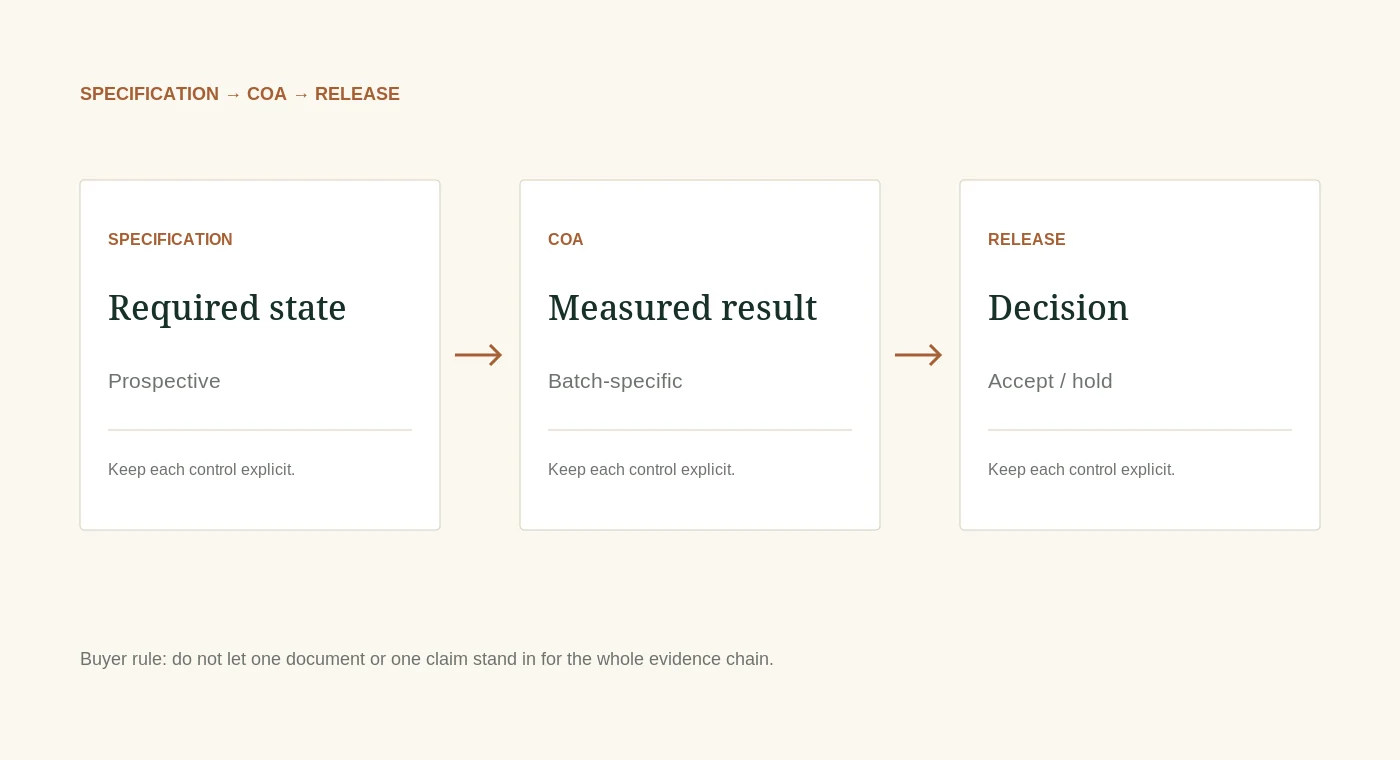
A specification is prospective: it defines the product identity, contractual targets, limits, pack requirements and release conditions that the supplier is expected to meet. A COA is retrospective: it records analytical results for a specific sample or batch. A batch can have an impressive-looking COA and still fail the buyer’s specification if the wrong grade, pack, test scope or evidence basis was supplied.
This distinction matters because procurement becomes weak when the specification is reconstructed after quotations arrive. If every supplier is allowed to define a different product, the buyer is not comparing like with like. The specification should therefore be stable enough to support comparable RFQs while still showing which fields remain open pending supplier and destination evidence.
02 · Product identity
Start with product identity before adding laboratory limits
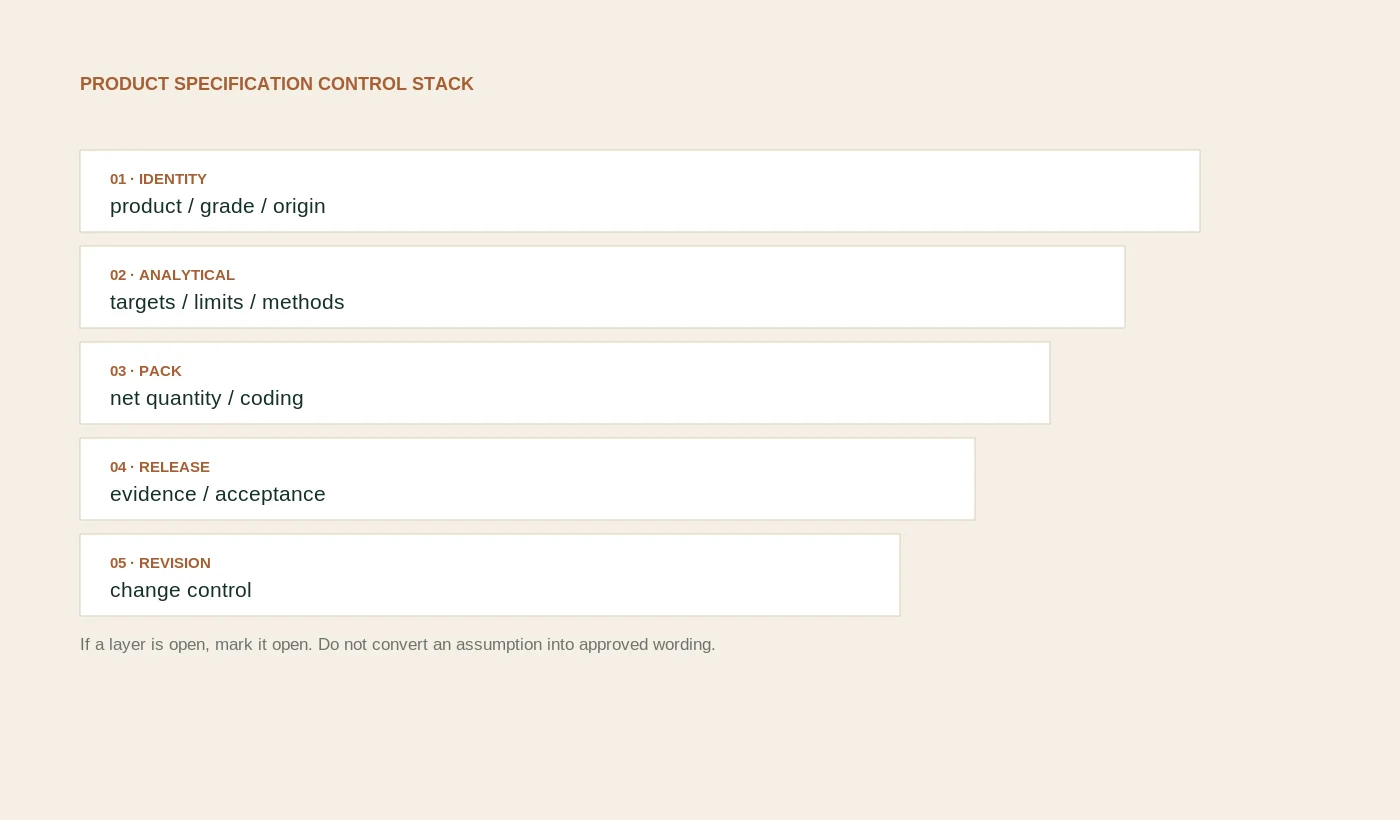
The first block should identify exactly what is being purchased: product name or description, intended Australian-origin wording, intended floral-source wording, MGO grade or target, net quantity, retail-ready or bulk format, and the destination market or markets for which the specification is being prepared.
Keep unresolved claims visibly unresolved. If SELVEH has not yet selected a supplier, verified an origin statement, finalised a monofloral claim or confirmed an AMHA licence pathway, those fields should be marked OPEN rather than filled with marketing language. A specification is a control document, not a place to make the project look more complete than the evidence supports.
03 · Analytical requirements
Define analytical requirements only when they have a purpose
A buyer specification may include MGO and DHA where those values are relevant to the commercial grade and ageing profile. It may also include moisture, HMF or other composition and quality parameters where they are required by law, customer agreement, destination requirements, shelf-life strategy or risk assessment. The exact list should not be copied mechanically from another brand or another market.
For honey sold under the Australian Food Standards Code, Standard 2.8.2 sits within the sugars and honey standards. Codex also publishes a general honey standard with composition and quality provisions and a voluntary annex covering factors such as HMF and diastase. Those documents are useful reference points, but they do not by themselves create a universal “Mānuka export specification” for every buyer and destination.
The practical rule is simple: every line in the specification should answer “why is this here?” If the answer is unknown, the buyer should not invent a target merely because a laboratory can test it.
04 · Evidence mapping
Pair every requirement with an evidence method
A specification becomes operational only when each important requirement has an evidence route. “MGO 250+” should not sit as a decorative line of text; the document should state how the buyer expects it to be demonstrated, whether by a batch-linked laboratory result, agreed test method, supplier release record or other defined evidence.
The same logic applies to origin, floral-source wording, food-safety documentation, net quantity, packing configuration and destination-specific label requirements. Where the requirement is documentary rather than analytical, the evidence field should say so. Not every acceptance criterion belongs on a laboratory COA.
05 · Pack specification
Treat the pack as part of the product specification
For retail-ready supply, the specification should control net quantity, container type, closure, tamper evidence where used, label or decoration basis, coding requirements, carton configuration and any pallet or shipper assumptions that materially affect the offer. If the buyer is still choosing between 250 g and 500 g, create controlled alternatives rather than one vague line that says “retail jar”.
Australia’s National Measurement Institute sets legal measurement requirements for pre-packaged goods, including correct units and measurement marking. The pack section therefore should not be treated as purely visual artwork. Net quantity, fill control and the evidence used to support the declared measurement belong in the commercial-quality system.
06 · Shelf life & storage
Define shelf-life and storage responsibilities without inventing a number
The specification should record the agreed shelf-life basis, date-marking approach where applicable, storage conditions and any minimum remaining shelf life required at dispatch or receipt. FSANZ notes that food suppliers are responsible for date marking and that storage conditions must be stated when they are needed for the product to keep until the declared date.
For SELVEH, a final shelf-life number should remain OPEN until the selected product, processing history, pack, supplier evidence and destination requirements are known. A generic statement copied from another Mānuka brand is not a substitute for evidence tied to the actual supply programme.
07 · Batch release
Make release criteria explicit before production
The strongest specifications include a release block: which results or documents must be available before a batch can be accepted, who reviews them, what happens if a result is outside the agreed limit, and which deviations require buyer approval. This stops a shipment from becoming the first point at which the parties discover that they interpreted “acceptable” differently.
Batch identity should also connect to the records used for traceability. FSANZ’s traceability guidance emphasises lot identification and records connecting products, suppliers, customers and transaction information. The specification should therefore point to the buyer’s batch-documentation expectations rather than operating as a stand-alone file.
08 · Revision control
A specification needs revision control, not silent edits
Every approved version should carry a document identifier, revision number, effective date and approval status. Changes to MGO grade, net quantity, label wording, testing scope, pack material, shelf-life basis or destination-market requirements can alter the economics or compliance position of the offer. Those changes should be visible, not overwritten without a record.
A practical buyer rule is to quote and approve against a named revision. If a supplier later proposes a substitution or new specification, the buyer can compare the proposed change against the controlled baseline instead of relying on email memory.
09 · Red flags
Specification red flags a buyer should not ignore
Common warning signs include a specification with no revision number; a grade statement with no evidence field; a COA being used as the entire product specification; pack details missing from a supposedly retail-ready offer; shelf-life wording with no basis; destination claims copied from another market; or acceptance limits added simply because they appeared in a competitor document.
Another warning sign is a “universal” specification presented as valid for every country. Destination-market requirements can change the label, documentation, testing or importer responsibilities. The product core can be standardised, but market-specific overlays should be controlled separately.
- No revision or approval status.
- Grade statement with no evidence route.
- A COA used as the entire product specification.
- Retail-ready supply with pack fields missing.
- A universal destination specification presented without market review.
10 · Buyer template
Use a requirement-to-evidence template before comparing quotes
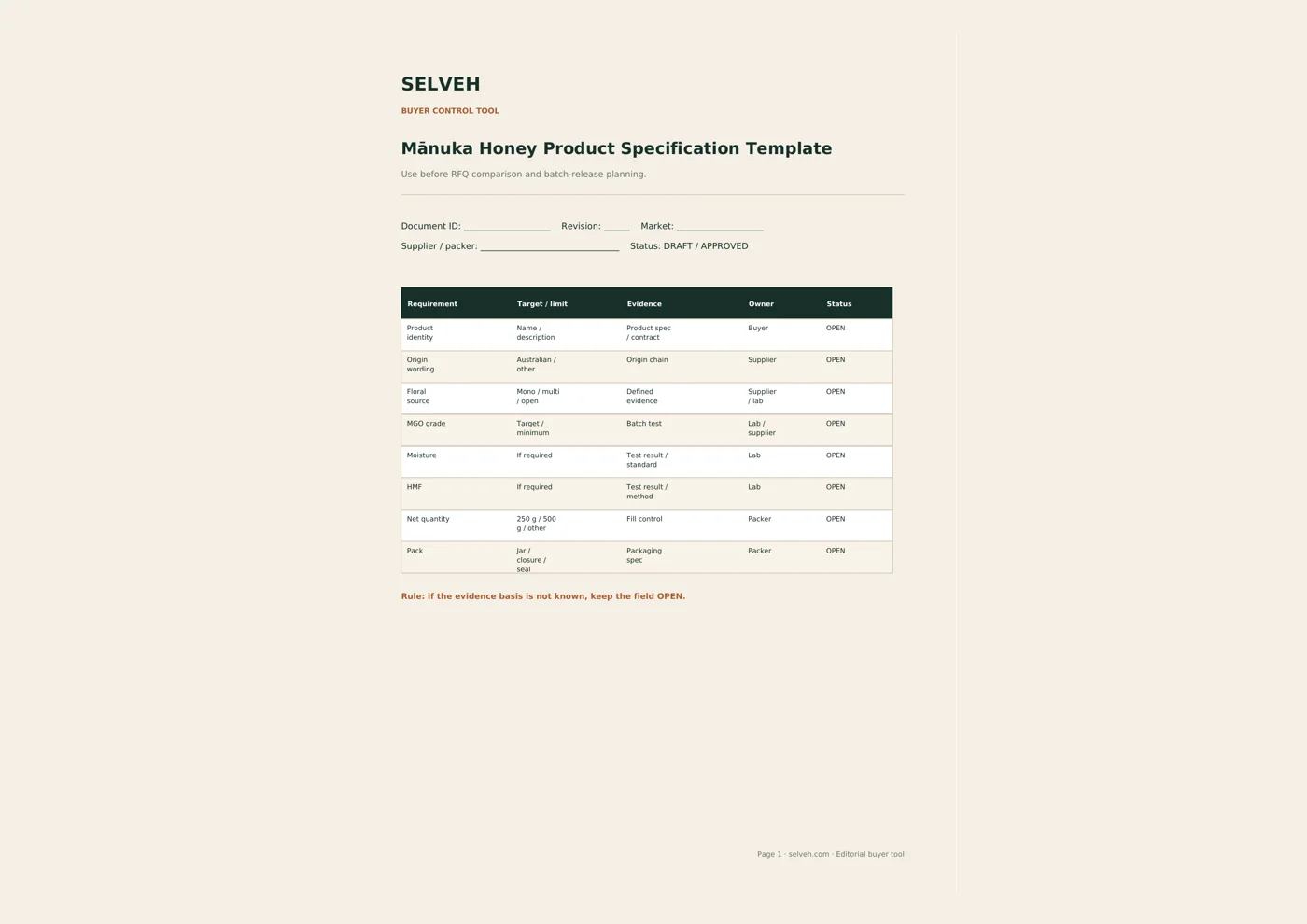
The downloadable SELVEH template uses six fields: requirement; target or limit; evidence or test method; responsible party; revision or source; and status. Green means the requirement and evidence path are closed. Amber means the requirement is commercially plausible but still needs confirmation. Red means the proposed requirement or claim should not be accepted or printed in its current form.
The purpose is not to create the longest specification. It is to create the shortest controlled document that prevents material ambiguity between buyer, supplier, packer, laboratory and destination-market responsibilities.
11 · SELVEH status
What SELVEH can define now - and what must wait
SELVEH can define the document architecture now: product identity, MGO requirement, evidence fields, pack variables, release conditions, revision control and market overlays. That gives prospective suppliers a common basis for quotation.
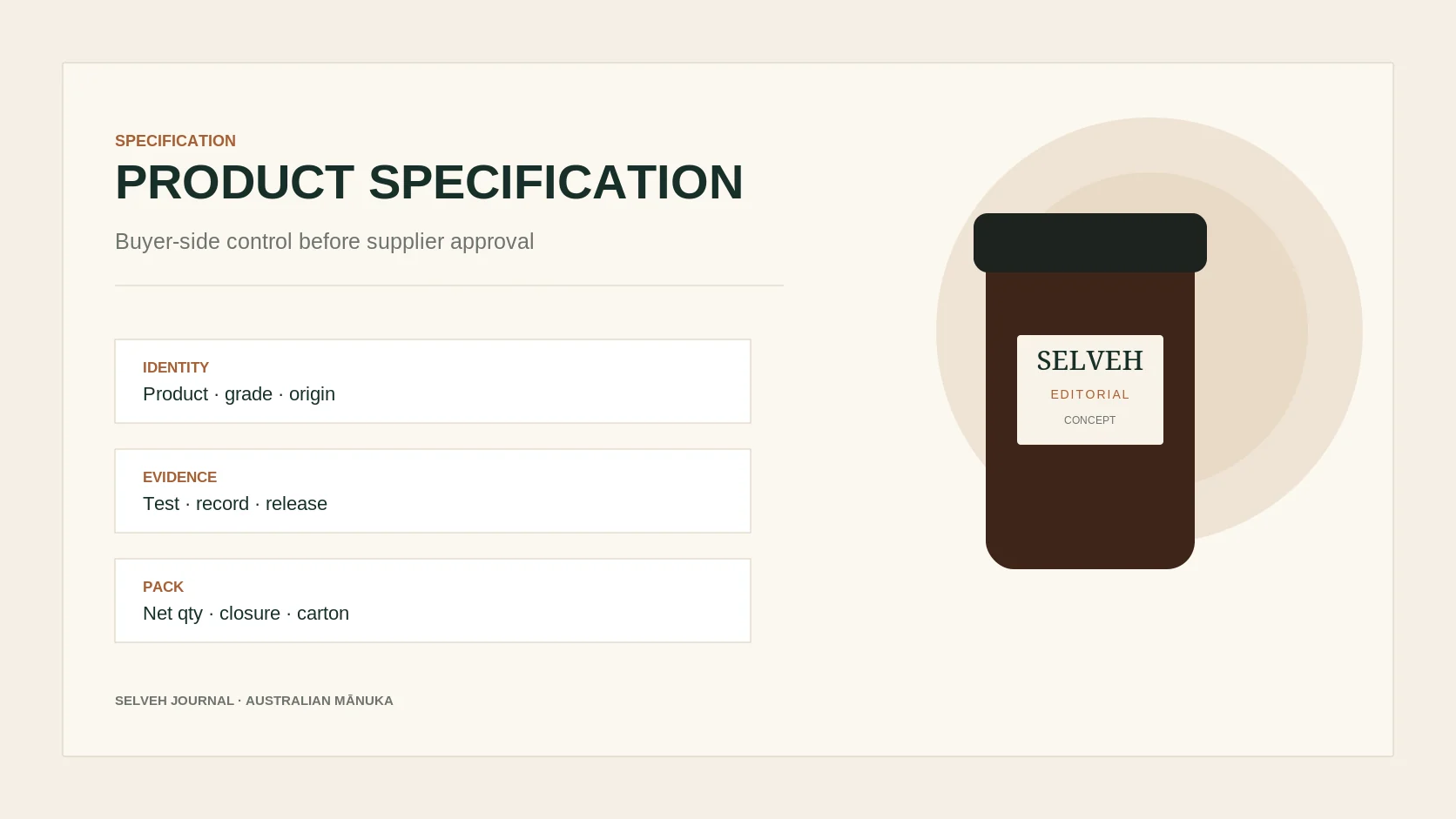
SELVEH should not publish a final specification as if it were a production-controlled document until the supplier, batch programme, pack format, testing scope, shelf-life evidence and destination requirements are verified. Current product imagery and templates remain editorial/development tools rather than evidence of a final commercial SKU.
Sources
Sources and evidence notes
- Food Standards Australia New Zealand — Food Standards Code legislation (including Standard 2.8.2 Honey)
- Codex Alimentarius — Standard for Honey, CXS 12-1981
- National Measurement Institute — Guide to the sale of pre-packaged goods
- Food Standards Australia New Zealand — Food traceability
- Food Standards Australia New Zealand — Use-by and best-before dates
Editorial boundary: This page distinguishes current regulatory or scheme information from SELVEH buyer-side recommendations. Where supplier, batch, licence or destination evidence is not yet verified, the article keeps the status open rather than implying a final SELVEH capability.
Trade planning
Need a cleaner product specification before supplier quotes?
SELVEH is developing its Australian Mānuka supply programme. Final grades, specifications, suppliers, pack formats and release criteria remain subject to verification.
Start a trade enquiry