

01 · Planning question
Inventory planning decides how much, when and under what conditions
The objective is not to maximise jars in a warehouse. It is to protect service while limiting cash tied in slow, unusable or ageing stock. A reorder decision should connect demand, replenishment time, batch and artwork status, order constraints, remaining shelf life and available working capital.
This decision is distinct from negotiating the supplier’s MOQ. MOQ tells the buyer the minimum permitted production or order structure. Inventory planning tests whether that structure is commercially supportable, when the commitment should be made and what conditions must close first.
Use one decision record per SKU and market version. Portfolio totals can hide an out-of-stock core SKU beside surplus stock that cannot substitute for it.
02 · Stock identity
Track the inventory that can actually satisfy the order
Define the stock-keeping unit by product, pack size, MGO or grade, market/language artwork, case configuration and any channel-specific requirements. Two jars with similar honey may not be interchangeable if their label, importer details, barcode, evidence or customer approval differs.
At batch level, record lot, quantity, receipt date, date mark, evidence status and location. Reconcile physical stock to the inventory record through a controlled stocktake. Business.gov.au recommends accurate records because inventory data supports ordering, valuation and business decisions.
Do not pool stock across markets until regulatory, artwork, commercial and operational interchangeability has been verified.
03 · Availability
Separate on-hand stock from usable stock
Total on-hand can include units that are quarantined, damaged, reserved, sampled, awaiting evidence, allocated to a customer, in transit or too close to a customer’s remaining-shelf-life requirement. Those units should not automatically count as available.
| Status | Inventory treatment | Decision owner |
|---|---|---|
| Released and unallocated | Potentially usable | Inventory control |
| Reserved | Deduct from free stock | Sales / operations |
| Quarantine or evidence hold | Exclude until released | Quality |
| Damaged or non-conforming | Exclude and disposition | Quality / finance |
| Near customer age limit | Channel-specific review | Commercial / quality |
04 · Demand base
Use observed demand and named assumptions
Build the baseline from actual sales, confirmed orders and credible pipeline by SKU. Separate one-off launch fills, promotions and samples from repeat demand. A distributor’s opening order does not prove the ongoing monthly rate.
Choose a time bucket that matches the business: weekly for active replenishment, monthly for slower imported lines. Record stockouts because sales during an out-of-stock period understate unconstrained demand. Also record returns and cancellations rather than counting gross orders as final sell-through.
Where history is limited, use a scenario range and decision milestones. Label the forecast as an assumption; do not manufacture precision by adding decimals to an uncertain launch estimate.
05 · Replenishment time
Decompose lead time from decision to usable receipt
Supplier production time is only one component. The replenishment clock may include buyer approval, packaging procurement, production scheduling, packing, batch testing, evidence review, export booking, origin handling, international freight, destination clearance, local delivery, receiving and release.
Use the path relevant to the Incoterm and receiving point. Record low, base and delayed durations from evidence or named quotations. A lead-time statement should identify when its clock starts—for example, deposit, artwork approval or final PO acknowledgement.
Our private-label lead-time guide helps separate supplier time, buyer time and logistics time.
06 · Framework
Bring demand, lead time, constraints and shelf life together
No single input can determine the order. Fast demand with short lead time may need less safety stock than volatile demand with uncertain testing and freight. A favourable MOQ may still create excessive age or cash exposure.
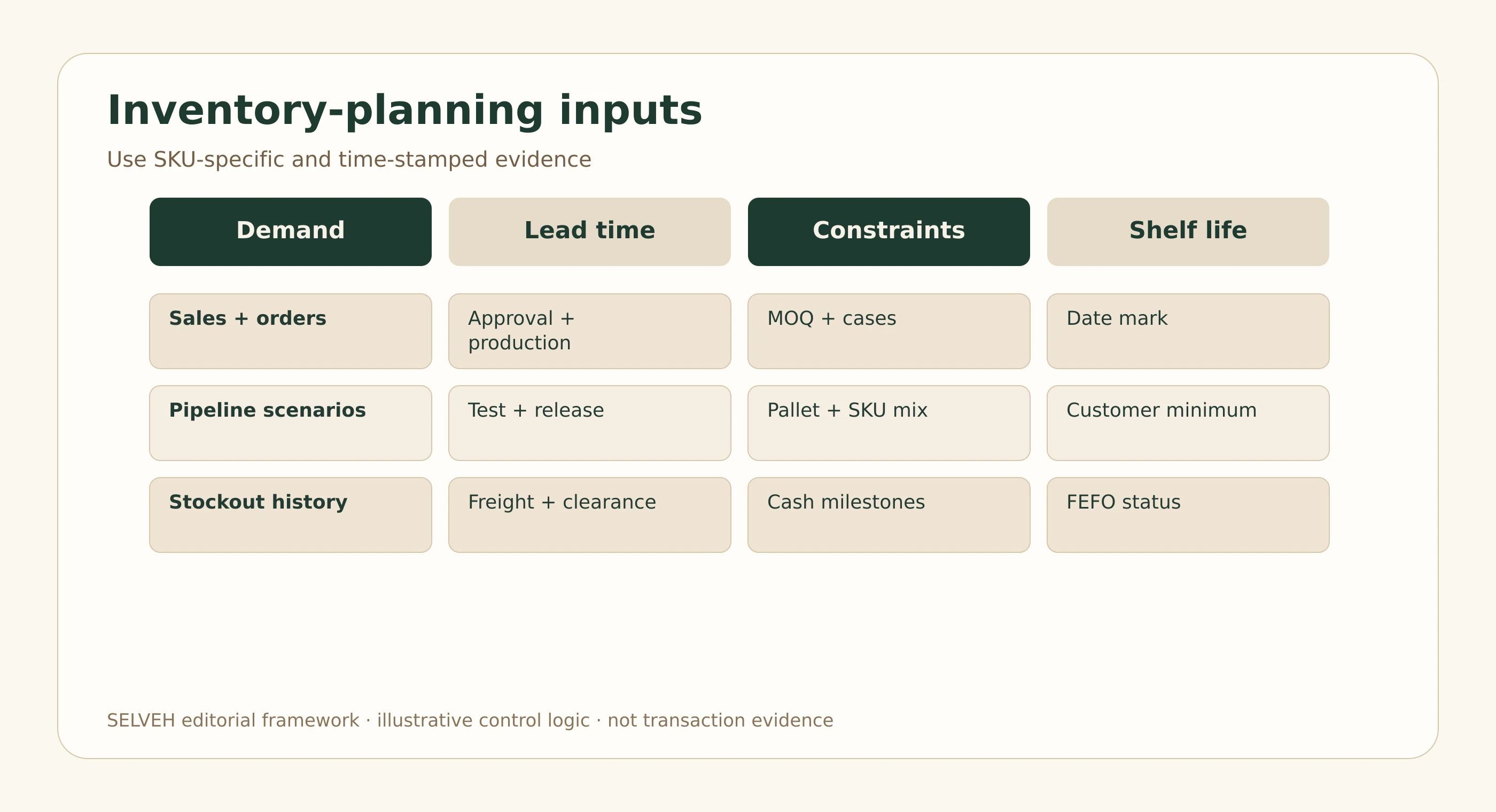
Assign each input an owner, evidence source, date and confidence level. A reorder model should reveal weak inputs rather than average them into an unexplained answer.
07 · Trigger formula
Calculate a transparent reorder point
A practical starting formula is: reorder point = expected demand during replenishment lead time + approved safety stock. Use consistent units. If demand is monthly and lead time is recorded in weeks, convert them before calculating.
Compare the trigger with inventory position, not just shelf stock. Inventory position can include released on-hand and suitably evidenced inbound stock, then subtract allocations or backorders. Define the exact treatment in the worksheet.
Crossing the reorder point triggers review; it should not bypass budget, evidence, MOQ, shelf-life or approval gates. A formula cannot know that artwork is changing or an importer registration is unresolved.
08 · Uncertainty
Set safety stock through a policy, not a guess
Safety stock protects against defined uncertainty such as demand variation or replenishment delay. It should not conceal chronic forecasting error, unreliable master data or an unresolved supplier problem. State which risk it covers and which it excludes.
For a new market, use low, base and high scenarios with review milestones. For an established SKU, the business may later use measured demand and lead-time variability. The method should match data quality and service requirements.
A larger buffer increases availability but also cash, storage and age exposure. Approve it as a trade-off with a named owner and review date rather than treating more stock as automatically safer.
09 · Order structure
Round the need to valid commercial quantities
The calculated replenishment need may not match the supplier’s MOQ, jars per case, cases per pallet or permitted SKU mix. Round deliberately and show the incremental stock created by each constraint. Then test whether the order remains viable.
Separate production MOQ, order MOQ, per-SKU minimum and freight-efficient quantity. They are not synonyms. Confirm whether mixed MGO grades, pack sizes or artwork versions can share the order and whether doing so changes lead time or price.
Our MOQ and trial-order guide provides the negotiation controls upstream of this decision.
10 · Age control
Test remaining shelf life before approving quantity
Inventory should be planned against the date information and storage conditions supported for the actual product and market. In Australia, FSANZ explains that a use-by date relates to safety, while best-before generally relates to quality. Destination rules and customer acceptance policies can differ.
Record the date mark, production or packing reference where available, remaining life at receipt, minimum remaining life required by each customer, and expected time to sell. Apply first-expired, first-out where appropriate and prevent an older batch from being stranded behind a newer receipt.
Do not publish a universal Mānuka honey shelf life. Use supplier, product, batch, packaging and regulatory evidence for the actual offer. See the shelf-life and storage guide.
11 · Working capital
Show the cash calendar as well as the stock quantity
An apparently economic order can still create a cash shortfall if deposits, balance payment, freight, duty, tax and local charges fall before customer receipts. Map payment milestones to the expected stock and sales timeline.
Business.gov.au advises avoiding excess stock, improving ordering and dealing with slow or outdated inventory as ways to improve cash flow. Business Queensland notes that lower stock turnover means inventory is held longer. Those principles do not dictate an ideal rate for this product; they support active measurement.
Track inventory value, months of cover, aged stock and committed cash by SKU. Do not hide slow inventory inside a blended portfolio average.
12 · Stress test
Compare slow, base, fast and delayed cases
Use the same opening inventory and order constraints, then change named variables. A slow-sales case tests age and cash exposure. A fast-sales case tests stockout risk. A delayed-replenishment case tests whether the buffer protects the intended service level.
| Scenario | Primary change | Risk exposed | Possible response |
|---|---|---|---|
| Slow demand | Lower sell-through | Age and cash | Phase order or reduce SKU count |
| Base | Best supported inputs | Execution | Approve with conditions |
| Fast demand | Higher sell-through | Stockout | Earlier review or reserved capacity |
| Delayed supply | Longer lead time | Service failure | Buffer, alternate timing or hold |
13 · Decision control
Use the reorder flow to stop automatic overbuying
The decision begins with reliable usable stock, open customer commitments and expected demand during replenishment. It then checks the trigger against MOQ, case rounding, evidence, shelf life, cash and approval status.
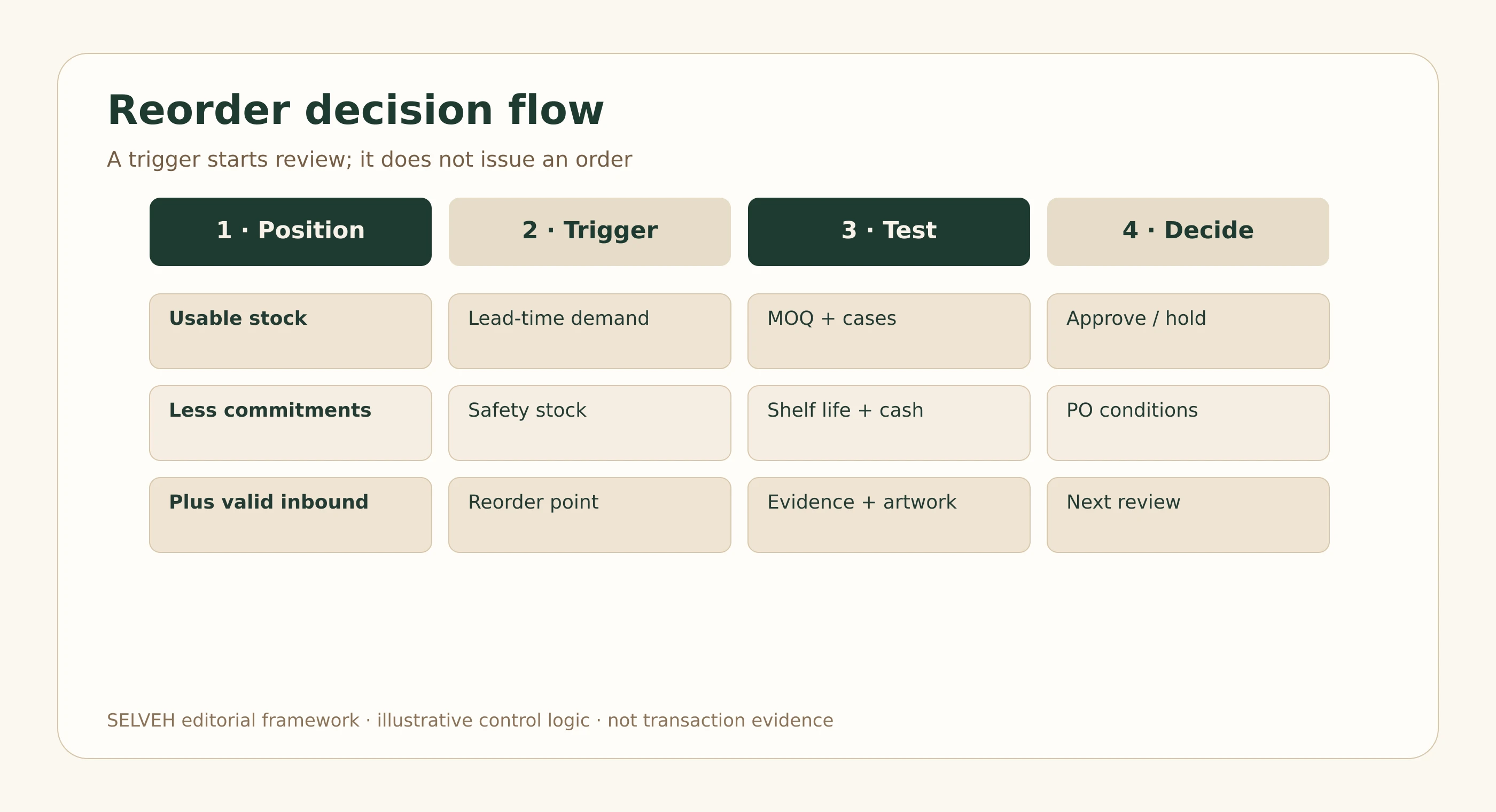
Document the final status as hold, conditional, approved or rejected. Conditions may include customer commitment, artwork release, batch evidence, freight confirmation or a working-capital limit.
14 · New-market control
Use phased commitments when demand evidence is thin
A new-market forecast often has less evidence than the supply chain requires. Reduce uncertainty with a controlled trial SKU set, explicit review points, pre-selling only where claims and timing are responsibly stated, and supplier discussions about staged production or packaging commitments.
Do not promise availability before supplier acceptance, batch release, freight and import conditions support it. Deposits or expressions of interest should be handled under clear customer terms.
The goal is not to eliminate all risk. It is to make the size, timing and owner of each risk visible before the order becomes difficult to reverse.
15 · Buyer tool
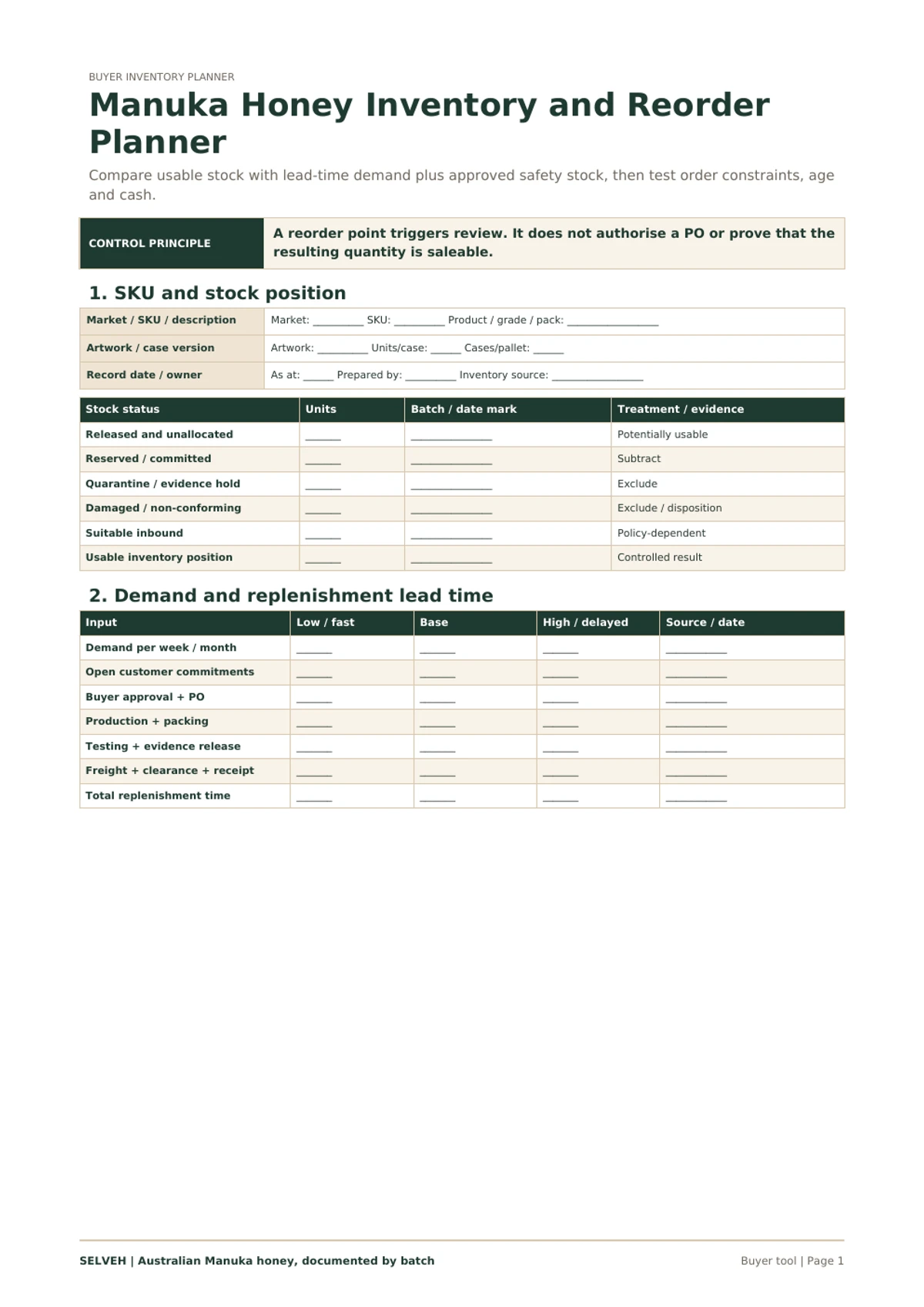
Download the inventory and reorder planner
The two-page planner records SKU identity, stock status, demand, lead-time components, safety-stock policy, reorder point, MOQ and case rounding, remaining shelf-life gates, cash timing, scenarios and approval status.
Update it on a fixed cadence and after material changes. Reconcile the result with the actual inventory system, purchase order and supplier acknowledgement. It is a planning aid, not a demand guarantee, accounting valuation, supplier commitment or food-date determination.
16 · Review triggers
Investigate these inventory plans
- Total on-hand is treated as available without subtracting holds, reservations or age restrictions.
- Different pack, grade or market artwork versions are pooled as one SKU.
- Lead time includes production but omits buyer approval, evidence release or clearance.
- Safety stock is an unexplained percentage copied across every SKU.
- The reorder quantity ignores MOQ, case rounding, cash milestones or remaining shelf life.
- Opening orders are treated as recurring monthly demand.
- The formula automatically issues a PO without human approval and current evidence.
17 · Buyer FAQ
Frequently asked questions
What is the right safety-stock percentage?
There is no universal percentage. Define the uncertainty, service objective, data quality, lead-time risk, cash and age exposure for the SKU.
Should stock in transit count as available?
Only under a defined inventory-position policy and with appropriate shipment and evidence status. It cannot satisfy an immediate warehouse order.
Does a long best-before period justify a larger order?
No. Customer remaining-life rules, demand, cash, storage, batch status and market-specific date requirements still matter.
Is reorder point the same as reorder quantity?
No. The point is a trigger. Quantity is calculated separately and adjusted for inventory target, open orders, MOQ, cases, shelf life and cash.
18 · SELVEH status
What SELVEH can state today
SELVEH can define a buyer-side inventory method and use it to evaluate future MOQ, lead-time and order proposals. It can label assumptions and make approval conditions visible.
SELVEH should not claim current stock, a confirmed production slot, an available batch, a guaranteed lead time, a fixed shelf life or a reorder commitment until the relevant supplier, batch, shipment and inventory records exist.
Sources
Official inventory and food-date sources
- Business.gov.au — Manage your inventory
- Business.gov.au — Improve your cash flow
- Business Queensland — Stock control basics
- FSANZ — Date marking and storage instructions
- FSANZ — Storing food safely
- Business.gov.au — Prepare for stocktake
Source review: Official guidance reviewed 24 August 2026. Date-mark, import and customer requirements vary and can change; verify the actual product and destination.
Trade planning
Need to test a Mānuka honey reorder decision?
Share the SKU, market, usable stock, demand range, required delivery point and order constraints. We will map the evidence, timing and conditions behind the next commitment.
Start a trade enquiry