

01 · Decision model
Price architecture is more than choosing one price
A wholesale price is only one visible output of a larger commercial system. The system must connect the cost of a saleable jar to the services performed by the importer, distributor, retailer or direct-to-consumer operator. It should also show which party funds freight, storage, fulfilment, promotions, returns and payment delay.
Build one architecture per market, channel, pack size and commercial term. A distributor price, a retailer buy price and a recommended retail price answer different questions. Reusing a single multiplier hides who carries cost and risk.
The purpose is decision control: can the offer support the intended channel after normal deductions, and which assumptions could reverse the answer?
02 · Cost foundation
Begin with economic landed cost per saleable unit
The supplier’s quoted jar price is not the correct starting point once freight, border costs and expected non-saleable stock sit with the buyer. Use the economic landed cost at the agreed receiving point, excluding recoverable tax where the importer’s actual treatment supports that exclusion.
Keep the cash required to import visible even when a tax may later be recovered. Cash timing and economic cost are related but not identical. Reconcile product, packaging, testing, freight, duty, clearance, storage and local delivery to the same shipment and currency.
Our landed-cost guide provides the upstream calculation. Do not approve pricing while material landed-cost lines remain anonymous.
03 · Revenue basis
Separate list price from net realised price
A list price may never be the amount retained. Customer discounts, launch support, rebates, free cases, promotional funding, damaged-goods credits, payment fees and returns can reduce the realised value. Record each deduction rather than hiding them inside a general percentage.
| Price view | What it answers | Control |
|---|---|---|
| List price | What appears before agreed deductions | State currency, unit and validity |
| Invoice price | What is billed for the order | Reconcile discounts and free goods |
| Net realised price | What remains after commercial deductions | Use for margin analysis |
| Cash received | What arrives and when | Include payment timing and fees |
04 · Calculation
Do not confuse gross margin with markup
Gross margin percentage is calculated as (net selling price − cost) ÷ net selling price × 100. Markup percentage is (net selling price − cost) ÷ cost × 100. The same transaction produces different percentages because the denominators differ.
Define “cost” before using either formula. For a channel contribution view it may include landed cost, local warehousing, fulfilment, commissions and expected trade deductions. For a narrower product-margin view it may not. Label the measure so stakeholders do not compare unlike results.
Business.gov.au describes cost-plus pricing as adding a markup or margin after calculating the total cost of making or supplying the product, including relevant overheads and taxes. That method is a starting structure, not proof that the market will accept the result.
05 · Route to market
Map the work performed by every channel participant
An importer may fund border clearance and local stock. A distributor may provide sales coverage, credit, pick-and-pack and regional delivery. A retailer may require promotional support, listing administration, returns or service-level compliance. Direct-to-consumer sales may remove a wholesale layer but add fulfilment, payment, customer-service and acquisition costs.
Write the commercial role beside the proposed earnings line. If a margin appears without a defined service or risk, challenge it. If a service is required but no party or cost line exists, the model is incomplete.
Do not publish a universal “standard distributor margin”. Required economics vary by market, product, volume, service level, payment terms and negotiating power. Use the actual channel proposal and test it against the cost stack.
06 · Framework
Build the waterfall from cost to shelf
The price waterfall should move from saleable-unit landed cost through each controlled addition and deduction. It must show both the forward view—what each party needs to charge—and the reverse view—what remains if the market-facing price is constrained.
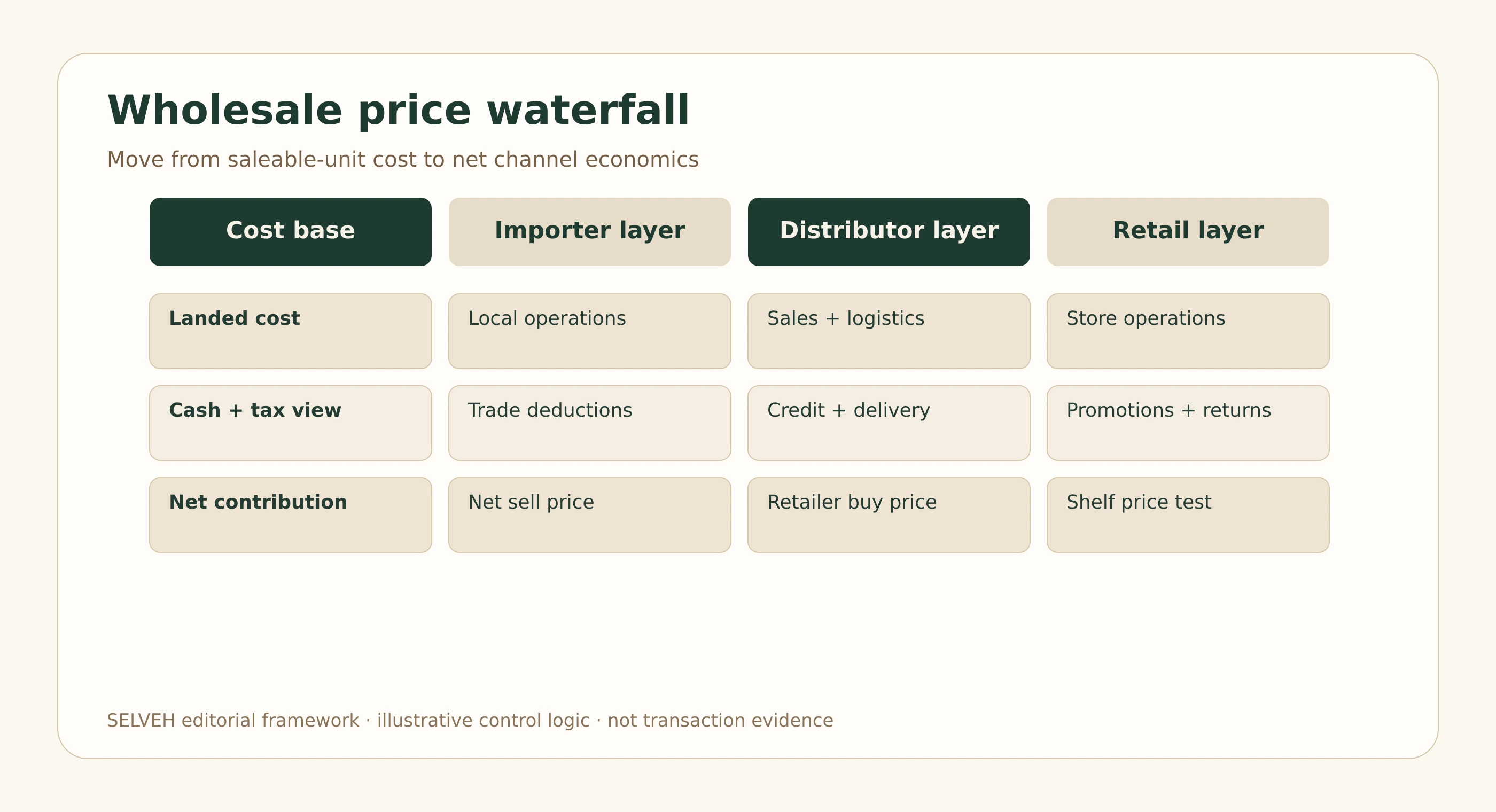
Run the reverse calculation whenever the proposed shelf price comes from a buyer or market benchmark. It exposes whether cost, trade spend or channel structure must change before the offer is viable.
07 · Unit comparison
Control pack-size and unit-price comparisons
A 250 g jar and a 500 g jar should not be compared only by ticket price. Calculate price per 100 g, packaging cost per jar, case configuration, freight density, likely basket role and expected rate of sale. A larger format may have a lower price per 100 g while carrying a higher cash commitment and slower stock rotation.
Australia’s Unit Pricing Code requires many grocery retailers to show a unit price that is accurate, clear and sufficiently prominent. Destination-market rules differ, so confirm the applicable display basis locally. Even when not legally required, a buyer-side unit comparison is useful for architecture control.
Use our 250 g versus 500 g buyer guide to test format roles before finalising the ladder.
08 · Portfolio logic
Build grade architecture from evidence and use case
MGO grades can support a portfolio ladder, but the price increment should not be assumed to move in a fixed ratio. Actual input cost, testing, availability, pack size, buyer demand and positioning all affect the commercial result. Do not infer a consumer benefit or health outcome from the number alone.
Define the role of each proposed SKU: entry format, core volume, premium step or specialist request. Then require batch-specific evidence for any MGO value used in the offer and artwork. Our MGO grades guide explains how to read and verify the number.
A crowded ladder can split demand across too many slow SKUs. Add a grade only when it has an independent buyer role and inventory plan.
09 · Commercial deductions
Name the allowances that sit below invoice price
Trade spend must be visible and governed. Possible items include introductory discounts, promotional funding, samples, free fills, listing support, settlement discounts, payment-processing charges, returns and claims. Whether each item is appropriate depends on the actual channel agreement.
Separate recurring deductions from one-off launch costs. State whether an allowance is a percentage of list sales, invoice sales, net sales, units or a fixed amount. A five per cent line can produce materially different results depending on its base.
Keep tax treatment separate from commercial presentation. “Tax inclusive” and “tax exclusive” prices must be labelled consistently, and the importer or adviser should confirm recoverability and invoicing treatment.
10 · Stress test
Run low, base and high commercial cases
A single case encourages false precision. Change only named drivers: landed cost, exchange rate, saleable units, promotional deductions, returns, freight or customer payment timing. Record the source, owner and review date for each assumption.
| Case | Purpose | Typical change | Decision question |
|---|---|---|---|
| Low-cost / strong sell-through | Upside boundary | Favourable FX and fewer deductions | Where is the benefit retained? |
| Base | Current planning case | Best supported assumptions | Is the model executable? |
| Adverse | Downside resilience | Higher cost or lower net sales | What triggers renegotiation or hold? |
11 · Control view
Use a margin ladder without pretending it is a benchmark
A margin ladder shows the relationship between cost, net selling price and channel deductions. It does not prescribe what any party “should” earn. The valid result comes from actual services, costs and negotiated terms.
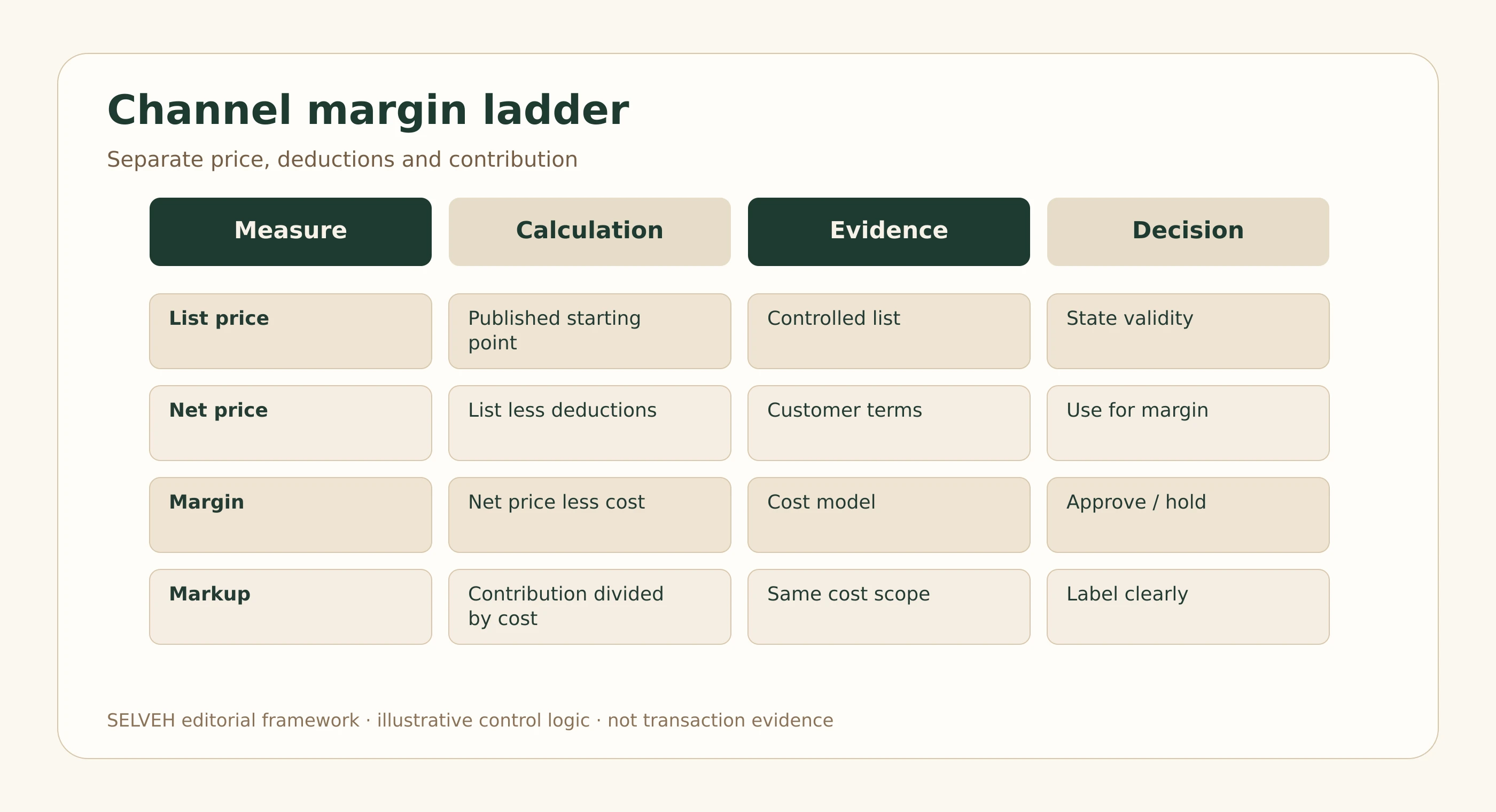
Use the ladder to identify double-counting—for example, local delivery inside both the distributor discount and the importer cost—or missing work such as retail returns with no funding line.
12 · Version control
Make price approval traceable
Every model should carry market, customer, SKU, pack size, currency, Incoterm, receiving point, quote references, tax basis, version, preparer, approver and expiry date. Lock the formulas and distinguish inputs from calculated cells.
Reopen the model when the supplier quote, freight route, exchange rate, duty treatment, case configuration, payment term or customer deduction changes. Do not overwrite the approved version; archive it and issue a new one.
The approved output should state what it is: indicative planning price, buyer-specific offer, or authorised price list. A worksheet is not a binding quotation until the commercial terms and validity are deliberately issued.
13 · Buyer tool
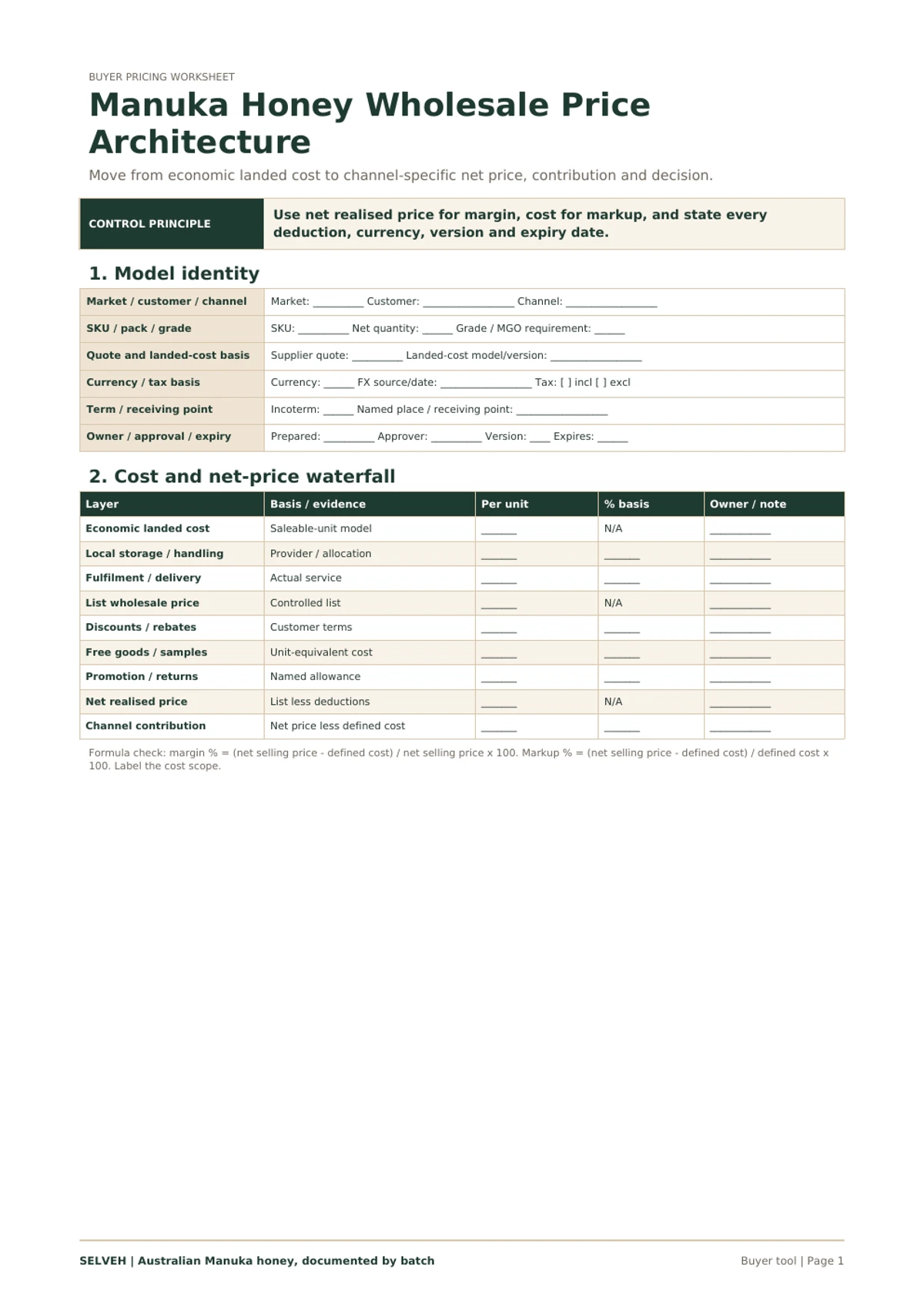
Download the wholesale price architecture worksheet
The two-page worksheet captures cost basis, list and net price, margin and markup, channel services, allowances, pack-size comparisons, scenarios and decision status. It is designed to expose assumptions before a price is shared.
Complete one file per market and route to market. Attach the referenced landed-cost model and the customer’s actual commercial terms. The worksheet is a planning aid, not financial advice, a valuation, a supplier quotation or evidence that a retailer will accept the price.
14 · Review triggers
Investigate these pricing models
- The model starts with supplier price and omits landed or local channel costs.
- Margin and markup are used as interchangeable labels.
- The same discount is applied to every route to market without service evidence.
- List price is treated as realised revenue despite rebates, free goods or promotions.
- A fixed MGO premium is assumed without batch cost and buyer-demand evidence.
- Recoverable tax is hidden, omitted from cash flow or permanently added without advice.
- The spreadsheet has no currency, version, approval, expiry date or downside case.
15 · Buyer FAQ
Frequently asked questions
What margin should an importer or distributor use?
There is no defensible universal percentage. Model the party’s actual services, operating costs, credit exposure, deductions and negotiated return.
Should recommended retail price drive the calculation?
It can be a market constraint, but reverse-calculate from it to test whether every layer remains viable. Do not force unsupported assumptions to reach it.
Is a higher MGO grade always proportionally more expensive?
No. Require actual batch and supplier economics; do not apply an automatic linear premium.
Can the worksheet be used as a quotation?
No. A quotation needs confirmed product, quantity, currency, term, named place, validity, inclusions and approval.
16 · SELVEH status
What SELVEH can state today
SELVEH can publish the method used to evaluate a future wholesale price and can distinguish confirmed inputs from assumptions. It can compare supplier and channel proposals on a controlled basis.
SELVEH should not publish a confirmed supplier cost, landed cost, distributor margin, retailer margin, wholesale price, recommended retail price or promotional allowance until transaction-specific quotations and approvals exist. Any future commercial offer should carry its own currency, validity, pack, quantity, Incoterm and named place.
Sources
Official pricing sources
- Business.gov.au — Choose a pricing strategy
- ACCC — Setting prices
- ACCC — Unit Pricing Code
- Business.gov.au — Guide to managing cash flow
Source review: Official guidance reviewed 24 August 2026. Pricing, tax and unit-pricing obligations can change; verify the actual market, customer and transaction before issue.
Trade planning
Need to test a Mānuka honey price architecture?
Share the destination, pack, order size, channel roles and receiving point. We will separate confirmed inputs, open assumptions and decision conditions before a commercial offer.
Start a trade enquiry