
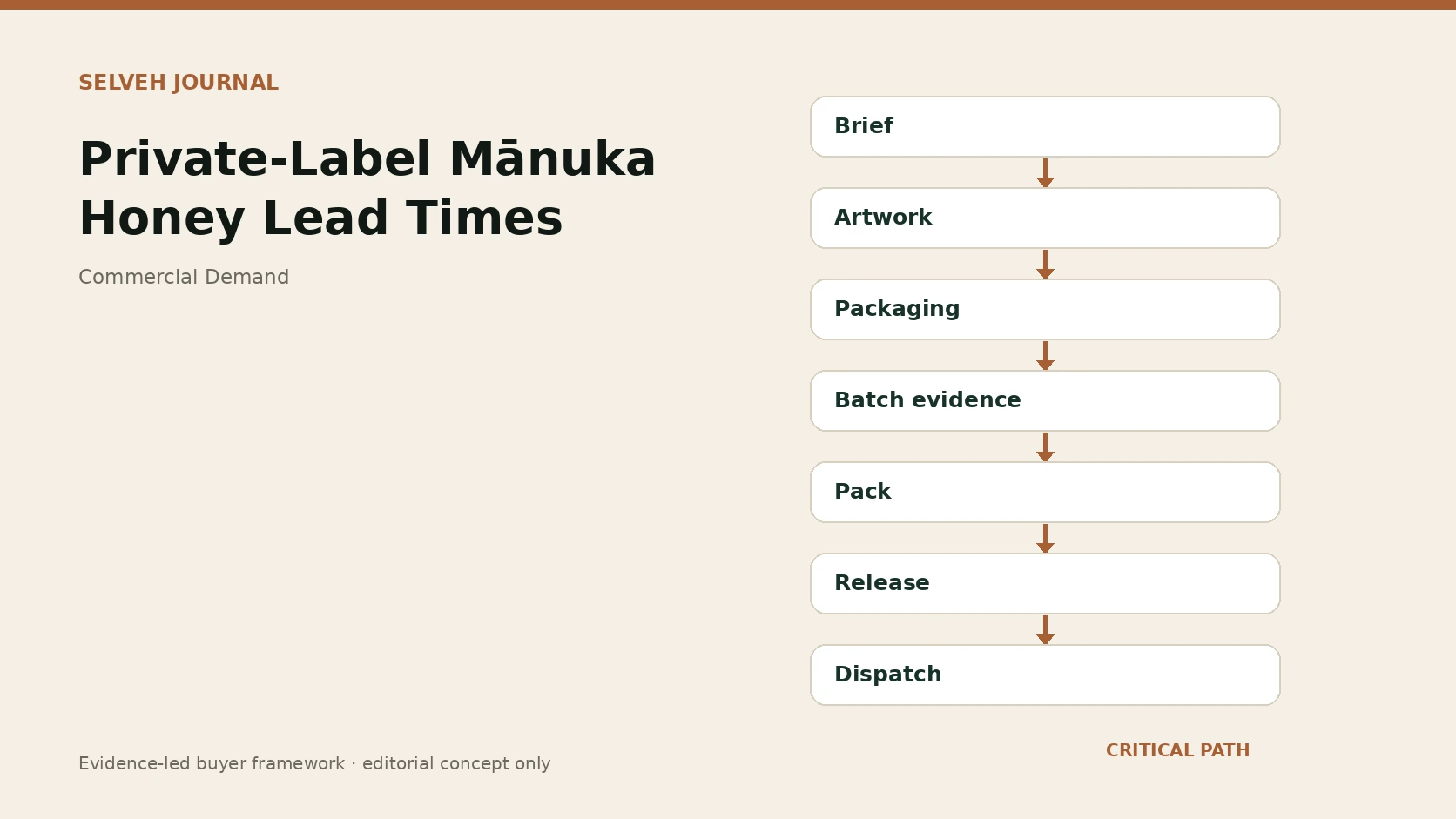
01 · Critical path
Lead time is a chain of dependencies, not one number
A quoted “6-week lead time” is not useful unless the buyer knows when the clock starts, what has to be approved before production can begin, and which steps can run in parallel. A private-label Mānuka programme can include commercial brief approval, honey allocation, packaging sourcing, artwork review, label printing, batch testing, production scheduling, packing, release, export documentation and freight preparation.
The buyer should therefore map a critical path: the sequence of activities that would move the dispatch date if they slip. A supplier may be able to fill jars quickly while printed labels, a custom closure or buyer artwork remains the true timing constraint.
The useful question is not only “what is the lead time?” but “what is the lead time from which agreed trigger, and what assumptions must remain true for that date to hold?”
02 · Start trigger
Define exactly when the lead-time clock starts
A first-order timeline should identify the formal start trigger. Depending on the supplier, that might be written specification approval, deposit receipt, artwork sign-off, packaging availability, honey allocation or a combination of these.
If a buyer counts from the first enquiry while the supplier counts from final artwork approval, both parties can report the same production duration and still disagree about the expected dispatch date by weeks.
Record the start trigger in the purchase order or project tracker and separate supplier-controlled time from buyer-controlled approval time. This makes delays diagnosable instead of becoming a general argument about “lead time”.
03 · Artwork gate
Artwork and compliance review can sit on the critical path
Artwork is not merely a design task. A private-label jar may need product identity, net quantity, country-of-origin wording, date/lot information, importer details and market-specific label elements to be resolved before files can be printed.
A buyer should version-control the artwork, identify who has approval authority and prevent labels from going to print while material claims or destination requirements remain OPEN. Reprinting labels after production has started is one of the easiest ways to turn a small trial into an avoidable delay.
Where the same design will be used in more than one destination, do not assume one artwork is automatically acceptable everywhere. Market review should be a defined milestone, not an informal final check.
04 · Packaging
Packaging availability may control the schedule
A stock jar and stock closure may be available quickly, while a custom glass colour, lid, liner, carton or decorated component can have a different procurement cycle. Buyers should distinguish “packing capacity available” from “all required packaging components available”.
Ask the supplier which components are in stock, which are ordered against the project, what minimums apply, and whether production can be booked before all components are physically received. A packaging substitution should not be accepted without checking fit, food-contact suitability, artwork dimensions and commercial appearance.
For a trial order, using proven stock components can reduce setup risk, but that is a commercial choice rather than a universal rule. The important control is knowing which component sets the latest possible start date.
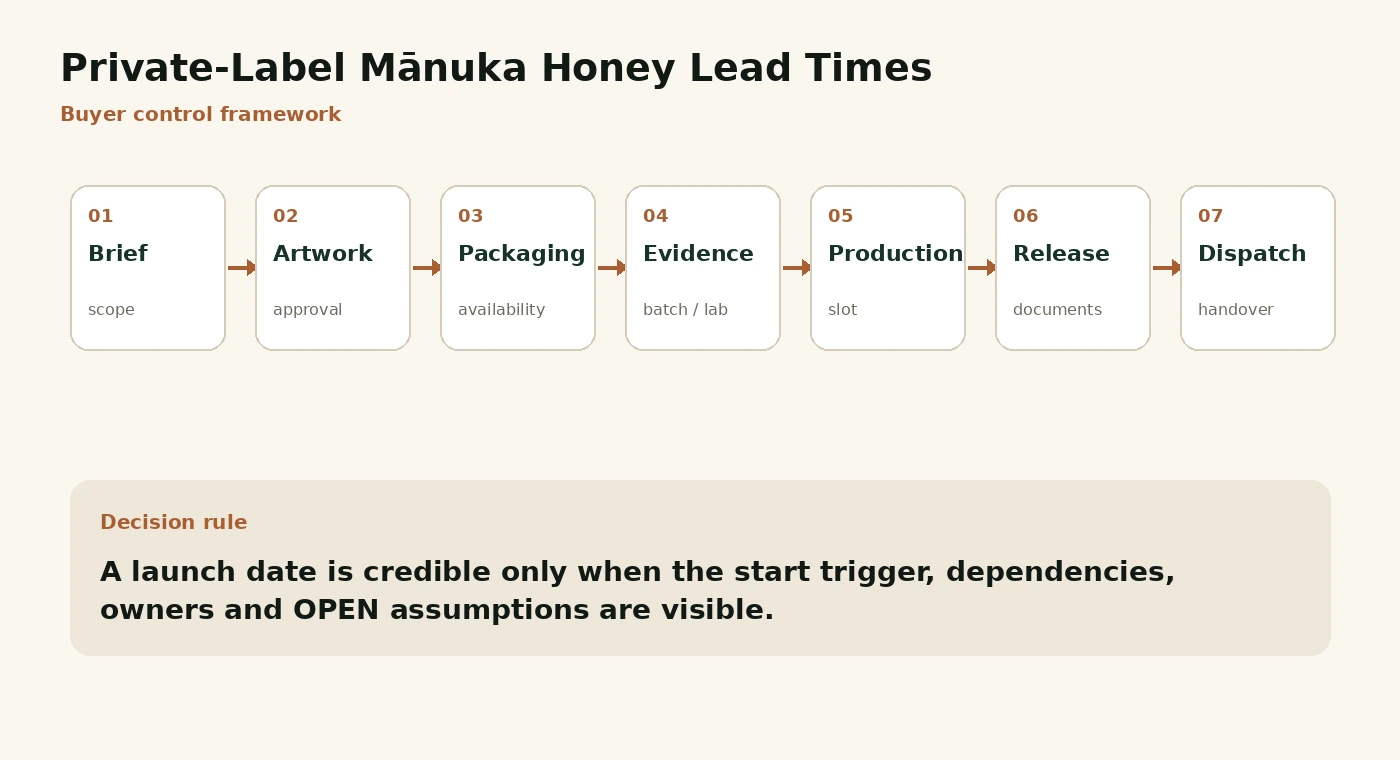
05 · Batch evidence
Honey allocation, testing and release need their own milestones
The product batch that will actually be packed must be linked to the agreed grade and release evidence. If a buyer requires MGO, moisture, HMF, authenticity or residue evidence, the timeline should state whether testing occurs before packing, after packing, or through a supplier release system.
Do not count a generic or historic certificate as completion of the production-batch release step. The relevant question is whether the evidence is tied to the lot being supplied and whether any required test is within the laboratory scope expected by the transaction.
Testing turnaround should be confirmed with the supplier or laboratory for the specific programme. SELVEH should not publish a generic number as if it applies to all laboratories or batches.
06 · Production window
Separate line capacity from a confirmed production slot
A packer may advertise substantial daily capacity but still have a production backlog, changeover constraints or campaign scheduling that affects the buyer’s order. Capacity tells you what a line can do; a booked slot tells you when your order is expected to run.
Ask for the planned production window, whether the date is firm or indicative, what conditions can move it, and how line changeovers are handled across multiple grades or pack sizes. A mixed-SKU order can create more scheduling complexity than the same number of units in one SKU.
Repeat orders can become faster once artwork, packaging and specifications are stable, but buyers should obtain a repeat-order assumption in writing rather than treating first-order and repeat lead times as interchangeable.
07 · Public evidence
Use public supplier timelines as examples of variability, not a market benchmark
Australian honey suppliers publicly describe different production models. Honey X currently publishes staged private-label and contract-packing timelines and also states longer first-order than repeat-order lead times in its buyer material. Bendigo Honey describes private-label work that can include product specification, label and packaging coordination, traceability and packaging sourcing.
These pages show why lead time is process-dependent, but they do not establish an industry average and they are not evidence of what SELVEH will receive. Supplier-specific figures can change with backlog, packaging, order size and market requirements.
Use public information to frame questions; use a dated written quotation or project plan to set the actual commercial schedule.
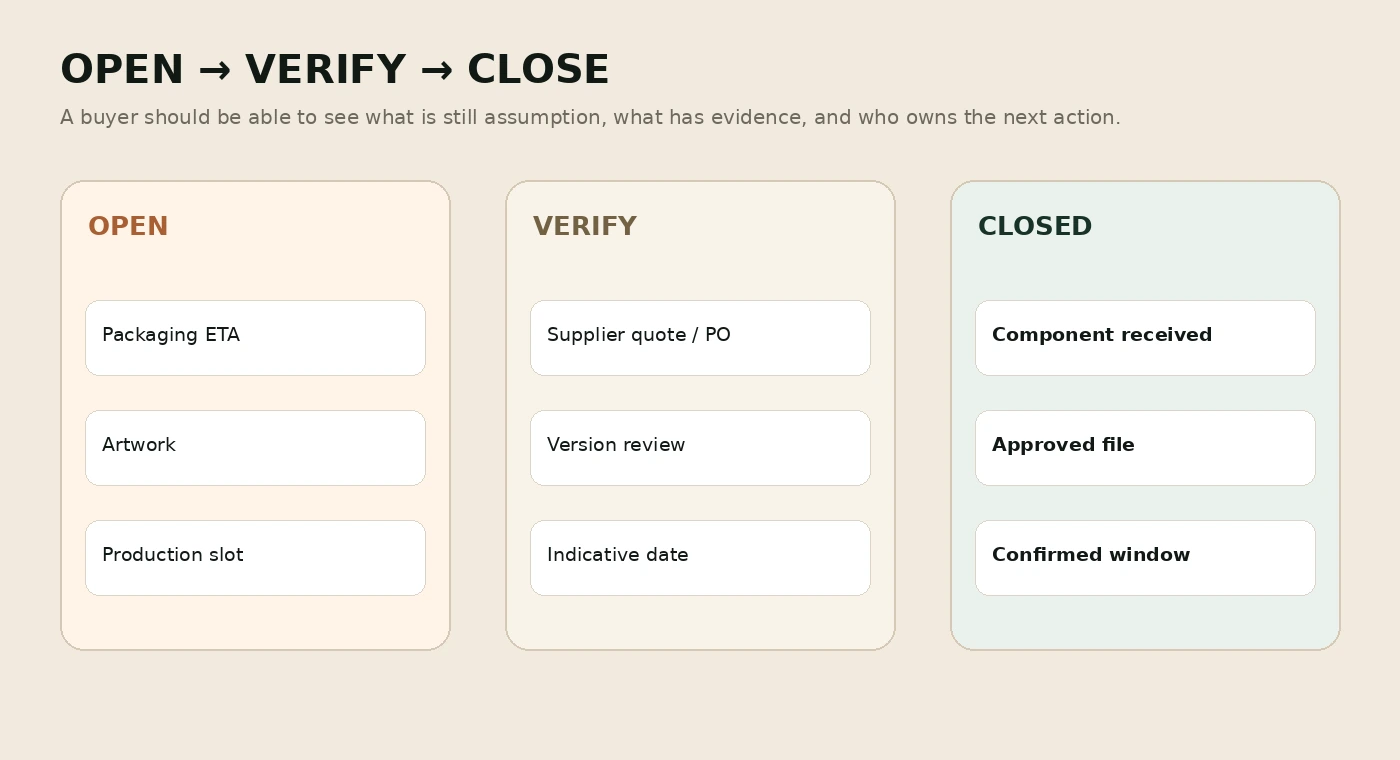
08 · Export readiness
Export documentation and importer actions should be scheduled before dispatch
The Australian Department of Agriculture, Fisheries and Forestry states that export documentation verifies compliance with Australian and importing-country requirements, and Micor is the guide to destination requirements. For some honey markets NEXDOC is used to obtain required certification.
This means “goods packed” is not automatically the same as “goods ready to ship”. The project timeline should identify who checks Micor, who supplies certificate inputs, which importer-side permits or registrations must already be in place, and what has to be closed before freight is booked.
For UAE and Singapore projects, use the current destination-specific guidance and importer confirmation at transaction time because requirements can change.
09 · First vs repeat
Build separate first-order and repeat-order assumptions
The first order usually carries setup activities that may not recur: supplier onboarding, specification creation, packaging qualification, artwork development, label review and new-SKU setup. A repeat order may only need batch allocation, testing, production, release and dispatch preparation if nothing material has changed.
Keep the two timelines separate. Otherwise an efficient repeat production run can create an unrealistic promise for a new launch, or a complex first order can make future replenishment look slower than it should be.
Also define what resets the project to “first-order logic”: new jar, new market, new label version, new grade, new closure or a material specification change.
10 · Buyer tool
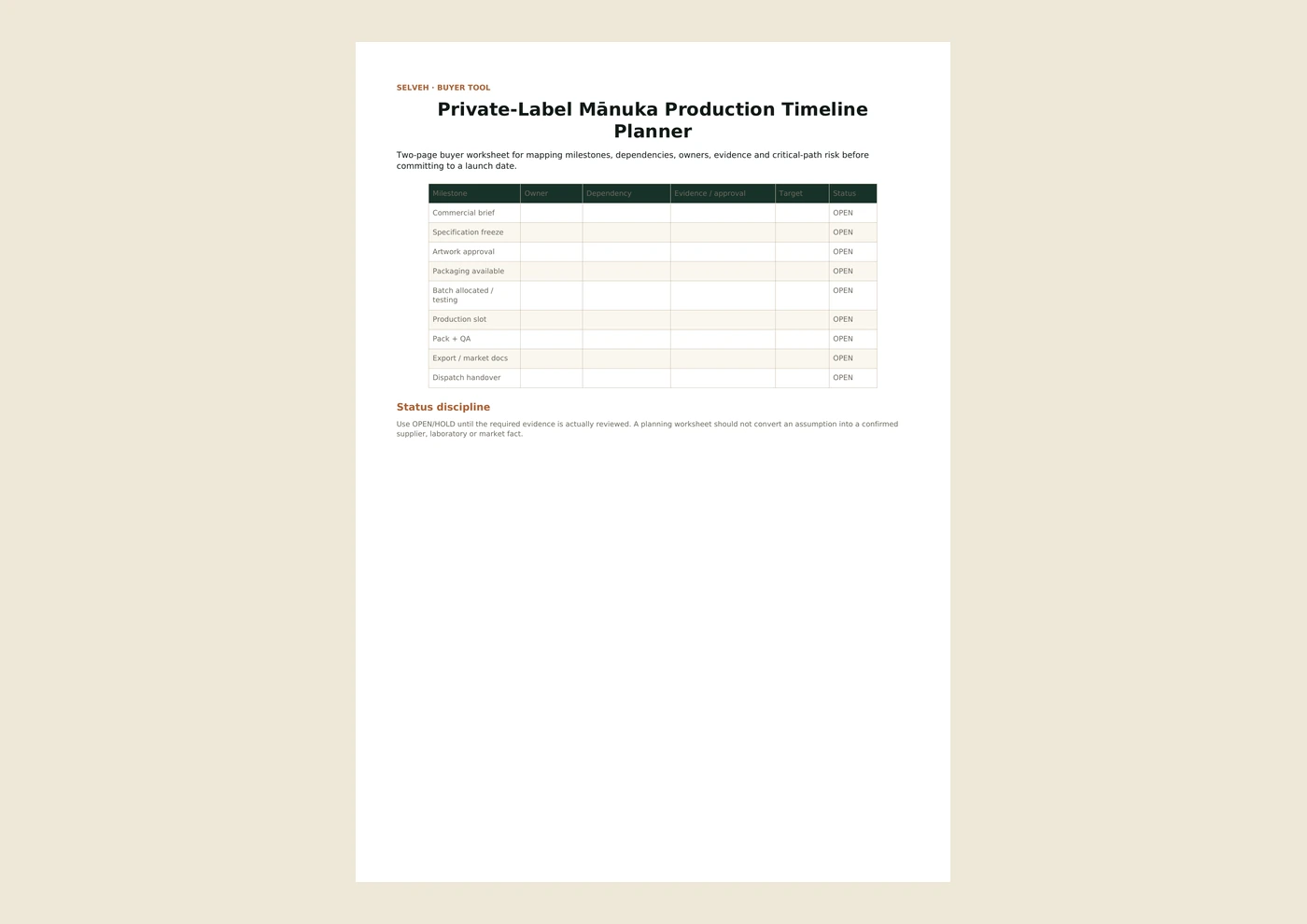
Use a Production Timeline Planner before accepting a launch date
The downloadable planner converts the project into milestones with owner, dependency, evidence, target date and status. It is designed to show which task sits on the critical path and where buyer approvals are holding the schedule.
It is a planning tool, not a supplier commitment. The final dispatch date should come from the actual supplier, packaging, laboratory, importer and freight evidence for the transaction.
11 · Red flags
Investigate these lead-time statements
- “Lead time is four weeks” with no start trigger or exclusions.
- A dispatch date that assumes artwork approval, packaging arrival and batch release will all happen instantly.
- A first-order timeline copied from a repeat-order schedule.
- A production date with no identified owner for market-specific label or export-document checks.
- A promise based on line capacity rather than a confirmed or clearly qualified production slot.
12 · SELVEH status
What SELVEH can state today
SELVEH can define the milestones, dependencies and evidence that a private-label production plan should contain and can request a dated schedule from suppliers.
SELVEH should not publish a confirmed production lead time, packing slot, testing turnaround or dispatch date until the relevant supplier and transaction evidence has been received and validated.
Sources
Sources and evidence notes
- Honey X - Private label service and staged production timeline
- Honey X - Contract honey packing in Australia: facility guide
- Bendigo Honey - Contract manufacturing and private-label services
- DAFF - Australian export documents and certification
- DAFF - NEXDOC help for honey and apiculture products
Editorial boundary: Current official, technical and public commercial information is separated from SELVEH recommendations. Public supplier material is illustrative only. No open supplier, packaging component, batch, laboratory result, importer, production schedule, certificate or shipment is represented as confirmed SELVEH evidence.
Trade planning
Building a private-label Mānuka launch timeline?
Use the trade enquiry to define grade, pack, destination and target timing. A supplier timeline can then be requested against explicit dependencies.
Start a trade enquiry