01 · MOQ architecture
MOQ is not one number
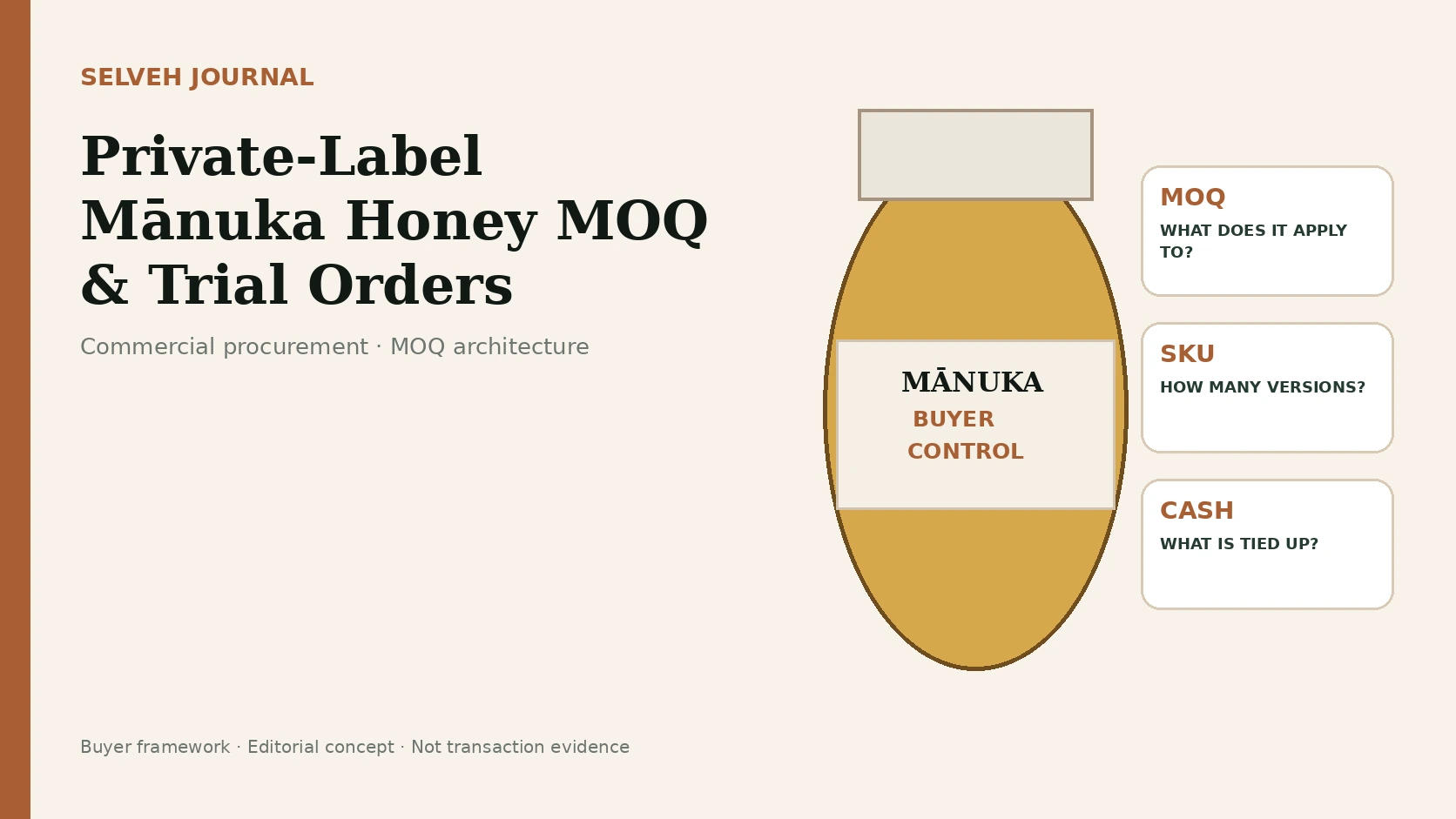
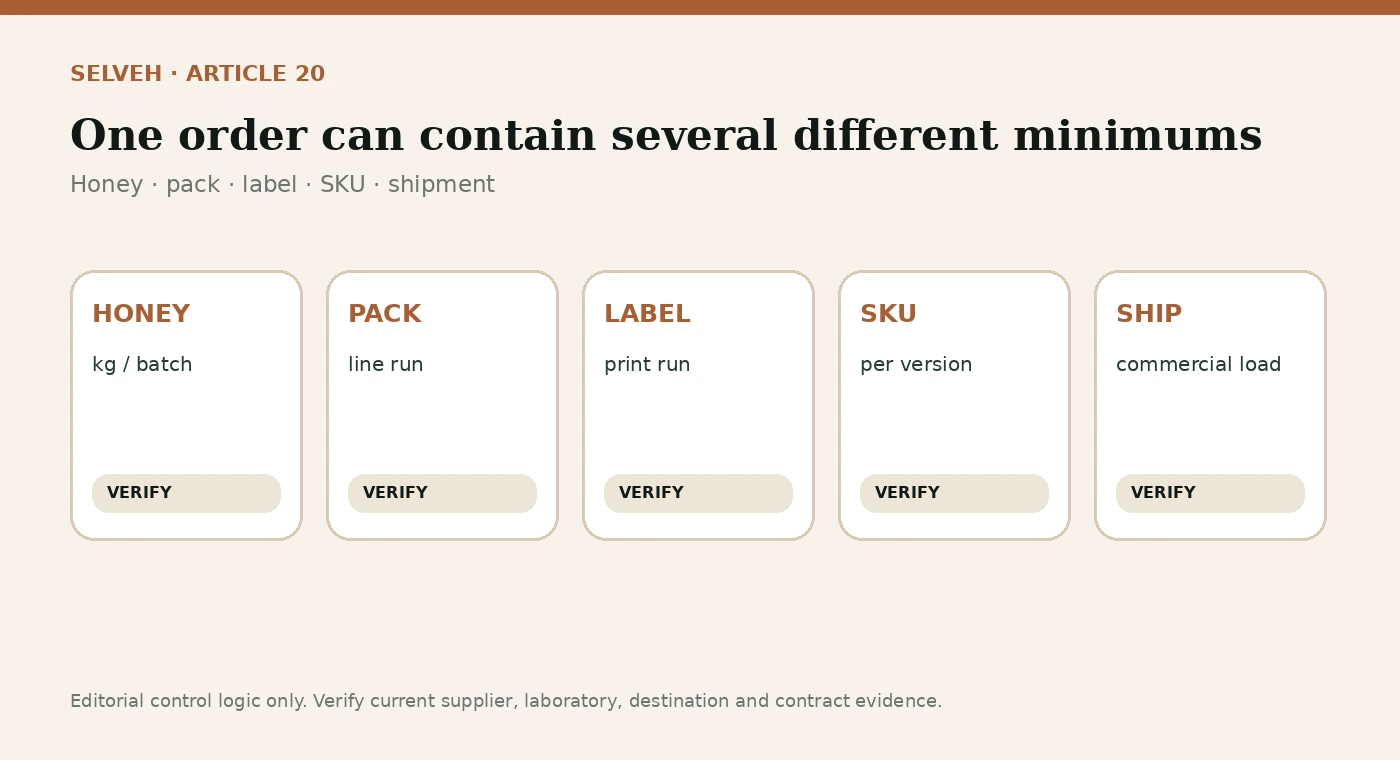
A private-label Mānuka project can have several minimums at the same time: a minimum honey quantity, a packing-line run, a label or decoration print minimum, a carton minimum, a per-SKU minimum and a commercial shipment minimum. One supplier may quote a dollar-based export MOQ while another frames the minimum in kilograms or finished units.
That means a headline “MOQ” can be commercially misleading unless the buyer knows what the number attaches to. A 500-unit minimum per SKU behaves very differently from 500 units across the whole order.
The buyer question is therefore not “what is your MOQ?” but “what minimum applies to each grade, pack, label version, production run and shipment?”
02 · SKU structure
Map the grade × pack × artwork matrix before asking for a small run
Every additional MGO grade, jar size or label version can create another SKU. If minimums apply per SKU, a seemingly modest assortment can multiply the required finished-unit count and working-capital exposure.
For a first commercial test, define the smallest assortment that can answer a market question. Do not add a second jar size or a second grade simply because the supplier can produce it.
This is where the 250 g vs 500 g decision and the MGO architecture should be resolved before MOQ negotiation rather than after the quote arrives.
03 · Minimum layers
Separate honey, packing and print minimums
A supplier may be able to source a small quantity of honey but still face an economical minimum for line setup, label printing, tamper evidence, custom cartons or pallet configuration. Conversely, a stock jar and digitally printed label may allow a lower finished-goods minimum than a bespoke mould, closure or decorated jar.
Ask the supplier to show which minimum is driven by honey availability, which by production setup, which by packaging procurement and which is simply a commercial policy. The buyer can then decide which specification features are worth preserving in a trial order.
No public supplier MOQ should be treated as an industry standard. Publicly stated Australian wholesale terms vary materially by supplier, format and market, which is precisely why buyer-side normalisation is necessary.
04 · Trial order
A trial order should test a commercial hypothesis
A trial order is not automatically low risk just because it is small. It should be designed to answer defined questions: can the importer clear the SKU, does the label workflow hold up, does the channel accept the price architecture, and can the supplier deliver the evidence package consistently?
If the order is too fragmented, the buyer may pay disproportionately for setup and freight while learning little. If it is too large, inventory and cash are committed before market evidence exists.
Define the trial objective, the decision date and the next-order trigger before approving production.
05 · Working capital
Translate MOQ into cash exposure, not just units
Export inventory consumes cash before it produces revenue. business.gov.au advises businesses to manage inventory to reduce over-ordering and to negotiate supplier payment terms as part of cash-flow control. Export Finance Australia similarly describes inventory, supplier deposits and long export lead times as working-capital issues.
For each proposed MOQ, calculate deposit cash, balance payment, freight and import charges, then estimate how long that cash may remain tied up before sell-through and customer payment.
A lower unit price at a much larger minimum can be the more expensive commercial decision if the additional stock is not justified by evidence.
06 · Mixed-SKU requests
Ask whether a mixed-SKU minimum is technically and commercially possible
Some buyers want one total minimum split across MGO grades or jar sizes. That request should be made explicitly because line changeovers, separate labels, batch allocation and carton requirements can make the answer different for each component.
If the supplier accepts a mixed trial, record the minimum per SKU, total order minimum, any setup charges and whether the same honey batch can be packed into multiple formats. Do not assume “mixed MOQ accepted” means every combination is available at the same unit price.
If mixing is not economical, reducing the first range to one anchor SKU may be a better test than forcing artificial breadth.
07 · Samples & approval
Do not confuse sample quantity with production MOQ
A pre-production or stock sample can validate taste, pack feel, label dimensions or basic evidence review, but it does not prove that the eventual production run will match the approved sample in every respect.
Before deposit release, define which approvals are sample-based and which must be verified again on the production batch: MGO evidence, lot identity, final artwork, closure/tamper system and any destination-specific label elements.
The buyer should keep a simple approval trail so a small trial does not become an uncontrolled exception to the normal specification process.
08 · Public supplier evidence
Use public MOQ statements as examples of variability, not benchmarks
Public Australian supplier pages currently illustrate different commercial structures. Sunhighlands publishes dollar-based domestic and export minimums, while Australia’s Manuka publishes wholesale and bulk pathways and, on its USA page, a minimum quantity for certain overseas bulk orders. These are supplier-specific commercial terms, not a market average and not evidence of what SELVEH will receive.
Public terms can change and may not apply to private label, a specific destination, a specific MGO grade or the packaging configuration a buyer wants. Always request a dated written quotation for the actual project.
The useful conclusion is simply that MOQ can be expressed on different bases and must be normalised before comparison.
09 · Buyer decision
Approve the smallest order that still produces useful evidence
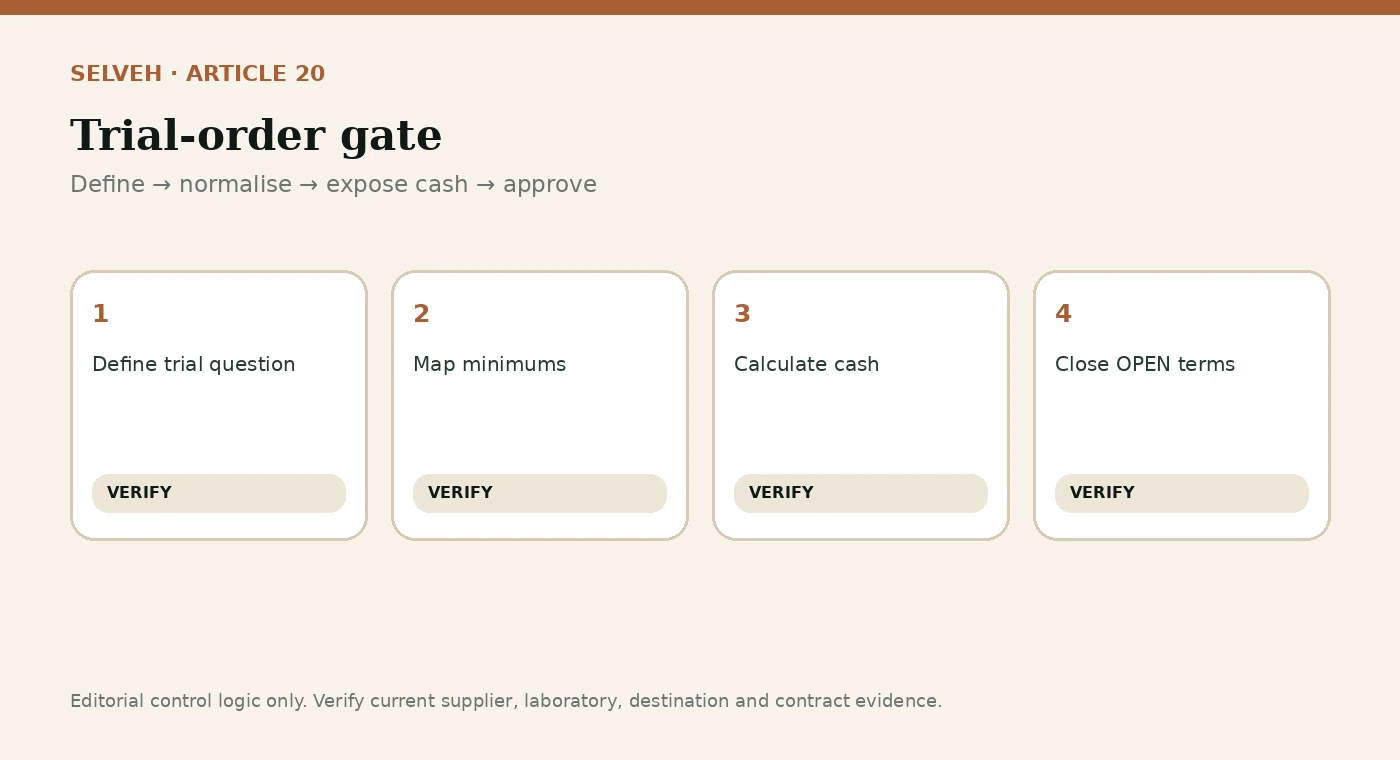
A credible first-order gate should show the SKU count, minimum driver, total finished units, honey mass, deposit timing, estimated landed cash exposure and the commercial question the order is designed to answer.
If the order is only “small” because one cost has been hidden outside the quoted unit price, it is not a controlled trial. If the order is operationally viable but does not test a real market decision, it is still weak.
Hold the order until OPEN assumptions on MOQ basis, packaging minimums, payment and delivery are closed.
10 · Buyer tool
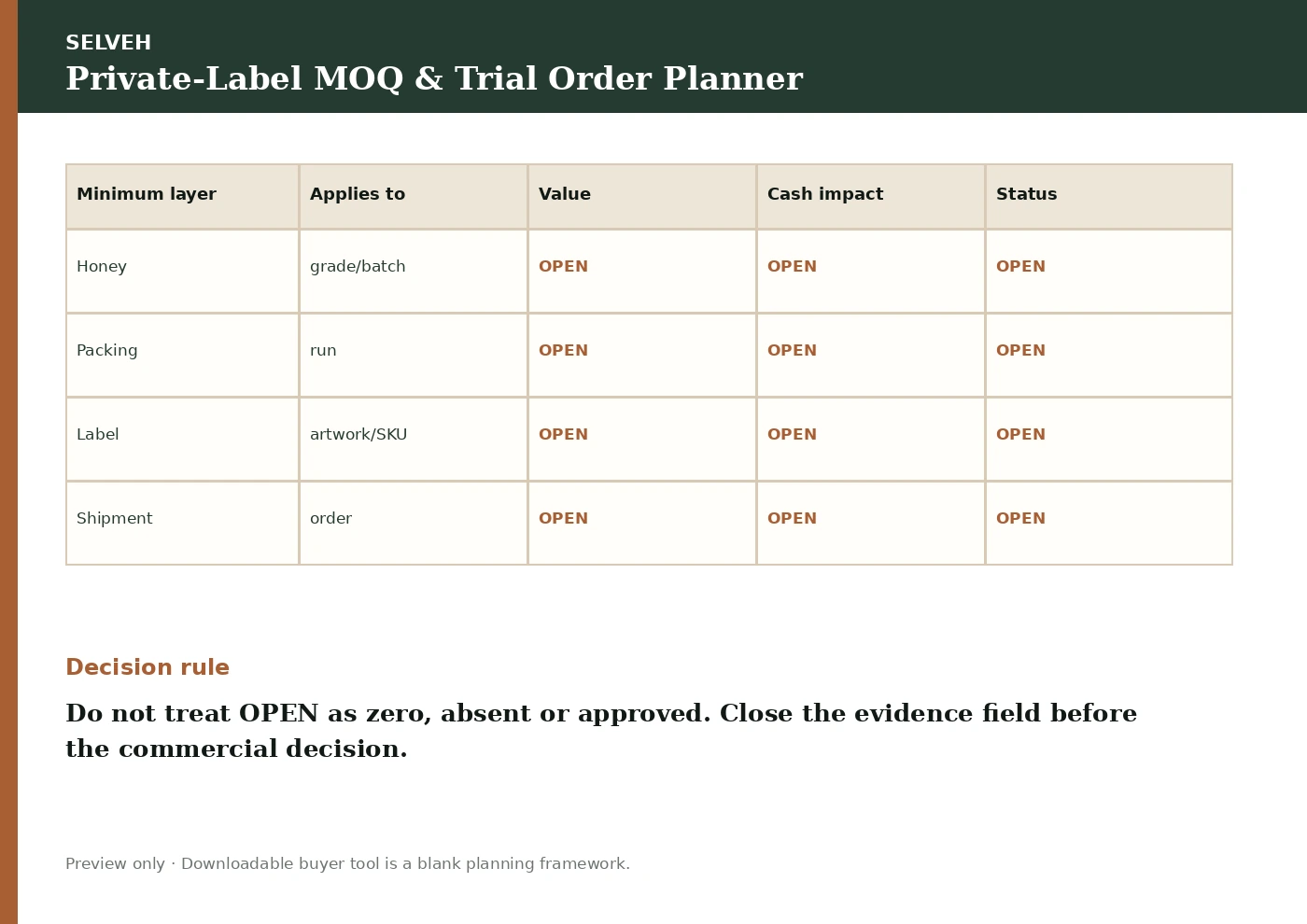
Use an MOQ & Trial Order Planner before approving a first run
The downloadable planner separates MOQ layers, SKU multiplication, cash timing and trial objectives. It is designed to make a buyer state what each minimum applies to and what evidence the first order must generate.
It is a procurement planning tool, not a supplier quotation, market forecast or promise that SELVEH can currently supply at any particular minimum.
11 · Red flags
Investigate these MOQ statements
- “MOQ is 1,000” without saying whether that is per grade, per pack, per label or total order.
- “Low MOQ” where artwork, testing, setup or freight charges are excluded from the comparison.
- “Mixed SKUs allowed” without a minimum per SKU.
- “Trial order” with no defined test objective or reorder decision rule.
- Pressure to add more SKUs solely to reach a supplier’s preferred production run.
12 · SELVEH status
What SELVEH can state today
SELVEH can define how a future MOQ should be decomposed and compared, and can request mixed-SKU, setup, payment and packaging terms from suppliers.
SELVEH should not publish a confirmed MOQ, trial-order size, supplier capability or price until a real supplier quotation and specification have been received and validated.
Sources
Sources and evidence notes
- business.gov.au - Guide to managing cash flow
- Export Finance Australia - Inventory and working-capital finance
- Australia's Manuka - wholesale information
- Australia's Manuka - USA wholesale / bulk order information
- Sunhighlands - wholesale application and published terms
Editorial boundary: Current official, technical and public commercial information is separated from SELVEH recommendations. Public supplier terms are examples only and no open supplier, batch, importer, price, MOQ or contract evidence is represented as confirmed SELVEH evidence.
Trade planning
Planning a first private-label Mānuka order?
Use the enquiry to define grade, pack, destination and trial objective. MOQ can then be requested on the right commercial basis.
Start a trade enquiry