
01 · Shelf-life claim
Shelf life is a product claim that needs a basis
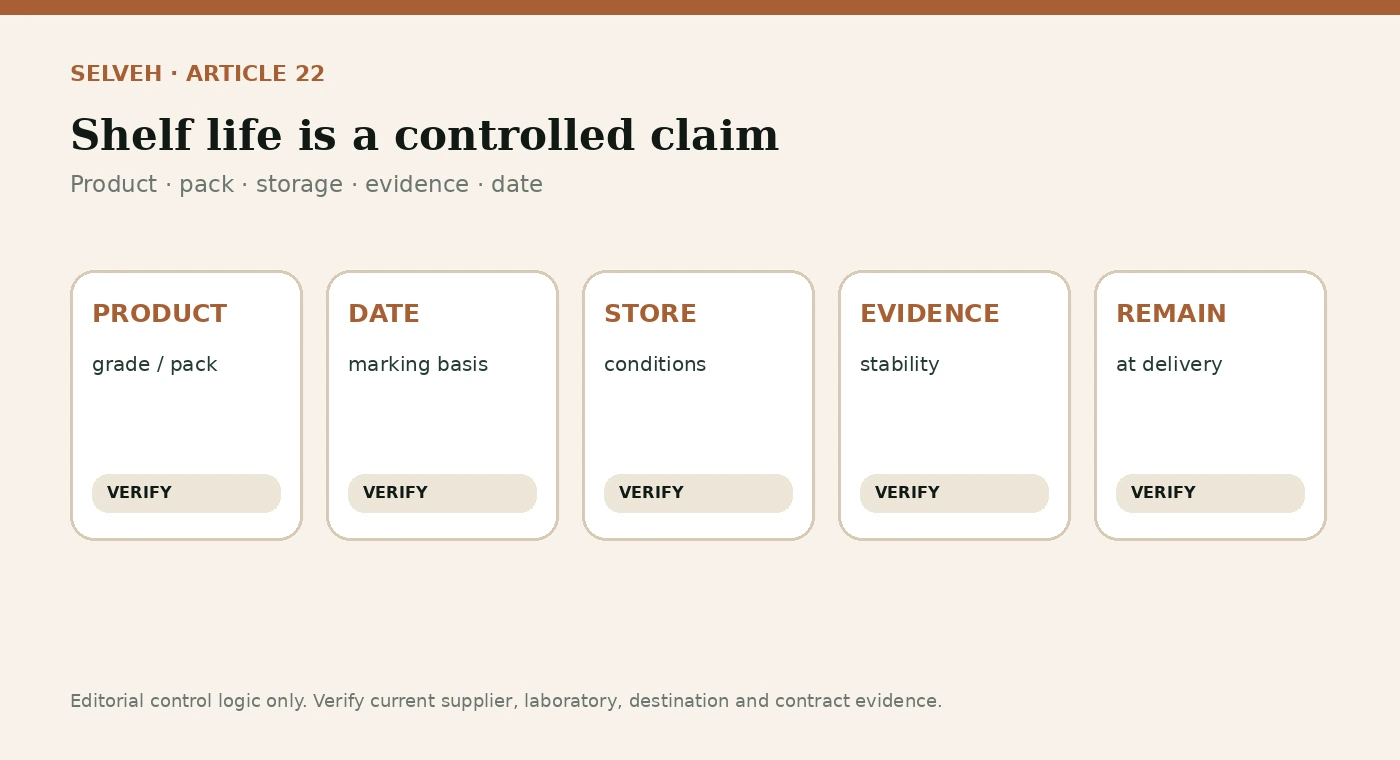
A wholesale buyer should not assume that every Mānuka honey has the same shelf life simply because honey is generally shelf-stable. The stated durability belongs to the actual honey, packaging system, storage conditions and quality criteria the supplier is prepared to support.
For a buyer, the key question is not “does honey last a long time?” but “what evidence supports this product’s best-before or durability statement under the specified conditions?”
This matters commercially because remaining shelf life at arrival affects importer inventory, retailer acceptance, markdown risk and the time available for sell-through.
02 · Date marking
Best-before and use-by mean different things
FSANZ explains that use-by dates are used where the date is linked to health or safety, while best-before dates relate to the period the food remains fully marketable and retains relevant qualities when stored as specified.
Under Standard 1.2.5, date marking is generally required for packaged food, but a best-before date is not required in Australia where it is two years or more after the date it is determined, subject to the standard’s exceptions. Export-market rules can differ.
A buyer should therefore avoid assuming that the absence of an Australian best-before mark proves indefinite shelf life or that an Australian date format is automatically sufficient for the destination market.
03 · Storage conditions
The storage statement and the shelf-life statement belong together
FSANZ requires storage conditions to be stated where they are necessary for the food to keep for the period indicated by the date mark. Operationally, that means a durability claim cannot be separated from the conditions under which it was established.
Ask the supplier what temperature, humidity, light exposure and pack-integrity assumptions sit behind the stated shelf life. If the product specification says “store in a cool, dry place”, define how that instruction will be translated into warehouse and transport controls where commercially necessary.
A generic phrase on a label is not a substitute for a documented storage specification.
04 · MGO & DHA
MGO is not chemically frozen at the packing date
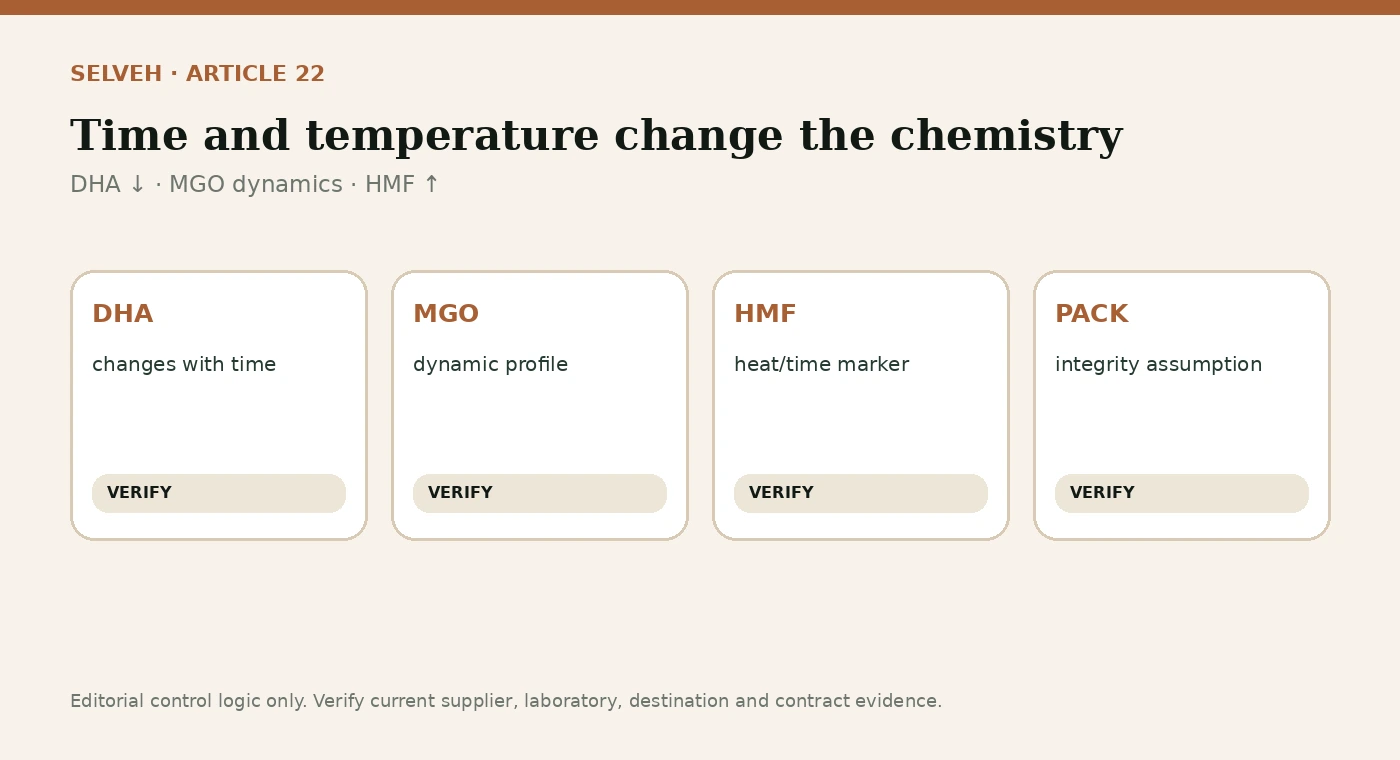
Peer-reviewed work on New Zealand Mānuka honey shows that DHA converts to MGO over time and that storage temperature changes both the rate and efficiency of that process. At higher temperatures DHA disappears faster and MGO can later decline, so the direction of change is not a simple “more time equals more MGO” rule.
The practical buyer implication is that the labelled MGO grade should be supported by the supplier’s release and stability approach rather than by an assumption that one early result will remain unchanged indefinitely.
Avoid using the research to predict a specific future MGO value for an Australian batch unless batch-specific stability evidence supports the model.
05 · HMF
HMF is one reason time and heat cannot be ignored
Research on Mānuka honey has shown HMF formation increases during storage and is strongly influenced by temperature and time. HMF is therefore relevant to quality control when honey is matured, processed, transported or stored.
This does not mean a buyer should invent a universal shipping temperature or reject ambient distribution automatically. It means the supplier’s processing and storage history should be compatible with the agreed quality specification.
Where HMF is a contractual parameter, define the test method, limit and stage at which it must be met.
06 · Remaining shelf life
Specify how much shelf life must remain at delivery
The total shelf life printed at packing is not the same as the commercial shelf life available to an importer. Production lead time, QA release, ocean or air freight, customs clearance, warehousing and retailer distribution all consume time.
A buyer can therefore specify a minimum remaining shelf-life requirement at handover or arrival, subject to the commercial contract and destination rules. That requirement should be realistic and linked to expected sell-through rather than copied from another product.
If the supplier cannot state the manufacturing/packing date and best-before basis clearly, remaining shelf life cannot be managed well.
07 · Warehouse control
Separate transport excursions from routine storage
The export-logistics article addresses route and temperature exposure during shipment. Shelf-life control is the longer-duration question: what storage conditions apply before shipment, in the destination warehouse and through the distribution chain?
FSANZ advises food businesses to follow manufacturer storage instructions and avoid warm, humid or direct-sunlight conditions where these could spoil food or make it unsuitable. For premium honey, visual and chemical quality may also be commercially important even when safety is not the issue.
Use a warehouse requirement that matches the product specification rather than assuming “ambient” means any temperature for any duration.
08 · Packaging integrity
Shelf-life evidence assumes the package remains fit for purpose
Standard shelf-life reasoning assumes an intact package. Buyers should confirm closure integrity, tamper-evident components where specified, jar compatibility, label durability and secondary-carton protection.
Damage, leakage or repeated opening can invalidate the assumptions behind a packaged shelf-life statement. For retail-ready exports, packaging QA therefore belongs in the durability discussion rather than only the branding discussion.
If the supplier changes the jar, lid, liner or sealing process, the buyer should ask whether the supported shelf-life basis is affected.
09 · Evidence package
Ask what the supplier used to set the shelf life
A useful supplier answer may include historical batch data, stability studies, retained-sample monitoring, packaging validation, quality parameters at release and documented storage assumptions. The depth of evidence should match the product and commercial risk.
The buyer does not need a laboratory study for every theoretical question, but should be able to distinguish a substantiated shelf-life statement from an inherited number copied from another SKU.
If the product is private label, agree who owns the shelf-life statement and who approves any date-marking change.
10 · Buyer specification
Put durability into the product and logistics specifications
Record the stated shelf life or date-marking rule, storage conditions, minimum remaining shelf life at delivery, relevant quality parameters, batch/packing date fields and any excursion disposition process.
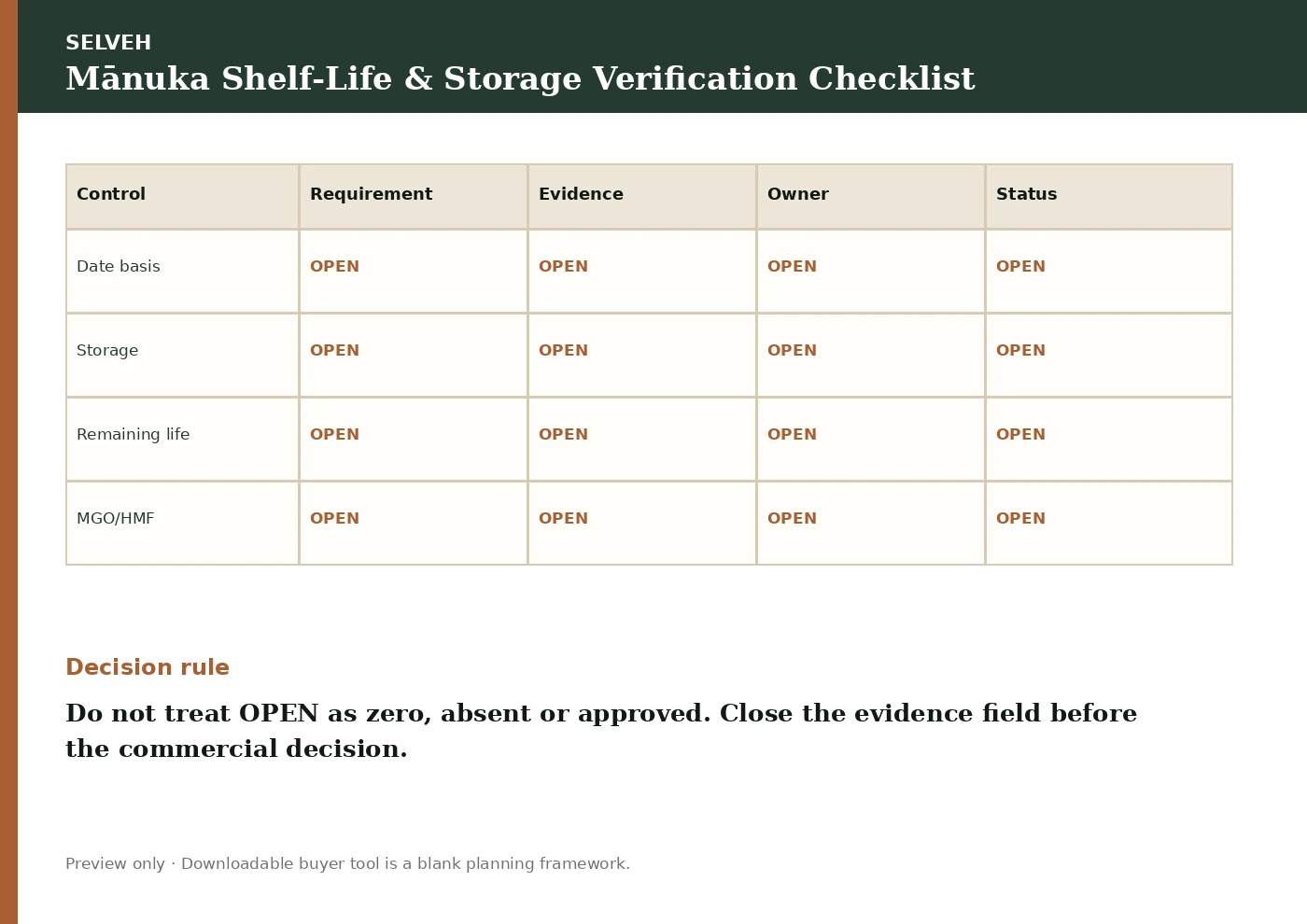
The specification should also state which items remain OPEN until supplier and destination evidence are confirmed. This is especially important before artwork is printed.
Do not let a commercial team promise a date or storage claim that the supplier’s evidence has not closed.
11 · Buyer tool
Use a Shelf-Life & Storage Verification Checklist
The downloadable checklist links the date-marking basis, product/pack version, storage conditions, remaining shelf-life requirement, MGO/HMF evidence and ownership of approval.
It is a buyer verification tool, not a SELVEH shelf-life claim and not a substitute for destination-market labelling advice.
12 · Red flags
Investigate these shelf-life statements
- “Honey never expires” used as the only basis for a commercial shelf-life claim.
- A best-before date copied from another supplier or pack format without evidence.
- No storage conditions even though the stated durability depends on them.
- An MGO result assumed to remain unchanged for the full commercial life.
- No minimum remaining shelf-life requirement for a long export and distribution chain.
13 · SELVEH status
What SELVEH can state today
SELVEH can define the evidence fields a future shelf-life and storage claim must close and can separate transport control from longer-term storage control.
SELVEH should not publish a confirmed shelf life, best-before period or storage temperature for a commercial SELVEH Mānuka SKU until the supplier, packaging and destination requirements are final and the evidence supports the claim.
Sources
Sources and evidence notes
- FSANZ - Use-by and best-before dates
- FSANZ - Food Standards Code compilation (April 2026)
- FSANZ - Storing food safely
- Grainger et al. - DHA to MGO kinetics in manuka honey
- Grainger et al. - HMF formation in manuka honey
Editorial boundary: Current official, technical and public commercial information is separated from SELVEH recommendations. Public supplier terms are examples only and no open supplier, batch, importer, price, MOQ or contract evidence is represented as confirmed SELVEH evidence.
Trade planning
Need to define shelf-life evidence for a trade SKU?
Use the enquiry to identify destination, pack format and commercial timing. SELVEH can then request the right shelf-life and storage evidence before a claim is treated as closed.
Start a trade enquiry