
01 · Define the offer
Separate packing location from order size
Source-packed means the honey is filled, closed, coded and normally labelled into the agreed retail unit before export from Australia. Destination-packed means honey is exported in a larger food-grade format and filled or finished by a qualified business in the destination market. A part-finished route can sit between them: for example, source-filled jars that receive market-specific labels or secondary packaging after arrival.
“Bulk” and “wholesale” are not synonyms. A buyer can purchase wholesale quantities of finished 250 g jars, while a bulk shipment can be packed into many retail formats later. Quotations must state the physical pack, net contents, closure, liner, coding, case, pallet and point at which ownership and release responsibility transfer.
This decision follows, rather than replaces, the white-label versus private-label operating-model choice.
02 · Responsibility matrix
Map who controls each critical step
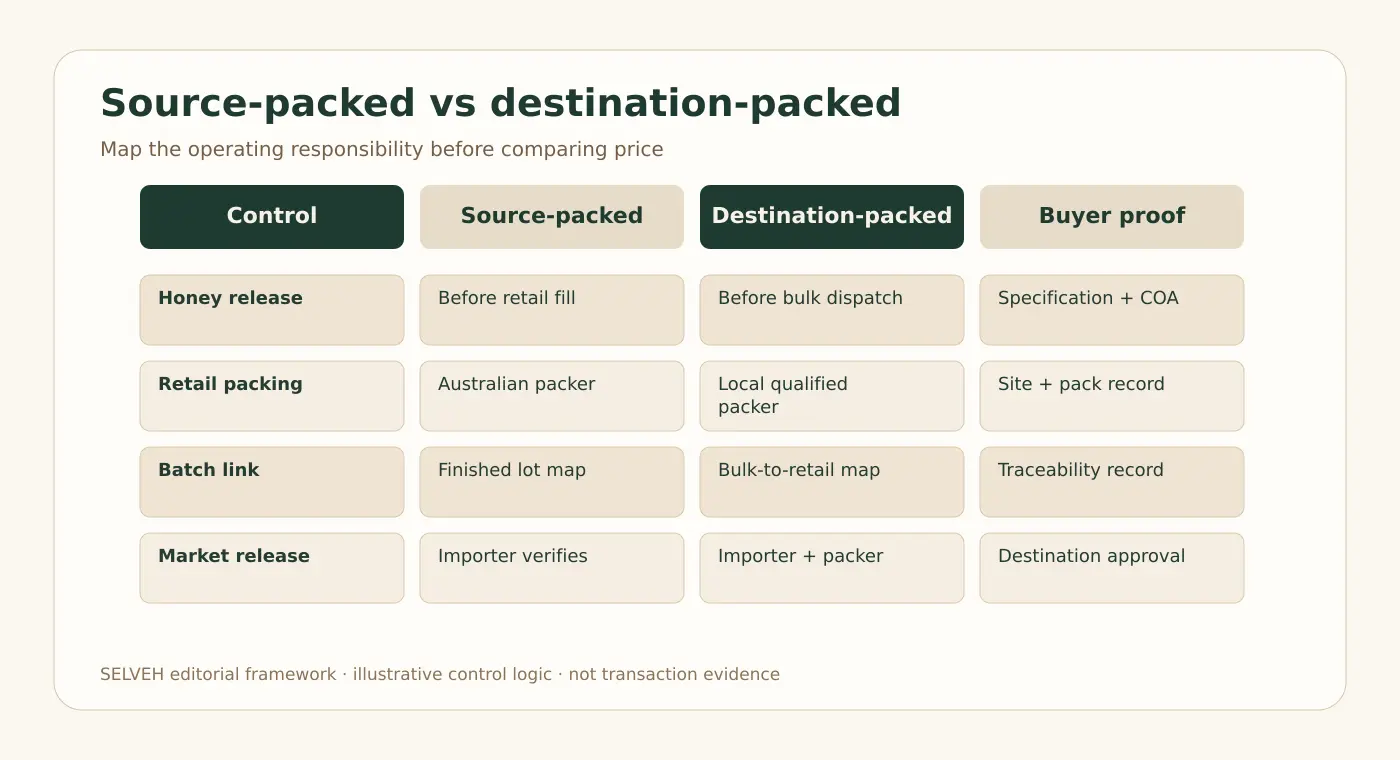
| Control | Source-packed route | Destination-packed route | Evidence to request |
|---|---|---|---|
| Honey release | Released before source filling | Released for bulk dispatch; local release may also apply | Specification, lot map and COA |
| Primary packaging | Australian packer qualifies the system | Destination packer qualifies the retail system | Component specification and suitability |
| Fill and coding | Controlled at source | Controlled locally | Fill record, code map and reconciliation |
| Artwork | Usually approved before source production | May be applied or completed locally | Approved version and responsibility record |
| Market release | Importer still verifies destination acceptance | Importer and local food business carry more operating interfaces | Import, label and release approval |
03 · Batch continuity
The evidence must travel with the honey
A laboratory report for a source lot is not self-linking. The buyer needs a documented relationship between the tested sample, source lot, exported bulk container or finished run, local receiving record, any blend or split, retail filling record and final lot code. If several source lots are combined, the new bulk or packed lot needs a controlled identity and an evidence rule appropriate to the claims being made.
AMHA describes traceability and independent testing as important elements of its member standards. Where an AMHA mark or another scheme is proposed, verify that the specific route, facility, product and finished presentation remain eligible; do not assume eligibility automatically follows honey into a different packer or market.
Use the COA buyer guide and the batch-documentation guide to test the chain.
04 · Food-business control
Destination packing transfers more than a filling task
Local filling can transfer responsibility for receiving, storage, hygiene, equipment, foreign-material control, calibration, net-content control, component handling, coding, rework, release and record retention. Those duties should be assigned to named legal entities and sites. A logistics provider or importer is not automatically a competent food packer merely because it can store drums.
FSANZ requires Australian food businesses to use packaging fit for its intended purpose, avoid materials likely to contaminate food and prevent contamination during packing. Destination requirements may differ, but the control logic remains useful: qualify the facility and actual process, not just the container supplier.
Ask for the packer’s current scope, audit or licence evidence where applicable, process flow, hygiene controls, traceability exercise, complaint or recall route and change-notification practice.
05 · Export and import route
Check the exact market before choosing the model
Australian honey is generally treated as a non-prescribed good for export, but that does not mean every shipment is document-free. DAFF states that importing-country requirements determine certificates, establishment listing and other conditions, and directs exporters to Micor and the importer or competent authority. Some honey markets use NEXDOC certification.
Packing location can change the facts used in an application, label or certificate: the exporter, manufacturer or packer of record, establishment, product description, package count, net weight, lot identity and final presentation may differ. Map those facts before the purchase order.
For SELVEH’s initial focus, review the UAE and Singapore starting guides, then obtain current market-specific confirmation.
06 · Origin and wording
Do not confuse Australian honey with Australian packing
Country of origin, place of packing and brand ownership answer different questions. Honey can be Australian in origin and packed elsewhere, but the finished label and marketing must describe the actual facts without implying a process or certification that did not occur.
In Australia, honey is a priority food for country-of-origin labelling. Export destinations apply their own formats and consumer-protection rules. If the product will be filled in the destination, review how local processing, added ingredients, blending, repacking or relabelling affect the permitted origin statement in that market.
Retain the reasonable grounds behind every origin phrase: supplier declaration, lot records, packing records and applicable official documentation. The certificate-of-origin guide explains why a trade document and a consumer label are not interchangeable.
07 · Packaging system
Qualify every contact layer and closure
A bulk route requires a qualified transport container, liner or gasket, closure, tamper control and opening or dispensing method. The local retail route then adds the jar, closure, seal, label, ink, adhesive, case and pallet. Each layer must be suitable for the honey, intended contact, storage time, temperature and handling conditions.
Do not treat a supplier statement such as “food grade” as the entire validation. Request material and component identification, intended-use assurance, dimensional drawings, closure compatibility, storage limits and change control. Confirm how the opened bulk container is protected during the filling run and how residual honey is handled.
For retail components, use the packaging specification guide.
08 · Yield and reconciliation
Price the loss between received and sellable units
Bulk kilograms do not convert perfectly into invoiced retail units. The model should include receiving variance, product retained in the container and transfer lines, start-up and changeover loss, sampling, quality holds, overfill, damaged components, rejects, rework and finished-goods reconciliation.
Define an expected and acceptable yield, the measurement method, ownership of variance and the evidence required before a shortage claim. Record calibrated weights and distinguish gross, tare and net quantities. If honey viscosity changes with temperature, ensure the handling method is controlled without inventing an unsupported heat treatment or quality promise.
Compare the destination-packed result as cost per accepted, released and sellable unit, not simply landed bulk cost divided by nominal net weight.
09 · Landed economics
Normalise both routes to the same commercial point
A source-packed quote may include honey, jar, closure, label, coding, case, filling, quality release and export preparation. A bulk quote may exclude destination transport, storage, customs handling, sampling, local components, printing, filling, testing, release, waste, rework and financing. Put both routes on the same Incoterm, named place, currency, quantity, grade, shelf-life and payment basis.
Then add working capital. Destination packing may delay component commitment or allow several local formats, but it can also create separate minimums for honey, jars, labels and production slots. Source packing may simplify the interface while creating more finished-SKU inventory. Neither outcome is guaranteed.
Use the landed-cost worksheet and price-architecture guide.
10 · Inventory and flexibility
Identify where postponement creates real value
Destination packing can postpone the final pack-size, language or channel allocation until more demand is known. That flexibility is valuable only if the bulk honey, packaging components, local capacity and evidence remain available and within controlled storage and shelf-life limits.
Source packing can reduce operational variables and make the export unit immediately recognisable, but each grade-pack-language combination becomes a finished SKU. Model months of cover and residual stock for every variant. A single bulk lot may look flexible while local component minimums create the same fragmentation later.
Use the inventory and reorder guide to model each commitment separately.
11 · Contract controls
Write the hand-off into the quality agreement
The quality agreement should identify who owns product and packaging specifications, sampling, testing, release, artwork, storage, transport conditions, deviation approval, non-conformance investigation, recall support and change notification. The commercial contract should align ownership, risk transfer, insurance, payment, loss, rejected goods and residual inventory.
For destination packing, define whether the source supplier may audit or approve the local facility when its name, specification or scheme evidence remains associated with the finished product. For source packing, define importer approval of artwork and destination requirements without suggesting that importer approval removes the packer’s duties.
The quality-agreement planner provides the operating layer.
12 · Release flow
Use two gates when the process has two transformations
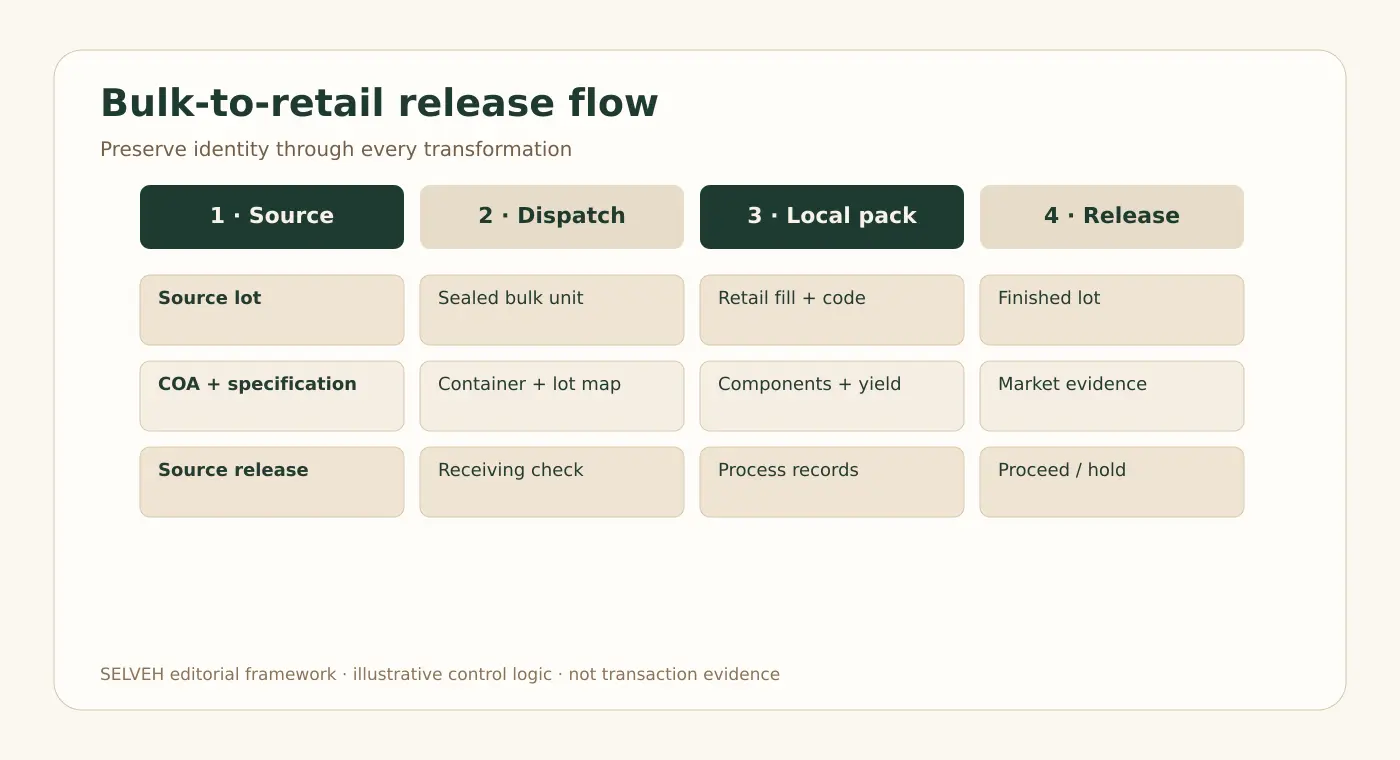
A source release confirms the source product against its specification and dispatch requirements. Destination receiving confirms seal condition, lot identity, quantity and transport status. Local filling creates new records for components, line, date, code, yield and exceptions. Finished release confirms the retail lot, artwork and market requirements.
Some tests may remain valid from the source lot; others may need confirmation because the process, destination rule, elapsed time or claim basis changed. Decide this with the responsible quality and regulatory parties rather than applying a universal retest list.
13 · Pilot design
Run a controlled operational pilot
A useful pilot follows one defined bulk lot or source-packed run through receipt, document review, filling where relevant, coding, release, shipping, customer receiving and reconciliation. Record elapsed time, labour, yield, damage, evidence defects, deviations and true landed cost.
For destination packing, include a documented trial of transfer and filling, closure application, net-content control, code legibility and pack-out. For source packing, include transit and receiving review of the finished configuration. Use the same acceptance criteria so the models can be compared.
Do not scale because the first jars look good. Scale when the process repeatedly produces accepted units with complete evidence and viable economics.
14 · Buyer tool
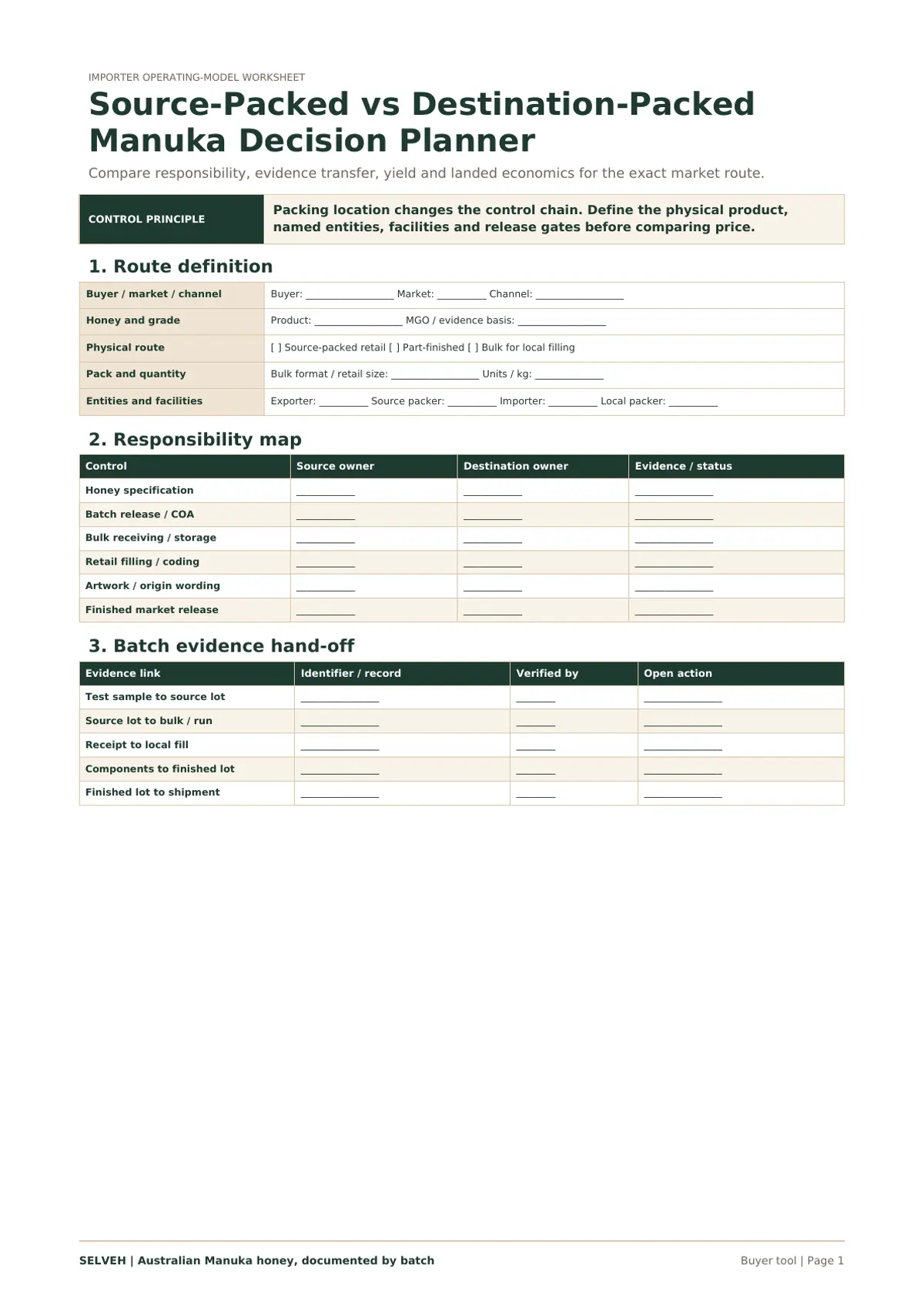
Download the packing-location decision planner
The two-page planner captures the proposed physical route, entity and facility responsibilities, batch-evidence hand-off, packaging qualification, yield, normalised cost, destination readiness and pilot decision. Complete a separate version for each market and pack family.
The planner is not an import approval, facility audit, certificate, quotation, legal opinion or confirmed SELVEH supply route.
15 · Review triggers
Investigate these proposals before commitment
- “Bulk” is quoted without a defined container, liner, closure, net weight or lot map.
- The source COA cannot be connected to the exported container and final retail lot.
- A warehouse is presented as a packer without a verified food-business scope.
- The cost comparison ignores yield, local components, testing, rejects or working capital.
- Australian origin wording implies Australian packing when filling occurs elsewhere.
- The destination route has no named importer, label reviewer or competent-authority check.
- Residual honey, opened containers, rework and non-conforming stock have no rule.
- A scheme mark or supplier approval is assumed to transfer automatically to a new site.
16 · Buyer FAQ
Frequently asked questions
Is destination packing always cheaper?
No. Lower freight weight or local component access may help, but filling, testing, yield loss, minimums, rejects, storage and financing can reverse the result.
Does source packing remove importer responsibility?
No. The importer still needs to verify destination requirements and the accepted product, documents and label.
Can one source COA support every locally packed jar?
Only when the lot relationship, specification, process and applicable claim rules support that conclusion. Document the mapping and any required local checks.
Which route does SELVEH currently offer?
This article does not represent a confirmed source-packed, bulk or destination-packed programme. The route remains subject to verified suppliers, packers, batches, components, markets and terms.
17 · SELVEH status
What SELVEH can state today
SELVEH can use this framework to compare buyer requirements and expose the supplier, packer, importer, documentation and cost inputs that remain unresolved.
SELVEH should not claim a live bulk format, source-packed SKU, destination packer, facility approval, batch, MGO result, price, MOQ, lead time, certificate or market acceptance until first-party records confirm them.
Sources
Official export, packaging, origin and quality guidance
- DAFF — How to export non-prescribed goods
- DAFF — Determining a non-prescribed good
- FSANZ — Food packaging
- ACCC — Country of origin food labelling
- AMHA — Quality standards
Source review: Official and scheme guidance reviewed 27 August 2026. Recheck the exact destination, facility, product, batch and route before a transaction.
Trade planning
Comparing a source-packed or destination-packed route?
Share the market, product, pack sizes, expected quantity and proposed facilities. SELVEH will map the evidence, responsibility and cost assumptions that must be verified before an offer.
Start a trade enquiry