

01 · Commercial structure
Separate method, timing and delivery terms
“Thirty days”, “letter of credit” and “FOB Melbourne” answer different questions. A payment term describes when money is due. A payment method describes how funds or documents are handled. An Incoterm allocates specified delivery tasks, costs and risk at a named place. None should be used as shorthand for the other.
Write all three explicitly. A commercial schedule should show currency, total order value, instalment amounts or percentages, trigger evidence, due-date calculation, bank charges and what happens if a milestone or document is disputed.
Use the Mānuka honey Incoterms guide for delivery allocation and the purchase-order guide for transaction control.
02 · Exposure assessment
Assess risk before choosing a payment structure
The strongest structure is not automatically the most practical. Start with the exposure created before cash is received: raw honey allocation, jars, printed labels, production capacity, testing, freight bookings and branded inventory that may be difficult to resell.
Then assess buyer trading history, order value, financial information available through appropriate checks, jurisdiction, transfer restrictions, bank capability, documentary complexity and the time between commitment and receipt. A repeat order with stable forecasts may justify different credit exposure from an untested private-label launch.
Record the facts and the approver. “Trusted buyer” is not a control unless the basis, limit and review date are visible.
03 · Method selection
Compare methods without implying a universal best answer
| Method | Core feature | Exporter exposure | Buyer consideration |
|---|---|---|---|
| Advance payment | Funds before defined work or dispatch | Lower non-payment exposure for the paid amount | Higher performance and delivery exposure |
| Letter of credit | Bank undertaking subject to compliant presentation | Documentary and bank/country conditions remain | Cost, setup and strict document requirements |
| Documentary collection | Banks handle documents against payment or acceptance | No bank payment guarantee merely from collection | Document release process must fit shipment |
| Open account | Payment after invoice, shipment, receipt or acceptance | Greater buyer-credit and collection exposure | Lower prepayment and financing burden |
Australian export guidance presents these as different risk and cash-flow choices. The applicable bank should confirm availability, process, wording, fees and country limitations for the actual transaction.
04 · Negotiation
Balance buyer assurance and exporter exposure
Large buyers may resist full advance payment because they carry product, performance and delivery risk. Exporters may resist open account because they fund procurement and production before collection. A staged structure can allocate exposure to the party best able to control each stage.
Examples might connect an initial amount to an accepted order and approved artwork, another amount to completed production or release evidence, and a balance to shipment documents. These are design options, not confirmed SELVEH terms. Each milestone must correspond to actual work, value at risk and objective proof.
Do not call a deposit “non-refundable” without transaction-specific legal advice and a proportionate explanation of committed costs.
05 · Timing design
Build observable payment milestones
Milestones should be specific enough that finance, operations and the buyer reach the same conclusion. “On production” may be ambiguous: does it mean materials ordered, filling started, finished goods completed or quality release approved? Name the event, evidence, issuer, currency amount and due calculation.
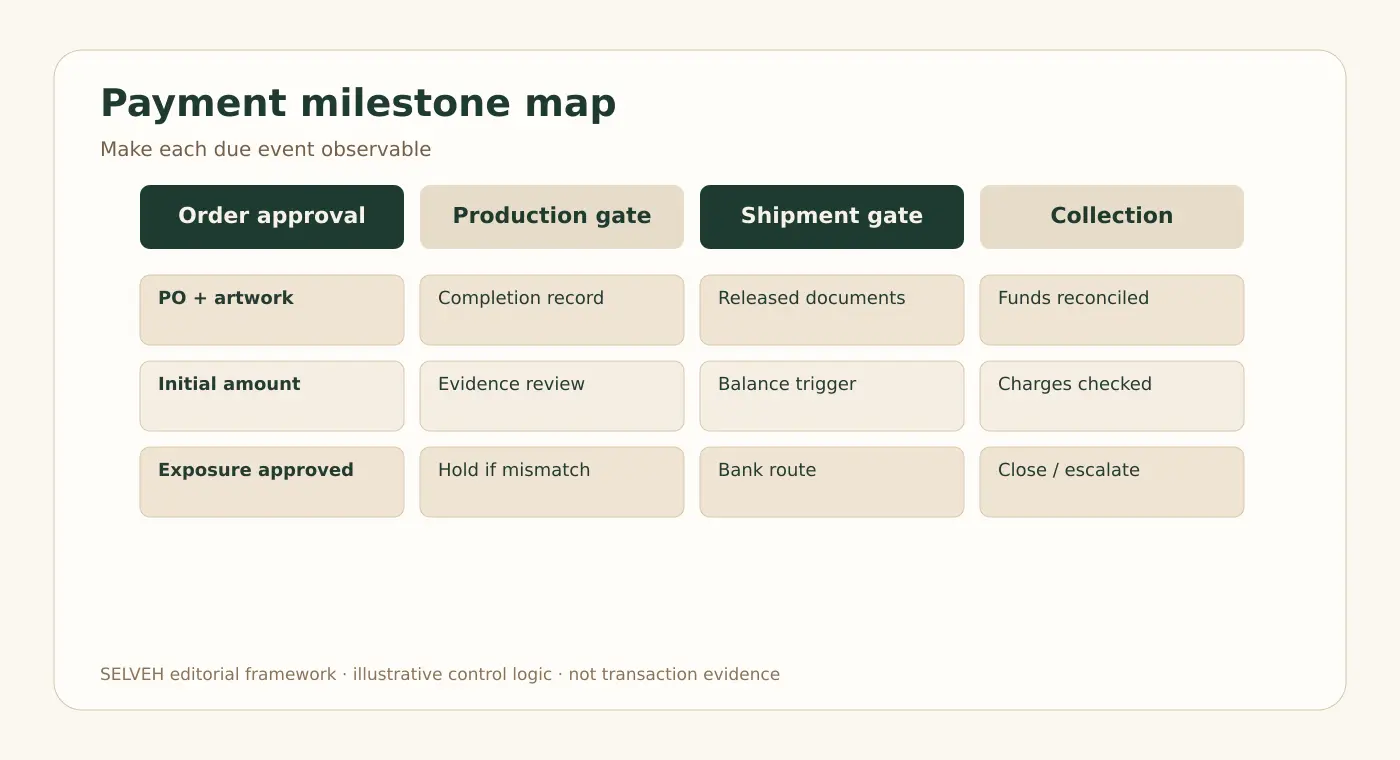
Include a hold route for missing or inconsistent evidence. A deadline should not force payment against an unresolved material discrepancy unless the contract deliberately provides otherwise.
06 · Documentary credit
Treat a letter of credit as a document-driven instrument
A documentary credit can provide an issuing bank undertaking to pay when the required terms and presentation are complied with. It does not inspect honey, confirm commercial satisfaction or cure unclear contract wording. Banks examine documents under the credit.
Before acceptance, have the nominated bank review feasibility, issuing bank, expiry, presentation place, shipment dates, required documents, tolerances and amendment process. Avoid requirements that depend on a document the exporter cannot control or obtain. Names, quantities, dates and shipment details must reconcile across the presentation.
ICC rules and the issued instrument matter. Obtain bank and legal guidance rather than copying clauses from another trade.
07 · Documentary collection
Understand what documentary collection does not guarantee
In documentary collection, banks can handle commercial or transport documents against payment or acceptance under the collection instruction. The process does not create a bank guarantee of buyer payment simply because documents move through banks.
Assess whether control of the documents gives meaningful leverage for the shipment and destination. Goods may arrive, incur storage or be difficult to redirect if the buyer refuses. Define instructions, charges, release condition, protest or non-payment handling with the banks involved.
Do not assume “documents against acceptance” is economically equivalent to cash. Acceptance can leave a future-payment exposure that requires separate credit judgment.
08 · Trade credit
Control open-account exposure deliberately
Open account can support buyer cash flow and competitive offers, but it transfers collection risk to the seller until payment. Set a documented credit limit, due-date basis, overdue escalation, stop-supply trigger and review frequency. Reassess when order size, ownership, payment behaviour or country conditions change.
Possible mitigations include smaller initial orders, staged limits, shorter terms, approved security, export credit insurance where available and suitable, or receivables finance. These products have eligibility, exclusions, cost and documentation conditions; they are not automatic protection.
Never let an urgent repeat order silently override an overdue-account hold.
09 · Trigger evidence
Define the evidence behind every due event
A payment trigger may reference an accepted quotation, buyer-approved artwork, supplier acknowledgement, production completion record, batch release decision, commercial invoice, packing list, transport document or receipt evidence. Use only documents that actually demonstrate the stated milestone.
State whether originals, electronic records or bank-channel presentations are required and who reviews discrepancies. Document names should match the PO and contract. If the buyer’s acceptance is a trigger, define objective criteria and a response window so acceptance cannot remain indefinite.
Our invoice and packing-list guide explains shipment-document reconciliation.
10 · Currency and charges
Make exchange rate and bank cost visible
State the invoice and settlement currency. Identify who carries exchange-rate movement between quotation, order, production and payment. If a price has an FX validity or adjustment mechanism, define the source, reference date, threshold and approval path.
Allocate sending, intermediary and receiving bank charges so the amount arriving can be reconciled. Do not assume a transfer instruction guarantees the invoiced net receipt.
Record withholding, tax or regulatory deductions only after qualified advice for the actual jurisdictions. A commercial worksheet should expose the assumption, not invent the treatment.
11 · Payment security
Independently verify bank-detail changes
Business email compromise can redirect legitimate payments by impersonating a supplier, buyer or adviser. Australian cyber guidance recommends approval processes for changed payment details or large transfers and verification by calling a known, verified phone number—not a number supplied in the suspicious email.
Use multi-factor authentication, restricted authority, dual approval where proportionate, controlled beneficiary records and an out-of-band verification procedure. Treat urgency, secrecy and requests to bypass established controls as escalation triggers.
Record who verified the request, which known channel was used, the date and the approved beneficiary details. Do not publish bank details in an article or uncontrolled attachment.
12 · Exceptions
Connect payment holds to defined disputes
A buyer should not withhold an entire unrelated balance for any minor issue, and an exporter should not ignore a material non-conformance because an invoice is due. The contract should connect payment adjustments, credits or holds to documented criteria and authorised decisions.
Separate a quality claim from a bank-document discrepancy. One concerns product or performance; the other concerns the documentary presentation. They may interact, but different evidence and deadlines can apply.
The quality agreement guide maps the operational claim route.
13 · Buyer tool
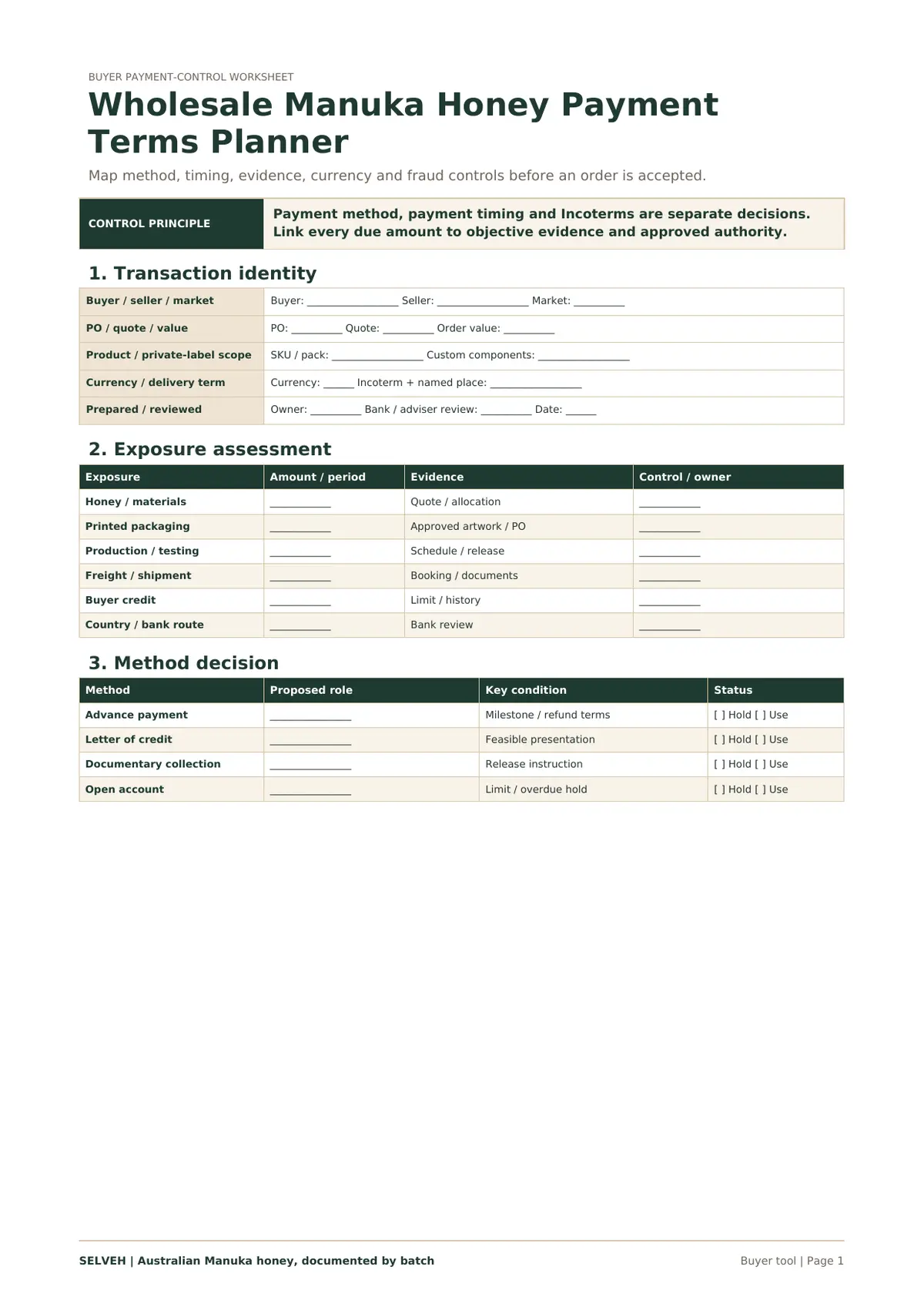
Download the payment terms planner
The two-page planner records parties, order value, method, timing, milestone evidence, currency, charges, credit exposure, approval and fraud controls. Use one controlled version per transaction and attach the bank or contract references that support the decision.
The planner is not a bank instrument, quotation, credit decision, legal advice, financial advice or confirmed SELVEH payment term. Obtain transaction-specific advice and bank confirmation before issue.
14 · Review triggers
Investigate these payment proposals
- “Net 30” has no defined starting event or calendar rule.
- The Incoterm is presented as if it determines payment security.
- A large branded order has no allocation for pre-shipment exposure.
- A letter of credit requires documents the exporter cannot control.
- Documentary collection is described as guaranteed bank payment.
- Open-account credit has no limit, review date or stop-supply rule.
- Bank details changed by email without independent verification.
- Currency, bank charges, amendment fees or dispute handling are omitted.
15 · Buyer FAQ
Frequently asked questions
What payment terms does SELVEH offer?
No universal term is represented here. Any offer must be based on the buyer, order, product, production exposure, market, bank route and approved contract.
Is a deposit always required for private label?
Not as a universal rule. Custom packaging and early committed costs are relevant, but the structure must be negotiated and approved for the actual order.
Does a letter of credit guarantee product quality?
No. It is document-driven. Product conformity needs specifications, evidence, release and claim controls.
Can payment be due after buyer inspection?
It can be negotiated, but the inspection scope, evidence, deadline and consequence must be objective and operationally workable.
16 · SELVEH status
What SELVEH can state today
SELVEH can use this framework to compare proposed payment structures and identify which facts, bank confirmations and approvals remain open.
SELVEH should not state that advance payment, credit, documentary collection, a letter of credit, insurance, finance, a bank account or a fixed payment schedule is available or accepted until transaction-specific counterparties and advisers confirm it.
Sources
Official export-payment and security sources
- Go Global Toolkit — Export payment methods
- Go Global Toolkit — Know your Incoterms
- ICC Academy — Key trade finance products
- Cyber.gov.au — Preventing business email compromise
- Export Finance Australia — Finance and risk solutions
Source review: Official guidance reviewed 26 August 2026. Bank rules, sanctions, exchange controls and commercial terms can change; confirm the actual transaction with the relevant bank and advisers.
Trade planning
Need to map payment risk for a wholesale order?
Share the destination, order size, private-label scope, proposed delivery term and preferred payment structure. SELVEH will identify the commercial assumptions, documentary triggers and approvals that must close before an offer.
Start a trade enquiry