

01 · Order control
Treat the PO as a transaction control, not a complete contract
A purchase order records what the buyer is offering to buy and on which stated terms. Depending on the surrounding conduct and documents, acceptance can create legal obligations. The operational team therefore should not treat the PO as an informal shopping list.
Business.gov.au recommends that written supply contracts define the goods or services, price and payment, timeframes, delivery, quality standards, warranties, dispute handling and termination. The PO can carry or reference many of those controls, but complex or recurring relationships may also need an executed supply agreement and legal review.
State the governing document set. Do not assume a supplier quotation, buyer terms, specification and PO automatically align.
02 · Source of truth
Define document hierarchy before a conflict appears
A supplier quotation may include exclusions. A buyer specification may contain stricter requirements. The PO may state a different delivery date, while a later email changes the pack split. Without a hierarchy, each team can believe a different document is authoritative.
List the incorporated documents by title, reference, version and date. State which prevails for commercial terms, product specifications, artwork, quality requirements and logistics if a conflict arises. Obtain appropriate legal advice on the wording and enforceability.
| Document | Primary role | Control field |
|---|---|---|
| Supply agreement | Relationship and legal framework | Execution date and amendments |
| Purchase order | Transaction-specific commitment | PO number and revision |
| Product specification | Product and evidence requirements | SKU and version |
| Artwork approval | Controlled print file | File name and release status |
03 · Parties and references
Identify every commercial and operational party
Record the legal buyer and seller names, registration details and addresses. Distinguish the invoice recipient, importer of record, consignee, delivery location and notification contact where they differ. Name the operational contacts for order acknowledgement, artwork, quality, freight and accounts.
Use unique references: PO number and revision, supplier quotation, sales order, product specification, artwork file, contract, customer reference and project name. A jar description alone is not a stable identifier.
Require the supplier’s written acknowledgement to repeat the PO number, revision, quantities, delivery term, requested date and any exceptions. Silence is not a robust method for resolving a difference.
04 · Product line
Specify the product as a controlled line item
Each order line should identify SKU, product name, net quantity, pack size, case configuration, units, MGO or grade requirement where applicable, packaging format, market/language version and approved specification. Define the unit of measure so “quantity 500” cannot mean jars, cases or kilograms to different teams.
Do not convert a planning description into a batch claim. If MGO, origin, floral source or another attribute requires evidence, state the acceptance criterion and required document rather than declaring an unverified outcome.
For private label, reference the approved artwork file and version. A screenshot or email attachment without version control should not authorise production.
05 · Evidence map
Connect every important requirement to a record
A PO is stronger when it explains how conformity will be demonstrated. The evidence may include a batch certificate of analysis, packing record, origin document, finished-product label proof, pallet record or other transaction-specific document. Required evidence depends on product, destination, buyer and contract.
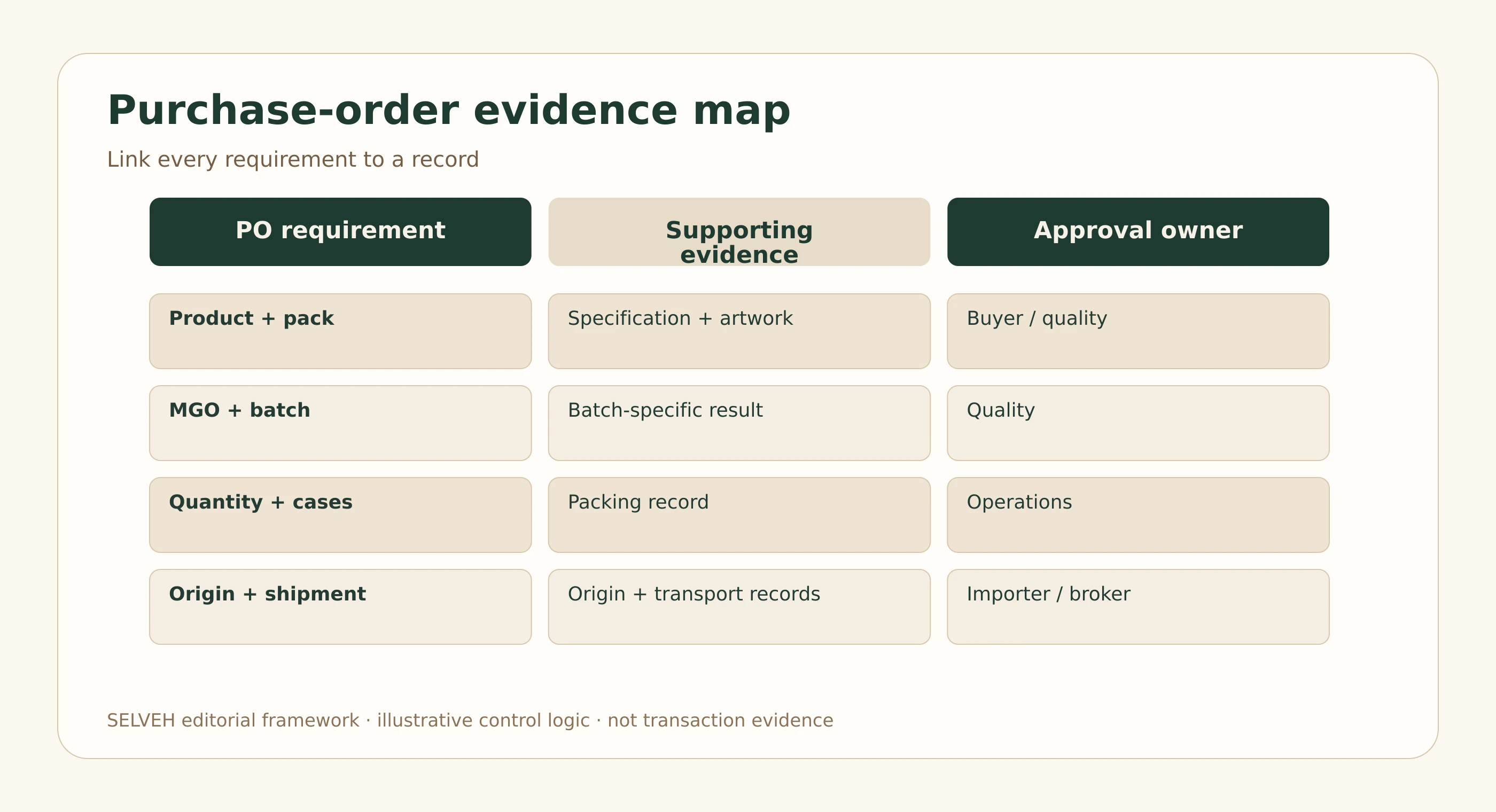
State timing: before production, before dispatch, with shipment, or after receipt. A certificate requested only after goods arrive may be too late to control release.
06 · Quantity control
Define tolerances, substitutions and over-shipments
Record ordered units, units per case, case count, pallet expectations and any permitted tolerance. If production processes can create over- or under-runs, agree whether they are acceptable, who approves them and how invoicing works. Do not leave the supplier to infer that more stock is automatically welcome.
Prohibit substitutions unless written approval is given. That includes jar, closure, label material, case configuration, MGO grade, batch, honey source and artwork version. A visually similar component may affect compliance, pallet geometry, shelf presentation or buyer acceptance.
For split deliveries, state the approved schedule and whether partial quantities change price, freight responsibility or payment.
07 · Commercial terms
State price, currency, tax and payment precisely
For each line, show unit price, unit basis, currency, quantity and extension. Identify included and excluded services. State whether relevant taxes are included, excluded or handled by the importer, subject to current advice. Reconcile the PO to the approved quotation and price architecture.
Payment terms should identify the trigger, due date method, payment channel and required supporting documents. Use the wholesale payment-terms framework to separate method, timing, documentary evidence and fraud controls. “Thirty days” is incomplete if it does not say from invoice, shipment, receipt or acceptance. Business.gov.au recommends clear payment terms and accurate invoicing to reduce disputes and support cash flow.
If advance or staged payment is proposed, link each instalment to an observable milestone and decision owner.
08 · Delivery term
Pair the Incoterm with a named place
Use the current agreed Incoterm rule and a precise named port, terminal, warehouse or other place. “FOB Australia” and “CIF UAE” are incomplete because responsibility depends on the named point. Incoterms allocate tasks, cost and risk; they do not determine title, payment, product compliance or every contractual issue.
State the requested ship or delivery window, not only an aspirational launch date. Define which event proves performance: goods ready, carrier collection, on-board date, port arrival, customs release or warehouse receipt.
Our Incoterms buyer guide explains the operational questions to close.
09 · Batch release
Control batch identity, testing and traceability
Define whether the buyer must approve the proposed batch, certificate of analysis or production evidence before dispatch. State the required identifiers and how they must reconcile across jar coding, cases, invoice, packing list, certificate and shipment records.
Where an MGO minimum is specified, require the relevant batch result and method or laboratory evidence appropriate to the agreement. Do not accept a generic marketing sheet as proof for a shipped batch. If the order allows multiple batches, specify whether each needs separate evidence and labelling.
Include a hold route for missing, inconsistent or out-of-specification evidence. A deadline without a decision rule is not a release control.
10 · Packaging release
Reference approved components and artwork
List container, closure, seal, label, case and pallet requirements at the level needed to prevent an unintended substitution. Reference technical drawings, material specifications and approved artwork rather than restating uncontrolled details across emails.
Record how lot and date information will be applied, where variable data appears and who checks a production proof. Confirm destination-language and importer fields through the applicable regulatory workflow; a supplier’s ability to print them is not evidence that they are legally sufficient.
Use the artwork approval workflow before the PO authorises printed production.
11 · Acceptance
Define inspection, acceptance and non-conformance
State what the supplier checks before dispatch and what the buyer can inspect on receipt. Possible controls include quantity, packaging condition, coding, document match, batch evidence and agreed specifications. Define the inspection window, notice method and evidence needed for a claim.
Acceptance should not be confused with customs clearance or payment alone. The applicable contract should explain remedies for shortage, damage, late delivery or non-conformance, including replacement, credit, rework, rejection or another agreed response. Obtain legal advice for the actual wording.
A reasonable process must also prevent indefinite or subjective rejection. Criteria should be objective, proportionate and linked to the specification.
12 · Change control
Require impact review before changing the order
Every proposed change should identify the affected PO line, reason, new requirement and requested timing. The supplier should respond with the impact on cost, quantity, schedule, evidence, packaging, freight and already committed work. The authorised buyer then approves, rejects or holds the change.
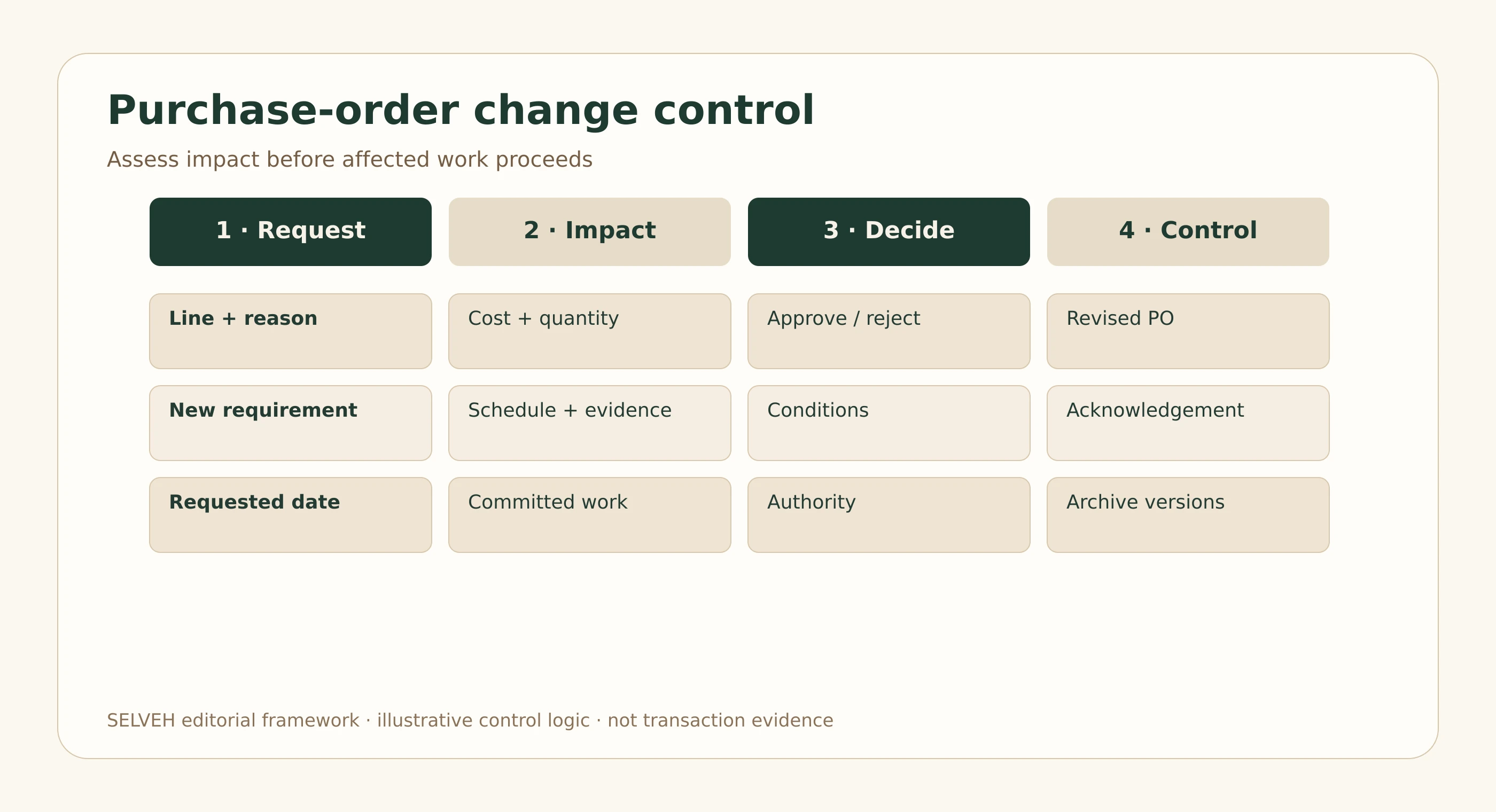
Issue a revised PO or formal amendment and obtain acknowledgement. Preserve the superseded version and decision trail.
13 · Exceptions
Address delay, cancellation and force events deliberately
The governing agreement should define notification duties, mitigation, recoverable committed costs, ownership of materials and treatment of branded packaging if an order is delayed or cancelled. These outcomes are too consequential to invent after production starts.
Standard-form small-business contracts in Australia are subject to unfair contract term laws. ACCC guidance notes expanded coverage and penalties from 9 November 2023. Whether a term or contract is caught requires legal assessment; the PO checklist is not a substitute.
Use balanced, specific terms and obtain advice, especially for unilateral variation, automatic renewal, broad indemnity, termination and liability clauses.
14 · Buyer tool
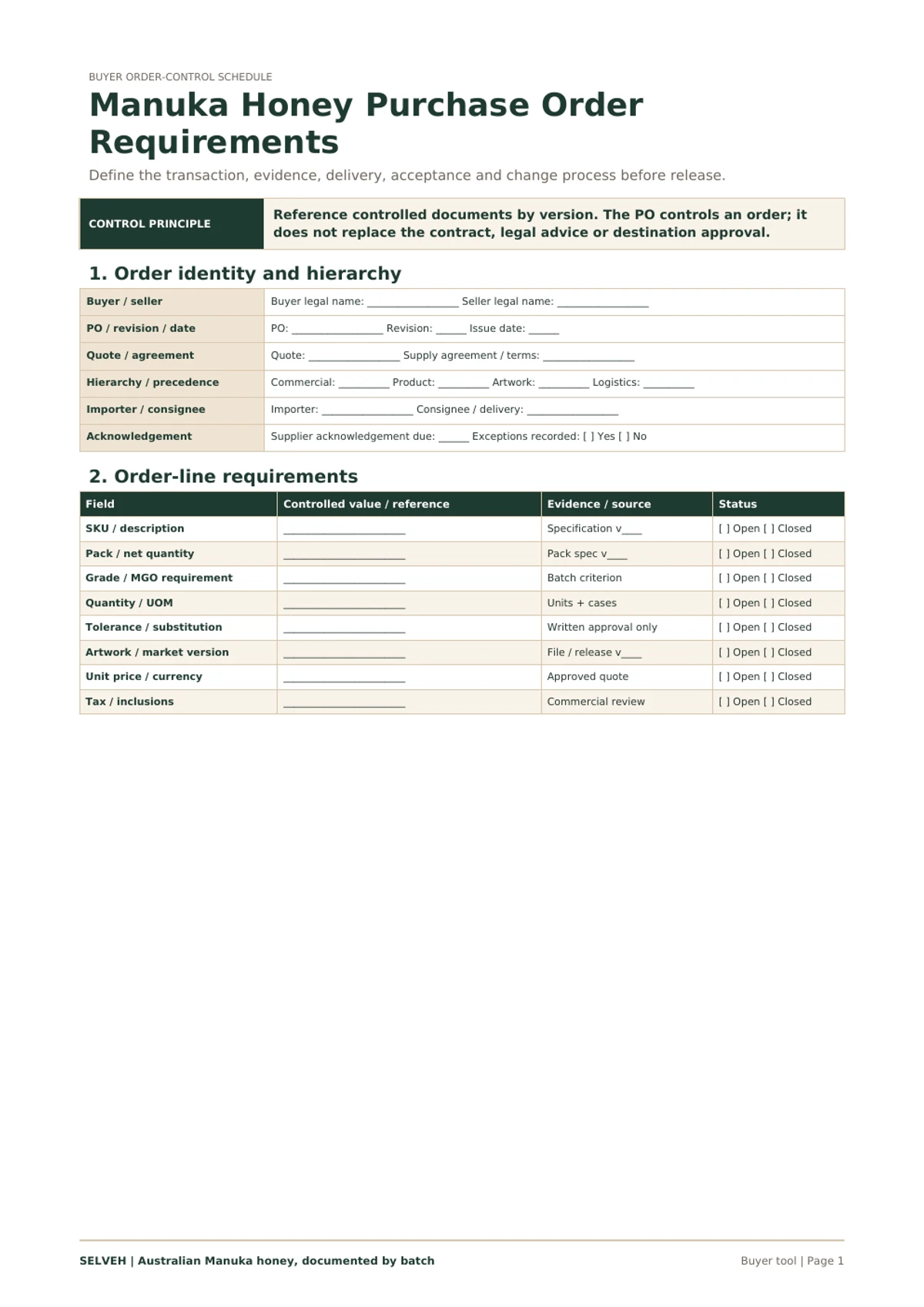
Download the PO requirements schedule
The two-page schedule records order identity, product and packaging versions, quantities, price, Incoterm, named place, evidence, delivery, acceptance, approvals, exceptions and change status. Attach it to the draft PO review and close open fields before release.
It is an operational checklist, not a legal contract, legal advice, regulatory approval or supplier acceptance. Tailor the actual PO and supply agreement with qualified advisers and the destination-market participants.
15 · Review triggers
Investigate these purchase orders
- The product is described only as “Mānuka honey” without SKU, pack or specification version.
- The PO uses an Incoterm without a named place.
- Quantity has no unit of measure, tolerance or substitution rule.
- Artwork is referenced as “latest version” rather than by controlled file.
- Batch or MGO evidence is requested but no approval timing or hold rule exists.
- Payment due date has no defined trigger.
- A material change is authorised in chat or email without impact review and revision.
16 · Buyer FAQ
Frequently asked questions
Does issuing a PO create a binding contract?
It may, depending on the offer, acceptance, incorporated terms and conduct. Obtain legal advice for the actual transaction.
Can the supplier quotation be the specification?
Only if it contains the necessary controlled requirements and is deliberately incorporated. A separate versioned specification is usually clearer.
Should a PO include the HS code?
It can record a proposed classification, but the appointed importer or broker should verify it. Do not make the supplier description fit a preferred code.
Can production start before artwork approval?
Only at a deliberately accepted risk. Printed production should reference an approved controlled file and clear authority.
17 · SELVEH status
What SELVEH can state today
SELVEH can define a robust buyer-side PO structure and use it to evaluate future offers. It can require controlled product, evidence and packaging references before an order is approved.
SELVEH should not imply that a supplier accepted an order, that stock or batch evidence is confirmed, that a destination registration exists, or that any product is ready to ship until the relevant first-party acknowledgements and records are held.
Sources
Official contract and payment sources
- Export.business.gov.au — Draft your export contract
- Export.business.gov.au — Negotiating contract terms
- Export.business.gov.au — Know your Incoterms
- Business.gov.au — Suppliers and supply contracts
- ACCC — Contracts
- Business.gov.au — Payment terms
Source review: Official guidance reviewed 24 August 2026. Contract, payment and trade requirements can change; obtain transaction-specific legal and destination advice.
Trade planning
Need to structure a controlled Mānuka honey order?
Share the intended market, pack, quantity, delivery point and evidence needs. We will map confirmed terms, open approvals and transaction controls before order release.
Start a trade enquiry