
At a glance
250 g and 500 g solve different commercial problems
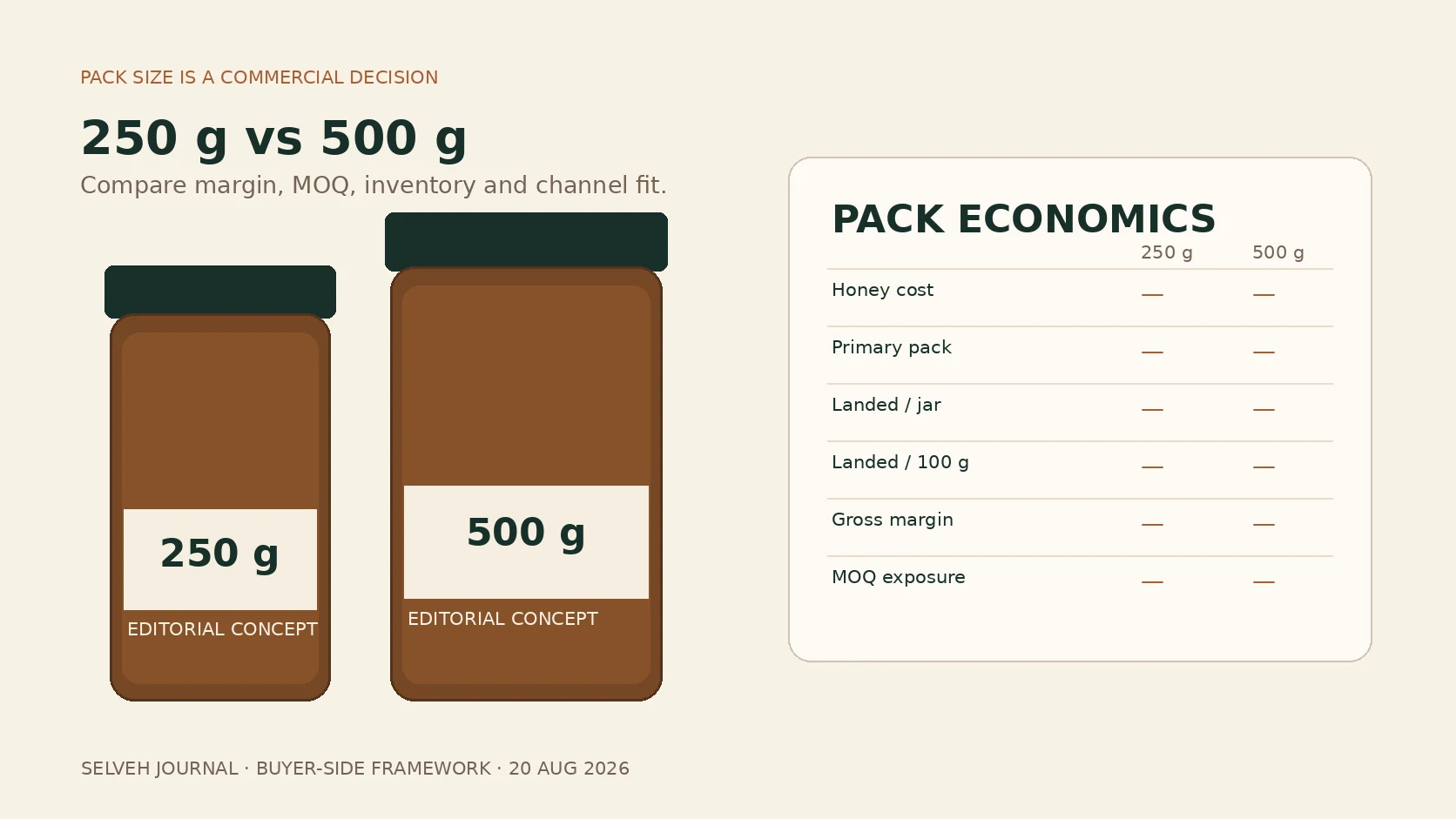
250 g
- Less honey value in each finished unit.
- More jars, closures and labels for the same honey mass.
- Can support a lower absolute ticket, depending on grade and cost.
- Does not automatically mean better margin or stronger demand.
500 g
- More honey value in each finished unit.
- Fewer primary packs for the same honey mass.
- May spread packaging cost across more product.
- Does not automatically mean better value or channel fit.
01 · Decision rule
Start with the commercial decision, not the jar
A pack-size decision is downstream of the product and channel decision. Before comparing 250 g with 500 g, a buyer should know the destination market, intended retail or wholesale channel, target MGO grade, expected price architecture, opening order size and whether the supplier applies MOQ by SKU, grade, packaging run or total production run.
This matters because the same jar size can be commercially sensible in one configuration and weak in another. A 250 g format may help control the absolute ticket of a high-cost grade, while a 500 g format may produce a different value-per-gram proposition at a lower grade. Neither is inherently premium, economical or easier to sell. Those conclusions require actual cost and channel evidence.
02 · Economics
250 g and 500 g change different cost variables
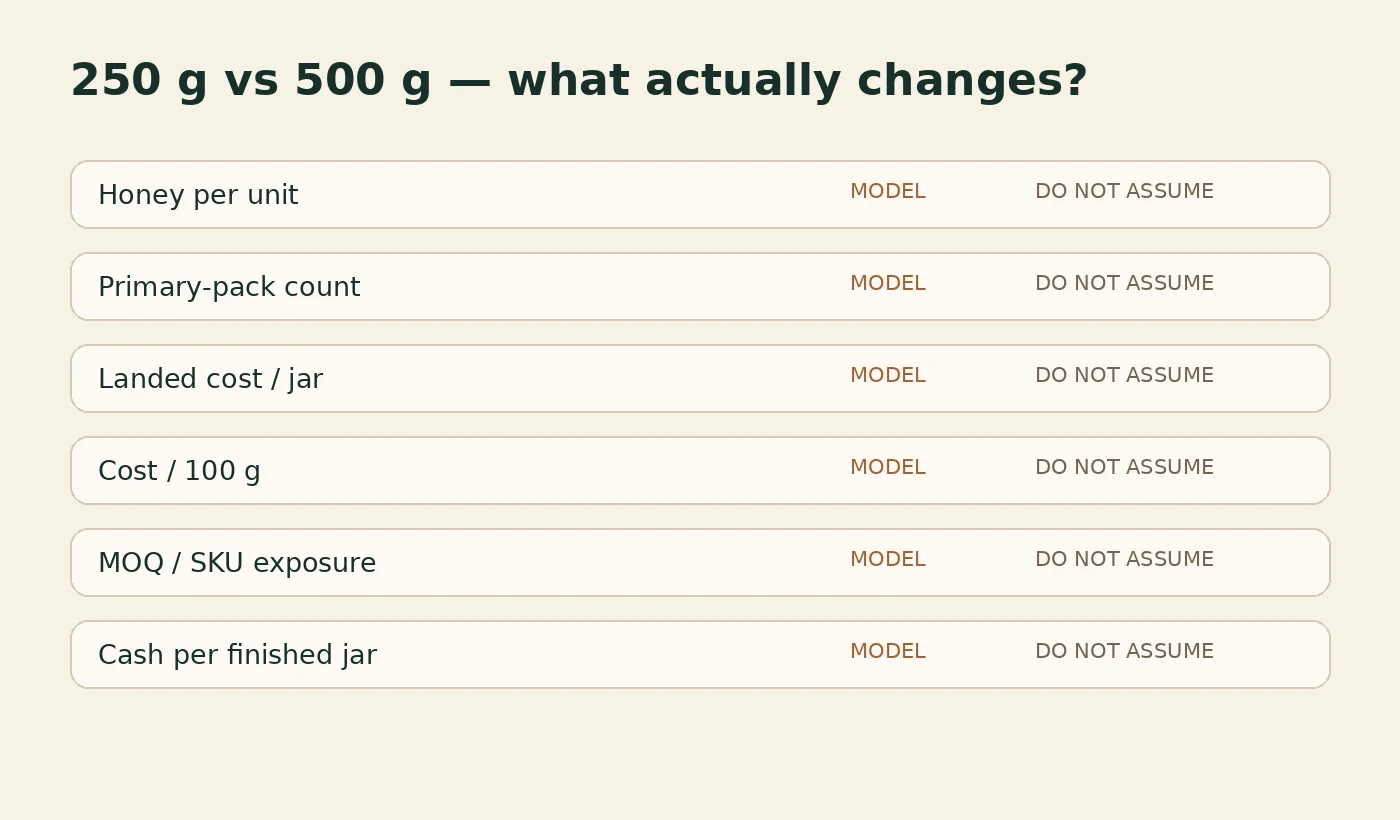
The common shortcut is to treat 500 g as simply twice 250 g. That is not how the project economics behave. Honey content approximately doubles, but the cost of the jar, closure, label, coding, carton handling, artwork setup and some production activities does not necessarily double with it.
The useful comparison therefore separates product cost from packaging and allocated project costs. The buyer should model each format as a finished commercial unit rather than extrapolating from honey cost alone.
- Honey content cost per filled unit
- Jar, closure and tamper-evidence cost
- Label, decoration and coding cost
- Secondary packaging and carton configuration
- Allocated testing, setup or artwork costs where relevant
- Freight and landed-cost allocation on a consistent basis
- Wholesale selling price and expected gross margin
03 · Compare two bases
Compare unit economics and weight-normalised economics
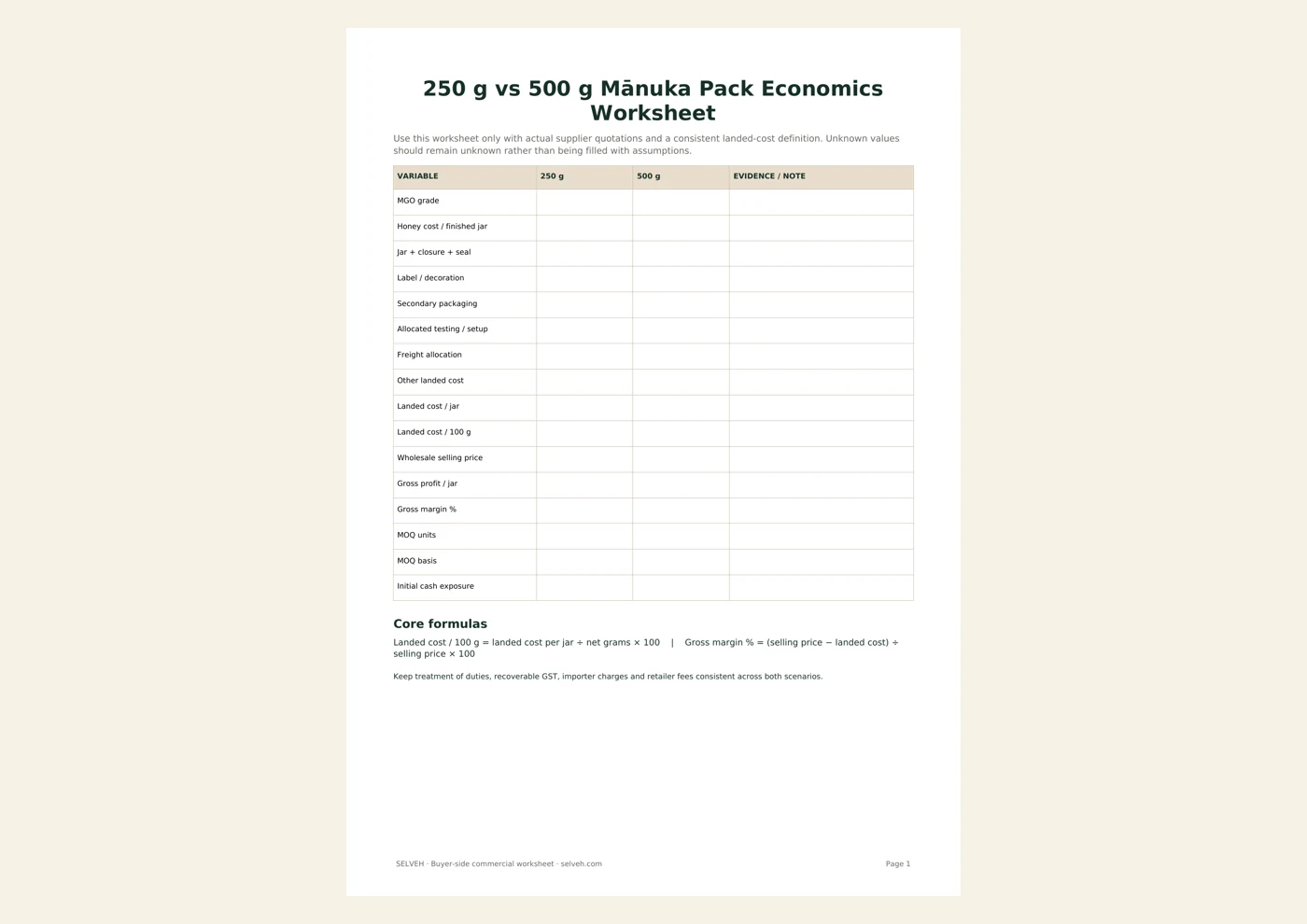
A 250 g and a 500 g SKU should be compared on two bases at the same time. First, compare what happens per jar: landed cost, wholesale selling price and gross profit per unit. Second, normalise to 100 g so that the buyer can see whether a larger pack changes the economics per unit of product.
A simple working set of formulas is: Landed cost per 100 g = landed cost per jar ÷ net grams × 100. Gross margin % = (selling price - landed cost) ÷ selling price × 100. Initial inventory cash exposure should then include MOQ × landed cost per jar plus any non-recurring setup costs that are genuinely payable for that SKU.
The definition of landed cost must stay consistent across both scenarios. Taxes, recoverable GST, duties, retailer fees or importer charges should not be mixed inconsistently between the 250 g and 500 g model.
Landed cost / 100 g = landed cost per jar ÷ net grams × 100Gross margin % = (selling price − landed cost) ÷ selling price × 10004 · Price architecture
Entry price and value per gram are different questions
A smaller jar can reduce the absolute amount the customer sees at checkout if all other variables are held constant. A larger jar can sometimes deliver a lower price per gram because more honey is sold through one primary pack. These are commercial possibilities, not universal rules.
The correct buyer question is therefore not ‘Which jar looks cheaper?’ It is ‘Which format gives the intended shelf position while preserving acceptable landed economics and margin?’ Until supplier quotations and channel feedback exist, SELVEH should treat the answer as an open variable.
05 · Grade × pack
MGO grade and pack size create the SKU architecture together
Pack size should not be chosen independently of grade. Every grade-and-size combination becomes another SKU with its own label, inventory, forecast, carton configuration and possibly its own MOQ or packaging setup.
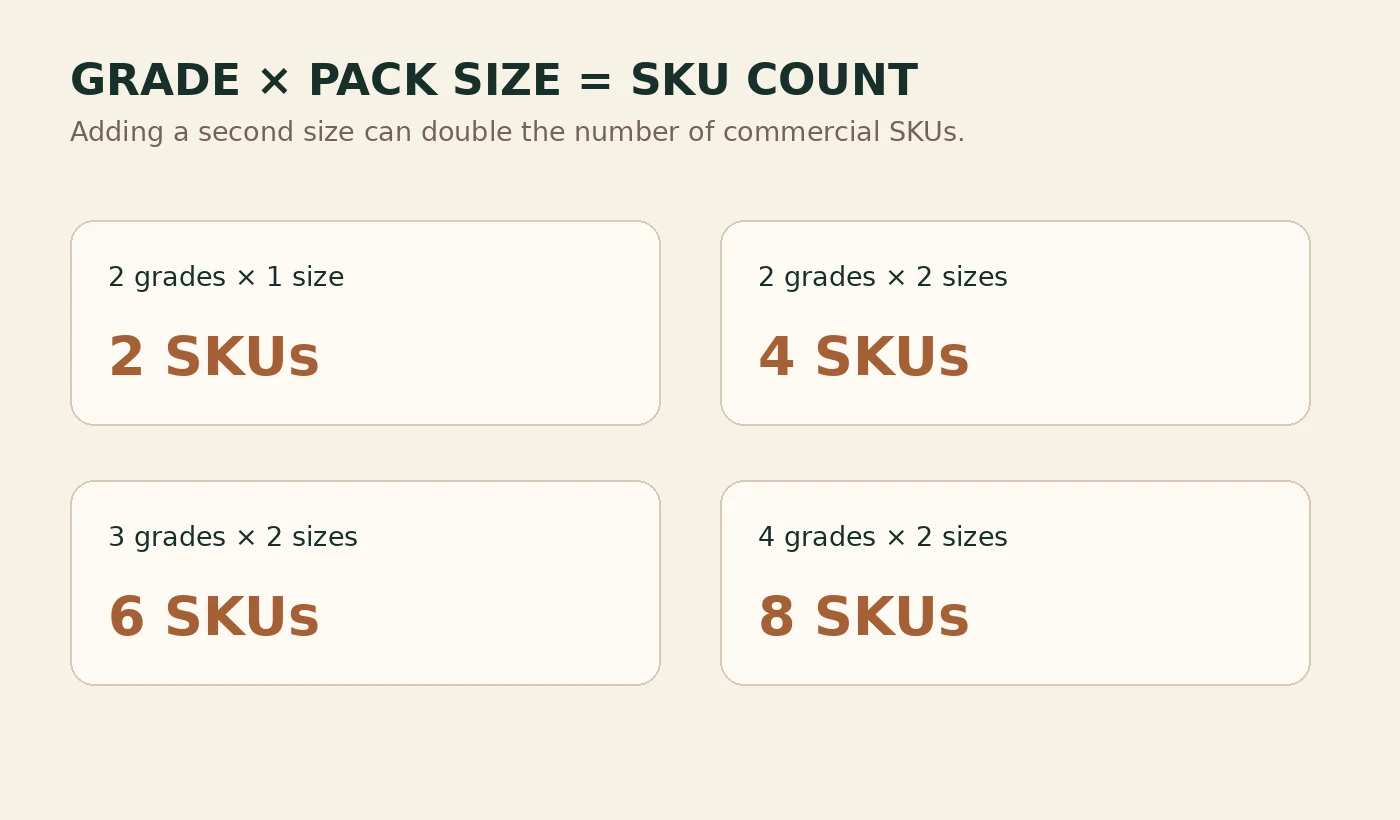
For example, two grades offered in both 250 g and 500 g create four SKUs. The same two grades offered in one size create two SKUs. That difference can materially change packaging inventory, working capital and operational complexity before a single unit has sold.
Current Singapore retail evidence illustrates why this is a hypothesis worth testing rather than a rule. In the Pure Origins FairPrice assortment observed on 20 August 2026, MGO 30+, 100+ and 250+ are listed in 500 g, while MGO 400+, 800+ and 1000+ are listed in 250 g. That is one brand's assortment architecture, not proof that higher MGO should always use 250 g.
2 SKUs
4 SKUs
6 SKUs
8 SKUs
06 · MOQ exposure
A second pack size can multiply MOQ and working-capital exposure
MOQ is often discussed as if it belongs to the project as a whole. In practice, a supplier may impose minimums by grade, jar, label run, carton, SKU or production batch. Article #8 therefore treats MOQ structure as something that must be clarified in the RFQ rather than guessed.
For this pack-size decision, the important test is conditional: if MOQ is applied per SKU, adding a second size can multiply the number of units that must be funded before demand is proven. A buyer should therefore request the MOQ basis in writing and model the cash exposure under one-size and two-size scenarios before approving artwork or ordering packaging.
07 · Inventory
The same honey mass creates a different unit count
Pack size also changes the number of saleable units created from a given net honey quantity. Nominally, 100 kg of honey corresponds to 400 × 250 g units or 200 × 500 g units before allowing for overfill, process loss, samples, retain samples or other production realities.
The smaller format therefore creates more jars, closures, labels and individual units to forecast and handle. The larger format creates fewer units but more product value in each unit. Neither is automatically lower risk; the buyer has to model how unit count interacts with forecast accuracy, carton configuration, breakage exposure, retailer ordering patterns and cash tied up per jar.
08 · Packaging system
Packaging cost is more than the jar
The pack economics should be built as a system. Primary packaging includes the container, closure and any tamper-evident component. Decoration includes label or print, coding and setup. Secondary packaging includes cartons, dividers and case configuration. Logistics then adds shipment density, palletisation, handling and breakage exposure.
The detailed transport and heat-risk questions belong in SELVEH's Australian Mānuka Honey Export Logistics guide. This page only owns the commercial choice between retail pack sizes.
For transport depth, see Australian Mānuka Honey Export Logistics.
09 · Market evidence
Use shelf evidence as a hypothesis, not a demand claim
Current UAE and Singapore retail observations show both 250 g and 500 g Mānuka formats across different grades and brands. Singapore provides a particularly clear within-brand example through Pure Origins. UAE listings also show several high-MGO Biosota references in 250 g, while the wider Waitrose range includes other pack configurations.
This evidence can establish that both formats are commercially used. It cannot establish the best-selling size, the preferred size for a specific grade, the margin available to an importer or the probability of repeat purchase. A listing is not a sell-through report.
See the dated Singapore market landscape and UAE market landscape for the underlying retail observations.
10 · Measurement
250 g and 500 g are regulated net-quantity declarations, not styling
For goods pre-packaged for sale in Australia, the National Measurement Institute states that pre-packaged goods must be marked with the net measurement - the weight of the contents excluding the packaging. Singapore's food-labelling guidance likewise treats net quantity as mandatory information for prepacked food.
Accordingly, 250 g or 500 g is not just front-label design language. The declared net quantity has to correspond with the applicable measurement and destination-labelling requirements. Market-specific label compliance still belongs in the relevant destination guide, including SELVEH's Singapore and UAE import pages.
Destination requirements are covered separately in the Singapore import guide and UAE import guide.
11 · Decision gate
The pack size should pass a documented buyer gate
A defensible decision can be made without pretending to know consumer preference. For each proposed pack, the buyer should have a written answer for target channel, grade, MOQ basis, landed cost, price per 100 g, expected wholesale price, gross margin, inventory cash exposure, carton configuration and the evidence still missing.
If one of those variables is unknown, mark it unknown. Do not fill the worksheet with an invented market price or assumed supplier cost merely to make the model look complete. The purpose of the framework is to expose the missing evidence before money is committed.
- Green: economics and channel evidence are sufficient for a controlled next step.
- Amber: the option is plausible but a key cost, MOQ, buyer or logistics assumption is still unverified.
- Red: the format fails the margin/cash gate or depends on unsupported demand assumptions.
12 · SELVEH status
What SELVEH can decide now - and what must wait
SELVEH can define the comparison method now. It can request comparable 250 g and 500 g quotations, normalise both to landed cost per 100 g, map SKU-level MOQ and ask prospective buyers which format they would actually review.
SELVEH should not publish a final pack recommendation, claim that one size sells better, or commit to final 250 g/500 g architecture until supplier quotes, packaging capability, landed-cost assumptions and buyer evidence are available. The current product imagery remains editorial/conceptual until final packaging is approved.
Before requesting comparable pack quotations, use the Private-Label Australian Mānuka Honey procurement guide.
Sources
Sources and evidence notes
- National Measurement Institute — Guide to the sale of pre-packaged goods
- Singapore Food Agency — Labelling Requirements for Food
- FairPrice Singapore — Pure Origins brand range
- FairPrice Singapore — Pure Origins MGO 400+ 250 g
- FairPrice Singapore — Pure Origins MGO 250+ 500 g
- Waitrose UAE — Biosota MGO 550 250 g
- Waitrose UAE — Biosota MGO 1443 250 g
- Midlands — wholesale/private-label Mānuka packaging
- Honey Australia — private-label pack sizes
- Australia's Manuka — wholesale 250 g and 500 g jars
Editorial boundary: Retailer and supplier pages are used only for dated assortment or capability observations. SELVEH does not adopt health claims displayed by retailers, infer demand from listing status, or represent third-party packaging capability as SELVEH capability.
Trade planning
Need a comparable 250 g / 500 g supplier brief?
SELVEH is developing its Australian Mānuka supply programme. Current grades, pack formats, MOQ and supplier capability remain subject to verification.
Start a trade enquiry