

01 · Approval object
Name exactly what is being approved
“Label approved” is too vague for a private-label project. Approval should identify the product, MGO claim, floral-source wording, net weight, jar and closure, label material, dieline revision, market, language set, artwork file and version.
The same front label may look suitable for 250 g and 500 g packs while the legal copy area, net-quantity presentation, barcode, batch coding zone or importer details differ. Treat each sellable configuration as a controlled SKU.
Approval scope should also state what is excluded. A digital artwork approval may not approve final colour, adhesive performance, code legibility or destination product registration.
02 · Market matrix
Design for the destination, not for a generic export label
Begin with a market-and-channel matrix. Record whether the pack is for Australia, Singapore, a named UAE emirate or another destination; whether it is retail, food service, sample or e-commerce; and who will act as supplier or importer on the label.
FSANZ states that Chapter 1 of the Food Standards Code contains general labelling and information requirements relevant to foods sold in Australia and New Zealand. Singapore Food Agency states that all prepacked food for sale in Singapore must comply with the general labelling requirements of its Food Regulations. Dubai Municipality provides services for food-item registration and assessment.
Those systems are not interchangeable. Do not create one “global compliant” label and ask the importer to discover the gaps after printing.
03 · Evidence layers
Keep required copy, claims and production data separate
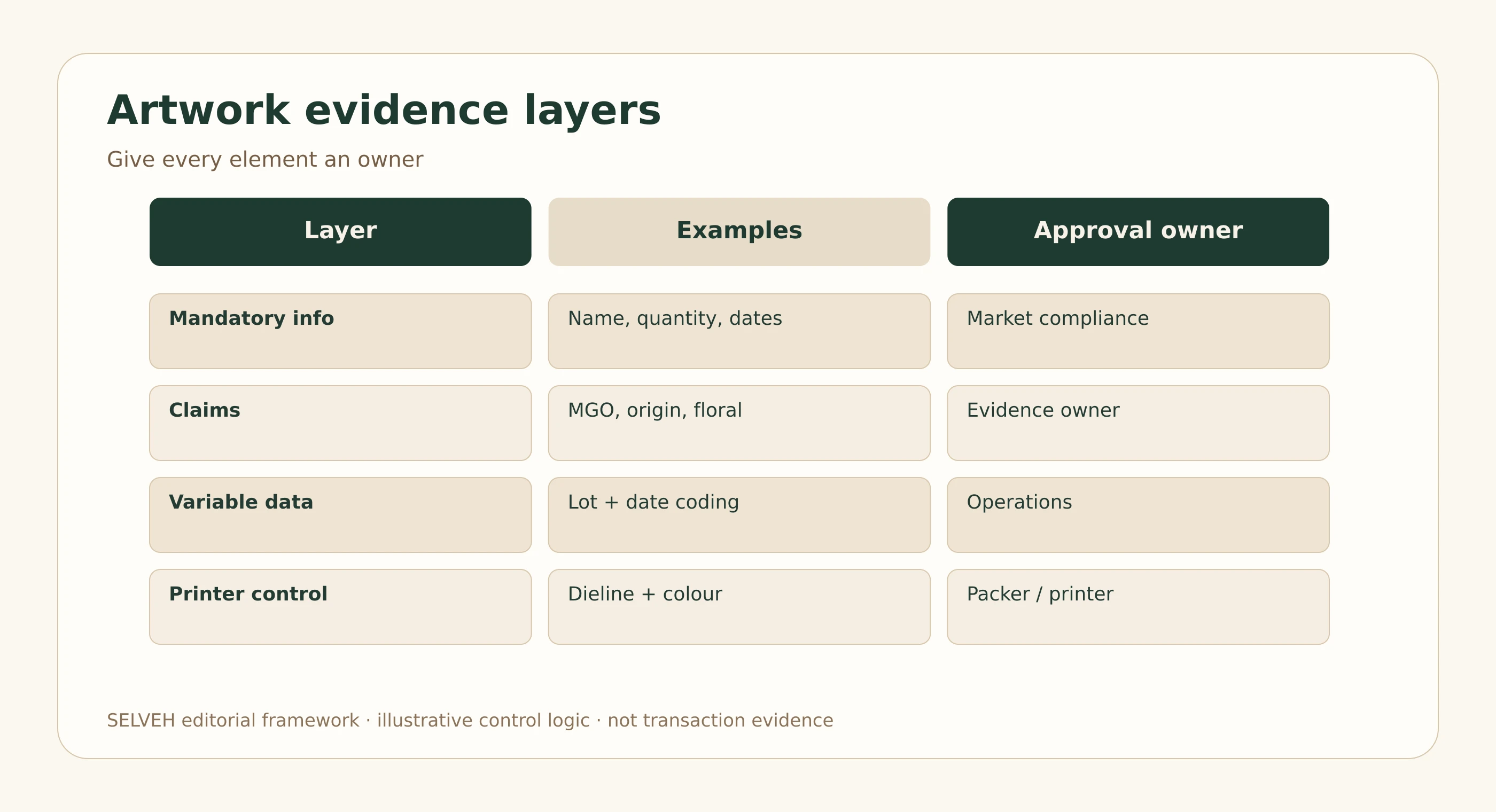
Every text element should belong to a controlled layer. Mandatory product information answers what must appear. Commercial claims answer what the brand chooses to say and must substantiate. Production data - such as lot and date coding - changes by batch. Printer controls govern size, bleed, colour, varnish and finishing.
04 · Information map
Build a field-by-field artwork register
For the defined market, map the product name, ingredients where required, supplier/importer identity, country of origin, net quantity, lot identification, date marking, storage instructions, nutrition information and any warnings or declarations that apply.
FSANZ’s traceability guidance highlights the food name, lot identification and supplier name and address as core label information. Australia’s National Measurement Institute states that prepacked goods must be marked with net measurement and that packaging is excluded from the quantity.
| Artwork field | Evidence owner | Release check |
|---|---|---|
| Product identity and grade | Product / quality | Matches specification and evidence |
| Origin wording | Compliance / supplier | Claim basis retained |
| Net quantity | Packer / measurement | Correct pack and presentation |
| Lot and date zone | Operations | Readable after production coding |
| Supplier/importer details | Market owner | Correct legal entity and address |
05 · Claim control
Do not let marketing copy outrun the evidence
MGO, Australian origin, monofloral, testing, traceability, natural, raw, organic and health-related wording each require a defined basis. A claim should have an owner, source, applicable product and expiry or review trigger before it enters artwork.
FSANZ Standard 1.2.7 governs nutrition, health and related claims for food in Australia and New Zealand. Destination rules can differ. Research on a Mānuka honey preparation does not automatically authorise a therapeutic statement on a conventional retail food.
Use precise product language and avoid borrowed scheme marks, laboratory logos, government emblems or certification cues unless permission and product eligibility are confirmed.
06 · Origin wording
Treat country-of-origin language as controlled copy
The ACCC states that most food sold in Australia must carry country-of-origin information under the applicable information standard. It also distinguishes “grown”, “produced”, “made” and “packed” concepts.
Artwork should not use “Made in Australia”, “Product of Australia” and “Packed in Australia” as stylistic alternatives. The actual supply and packing configuration determines the defensible wording. If the honey, jar, label or packing arrangement changes, repeat the origin review.
An export-market front label can also create a commercial origin impression even where a local mandatory statement appears elsewhere. Review the whole pack, not one legal line in isolation.
07 · Technical proof
A compliant copy deck can still fail on press
Confirm the final dieline, visible panel, bleed, safe area, seam, curvature, label direction, material, adhesive, finish, colour mode, image resolution and barcode quiet zone with the printer and packer. Reserve enough space for batch and date coding under actual line conditions.
Review a sized proof at 100 per cent, then a physical mock-up on the production-intended jar. Curvature can hide small copy, gloss can reduce contrast and a closure or tamper feature can cover required information.
Colour approval should state whether it is screen-only, contract proof, wet proof or production standard. A laptop screenshot is not a production colour reference.
08 · Destination sign-off
Make the importer approve market-specific content
SFA states that prepacked food sold in Singapore must meet its labelling rules, and its current guidance includes product name, ingredients and additives, country of origin and importer name and address among core information. The 2025 amendments to Singapore’s Food Regulations took effect on 30 January 2026.
For Dubai, food-item registration and assessment sit within the destination authority’s processes. The importer should confirm the current label, registration and language route for the actual product before print release.
Importer approval should identify the approving entity, person, date, market and version. “Looks fine for UAE” in an email is not a controlled market approval.
09 · Approval workflow
Use staged approval instead of one final signature
A robust workflow moves through brief approved, copy approved, regulatory review complete, dieline confirmed, design proof approved, physical proof approved and production file released. Conditions should be closed before the next irreversible step.
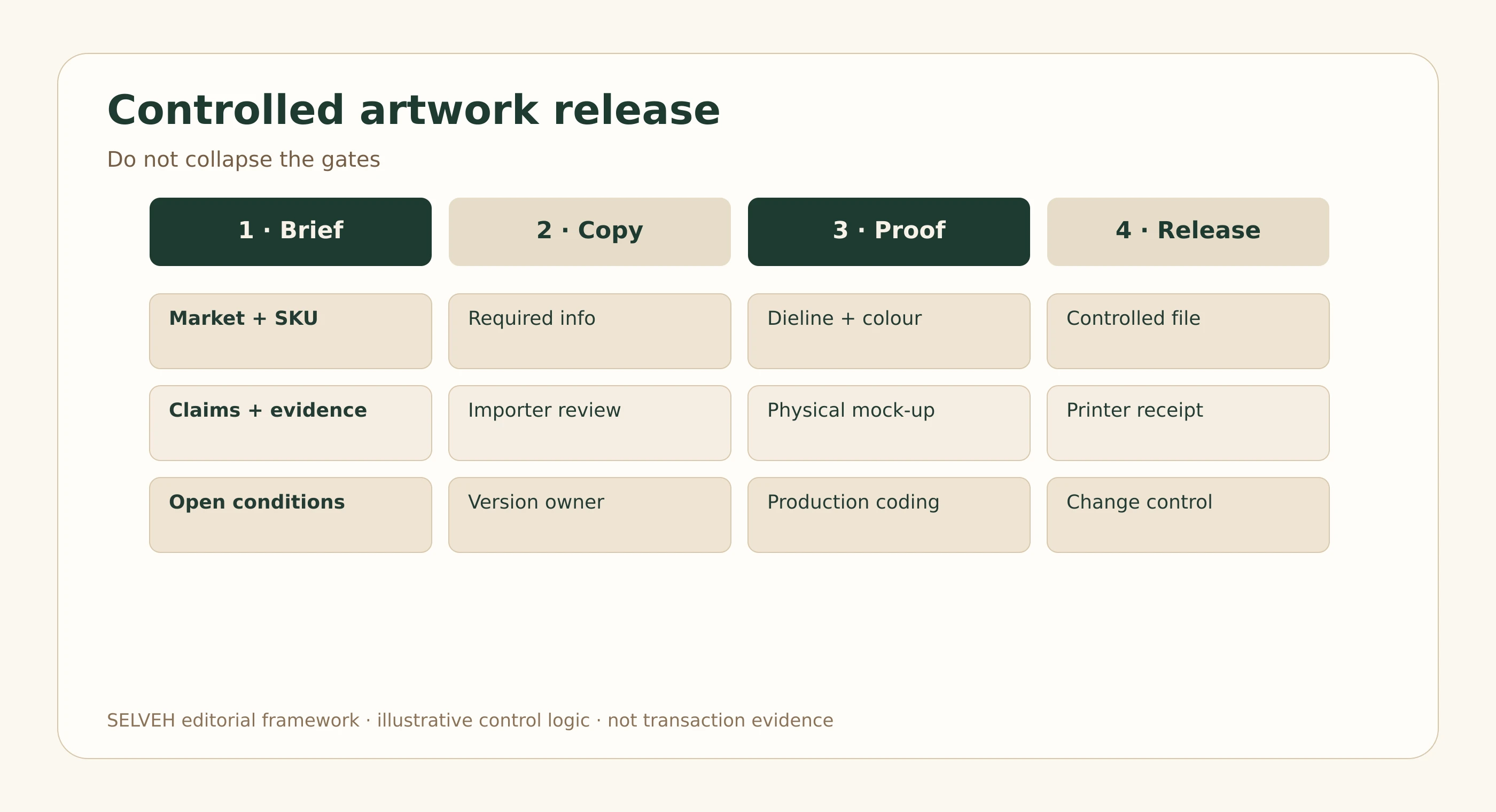
Assign one document controller to issue the current file. Printers and packers should receive the released version through a controlled channel, not from an old email thread.
10 · Change control
Reopen approval when the product or route changes
Triggers include a new supplier, honey lot type, MGO claim, origin statement, net weight, jar, closure, dieline, printer, packer, importer, destination, language, regulation or evidence source.
Not every change requires a full redesign, but every change requires an impact decision. Record whether the current file remains valid, needs a minor revision or requires complete market and production reapproval.
Archive superseded files so they remain traceable but cannot be mistaken for live artwork. Filenames such as “FINAL_final2” are not version control.
11 · Buyer tool
Use an approval record with scope, evidence and conditions
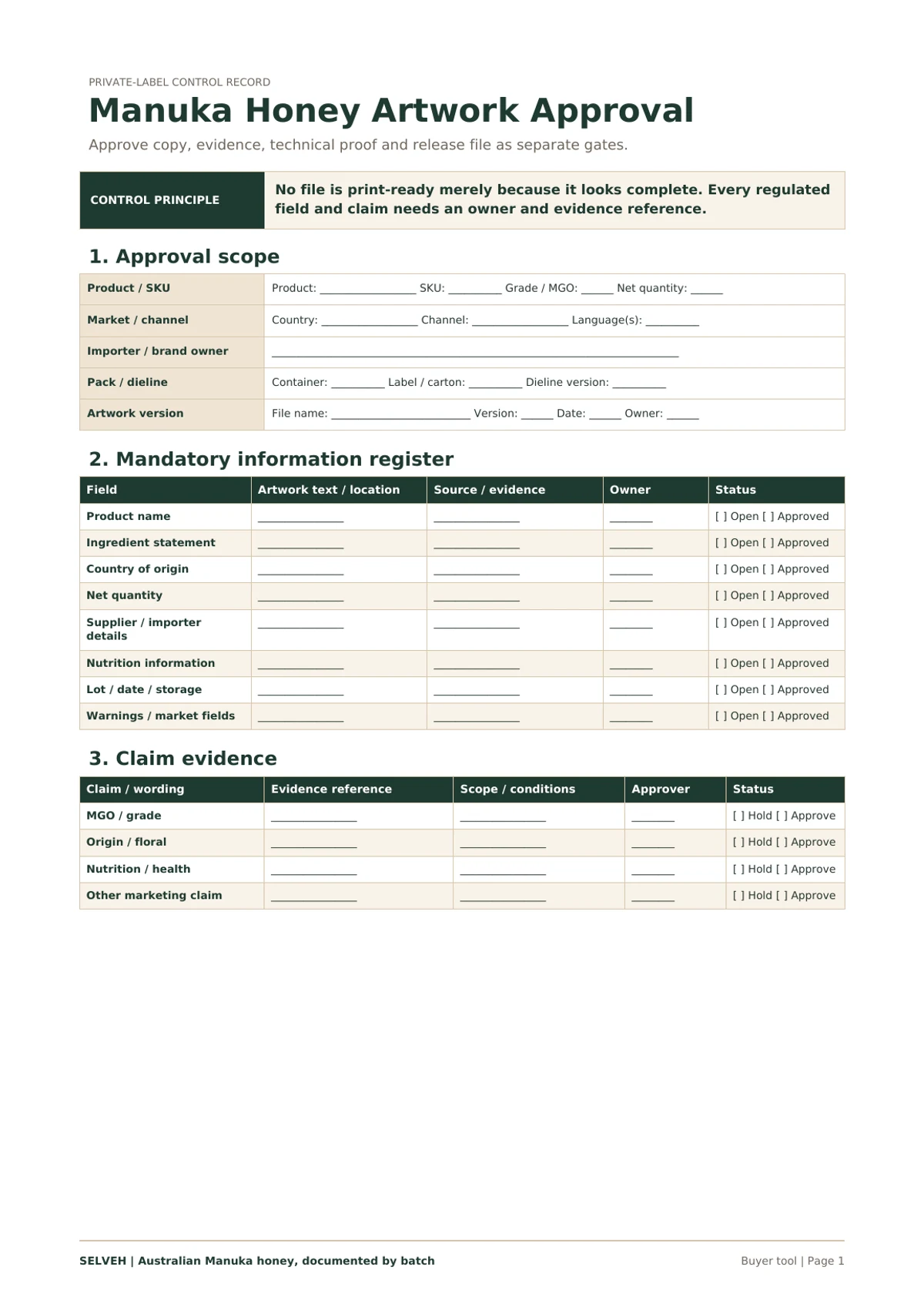
The downloadable record captures product and market scope, mandatory-information checks, claim evidence, technical proof status, approvers, open conditions and the exact production-release file.
It is a buyer control record, not legal advice, a destination product registration, printer warranty or proof that the physical production run matches the approved file.
12 · Red flags
Investigate these artwork situations
- The file has no SKU, market, dieline or version identifier.
- MGO, origin or certification language has no named evidence owner.
- A designer is asked to decide mandatory legal copy.
- The importer has not approved its entity name, address or destination content.
- A screen PDF is treated as approval of colour, material and production coding.
- The printer receives artwork from an uncontrolled email attachment.
13 · Buyer FAQ
Frequently asked questions
Should one label be used for Australia, UAE and Singapore?
Only if a market-by-market review confirms that the same configuration satisfies every applicable requirement and commercial need. Do not assume a universal label.
Who should approve the artwork?
At minimum, owners for product evidence, regulatory copy, brand, importer market content, pack/dieline and production release should be identified. One person may hold several roles, but the decisions remain separate.
Can an over-sticker fix missing information?
Sometimes a destination permits compliant supplementary labelling, but that decision belongs to the actual importer and authority route. Do not build a production plan around an assumed sticker fix.
Can SELVEH show final packaging now?
No. Current visuals should remain clearly described as concepts until the supplier, pack, artwork, destination and physical proof are approved.
14 · SELVEH status
What SELVEH can state today
SELVEH can define its intended artwork-control process and prepare product, market and evidence fields for future approval.
SELVEH should not claim final artwork, approved packaging, registered destination labels, confirmed importer details, production colour, printer release or compliant finished stock until first-party approvals and physical records exist.
Sources
Official labelling and measurement sources
- FSANZ - Labelling
- FSANZ - Food Standards Code legislation
- ACCC - Country of origin food labelling
- National Measurement Institute - Sale of pre-packaged goods
- Singapore Food Agency - Labelling requirements for food
- Singapore Food Agency - Food (Amendment) Regulations 2025
- Dubai Municipality - Food establishment services
Source review: Official sources reviewed 24 August 2026. Artwork requirements depend on the actual market, channel and product; the importer and relevant authority should confirm the current route before printing.
Trade planning
Planning private-label artwork for a defined market?
Tell us the destination, pack size, proposed claims and importer role. We will separate design preferences from evidence, market and production approvals that still need to close.
Start a trade enquiry