

01 · Decision scope
A jar is one component of a packaging system
The primary pack includes the jar, neck finish, closure, liner or induction seal, tamper evidence, label, adhesive, ink and coding surface. The distribution system adds dividers, shipper case, tape, pallet pattern and stretch wrap. Changing the jar material can change weight, stiffness, dimensions, closure torque, label behaviour, line handling and transit performance.
Start with the product, channel and route. Define net quantity, fill method, storage range, shelf-life basis, expected transport, e-commerce exposure, opening experience, visual job and destination requirements. Then compare qualified component sets against those requirements.
The Mānuka honey packaging-specification guide provides the broader control structure.
02 · Buyer matrix
Compare tendencies, then verify the component
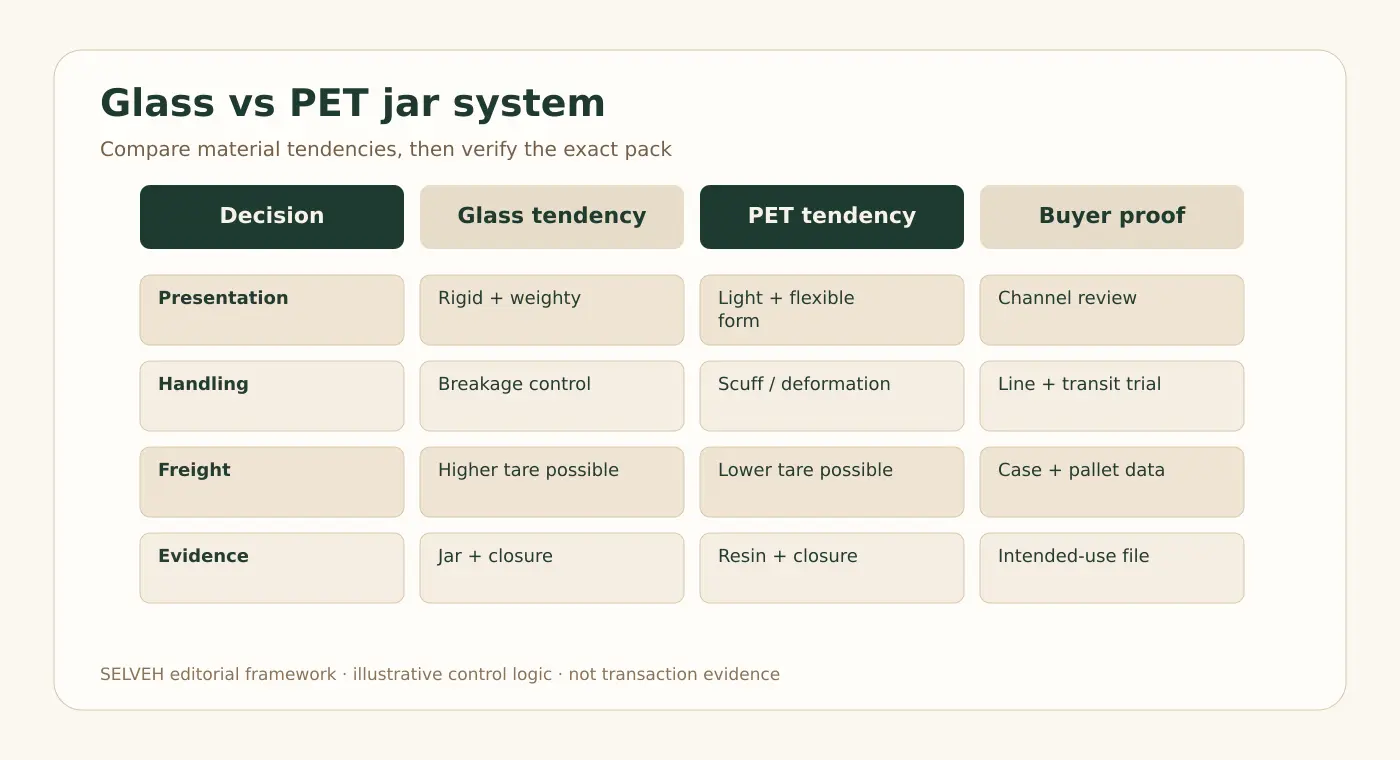
| Decision area | Glass tendency | PET tendency | Buyer verification |
|---|---|---|---|
| Presentation | Rigid, weighty and familiar premium cue | Lighter; form and colour can vary | Channel and customer review |
| Handling | Breakage and fragment controls matter | Scuff, deformation and compression controls matter | Line and transit trials |
| Freight | Higher tare weight is possible | Lower tare weight is possible | Packed case and pallet data |
| Food contact | System evidence still includes closure and coatings | Resin, colourant and conditions of use require evidence | Supplier assurance for exact components |
| Environment | Recovery and transport context varies | Resin, collection and recycled-content context varies | Market-specific substantiation |
03 · Food-contact evidence
“Food grade” must match the intended use
FSANZ states that packaging used by Australian food businesses must be fit for its intended purpose and not likely to contaminate food. It identifies contact type, food composition, time, temperature, humidity, heating, cleaning and recycled content as factors that can affect chemical migration or suitability.
For either glass or PET, obtain evidence for the exact jar and every food-contact component. Record manufacturer, material or grade, colour, drawing, neck finish, intended use, applicable declaration or test basis, storage limits and change notification. A generic brochure for a polymer family or a statement about glass does not automatically qualify the supplied item.
Assess the closure liner, sealants, coatings, inks and adhesives as well as the jar. The most visible material is not the only contact or contamination risk.
04 · Product and process fit
Validate the actual honey and filling conditions
Honey is viscous and its flow changes with temperature. The packer must define the controlled filling conditions, equipment, nozzle, headspace, net-content method, closure application and cooling or holding steps where relevant. Do not select a jar on the assumption that every honey packer uses the same temperature or process.
Check whether the proposed material and closure are suitable for the product, fill conditions and intended storage period. Evaluate dimensional stability, paneling or deformation, seal integrity, leakage, colour and odour transfer, surface contamination and compatibility with handling practices.
The finished product specification should reference the approved packaging version and acceptance criteria, not simply “amber jar”.
05 · Closure and tamper evidence
The neck finish controls the seal
A visually similar jar can have a different neck finish, thread profile, land dimension or tolerance. Match the closure and liner to the exact drawing. Define application torque or other closure control, removal performance, seal type, tamper evidence and inspection method.
Induction seals, pressure-sensitive liners and other systems have different equipment, material and validation needs. Do not state that one system is universally required or superior. Test the proposed jar, closure, liner, product and line together.
Record closure and seal lots in the packing record. If a component is substituted, require documented equivalence and approval before use.
06 · Production line
A lighter jar is not automatically easier to run
Glass may require breakage prevention, fragment control and careful accumulation. PET may behave differently in unscrambling, conveying, gripping, labelling and capping because of lower mass or wall flexibility. Actual line performance depends on the packer’s equipment and the component design.
Run enough units to observe feeding, fill accuracy, spills, container stability, cap application, seal acceptance, label placement, code legibility, reject rate and changeover. A hand-filled sales sample does not qualify a production pack.
Ask which components already run on the line, what trial quantity is needed, who funds trials and what acceptance threshold converts the component to approved status.
07 · Freight and damage
Measure the shipped case, not the empty jar
PET may reduce tare weight and breakage exposure, while glass may demand stronger dividers or cases. The commercial result depends on actual jar mass, units per case, case dimensions, pallet density, freight charging basis and damage performance. A lighter jar can lose part of its advantage if the pack geometry or protective packaging is inefficient.
Test filled units in the final shipper and pallet pattern. Include vibration, drop or compression testing appropriate to the route, plus temperature exposure and receiving inspection. E-commerce parcels and distributor pallets create different hazards.
Record damage by failure mode: broken jar, cracked or deformed neck, closure movement, leakage, label scuff, case crush and cosmetic rejection. Cost each failure as a lost sellable unit, not only as a component.
08 · Channel position
Test the cue with the intended buyer
Glass can communicate weight, permanence or familiar premium presentation in some channels. PET can support lower handling risk, lighter delivery and different shapes. These are hypotheses, not universal consumer truths. A pharmacy, premium grocer, travel retailer and e-commerce operator may value different attributes.
Show realistic prototypes at the intended net weight, label coverage and closure. Ask buyers about shelf presence, handling, perceived value, damage expectations and merchandising constraints. Do not ask only which jar looks better in a studio photograph.
The material should reinforce the product and price architecture. A premium cue that raises damage, freight or MOQ beyond the channel margin is not automatically the stronger commercial choice.
09 · Unit economics
Calculate cost to a delivered accepted unit
Compare jar, closure, seal, label, case, filling, line loss, inspection, freight, insurance, damage, storage and working capital. Include one-off tooling, mould, colour, decoration or trial costs and the minimum order for every component. Separate reusable tooling from buyer-specific inventory.
A lower unit jar price may require a larger component commitment. A higher-cost jar may reduce secondary packaging or improve accepted sell-through; that value still needs evidence. Model at pilot, first commercial order and repeat scale.
Use the pack-economics guide and landed-cost worksheet to keep pack weight and commercial terms consistent.
10 · MOQ and continuity
Component minimums can control the product MOQ
The honey, jar, closure, seal, label and case may each have different minimums and lead times. Custom colour, embossing, decoration or moulds can add commitment and extend the critical path. Ask for standard-stock and custom options separately.
Record supplier, manufacturing location, tooling ownership, reorder lead time, approved substitute and discontinuation notice. If the jar changes, the closure, label dieline, case and pallet may also change. Treat continuity as a system risk.
Do not build a unique pack before proving the channel job. A standard qualified component can be the stronger first-order choice when it preserves cash and learning speed.
11 · Labels and artwork
Material surfaces change label behaviour
Glass and PET can differ in surface energy, stiffness, curvature, mould seams and dimensional response. Label stock, adhesive, varnish and application settings should be tested on filled or representative units under the expected storage and transport conditions.
Check lift, flagging, bubbling, wrinkling, scuffing, ink adhesion, code contrast and placement tolerance. Confirm whether the label or sleeve affects recycling claims, inspection or tamper evidence. Artwork approval should identify the exact component drawing and version.
Use the artwork approval workflow to separate visual sign-off from component and regulatory approval.
12 · Environmental claims
Avoid “glass is greener” and “plastic is sustainable” shortcuts
Environmental performance can depend on material mass, recycled content, manufacturing, transport, reuse, collection, sorting and recycling infrastructure. A single material name does not prove a lower overall impact in every market.
The ACCC advises businesses to make environmental claims clear, specific and supported by evidence. Therefore, avoid broad claims such as eco-friendly, infinitely recyclable or lower carbon unless the exact statement has a defensible basis and relevant qualifications.
Record what can be substantiated for the actual pack: component material, verified recycled content where applicable, separability, disposal instruction and the target market’s accepted collection route. Regulatory and technical review should precede artwork.
13 · Validation gate
Approve the system through evidence and trials
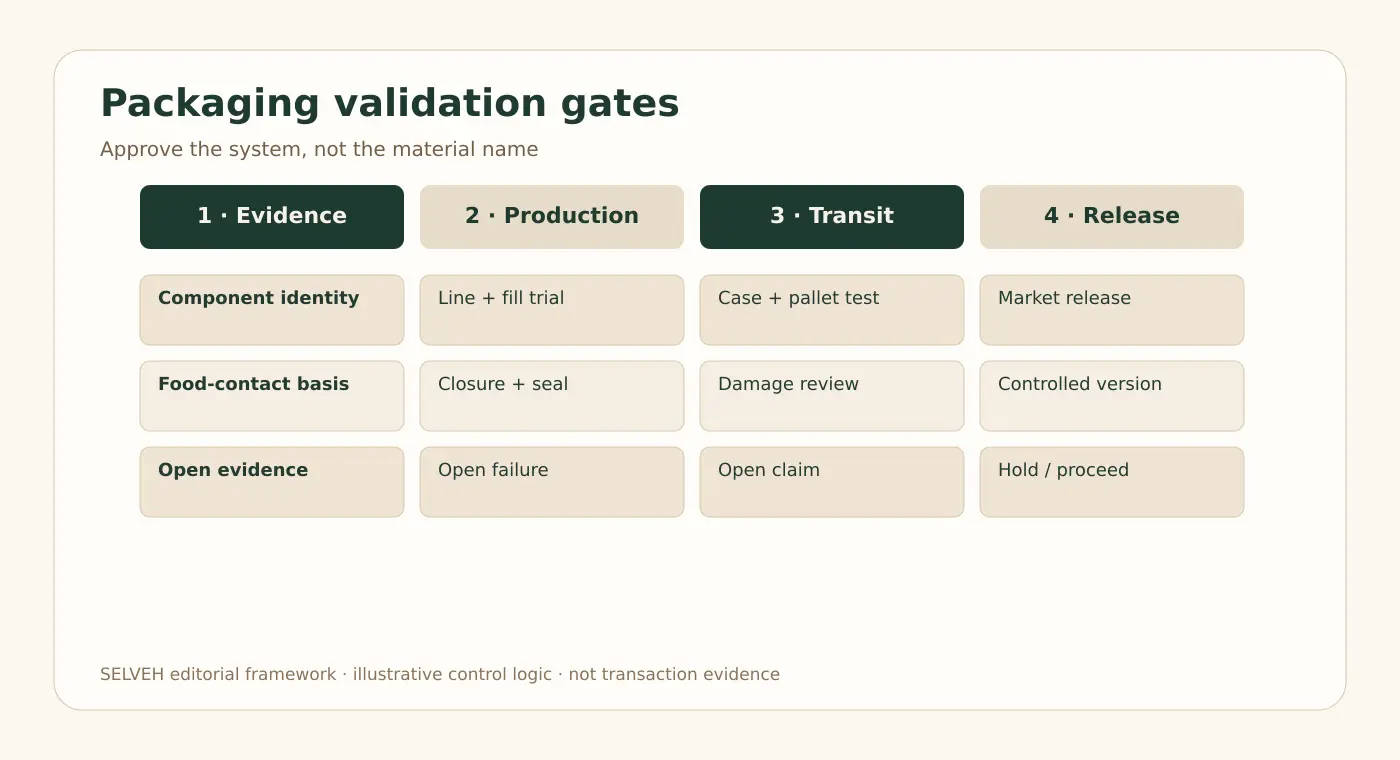
Begin with a controlled component specification and intended-use evidence. Confirm the packer’s line fit, then validate fill, closure, seal and code. Test distribution in the finished case. Review destination labelling and claims. Approve a dated configuration with owners, acceptance criteria and change control.
Where evidence or trials fail, record the failure mode and change one variable at a time. Do not approve “PET” or “glass” as a category; approve the specific system that passed.
14 · Buyer tool
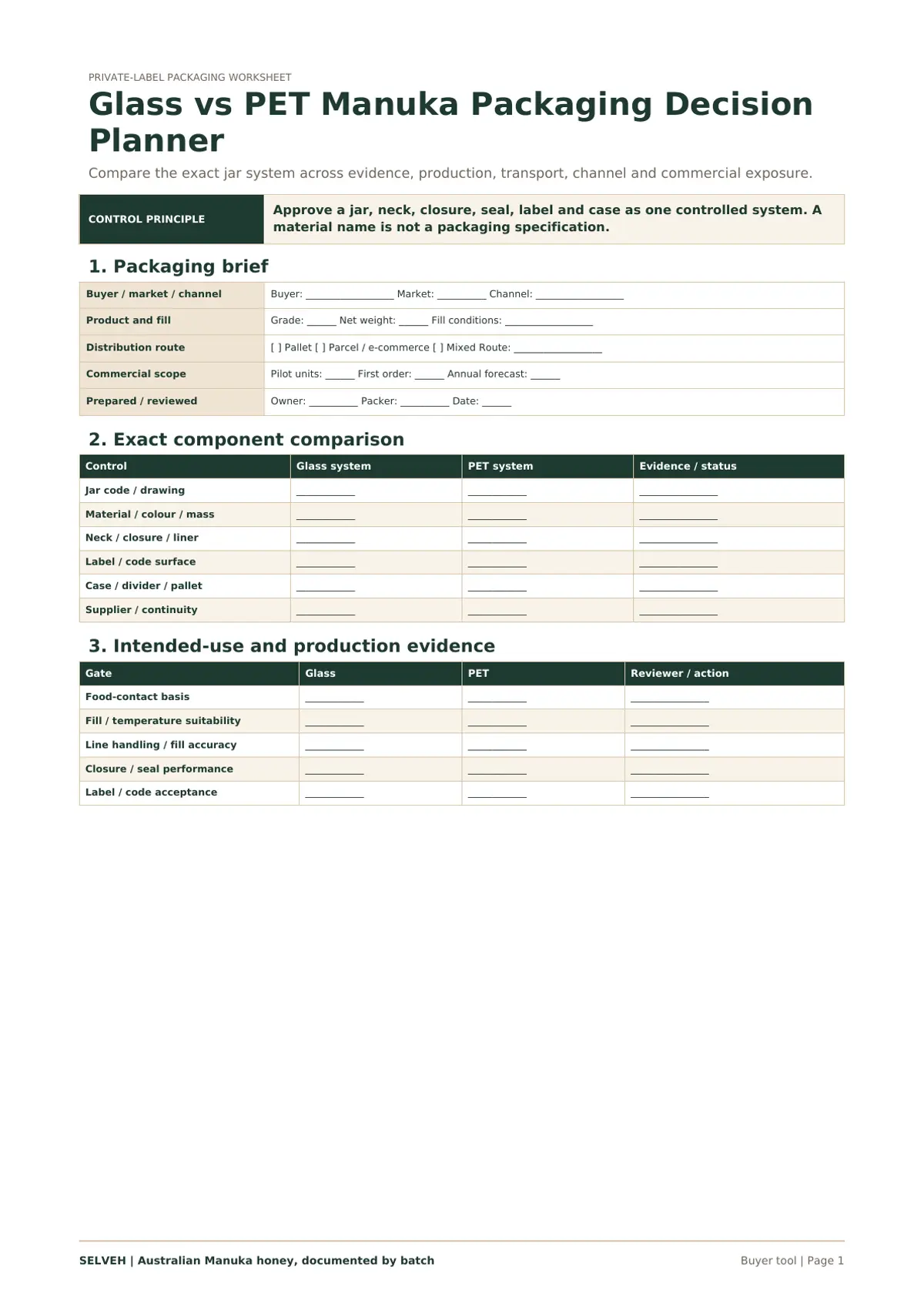
Download the glass-versus-PET planner
The two-page planner records the packaging brief, exact components, food-contact evidence, line and seal controls, shipped configuration, cost, MOQ, environmental-claim basis and pilot decision. Complete one version for each proposed component system.
The planner is not a food-contact certificate, packaging approval, environmental assessment, quotation, legal opinion or confirmed SELVEH packaging option.
15 · Review triggers
Investigate these packaging proposals
- The supplier identifies only “glass” or “PET” without a drawing, material and component code.
- Food-contact evidence does not match the intended product, time or temperature.
- The jar is selected before closure, liner, seal and line compatibility are confirmed.
- Freight comparison uses empty-jar weight but ignores case density and damage.
- A sales sample is treated as production-line qualification.
- A custom component has no tooling, ownership, continuity or exit terms.
- Environmental claims rely only on the material name or a generic recycling symbol.
- Substitution can occur without documented equivalence, trials and buyer approval.
16 · Buyer FAQ
Frequently asked questions
Is glass always more premium?
No. It can provide a familiar weighty cue, but premium perception depends on the complete design, channel and customer. Test the actual prototype.
Is PET always cheaper to ship?
It may reduce tare weight, but the result depends on case dimensions, pallet density, freight basis, protective packaging and damage.
Which material protects Mānuka honey better?
Do not decide from the material name alone. Validate the exact jar, colour, wall, closure, seal, process, storage and route against the product specification.
Which packaging does SELVEH currently supply?
This article does not confirm a glass or PET option. Any offer depends on verified suppliers, packers, components, trials, quantities and destination requirements.
17 · SELVEH status
What SELVEH can state today
SELVEH can use this framework to translate a buyer’s channel and logistics needs into a controlled packaging brief and evidence request.
SELVEH should not claim an approved glass or PET jar, food-contact result, recycled content, environmental benefit, packer compatibility, MOQ, tooling, price, lead time or transit performance until verified for the actual system.
Sources
Official packaging, claims and origin guidance
- FSANZ — Food packaging
- FSANZ — Chemicals in food packaging
- FSANZ — Labelling
- ACCC — Environmental and sustainability claims
- ACCC — Country of origin food labelling
Source review: Official guidance reviewed 27 August 2026. Confirm the exact component, packer, process, market and current rules before commercial approval.
Trade planning
Comparing glass and PET for a private-label range?
Share the target market, channel, pack size, expected quantity and distribution route. SELVEH will map the component evidence, trials and economics that must be verified before an offer.
Start a trade enquiry