01 · Evidence boundary
What this market analysis can - and cannot - establish
This article separates observable evidence from commercial inference. That distinction matters because online retail pages are easy to over-read.
What the evidence can establish
- Mānuka products are currently listed by large UAE grocery and pharmacy retailers.
- Australian-origin Mānuka is visibly represented in the market, including products from Australian brands.
- The observed shelf contains multiple MGO positions, pack formats and price points.
- Premium pricing exists in the category, especially for higher-MGO and specialist products.
- The UAE trade-access position for qualifying Australian honey improved after CEPA tariff elimination.
What the evidence cannot establish
- Actual sell-through, category revenue or growth rate.
- The best-selling MGO grade or pack size.
- Retailer or distributor margin.
- Repeat-purchase behaviour or consumer switching willingness.
- Whether an out-of-stock listing reflects strong demand, supply interruption, delisting or normal inventory timing.
- Whether a premium online list price is actually realised after promotions, membership discounts or negotiated channel terms.
SELVEH should not publish these unknowns as facts until first-party or reliable market data exists.
02 · Commercial context
Why the UAE merits commercial attention
The UAE has several structural features that justify commercial investigation. World Bank data places the UAE at roughly 12 million people in 2025 and around US$50,000 GDP per capita in the latest reported period, consistent with a high-income market and a large expatriate population.[2] These macro indicators support the plausibility of premium food segments, but they are not evidence of Mānuka demand by themselves.
More directly relevant to Australian exporters, CEPA eliminated the UAE's 5% tariff on honey from 1 October 2025 for qualifying Australian-origin goods.[1] For a supplier that can satisfy the agreement's origin requirements, this removes one cost layer that previously sat between Australian product and UAE landed cost.
The right interpretation is not “Australia now has an automatic advantage.” The right interpretation is “one trade barrier is lower, so a commercially competitive Australian offer has more room to work.” Brand recognition, distribution access, retail margin, compliant claims, packaging, MGO positioning and evidence quality still matter.
03 · Method
Method: a dated UAE retail shelf audit
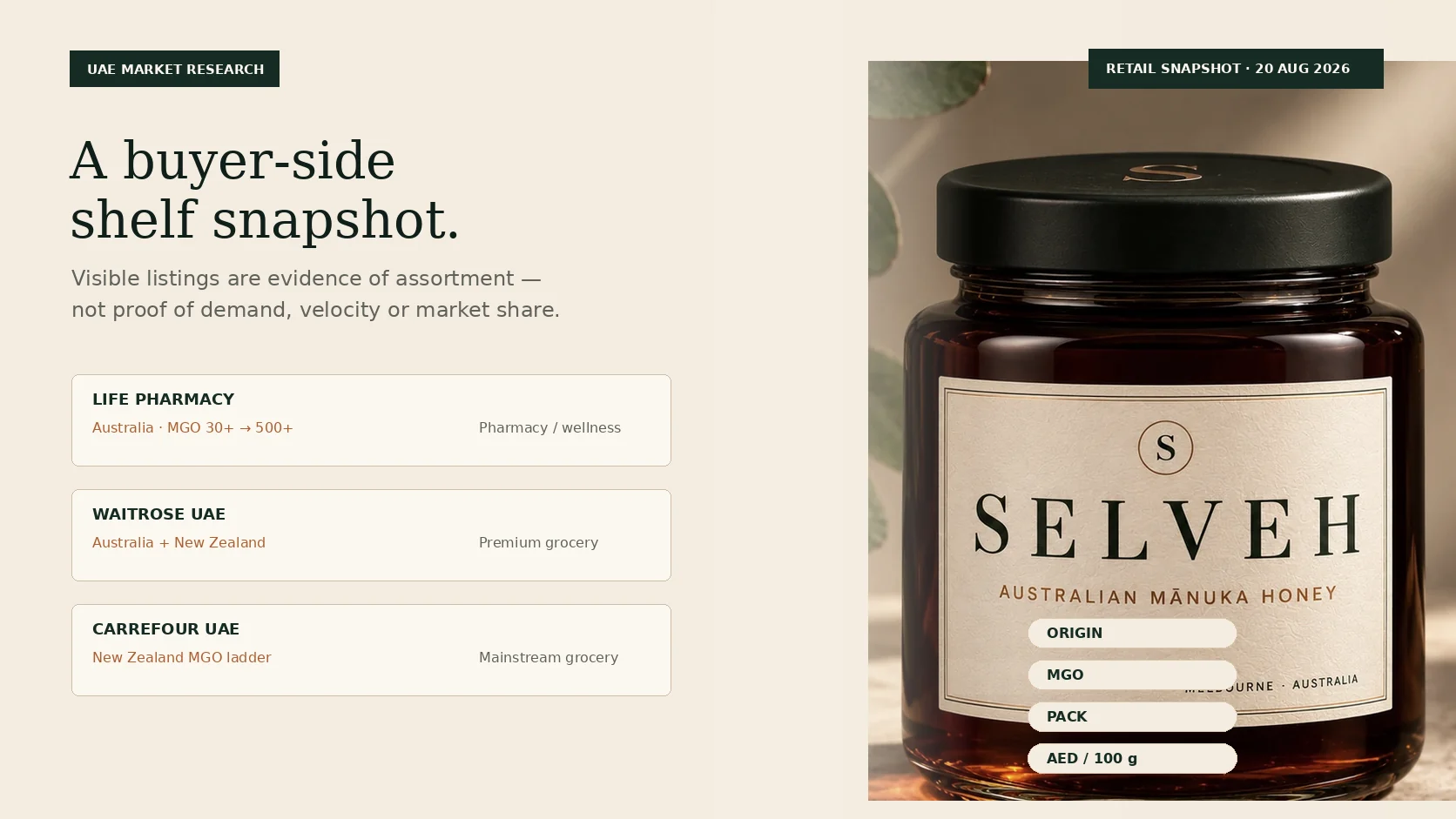
SELVEH reviewed current online listings on 20 August 2026 across three UAE channels: Waitrose UAE, Carrefour UAE and Life Pharmacy. The purpose was not to estimate market share. It was to observe assortment architecture: origin, brand, MGO position, pack size and public list price.
Prices below are normalised to AED per 100 g so different pack sizes can be compared. This is a retail snapshot only. Prices, promotions, membership discounts and availability can change quickly. The table should therefore be read as evidence of positioning, not as a permanent market price list.
Retailer, brand, origin, MGO, pack, listed price.
Hypothesis about positioning or a channel to investigate.
Importer feedback, landed cost, margins, sell-through or first-party sales.
04 · Retail snapshot
Representative live retail snapshot - 20 August 2026
Sources: current retailer listings from Life Pharmacy, Waitrose UAE and Carrefour UAE.[3][4][5] The matrix intentionally includes only a representative subset and is not a census of every UAE Mānuka SKU.
| Retailer | Brand | Origin | MGO | Pack | Listed AED | AED/100 g |
|---|---|---|---|---|---|---|
| Life Pharmacy | It's Manuka | Australia | MGO 30+ | 250 g | 78.75 | 31.50 |
| Life Pharmacy | It's Manuka | Australia | MGO 100+ | 250 g | 126.00 | 50.40 |
| Life Pharmacy | It's Manuka | Australia | MGO 250+ | 250 g | 173.25 | 69.30 |
| Life Pharmacy | It's Manuka | Australia | MGO 500+ | 250 g | 262.50 | 105.00 |
| Waitrose UAE | Biosota Organics | Australia | MGO 30+ | 250 g | 85.75 | 34.30 |
| Waitrose UAE | Biosota Organics | Australia | MGO 550 | 250 g | 154.00 | 61.60 |
| Waitrose UAE | Biosota Organics | Australia | MGO 880 | 250 g | 331.25 | 132.50 |
| Waitrose UAE | Biosota | Australia | MGO 1443 | 250 g | 884.75 | 353.90 |
| Waitrose UAE | Airborne | New Zealand | MGO 50+ | 500 g | 99.75 | 19.95 |
| Carrefour UAE | Balqees | New Zealand | MGO 263+ | 250 g | 345.00 | 138.00 |
| Carrefour UAE | Balqees | New Zealand | MGO 514+ | 250 g | 435.00 | 174.00 |
| Carrefour UAE | Balqees | New Zealand | MGO 971+ | 250 g | 745.00 | 298.00 |
Listed-price architecture · normalised
AED per 100 g across the representative snapshot
Bar length shows only the listed-price relationship inside this dated sample. It is not a quality score, demand score or market index.
05 · What the shelf tells us
What the current shelf actually tells us
Australian Mānuka already has visible shelf presence
Australian-origin Mānuka is not entering an empty market. In the audit, Life Pharmacy listed an Australian It's Manuka ladder from MGO 30+ through MGO 500+, while Waitrose listed multiple Biosota Australian Mānuka products from low-MGO positions through very high-MGO specialist products.[3][4]
That is commercially useful because an Australian entrant does not need to educate the market from zero about the existence of Australian Mānuka. It does not, however, establish Australian share, velocity or brand strength relative to New Zealand Mānuka.
The observed MGO architecture is broad
The audited shelf spans low MGO positions such as 30+ and 50+, mid positions around 100+ to 550, and specialist high positions above 800 and 1,400. This breadth suggests that UAE retailers are willing to merchandise Mānuka as more than a single premium SKU.
But the shelf does not tell us which grade sells best. A high-MGO product can be listed because it plays a halo, gifting or specialist role rather than because it generates the largest unit volume. A low-MGO product can be a daily-use entry point, but public listings do not reveal its sell-through either.
Price does not map cleanly to MGO alone
Within a single brand ladder, list price often rises as MGO rises. For example, the audited It's Manuka 250 g range moved from AED 78.75 at MGO 30+ to AED 262.50 at MGO 500+.[3] That pattern is commercially intuitive.
Across brands and retailers, however, MGO is not the only price driver. Brand equity, origin story, certification, packaging, retailer strategy, promotions, pack format and channel all affect the shelf price. The snapshot includes Australian MGO 550 at AED 61.60 per 100 g and New Zealand MGO 263+ at AED 138 per 100 g, which demonstrates why a buyer should not build a pricing model from MGO alone.[4][5]
The 250 g format is prominent in the premium snapshot
Most high-MGO products in the representative audit were listed in 250 g jars. A 500 g format also appears, particularly at lower MGO positions. This makes 250 g a sensible format to investigate for premium positioning, but it is not proof that 250 g is the best-selling UAE pack size.
For a new entrant, 250 g may reduce the consumer ticket price while preserving premium AED/100 g economics. The trade-off is higher packaging cost per kilogram and potentially lower absolute value per unit. This decision needs a landed-cost model, not just a shelf observation.
06 · Channel landscape
Channel landscape: grocery and pharmacy both matter
The audit shows Mānuka across at least two meaningful retail environments. Waitrose and Carrefour place it inside grocery/honey assortments, while Life Pharmacy carries a large dedicated Mānuka range within a wellness-oriented retail environment.[3][4][5]
This matters because the commercial proposition can change by channel. Grocery buyers may focus heavily on shelf productivity, price architecture, pack design and category fit. Pharmacy and wellness channels may use different merchandising language and may carry a broader ladder of specialised products. SELVEH should not assume the same SKU, claim strategy or trade terms will work equally well in both.
A channel decision should therefore precede final product architecture. “UAE market” is too broad a target. The real decision is which importer, which channel, which shopper mission and which price/MGO position.
07 · Origin landscape
Australian versus New Zealand Mānuka: what can be said safely
The UAE shelf contains both Australian and New Zealand Mānuka. New Zealand brands benefit from long-standing global category recognition, and the audited Carrefour and Life Pharmacy ranges include several New Zealand products.[3][5] Australian brands are nevertheless clearly present, especially in Waitrose and Life Pharmacy.[3][4]
SELVEH should not claim that Australian Mānuka is “better” or that UAE buyers are switching from New Zealand origin without evidence. A stronger commercial position is to make Australian origin verifiable, explain the MGO evidence clearly, link the finished lot to batch documentation and present the offer in a way that is easy for an importer to validate.
That shifts the competitive question from national-origin rhetoric to buyer confidence: can the supplier substantiate what is in the jar, what grade it is, where it came from and which batch-specific evidence supports the shipment?
For the evidence behind an MGO number, see MGO Grades in Australian Mānuka Honey.
08 · Trade access
What CEPA changes - and what it does not
For qualifying Australian-origin honey, the removal of the 5% UAE tariff is commercially positive.[1] On a landed-cost model, a five-percentage-point tariff difference can matter, particularly when distributor and retailer margins are added downstream.
But CEPA does not remove the need for importer readiness, product registration, compliant labels, origin evidence or other UAE market requirements. Those issues belong to SELVEH’s UAE import-compliance guide and should not be duplicated here.
The tariff benefit should therefore be treated as one input in the model. It is not a substitute for a viable ex-works price, freight plan, buyer margin, shelf price and repeatable supply.
09 · Offer hypotheses
What the shelf suggests for a new Australian offer
The current shelf supports several hypotheses worth testing, but none should be treated as validated strategy yet.
- A 250 g premium jar is worth testing because it is heavily represented in the observed higher-MGO assortment.
- A mid-MGO position may offer a more manageable consumer ticket price than ultra-high grades while still communicating a differentiated MGO specification.
- A broad grade ladder is visible in the market, but a new brand should resist launching too many SKUs before buyer demand is proven.
- Australian origin is already represented, so the commercial story should focus on evidence, consistency and buyer usability rather than novelty alone.
- Grocery and pharmacy should be treated as different commercial channels with potentially different buyers, merchandising language and economics.
- Duty-free access under CEPA can improve the landed-cost case for qualifying Australian honey, but should be verified alongside rules of origin before a quote is presented.
For SELVEH specifically, MGO 100+ and MGO 250+ remain sensible grades to test with suppliers because they fit the planned range and sit below the very high retail ticket prices seen in specialist grades. That is a sourcing hypothesis, not a claim that these are the UAE's best-selling grades.
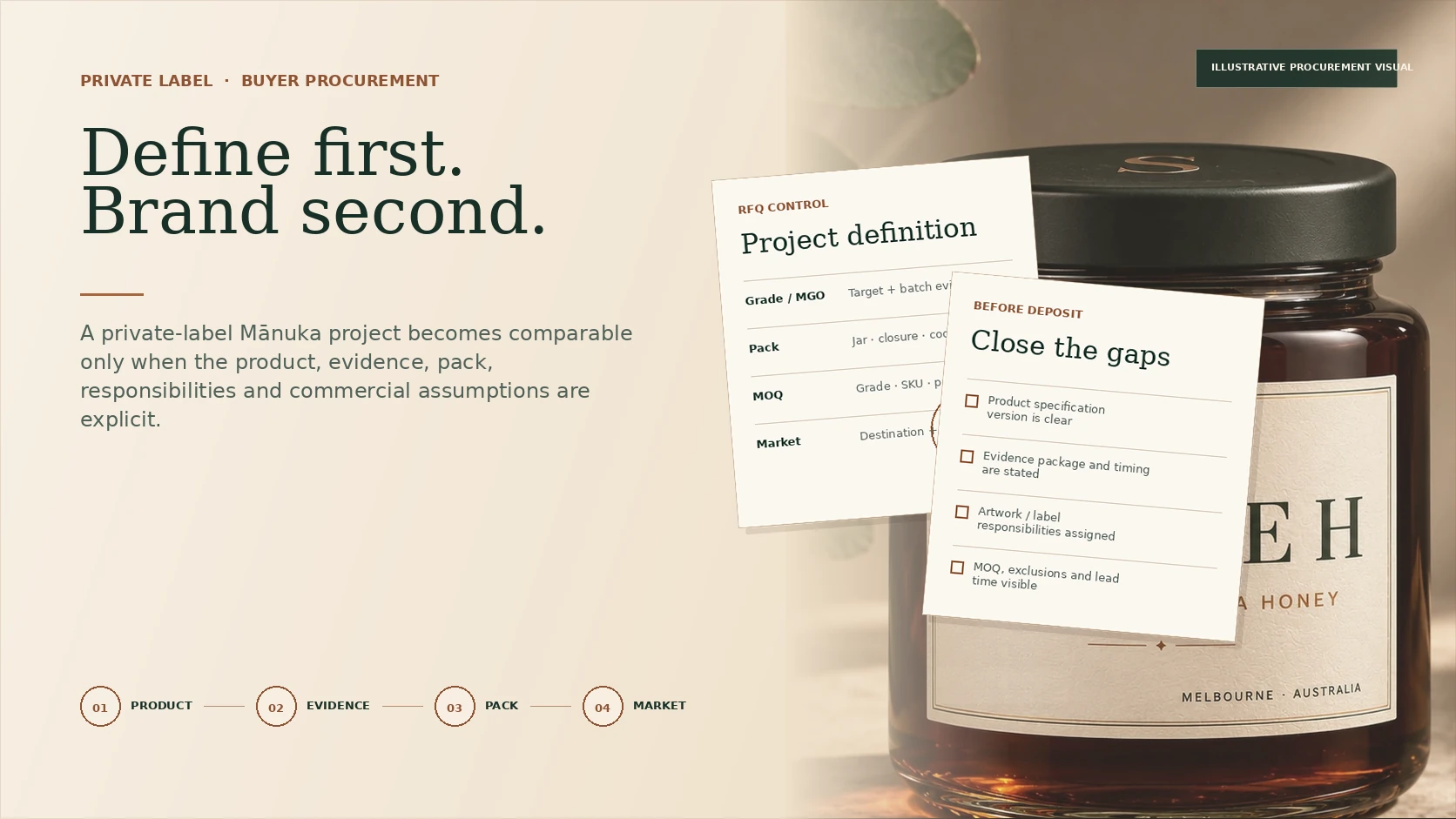
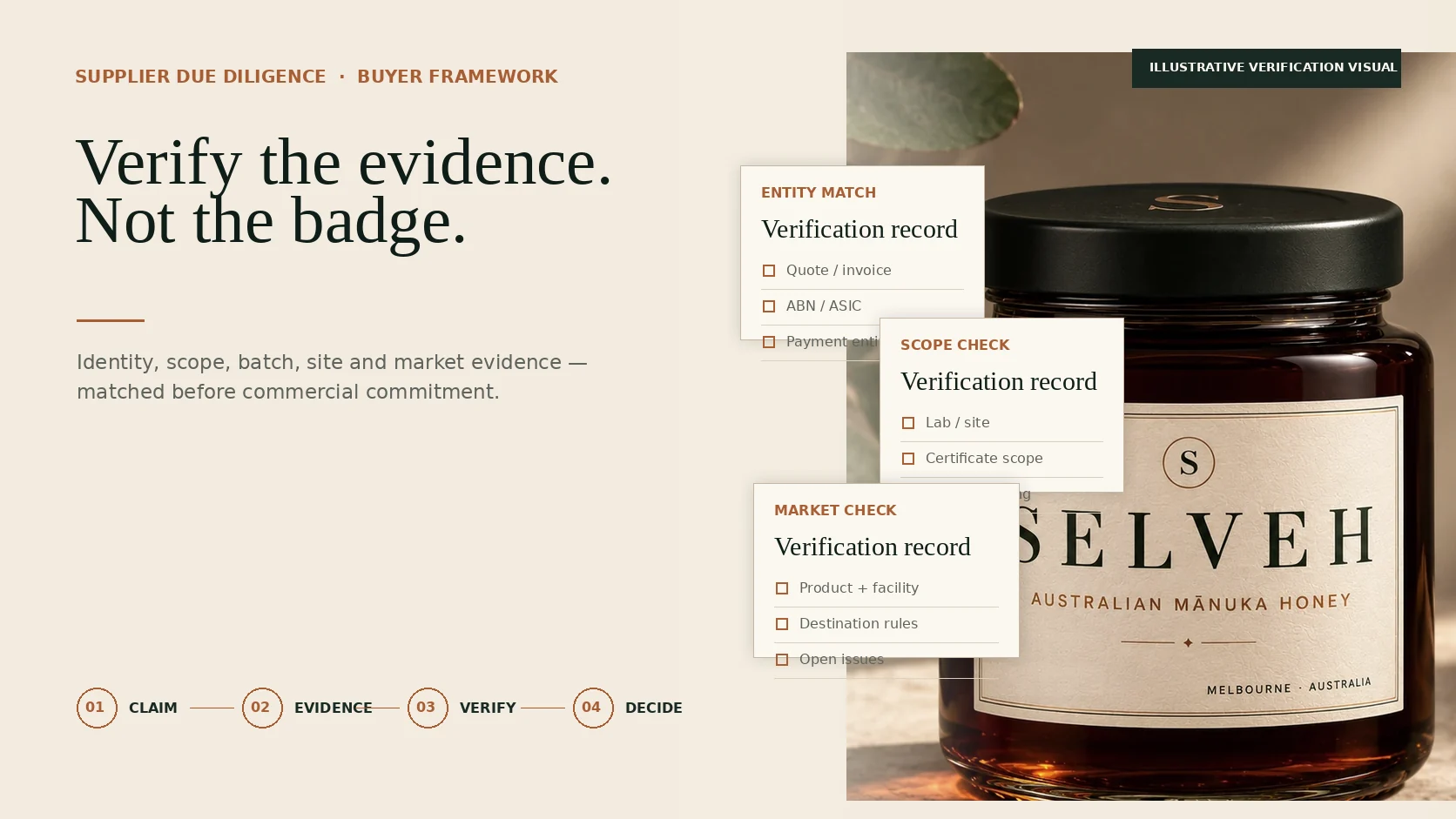
For procurement structure, see Private-Label Australian Mānuka Honey. For supplier verification, use the Supplier Due-Diligence Framework.
10 · Validation sequence
A buyer-side commercial test before committing inventory
A supplier or importer should not move from “the UAE looks attractive” straight to a production order. A stronger sequence is:
- Define the target channel - premium grocery, mainstream grocery, pharmacy/wellness or another specific route.
- Select one or two test grades and one core pack size rather than building a wide assortment.
- Obtain real supplier pricing, MOQ, packaging and testing costs.
- Build a landed-cost model using the actual trade route and confirmed CEPA eligibility where applicable.
- Test the proposed wholesale and shelf price against current UAE listings on an AED/100 g basis.
- Ask target importers/distributors whether the proposed grade, pack and price architecture fits their channel.
- Only then lock artwork, MOQ and first production volume.
This sequence protects against a common failure mode: selecting a product because it looks premium in Australia, then discovering that the UAE channel cannot carry the required shelf price or minimum order.
11 · Known unknowns
Data gaps SELVEH will not pretend to know
A credible market page should make its unknowns explicit. Public retail listings do not currently give SELVEH reliable evidence for:
- UAE Mānuka category size or annual sales growth.
- Australian versus New Zealand market share.
- Sell-through by MGO grade or pack size.
- Average retailer, distributor or importer margin.
- The best-selling Mānuka brand in the UAE.
- Repeat-purchase rates or price elasticity.
- Whether current out-of-stock items sold rapidly or were simply unavailable.
- The optimal SELVEH launch price, because supplier quotes, freight, final packaging and channel terms are not yet fixed.
These are not weaknesses to hide. They are the next evidence gaps to close through supplier quotations, distributor conversations, live buyer feedback and eventually first-party sales data.
12 · Buyer tool
UAE Mānuka Retail Landscape Matrix
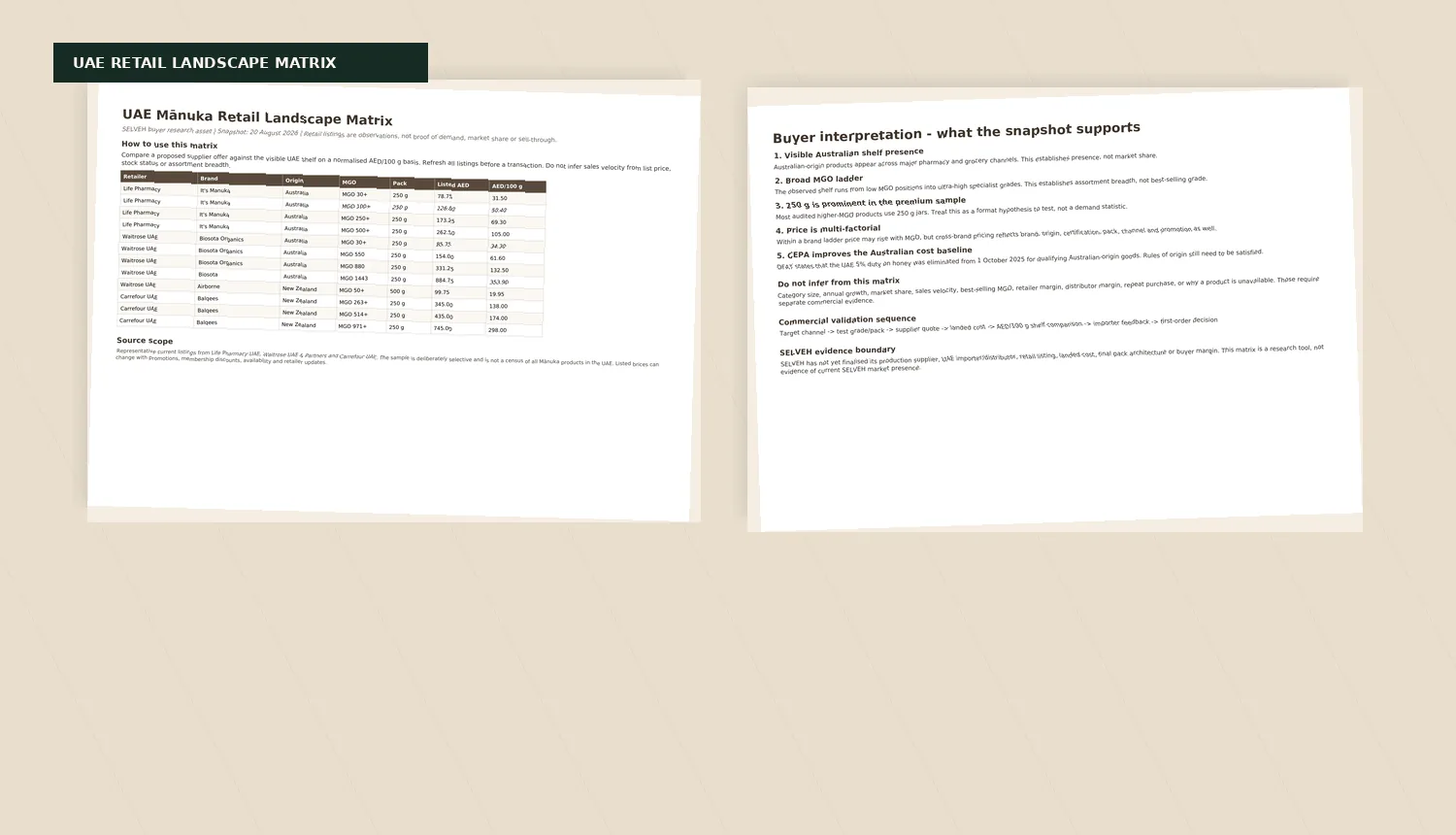
The downloadable SELVEH matrix converts a dated retail snapshot into a buyer research tool. It records retailer, brand, origin, MGO, pack size, listed price and AED/100 g, then separates what can be observed from what still requires buyer validation.
Use it to compare a proposed supplier offer against the visible UAE shelf, not to infer market share or demand. Retail listings change, so any serious purchasing decision should refresh the snapshot immediately before commercial negotiation.
13 · Practical conclusion
Practical conclusion
The UAE has enough visible Mānuka retail activity to justify continued commercial work for an Australian supplier or private-label entrant. Australian-origin Mānuka is already on shelf, New Zealand competitors are established, MGO ladders are broad and premium price points are real. CEPA has also improved the tariff position for qualifying Australian honey.
That still falls short of market validation. The next proof should come from commercial evidence: supplier quotes, importer conversations, channel-specific margin assumptions, compliant product positioning and a controlled first order. The strongest UAE strategy is not to predict demand from a web shelf. It is to use the shelf to design better questions, then validate those questions with buyers.
15 · SELVEH evidence boundary
Evidence status and SELVEH disclosure
This article is an independent commercial research guide. SELVEH has not yet finalised its production supplier, retail SKU architecture, UAE importer, distributor, retail listing, landed cost or buyer margin. Product and market observations are used to inform procurement and market-entry decisions; they do not imply a current SELVEH retail presence in the UAE.
Retail audit date: 20 August 2026. Recheck prices, listings, trade rules and market requirements before relying on this snapshot for a transaction.
Primary trade + retail sources
Source basis
- Australian Department of Foreign Affairs and Trade — Australia-UAE CEPA: Key Benefits for Australia
[1] Australian Department of Foreign Affairs and Trade (DFAT) - Australia-UAE CEPA - Key Benefits for Australia. States that the UAE 5% duty on honey was eliminated from 1 October 2025. - World Bank — United Arab Emirates country data
[2] World Bank - United Arab Emirates country data / Data360. Used only for macro context such as population and GDP per capita; not used as proof of Mānuka demand. - Life Pharmacy UAE — It’s Manuka brand listings
[3] Life Pharmacy UAE - Current Mānuka category and It's Manuka brand listings, accessed 20 August 2026. Representative Australian 250 g MGO 30+, 100+, 250+ and 500+ list prices used in the audit. - Waitrose UAE & Partners — Honey category / representative Biosota listings
[4] Waitrose UAE & Partners - Current honey category and Biosota product listings, accessed 20 August 2026. Representative Australian MGO 30+, 550, 880 and 1443 listings plus a New Zealand MGO 50+ listing used in the audit. - Carrefour UAE — Natural honey / Mānuka listings
[5] Carrefour UAE - Current natural honey / Mānuka listings, accessed 20 August 2026. Representative New Zealand Balqees MGO 263+, 514+ and 971+ list prices used in the audit.
Snapshot note: Retail listings and prices are time-sensitive. Recheck source pages immediately before using them in a buyer presentation, landed-cost model or commercial negotiation. Public listings are evidence of availability and positioning only; they do not establish sell-through, demand, market share or retailer margins.
For importers, distributors & premium retail buyers
Testing a UAE Mānuka offer against the visible shelf?
Bring the proposed grade, pack, supplier quote and destination assumptions. SELVEH will separate what is visible in the market from what still needs importer, margin, compliance and landed-cost validation.
Start a trade enquiry