01 · Evidence boundary
What this market analysis can - and cannot - establish
What the evidence can establish
- Australian-origin Mānuka is currently listed in mainstream Singapore grocery.
- New Zealand Mānuka is visible across grocery and health-and-wellness channels.
- The observed shelf contains multiple MGO/UMF positions, pack formats and price points.
- At least one Australian brand uses a clear grade-and-pack ladder from 500 g lower grades to 250 g higher grades.
- Promotional pricing is material in the wellness channel.
What the evidence cannot establish
- Actual sell-through, category revenue or growth rate.
- Best-selling grade or pack size.
- Retailer or distributor margin.
- Repeat-purchase behaviour or consumer origin preference.
- Whether sold-out status reflects demand, supply interruption, delisting or normal inventory timing.
- Whether promotional listed prices are sustainable long-term shelf prices.
SELVEH should not publish these unknowns as facts until first-party or reliable market data exists.
02 · Method
Method: a dated Singapore retail shelf audit
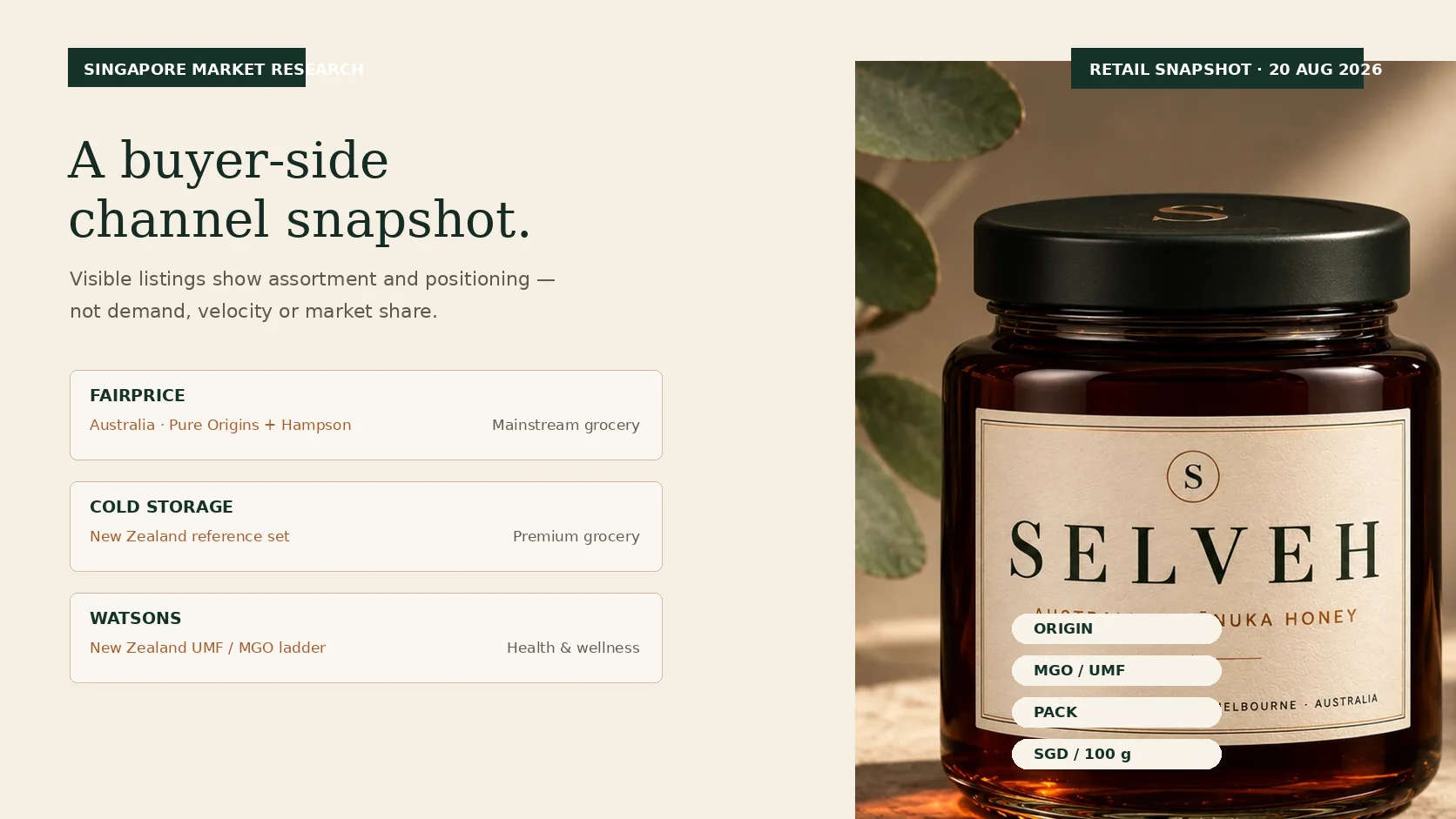
SELVEH reviewed publicly accessible listings on 20 August 2026 across FairPrice, Cold Storage and Watsons, with Guardian used as channel-presence corroboration. The purpose was not to estimate market share. It was to observe assortment architecture: origin, brand, grade, pack size, listed price and page-level availability.
Retailer, brand, origin, grade, pack, listed price.
Hypothesis about positioning or a channel to investigate.
Importer feedback, landed cost, margins, sell-through or first-party sales.
03 · Australian shelf presence
Australian Mānuka is already visible in mainstream grocery
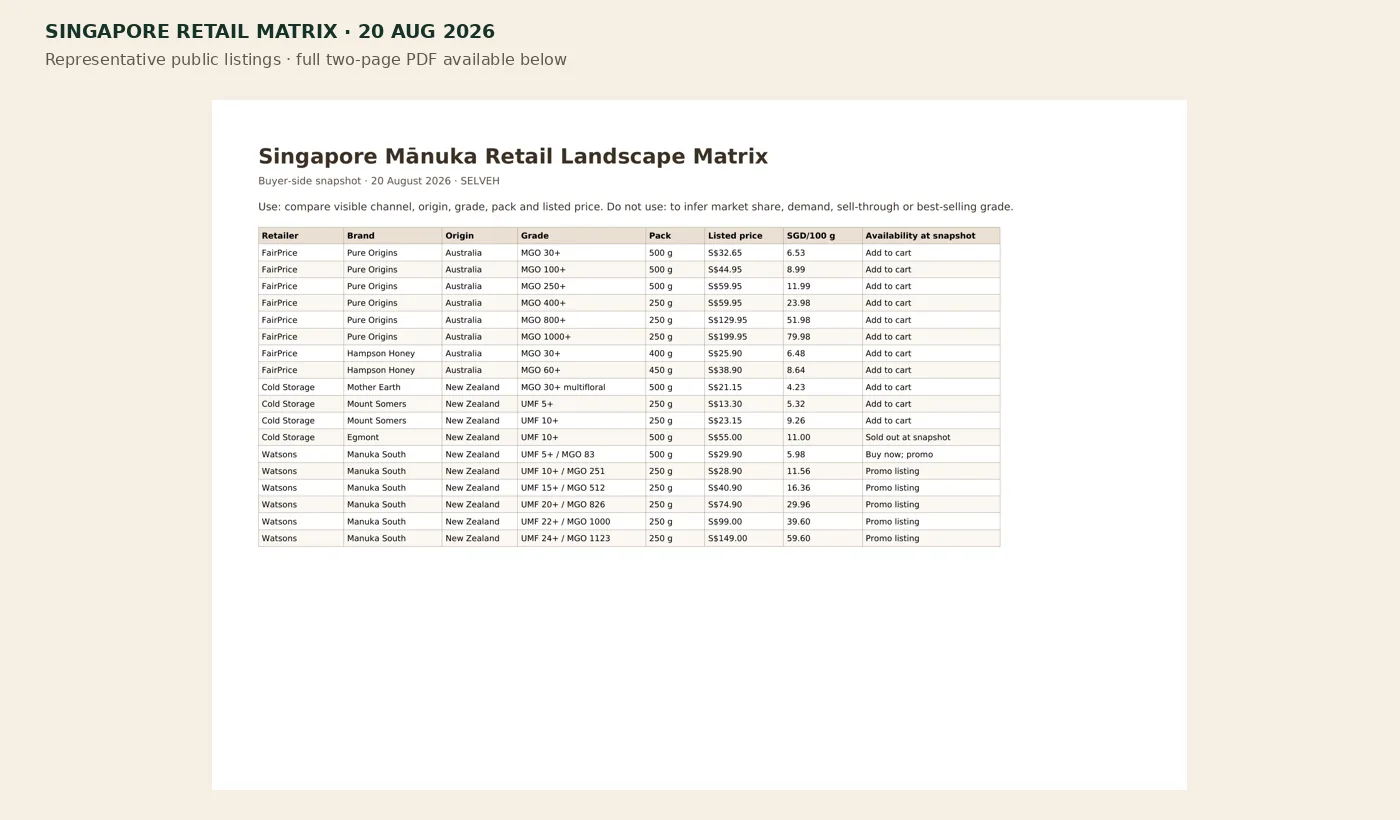
The clearest Australian evidence in the current snapshot is FairPrice. Pure Origins is listed with country/place of origin Australia and a six-grade observed range: MGO 30+, 100+, 250+, 400+, 800+ and 1000+.[1] Hampson Honey is also listed as Australian-origin, including MGO 30+ and MGO 60+ products.[2]
The correct inference is limited: Australian-origin Mānuka has visible retailer acceptance and shelf presence. This does not establish Australian market share, velocity, profitability or consumer preference.
04 · Competitive reference set
New Zealand Mānuka remains a broad reference set
Cold Storage lists New Zealand Mānuka products from Mother Earth, Mount Somers and Egmont, including MGO and UMF positions.[3][4][5] Watsons carries a deep Manuka South range from UMF 5+/MGO 83 through UMF 24+/MGO 1123, with several products under active promotions at the snapshot date.[6]
For an Australian entrant, “Australian Mānuka” is not enough positioning by itself. Buyers can compare origin, grading language, brand recognition, evidence, pack format, price ladder and promotional support.
05 · Price architecture
Normalise the shelf to SGD per 100 g
A 250 g high-grade jar and a 500 g entry-grade jar are not comparable on sticker price. The audit therefore normalises listed price to SGD per 100 g. This is still a snapshot - prices and promotions can move quickly - but it reveals the architecture more clearly.
| Retailer | Brand | Origin | Grade | Pack | Listed SGD | SGD/100 g |
|---|---|---|---|---|---|---|
| FairPrice | Pure Origins | Australia | MGO 30+ | 500 g | 32.65 | 6.53 |
| FairPrice | Pure Origins | Australia | MGO 250+ | 500 g | 59.95 | 11.99 |
| FairPrice | Pure Origins | Australia | MGO 400+ | 250 g | 59.95 | 23.98 |
| FairPrice | Pure Origins | Australia | MGO 1000+ | 250 g | 199.95 | 79.98 |
| FairPrice | Hampson Honey | Australia | MGO 30+ | 400 g | 25.90 | 6.48 |
| FairPrice | Hampson Honey | Australia | MGO 60+ | 450 g | 38.90 | 8.64 |
| Cold Storage | Mother Earth | New Zealand | MGO 30+ multifloral | 500 g | 21.15 | 4.23 |
| Cold Storage | Mount Somers | New Zealand | UMF 10+ | 250 g | 23.15 | 9.26 |
| Watsons | Manuka South | New Zealand | UMF 15+ / MGO 512 | 250 g | 40.90 | 16.36 |
| Watsons | Manuka South | New Zealand | UMF 20+ / MGO 826 | 250 g | 74.90 | 29.96 |
| Watsons | Manuka South | New Zealand | UMF 24+ / MGO 1123 | 250 g | 149.00 | 59.60 |
Selected Pure Origins ladder · current listed price
Observed SGD per 100 g
Observed pattern, not causation: within Pure Origins, normalised listed price rises sharply as MGO increases while pack size steps down to 250 g at MGO 400+ and above. Grade, brand, pack size and positioning are confounded; the shelf does not prove that MGO alone causes the premium.
06 · Channel landscape
Grocery and wellness retail do not behave the same
FairPrice provides broad grocery visibility and includes Australian and New Zealand Mānuka. Cold Storage provides a premium-grocery reference set with several New Zealand brands and multiple grading systems. Watsons places Mānuka inside a health-and-wellness environment where stronger grades and promotional mechanics are prominent.
- Mainstream grocery: test broader accessibility, coherent opening price and larger pack formats.
- Premium grocery: test provenance, packaging, evidence and differentiated grade architecture.
- Health & wellness: test higher-strength reference products, but maintain strict Singapore claims discipline.
These are channel hypotheses to validate with buyers, not performance claims.
07 · Pack architecture
Pack size is part of the price story
In the observed Pure Origins FairPrice assortment, MGO 30+, 100+ and 250+ are 500 g, while MGO 400+, 800+ and 1000+ are 250 g. Hampson uses 400 g and 450 g formats for lower MGO products. Watsons’ stronger Manuka South products are commonly visible in 250 g, with selected 500 g versions.
A smaller jar can reduce the absolute shelf ticket for a higher-grade product, but the shelf alone cannot tell us whether Singapore buyers prefer 250 g, whether 500 g improves value perception, or which format gives a viable importer margin.
08 · Grade architecture
Avoid assuming Singapore is a one-grade market
The observed shelf spans low MGO/multifloral positions through MGO 1000+ and UMF 24+/MGO 1123. That breadth does not support a simplistic “Singapore wants MGO 250+” or “Singapore is a high-MGO market” conclusion.
Possible entry role
Lower absolute ticket, larger pack, easier trial. Validate against grocery economics.
Possible core premium role
A defensible mid-tier step-up that gives the buyer a reason to trade up without making the shelf ticket excessive.
Possible halo role
High-grade 250 g used to demonstrate range depth, only if cost and MOQ do not create inventory risk.
Decision rule
Do not add a SKU because a competitor carries it. Add it only if it has a defined channel role, viable landed margin, evidence-ready supply and a buyer signal.
09 · Commercial validation
Turn shelf observations into buyer questions
- Opening price point: what retail ticket is credible and what wholesale price is required after retailer/distributor margin?
- Grade step-up: how much separation can the channel support between entry and core premium grades?
- Pack-size trade-off: does 250 g improve conversion at high grades, or does 400-500 g create better value perception?
- Origin positioning: will the buyer actively merchandise Australian origin or treat origin as secondary?
- Evidence burden: which documents are required before listing - COA, MGO report, origin evidence, food-safety certificate, traceability map or label review?
- Promotion economics: what launch discount, catalogue participation or trade spend is expected, and who funds it?
- Range width: does the buyer want one hero SKU, a two-tier ladder or a broad range?
- Replenishment: what lead time, safety stock and reorder cadence are acceptable?
The next proof should come from importer conversations and landed-cost modelling, not from adding more assumptions to the shelf audit.
10 · Data gaps
What the public shelf still does not tell us
- Category market size or growth rate.
- Brand or origin market share.
- Units sold, sell-through or stock turn.
- Retailer or distributor margin.
- Trade promotions funded by suppliers.
- Best-selling grade or pack.
- Repeat-purchase rate.
- Consumer willingness to switch origin.
- The buyer’s acceptable landed cost or target wholesale margin.
Any business case that fills these gaps with assumptions should label them as scenarios, not evidence.
11 · Downloadable buyer tool
Singapore Mānuka Retail Landscape Matrix
The downloadable matrix records representative Australian and New Zealand listings, normalises price to SGD per 100 g and separates shelf observation from commercial inference.
12 · Practical conclusion
Practical conclusion
Singapore has enough visible Australian and New Zealand Mānuka assortment to justify structured commercial testing. The shelf shows multiple channels, a broad grade ladder, meaningful pack-size differences and a wide retail price architecture.
That is still not market validation. The strongest next step is to use these observations to design better importer questions, compare supplier economics and test a narrow candidate assortment before committing to inventory.
14 · SELVEH evidence boundary
Evidence status and SELVEH disclosure
This article is an independent commercial research guide. SELVEH has not yet finalised its production supplier, Singapore importer, distributor, retail listing, final SKU architecture, landed cost or buyer margin. Retail observations are used to inform procurement and market-entry decisions; they do not imply a current SELVEH retail presence in Singapore.
Retail audit date: 20 August 2026. Recheck prices, listings and market requirements before relying on this snapshot for a transaction.
Primary retail sources
Source basis
- FairPrice - Pure Origins brand assortment
[1] FairPrice Singapore - Pure Origins current brand listings, accessed 20 August 2026. Australia origin filter and MGO 30+ to 1000+ ladder used in the audit. - FairPrice - Hampson Honey brand assortment
[2] FairPrice Singapore - Hampson Honey current brand listings, accessed 20 August 2026. Australian MGO 30+ and MGO 60+ listings used in the audit. - Cold Storage - Mother Earth MGO 30+ 500 g
[3] Cold Storage Singapore - Mother Earth Multifloral Mānuka MGO 30+ 500 g, New Zealand, S$21.15 at snapshot. - Cold Storage - Mount Somers UMF 10+ 250 g
[4] Cold Storage Singapore - Mount Somers UMF 10+ 250 g, New Zealand, S$23.15 at snapshot. - Cold Storage - Egmont UMF 10+ 500 g
[5] Cold Storage Singapore - Egmont UMF 10+ 500 g, New Zealand, S$55.00 and sold out at snapshot. Sold-out state is not treated as proof of demand. - Watsons Singapore - Manuka South assortment
[6] Watsons Singapore - Manuka South current listings, accessed 20 August 2026. UMF 5+/MGO83 through UMF 24+/MGO1123 visible; several products promotional. - Guardian Singapore - representative Comvita listing
[7] Guardian Singapore - used only to corroborate health-and-wellness channel presence for New Zealand Mānuka.
Snapshot note: Retail listings and prices are time-sensitive. Recheck source pages immediately before using them in a buyer presentation, landed-cost model or commercial negotiation. Public listings are evidence of availability and positioning only; they do not establish sell-through, demand, market share or retailer margins.
For importers, distributors & premium retail buyers
Testing a Singapore Mānuka offer against the visible shelf?
Bring the proposed grade, pack, supplier quote and destination assumptions. SELVEH will separate what is visible in the market from what still needs importer, margin, compliance and landed-cost validation.
Start a trade enquiry