01 · Operating model
Define the models before comparing them
White label and private label are commercial shorthand, not self-executing technical standards. Different packers use them differently. For this framework, white label means a largely supplier-defined honey, jar, closure and operating process that can carry a buyer’s brand. Private label means a buyer-branded offer with negotiated choices or controls over attributes such as MGO grade, pack size, label construction, carton, specification or release evidence. A fully bespoke product-development project sits further along the customisation spectrum.
The name of the model matters less than the schedule behind it. Ask the prospective packer to mark every element as fixed, selectable from an approved menu, buyer-supplied or newly developed. Put that map into the quotation, specification and contract. If two quotations use the same label but include different controls, they are not comparable offers.
For the broader sourcing process, start with the private-label Australian Mānuka buyer guide.
02 · Decision matrix
Compare control, speed and exposure together
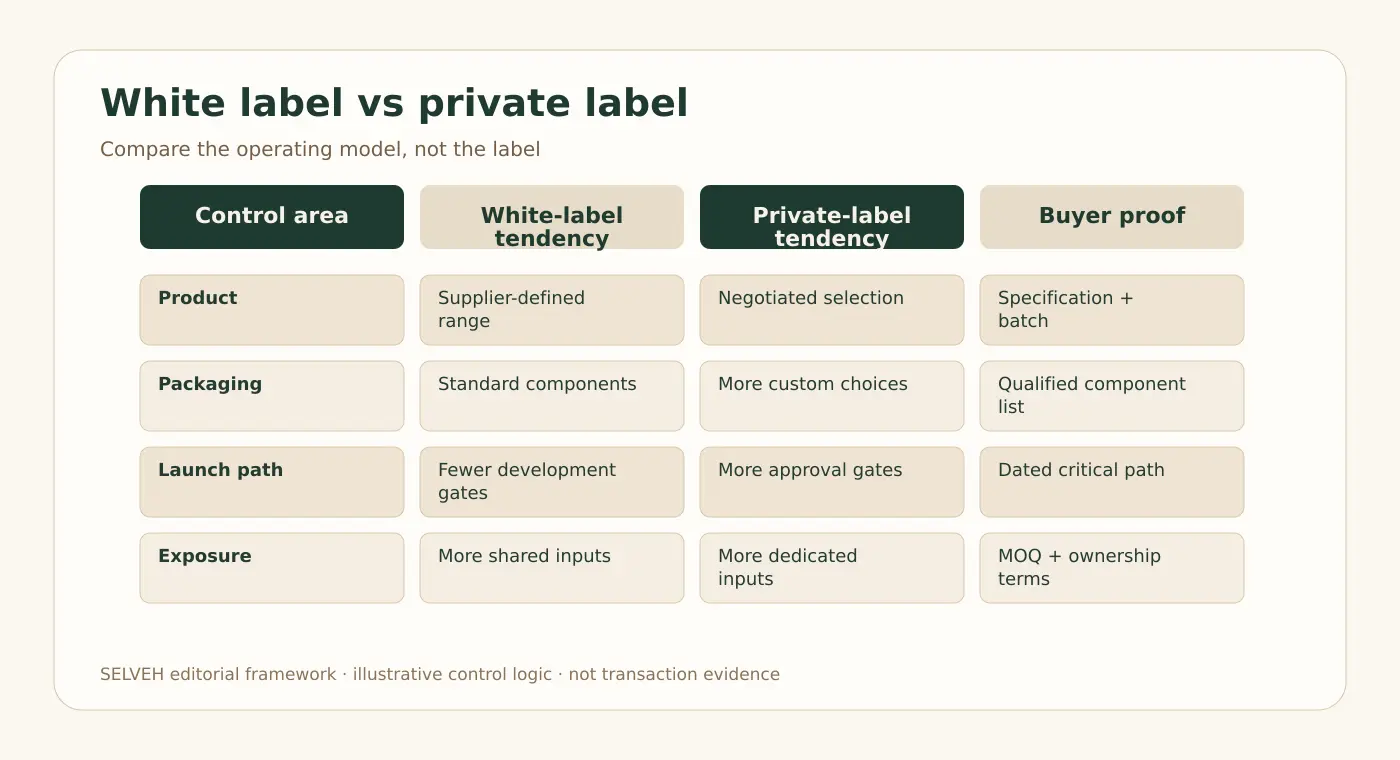
| Decision area | White-label tendency | Private-label tendency | Buyer question |
|---|---|---|---|
| Honey and grade | Pre-defined range | Negotiated selection or specification | Which batch evidence supports each SKU? |
| Primary pack | Standard jar and closure | More component choices | Which components are qualified and available? |
| Artwork | Brand applied to a template | Broader controlled artwork scope | Who owns files and approves changes? |
| Launch path | Potentially fewer development steps | Potentially more approval gates | What is the critical path? |
| Commercial exposure | May use shared components | More buyer-specific inventory | Who carries unused stock and tooling? |
These are tendencies, not promises. A supplier may offer a highly controlled white-label programme or a narrow private-label menu. Request evidence for the actual route instead of treating the column as a guarantee.
03 · Market fit
Match the model to the business problem
A white-label route can suit a buyer testing category demand, adding one credible SKU to an established retail portfolio or learning how customers respond before committing to specialised components. Its value is reduced complexity, not automatic low cost or immediate availability.
A private-label route can suit a distributor or retailer that needs a defensible range architecture, a specific pack hierarchy, destination-language artwork, channel-exclusive presentation or tighter control over specifications. More control is useful only when the differentiation matters to the buyer and can be operated consistently.
Do not choose private label merely because it sounds more premium. Every extra choice creates an approval, dependency or inventory position. Conversely, do not choose white label if the standard offer makes the product interchangeable in a channel where brand and pack distinction drive the commercial case.
04 · Product control
State who controls the honey specification
The model must identify the sellable unit: honey identity, declared MGO criterion, net quantity, sensory expectations where relevant, shelf-life basis, storage conditions, packaging configuration and evidence needed for release. A buyer should know whether it is selecting from existing released batches, reserving a grade band or requesting a new specification.
MGO is analytical information tied to the product and batch; it should not be converted into an unsupported health outcome. Review the wholesale product-specification guide and the COA buyer guide before approving a grade statement.
Also define substitution. If the nominated batch, jar or closure becomes unavailable, can the supplier substitute an equivalent, must the buyer approve, or does the order pause? “Equivalent” needs measurable criteria and documentary evidence.
05 · Packaging system
Separate branding freedom from pack qualification
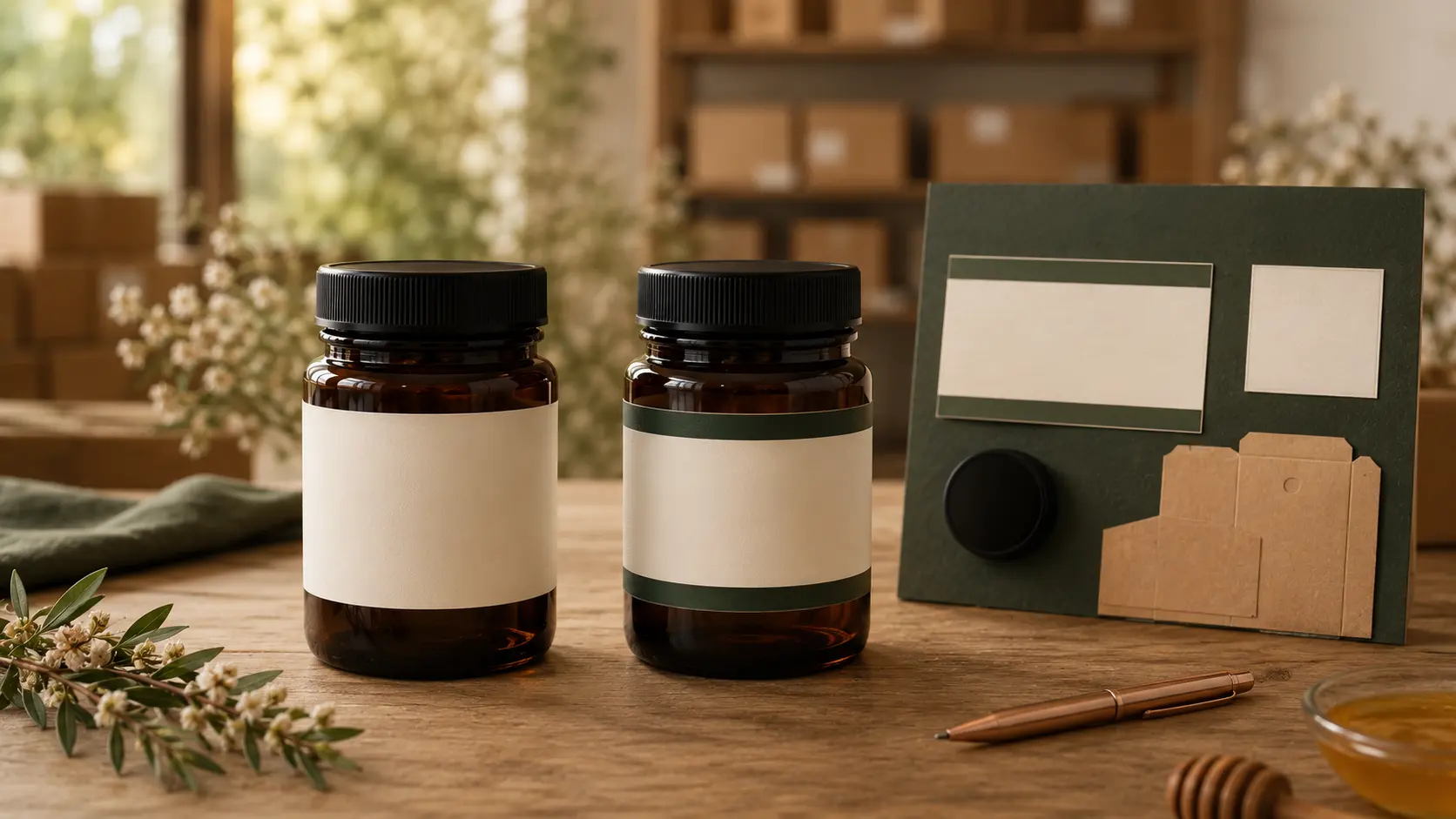
A different label does not automatically create a different packaging system. Record the jar, closure, tamper evidence, label stock, adhesive, coding method, shipper case and pallet configuration. Identify which items already run on the packer’s line and which require trials, tooling or new supplier qualification.
White label may restrict the dieline, print area, finish or closure. Private label may open more choices, but buyer-selected components still have to protect the product, run through filling and packing, survive distribution and comply in the destination market.
Use the packaging specification guide to convert visual preferences into controlled requirements.
06 · Artwork and claims
Assign label responsibility line by line
List who drafts, verifies and approves the product name, ingredient statement, net quantity, nutrition information, date mark, lot code, storage instruction, business identification, country-of-origin wording, MGO expression, language and destination-specific marks. The buyer’s designer, packer and importer may each hold different information; no single approval should be assumed to cover every legal duty.
FSANZ sets labelling standards for food sold in Australia and New Zealand, while destination markets impose their own requirements. The ACCC states that country-of-origin claims must be true, accurate and based on reasonable grounds. Export artwork therefore needs both product evidence and destination review.
Keep editable artwork, approved proofs and change history under version control. The artwork approval workflow provides the detailed gate.
07 · Commercial structure
Model MOQ by source of commitment
There may be several minimums: honey allocation, filling run, jar carton, closure case, label print, shipper case, pallet, testing or freight. A single headline MOQ can hide the component that actually creates exposure. Ask for the minimum and price break for every constrained item.
A standard programme may lower some setup or component commitments because materials are shared, but this is not universal. A customised route can create residual labels, cartons or closures that cannot be used for another buyer. Record ownership, storage fees, ageing, write-off and what happens when artwork changes.
Compare a mixed-SKU pilot against a full run using the MOQ and trial-order planner. Do not treat a low first-order quantity as proof that repeat economics will work.
08 · Timeline
Build the critical path from approvals
Lead time should be a dated sequence, not “six weeks” in isolation. Map supplier qualification, product and batch availability, quotation acceptance, deposit or credit approval, artwork, component procurement, production booking, testing, release, export documents and freight handover.
A white-label programme may remove some development work, yet stock availability, label printing, testing and production capacity can still control the date. Private label may require more gates, but a prepared buyer with approved components can sometimes move faster than an unprepared white-label buyer.
Ask which dates are estimates, reservations or firm commitments; identify the event that starts the clock; and state how buyer delay changes the schedule.
09 · Brand protection
Clarify ownership, access and exclusivity
Brand names, logos, artwork, packaging designs, photography, specifications and newly developed materials can involve different intellectual-property rights. Business.gov.au notes that IP ownership clauses are critical in commercial relationships. The contract should state what each party owns, what is licensed, where it may be used and what survives termination.
Do not assume private label creates market exclusivity. If exclusivity matters, define product, grade, pack, channel, territory, customer, term, performance threshold and exceptions. A vague promise such as “exclusive product” is difficult to operate.
Also cover access to production files and regulatory records. A buyer may own artwork but still lack the editable file or print specification needed to move production.
10 · Evidence system
Keep brand control connected to batch control
For each finished lot, connect the approved SKU and artwork version to the honey batch, MGO result or relevant analytical evidence, fill record, packaging component lots, date and lot coding, release decision, finished quantity and shipment documents. The evidence package should allow a buyer to trace what was sold without implying certification that has not been obtained.
Private branding does not replace supplier due diligence. Verify the responsible entities, production site, testing route, traceability and change notification. Use the supplier due-diligence scorecard and quality-agreement guide.
11 · Destination readiness
Design for the actual route to market
The same jar may require different artwork, importer information, language, registration or supporting documents across markets. Confirm who is the responsible importer, who reviews the label, which claims are permitted and what evidence must be retained. Do this before printing, not after finished stock exists.
Country of origin also needs precise wording. Australian honey, Australian packing and Australian ownership are different facts. Use the claim supported by the actual product and process, and retain reasonable grounds for it.
For SELVEH’s initial markets, the UAE and Singapore import guides provide starting checklists, not final regulatory clearance.
12 · Quote comparison
Normalise offers before choosing a model
Request the same scenario from every supplier: product and grade, pack size, units per case, total units, destination, artwork scope, testing, Incoterm, named place, currency, payment assumptions, lead-time basis and validity. Separate recurring unit cost from one-off setup, artwork, plate, tooling, testing, storage and destruction charges.
Then mark exclusions and unknowns. A lower quoted unit price may omit labels, cases, release testing or delivery to the comparison point. A higher price may include services the buyer does not need. Use the supplier quote-normalisation matrix before ranking offers.
13 · Decision gate
Use a pilot-to-scale decision flow
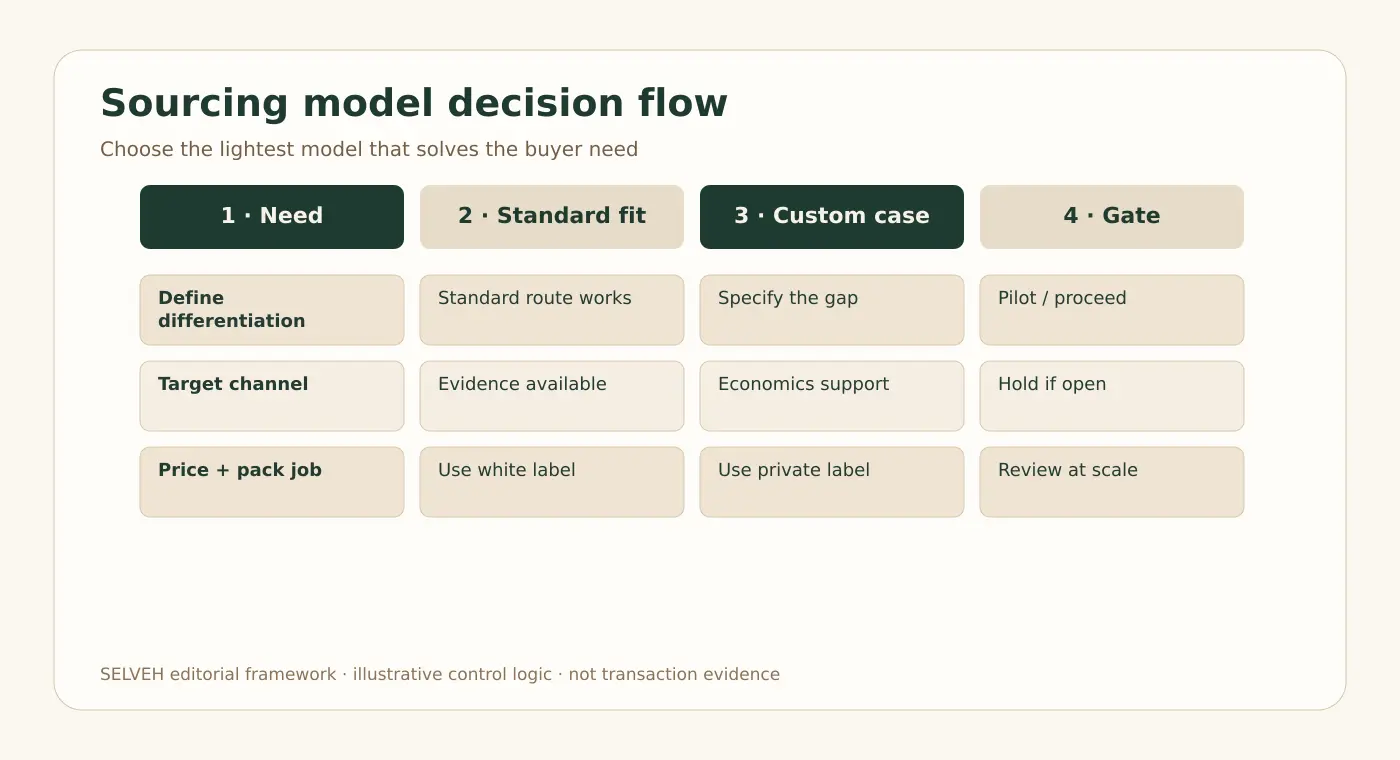
Begin with the differentiation the target channel will notice and pay for. If a standard product and pack meet that need, test the simpler route. If a material gap remains, specify the smallest set of private-label controls that closes it. Hold the project when evidence, importer responsibility, economics or supply continuity cannot yet be demonstrated.
A pilot should test more than consumer response. Measure approval effort, order accuracy, production variance, document quality, breakage, receiving performance, inventory rotation and the time required to resolve exceptions.
14 · Buyer tool
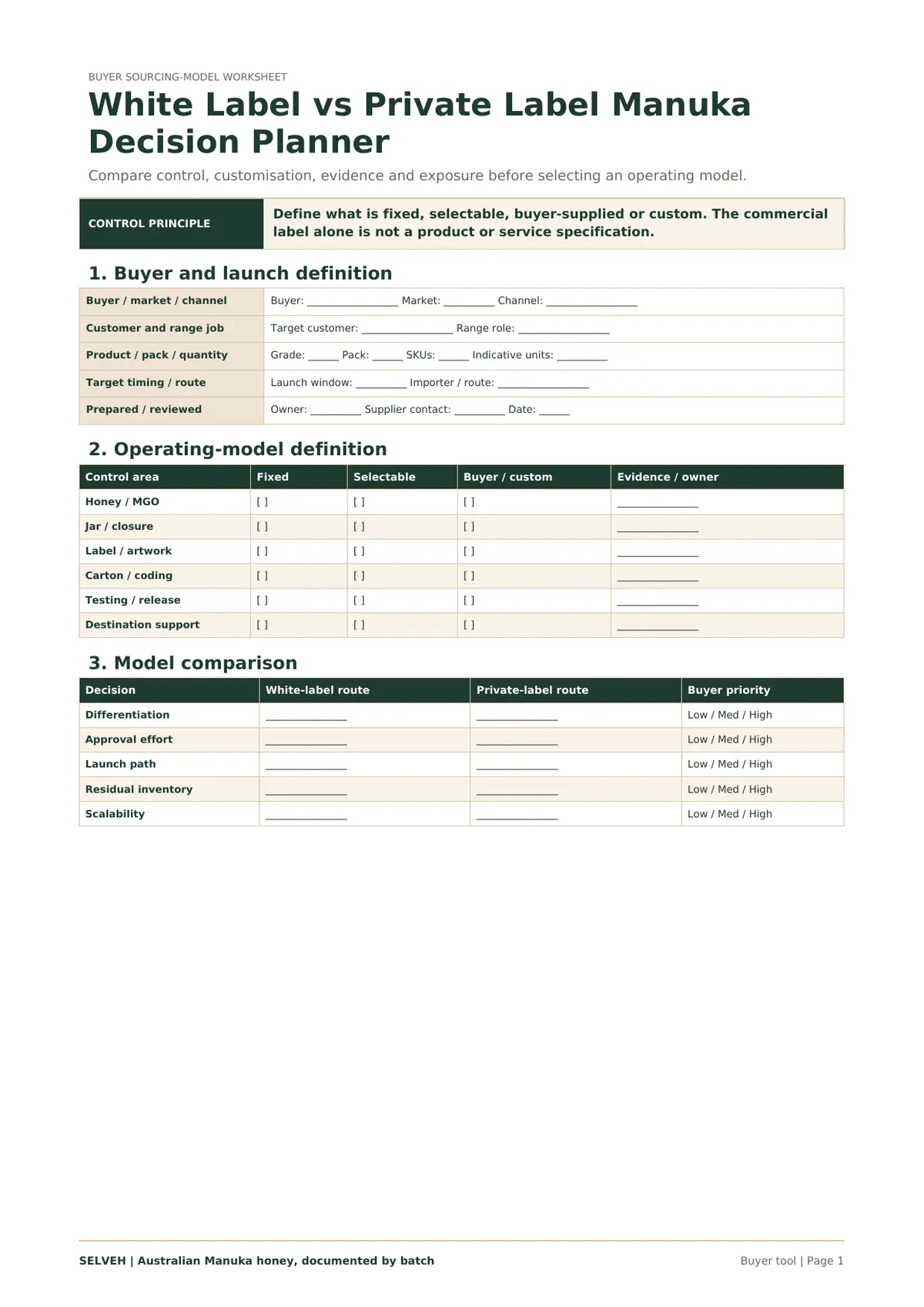
Download the sourcing-model planner
The two-page planner records the buyer objective, model definitions, product and pack controls, evidence, commercial exposure, responsibility, destination readiness and pilot decision. Complete one version per proposed SKU family and attach the supplier documents that support each answer.
The planner is not a quotation, supplier approval, contract, legal advice, regulatory approval or confirmed SELVEH service. It is a structured way to expose assumptions before money is committed.
15 · Review triggers
Investigate these sourcing proposals
- The model name is offered without a schedule of what is fixed or custom.
- A grade claim is shown without batch-specific supporting evidence.
- The headline MOQ omits component, print or testing minimums.
- Artwork approval has no regulatory, origin or version-control owner.
- Unused buyer-specific packaging has no ownership or disposal rule.
- Exclusivity is promised without product, territory, channel, term and performance boundaries.
- Substitution can occur without defined equivalence and approval.
- Lead time has no start event, critical path or buyer-dependency assumptions.
16 · Buyer FAQ
Frequently asked questions
Is white label always faster and cheaper?
No. It may reduce custom development, but availability, batch evidence, printing, production, testing and freight still determine timing and cost.
Does private label mean a unique honey?
Not automatically. The uniqueness may be limited to branding or packaging. Define the honey specification and exclusivity separately.
Can we begin with white label and move to private label?
Potentially. Plan data, artwork, inventory and contract ownership so the transition is possible, and confirm the supplier’s actual pathway.
Which model does SELVEH currently offer?
No fixed programme is represented by this article. Any future offer depends on verified supplier, packer, product, batch, component, MOQ and destination capability.
17 · SELVEH status
What SELVEH can state today
SELVEH can use this framework to structure buyer requirements, compare proposed sourcing models and identify missing commercial or evidence inputs.
SELVEH should not represent a live white-label or private-label programme, supplier appointment, available SKU, price, MOQ, lead time, exclusivity, certification or destination approval until the relevant counterparties and records confirm it. Commercial enquiries remain useful because they define the demand that supplier validation must test.
Sources
Official standards and business guidance
- Food Standards Australia New Zealand — Labelling
- FSANZ — Food Standards Code legislation
- ACCC — Country of origin food labelling
- Business.gov.au — Suppliers
- Business.gov.au — Prepare a contract
- Business.gov.au — Intellectual property
Source review: Official guidance reviewed 26 August 2026. Destination rules and commercial programmes can change; confirm the actual SKU, market and contract.
Trade planning
Need to choose a sourcing model for an Australian Mānuka range?
Share your target market, channel, grade, pack size, quantity and required customisation. SELVEH will map which inputs are fixed, selectable, custom or still unverified before any commercial offer.
Start a trade enquiry