

01 · Buyer fit
Decide what the quote needs to achieve
Start by stating whether you are a Singapore importer, distributor, wholesaler, premium grocery operator or specialist retailer. That context determines the relevant carton quantity, retail pack, evidence package, import responsibilities and required lead time. A retailer testing shelf demand may need a different first consignment from a distributor building a category-wide range.
Give the supplier an indicative buying horizon and a credible initial quantity range. Describe what must be established before a purchase order—such as sample approval, shelf-price viability, importer registration or documentation review—rather than treating interest as a firm order.
SELVEH’s initial intended offer is SELVEH-branded finished Mānuka for selected trade partners. This article is not an invitation to assume that buyer-owned private-label manufacture is available.
02 · Country of origin
Keep Australian and New Zealand Mānuka in separate quotation lines
Origin is a product attribute, not the location of the brand. A Melbourne company may source Australian or New Zealand honey, but the final SKU should carry an evidence-backed origin declaration. If either origin is acceptable, request two separate, identified route options. Do not let a single blended quote conceal which product is being priced. [ACCC origin labelling]
The assurance pathway differs. The New Zealand Ministry for Primary Industries (MPI) requires honey labelled as Mānuka for export to be tested by an MPI-recognised laboratory against its regulatory Mānuka definition, which assesses four chemical attributes and a DNA marker. Australian honey should not be described as holding New Zealand MPI recognition by implication; its origin and claim evidence must instead match the actual Australian product and applicable supply route. [MPI definition]
Ask for the botanical/floral description actually supported by the proposed lot, not just a visually appealing country name. Our origin comparison explains why similar-looking MGO numbers do not make two different origins interchangeable.
03 · Product specification
Specify the jar and grade before the unit price
Write down the preferred MGO designation (for example, 100+ or 250+ as illustrative requested grades), 250 g or 500 g net content, and whether the buyer can consider alternatives. An MGO 250+ statement is a minimum threshold claim that requires supporting product/batch evidence; it is not an origin test, safety certificate or promise of a health effect.
Ask the seller to distinguish supplier-quoted configurations from finished, orderable commercial SKUs. Confirm jar material, closure, label language, units per master carton, outer dimensions, palletisation where applicable and the packaging artwork approval process. The jar shown on a concept website is not proof of mass-production compatibility.
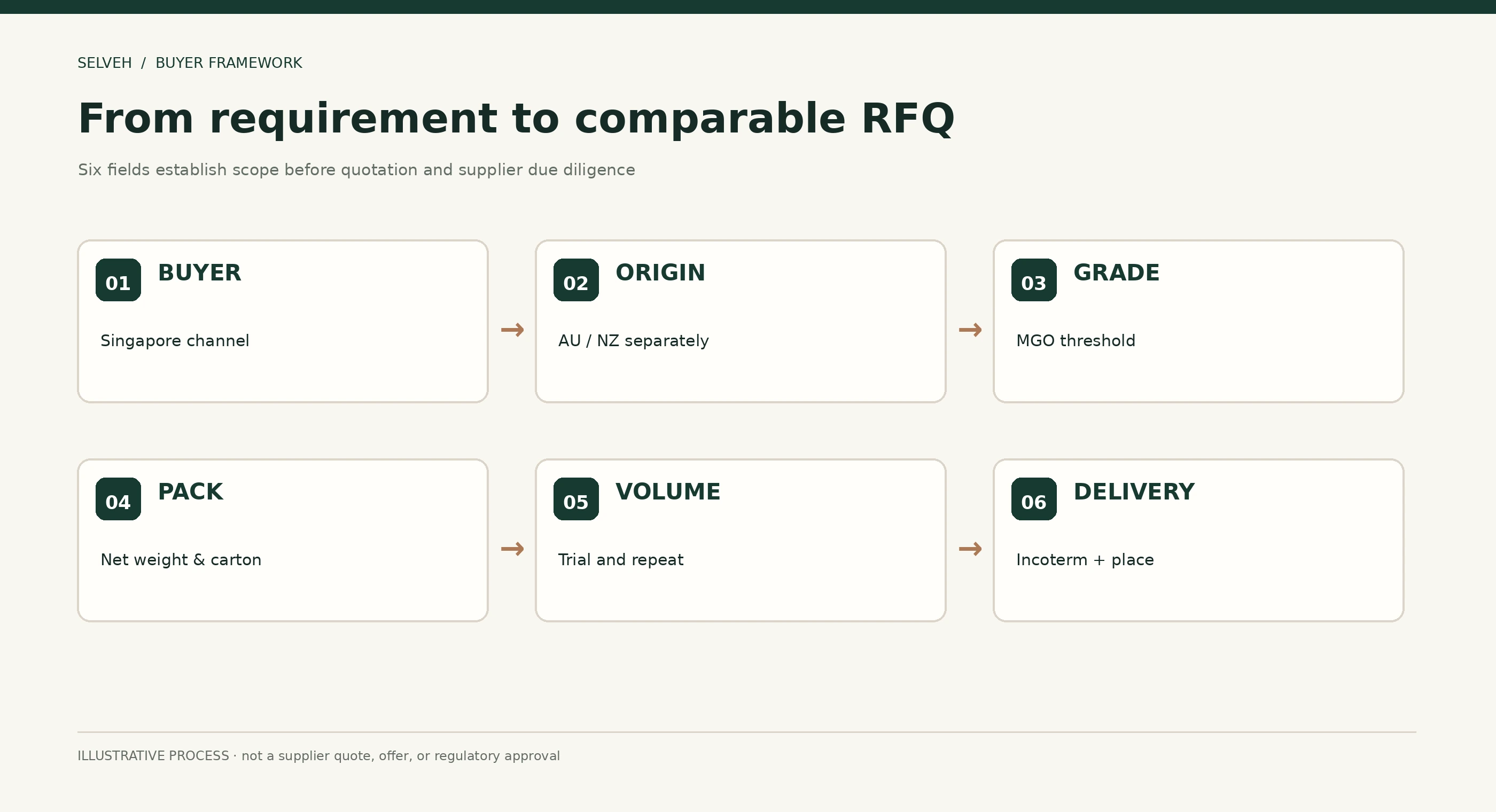
| RFQ field | What a usable buyer request looks like |
|---|---|
| Country of origin | Australia, New Zealand or two separately quoted alternatives |
| MGO grade | Target minimum grade; equivalent alternatives explicitly identified |
| Pack | Net weight, intended retail presentation, carton configuration |
| Quantity | Initial trial volume and potential repeat volume as separate scenarios |
| Commercial scope | Currency, unit basis, Incoterm with named place, exclusions |
| Evidence & readiness | Grade/lot evidence, origin, Singapore route checks, realistic lead time |
04 · MOQ & trial volume
Ask whether the minimum applies to honey, jars, labels or every SKU
“MOQ” can mean a minimum bulk honey weight, packing run, label print run, cartons per product, a pallet requirement or a combined mixed-SKU minimum. They are not interchangeable. The RFQ should request these as separate lines, including whether the buyer can combine two MGO grades or pack sizes in one shipment.
Ask for two price/quantity scenarios if the supplier can support them: one constrained first trial and one plausible repeat order. For both, require the total number of saleable jars and cartons. Never compare a price for 200 kg of bulk honey against a finished-jar quote with artwork and packaging without normalising the scope.
When several Singapore buyers are considering a coordinated order, request clarification of one shared inbound shipment versus multiple buyer deliveries. Consolidation may reduce some line-haul costs, but separate last-mile deliveries, local handling, tax/accounting roles and contract responsibilities do not disappear. Cost savings must be calculated, not assumed.
Consolidated freight: identify the real importer and documentation chain
Combining cartons in one freight movement does not automatically combine separate retail buyers into one importer, permit or commercial transaction. Before comparing a shared-shipment quote with separate consignments, identify the actual purchasing entity, the Singapore importer, its declaring agent, each consignee and the delivery arrangements. A forwarder’s ability to consolidate freight is not, by itself, authority to be named as importer.
Singapore Customs Circular 15/2026 (28 October 2026) states that parties with no interest in the goods, no involvement in their movement and no relationship with the actual traders must not be declared as importers. It places responsibility for accurate permit information on both importer and declaring agent and reminds importers to retain permits and supporting purchase, import and sale documents for at least five years from permit approval.
| Buyer control | Evidence or decision required |
|---|---|
| Importer and purchase chain | Identify the genuine buyer/importer, seller-to-buyer invoice chain and relationship to the goods. |
| Permit and declaring agent | Confirm the responsible declaring agent, applicable TradeNet permit arrangements and conditions for the actual transaction. |
| Cargo and consignee trail | Reconcile shipping marks or tracking, item description, quantity, value, Incoterm, consignee and delivery address to manifest and invoices. |
| Records and line items | Keep supporting records accessible for the required period; reconcile invoice items with permit line items where applicable. |
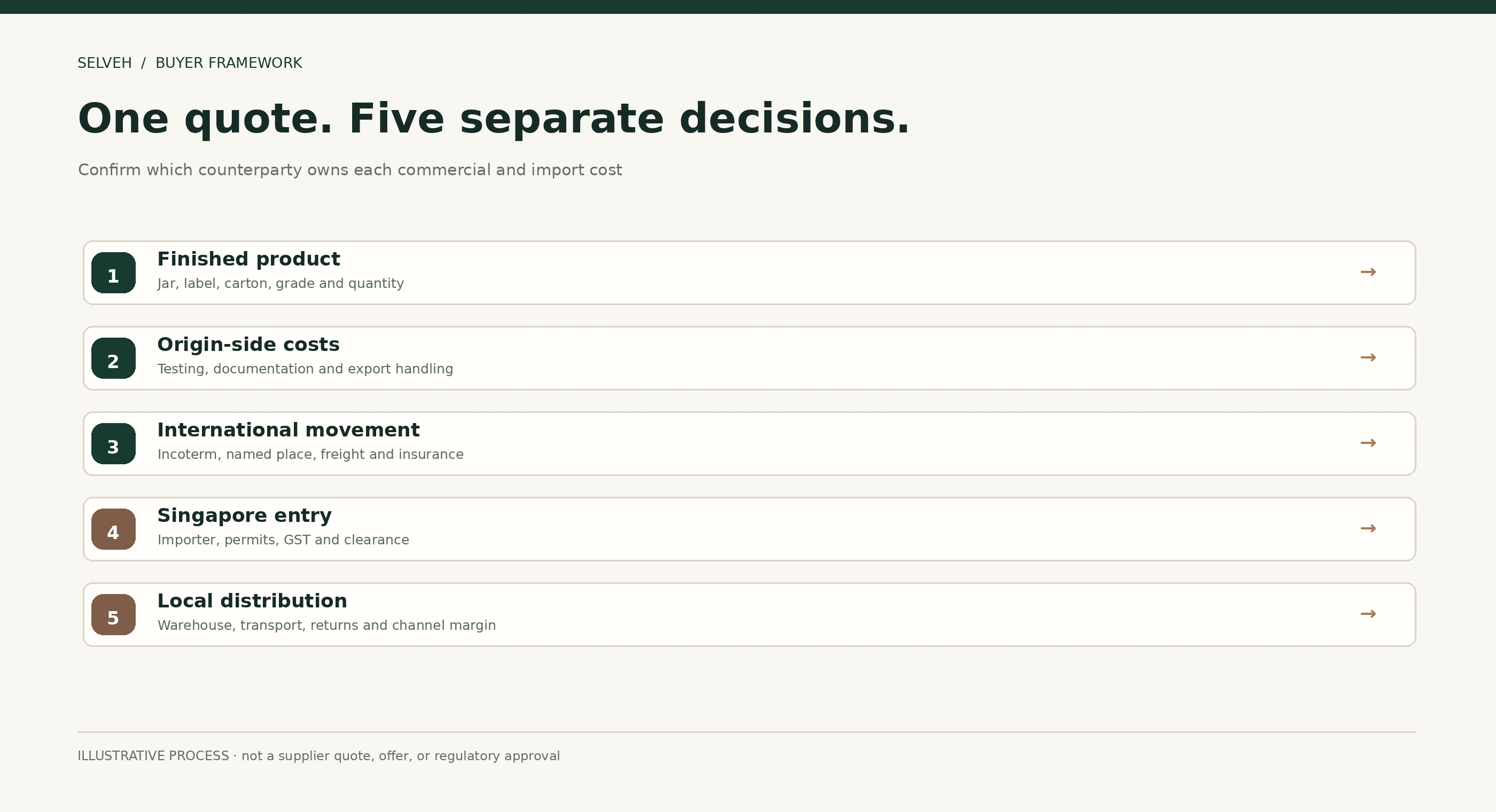
| True landed economics | Price importer/agent work, GST cash flow, destination handling, storage and each buyer delivery separately from line-haul freight. |
The circular lists information Customs may request for individual items after permit approval; it does not impose a universal serial-number requirement on every honey jar or decide the number of permits for an unconfirmed business structure. The actual importer and declaring agent must confirm the lawful arrangement. Compare the full costs using our landed-cost framework and wholesale price architecture; shared freight is only a potential cost lever, not a promised discount.
05 · Pricing basis
Turn an attractive unit price into a comparable landed proposal
Ask for quotation currency, validity period, unit price per finished jar, tooling or label charges, cartons, testing/documentation fees, origin-side handling, payment milestones and Incoterms® 2020 rule with named place. If freight is quoted, identify what is included and whether the route is air, sea groupage or another service. Freight estimates may change with shipment mass, volumetric dimensions, routing and destination services. [ICC rules]
Destination freight, Singapore permit/declaration costs, GST treatment, customs processing, warehouse receipt and local distribution should each have a named cost owner. Singapore Customs explains the import permit and import tax framework; these are not automatically included because a seller says “delivered”. [Singapore Customs import requirements] [Customs permit procedure]
Use the landed-cost framework and wholesale price architecture to compare a defined supplier price with the buyer’s viable retail or distribution margin. A quote with missing delivery scope is incomplete, not necessarily cheap.
06 · Product evidence
Ask for proof appropriate to the product, not a pile of certificates
For an initial sourcing inquiry, request a product specification, the basis for the declared origin and grade, available example or prospective batch documentation, any pertinent testing scope and an explanation of how actual shipped lots will be linked to those records. A sample certificate from a different production run is not evidence for a future, unidentified shipment.
For New Zealand Mānuka, clarify the MPI Mānuka export-definition evidence route as well as the separate commercial MGO claim. For Australian-origin honey, ask which origin, quality and testing records substantiate the proposed product; do not transfer the New Zealand definition onto it. In either case, ask whether laboratory accreditation covers the specific method being cited. [MPI export rules]
See our certification and evidence guide and COA reading guide. Avoid unsupported therapeutic claims: an MGO rating is not evidence that a finished retail food treats or prevents disease.
07 · Singapore requirements
Resolve the importer and retail label responsibilities early
Singapore Food Agency (SFA) guidance requires the relevant registration or licence for commercial food imports. The applicable path for processed foods and the product-specific requirements should be checked with the actual Singapore importer. Imported processed foods must be accompanied by the relevant valid import permit. Singapore Customs requires import declarations through TradeNet, either directly or through an authorised declaring agent. [SFA importer guidance]
SFA states that the 2025 amendments to Singapore prepacked-food labelling took effect on 30 January 2026. Confirm the current rules for the actual retail pack, including applicable lot and local business information, before approving artwork. Before printing labels or confirming dispatch, determine who acts as importer-of-record, who controls the permit, who is responsible for local import/label details and who approves final artwork. The final product label and shipment documents must agree on the declared origin, contents and commercial identity. Requirements may differ by product and route; validate these against current guidance and competent advisers rather than treating this article as regulatory clearance. [SFA food labelling]
If multiple buyers consider one inbound freight movement, first establish the genuine importer, permit responsibilities and document trail; see the Section 04 consolidated-cargo control. For a fuller explanation see importing Australian Mānuka into Singapore and importing New Zealand Mānuka into Singapore.
Before comparing offers, check not only the quoted payment schedule but also the importer's cash funding before local retailer settlement. The Singapore importer payment and cash-gap decision framework separates buyer terms, freight release and downstream credit exposure; it provides no SELVEH payment offer.
08 · Practical format
A usable first RFQ: concise, complete and non-binding
A first enquiry should describe the buyer’s own requirements, not copy an arbitrary sample order quantity. Replace bracketed fields with genuine preferences or state “not yet decided”. This is a non-binding example for a Singapore trade buyer, not an order or a confirmed SELVEH offer.
We are assessing SELVEH-branded Mānuka honey for [our Singapore retail or distribution channel]. Our preferred origin is [Australia / New Zealand / either as separate options]. We are considering [preferred MGO grade or range] in [proposed retail jar size], with indicative interest of [quantity and unit: jars or cartons] for [target timing]. Our importer arrangement is [our company / an established import partner / to be confirmed].
Please advise which grade, pack, carton, evidence and supplier minimums would need verification before a commercial proposal could be considered. If other buyers express compatible requirements, we would be open to assessing whether one origin-specific supplier order and shipment might be feasible, subject to lawful import arrangements and verified end-to-end landed costs. This does not reserve stock, join a group-buy programme, guarantee a discount or request immediate shipment. Any future quote should specify currency, unit, Incoterm with named place, exclusions and a realistic lead-time basis.
If the quantity is not yet credible, state a range rather than a fabricated number. Compatibility with other buyers, production capacity, MOQ and shipment structure cannot be assumed. A single freight movement does not establish a single lawful importer; see the consolidated-cargo controls in Section 04. For a potential Singapore SELVEH distribution discussion, provide your own channel and non-binding preferences through the existing enquiry route.
09 · Downloadable tool
Use a structured RFQ brief before comparing responses
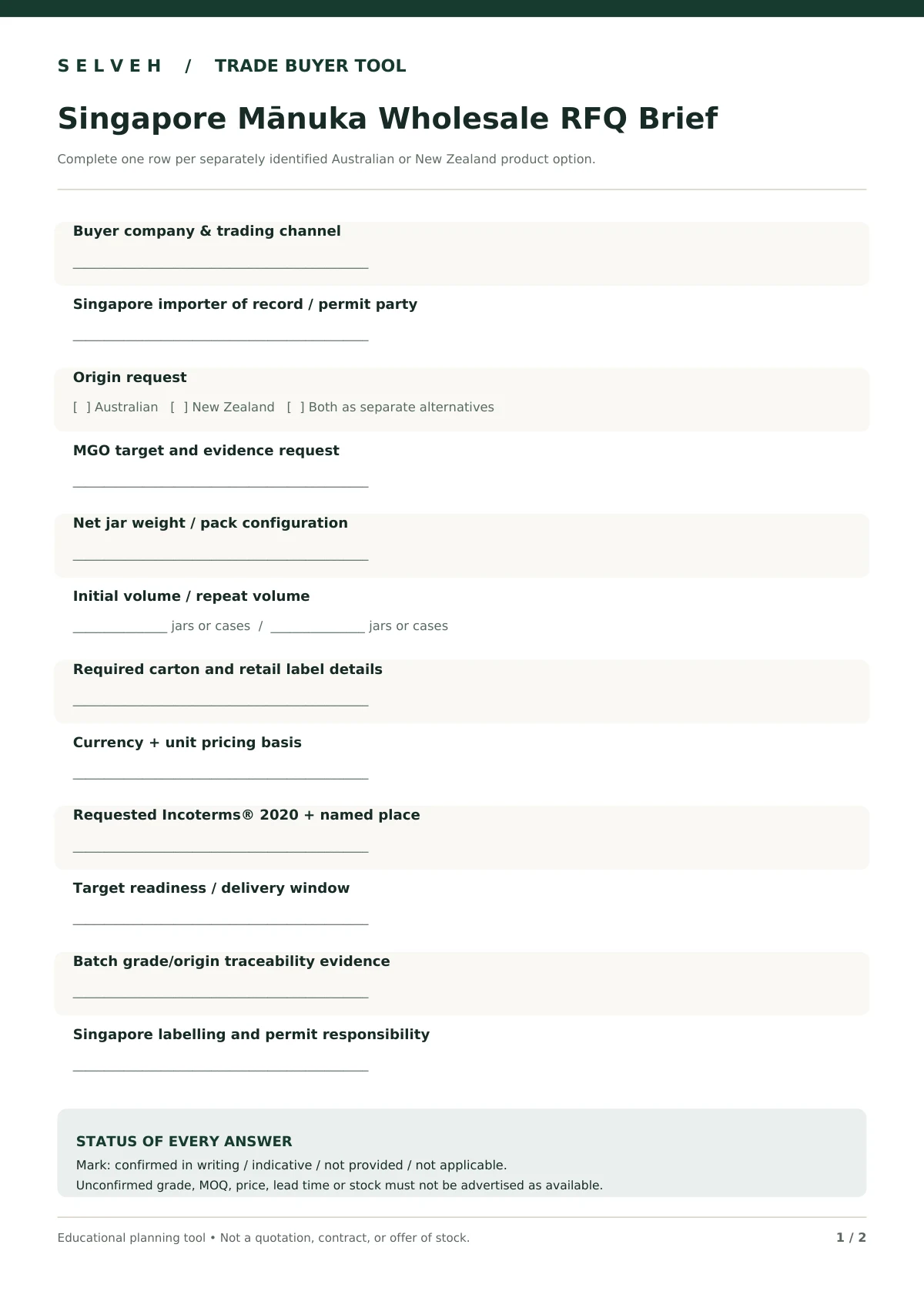
Download the blank Singapore Mānuka Wholesale RFQ Brief as a CSV, or use the plain-text enquiry outline. Both are generic buyer-side planning tools; neither is a supplier quotation or a form submitted to SELVEH.
For a print-ready buyer review, use the two-page A4 RFQ brief and option-comparison matrix. The CSV and TXT versions remain available for editing.
Download editable RFQ outline (TXT) ↓
Compare each supplier or origin alternative against the same requested scope. Record an explicit status for every line: confirmed in writing, indicative, not provided or not applicable. A blank cell is not a confirmed zero cost.
If you request sample jars before the main order: specify whether they will be sealed display pieces, opened for tasting or sent for laboratory review. The Singapore sample import and acceptance guide helps distinguish import responsibility from sensory or pack approval. Do not assume free-of-charge samples can be shipped without the appropriate export or import checks.
10 · Quality of quotation
Seven warning signs before accepting a wholesale price
- One jar price without a currency, grade, net weight or origin.
- “Available now” when no batch, pack or inventory evidence has been supplied.
- A quoted MOQ that ignores separate label and packing minimums.
- “All shipping included” without a named-place Incoterm and exclusions.
- A New Zealand authenticity claim based only on an MGO result.
- A certificate that cannot be tied to the intended product or batch.
- A proposed Singapore retail label with no identified importer/agent responsibility.
The fix is not necessarily to reject the counterpart. Ask for the missing fact, assign an owner and defer the commercial commitment until the gap is closed.
FAQ
Common wholesale RFQ questions
Can a Singapore retailer ask for both Australian and New Zealand Mānuka?
Yes, as separate sourcing alternatives. Compare the actual grade, packaging, evidence, costs and availability for each origin. Do not assume one can be substituted for the other after the buyer has selected a route.
Does “MGO 250+” mean the product is certified?
No. It describes a stated MGO threshold under the seller’s applicable specification. It does not on its own establish certification, origin, batch identity, MPI Mānuka authentication or health efficacy.
Should the first RFQ ask for the lowest price?
Ask for the best comparable proposal under a defined scope. A low headline price can conceal packaging, artwork, minimum quantity, evidence, freight or destination charges.
Does submitting an enquiry reserve products?
No. A request to SELVEH is non-binding, not an order, allocation, quotation acceptance or supply guarantee. Availability and terms are assessed case by case.
11 · Commercial next step
Explore SELVEH as a distribution partner
Importers evaluating exclusive versus non-exclusive rights can also use the Singapore Mānuka distributor appointment checklist to separate territory discussions from a real quote or purchase commitment.
If your Singapore business is considering the SELVEH-branded Mānuka collection for distribution or premium retail, introduce your channel and approximate commercial interest. We can discuss brand fit and potential future product releases; our partnership conversations concern SELVEH-branded products only.
Explore a SELVEH distribution partnership
For the SELVEH brand and prospective Singapore distribution partnerships, see the Singapore wholesale overview.
This invitation is for qualified business enquiries and does not imply a ready-to-ship product or firm quote.
Primary official sources
Evidence basis
- New Zealand MPI — Ensuring mānuka honey is authentic
- New Zealand MPI — Exporting honey and bee products
- Singapore Food Agency — Import registration for commercial food
- Singapore Food Agency — Labelling requirements for prepacked food (2026)
- Singapore Customs — Obtain a Customs Import Permit
- Singapore Customs — Import procedures and GST overview
- Australian ACCC — Country of origin food labelling
- International Chamber of Commerce — Incoterms® 2020
- Singapore Customs — Circular 15/2026: consolidated-cargo importer records (28 Oct 2026)
Core official guidance checked 23 October 2026; Singapore Customs Circular 15/2026 checked 30 October 2026. This buyer-side RFQ guide is educational; country-specific classification, trade and label requirements must be verified for each transaction. The planning controls are not a regulatory approval or guarantee of commercial supply.